| ||||||||
| | ||||||||
Hi Marketing Bestie, My uncle Steve taught me that the best flavor of cake is pie. Happy Thanksgiving, Marketing Bestie. Was this email forwarded to you? Sponsored by Roku For starters, happy Thanksgiving. 🦃 SPARKNOTES FROM THE PODCAST 5 MARKETING LESSONS FROM A 150-YEAR-OLD BRANDMost university ads look exactly the same. Beautiful campuses, smiling students, and inspirational music. Swap the logo, and you could probably run the same commercial for another university. Kelly Hiller, CMO of Purdue University, wanted to change that. When Taylor Swift brought her Eras Tour to Indianapolis, Purdue partnered with e.l.f. Beauty, took over an empty retail space, and taught Swifties how to make friendship bracelets using binary code. The results: Over 10,000 attendees and 292 million earned media impressions. And that's just ONE of the marketing lessons Kelly shared with me. Listen to the full episode here to learn how Kelly builds a memorable brand, gets her team to think bigger, and turns cultural moments into marketing opportunities. 1️⃣. Borrow Attention. Earn Affinity.Kelly's Take: "We could have gone out and bought a bunch of ad inventory and plastered Purdue University all over the place. But as we started to dig in, we learned that most of those coming to the concert were not from the state of Indiana. So you're looking at a really unaffiliated audience. If I put a billboard up, they're certainly not going to feel anything." Most brands look at big cultural events and immediately think about sponsorships, billboards, and paid media. Kelly looked at what people were doing when they WEREN'T at the concert. Hotels had 2-night minimums, meaning thousands of potential students and their families were in Indianapolis with time to kill. Purdue turned an empty retail space into a free STEM experience where visitors could make friendship bracelets using binary code, mix their own lotions, and design phone backgrounds. They even brought in e.l.f. Beauty to connect makeup with science. The genius of this campaign is that Purdue didn't have to create demand. Taylor Swift had already done that for them. They just needed to understand the audience well enough to create something they'd want to participate in. Takeaway: Before spending money advertising around a cultural moment, map out the customer journey surrounding it. Where are people staying? Find a way to fill those gaps with an experience that naturally connects back to your product. Your biggest marketing opportunity might be the 3 hours BEFORE the main event. 2️⃣. Budget For The Big Ideas.Kelly's Take: "When something flops, you don't treat it like a gigantic failure. It's like, okay, that was a swing and a miss. Why do we think so? And you dig into it and learn from that." Kelly's team has dedicated days where anyone can pitch ridiculously ambitious marketing ideas. Internally, they call them "big damn deals." These are the handful of marketing moments throughout the year designed to surprise people, generate conversation, and make Purdue memorable. I love this because most marketing leaders SAY they want more creativity, but their budgets, approval processes, and performance expectations incentivize the exact opposite. If you're asking your team to prove the return on an idea that's never been done before, you're probably going to end up approving ideas that have already been done before. Kelly keeps her traditional marketing campaigns running while dedicating resources to bigger creative experiments. Her team doesn't have to choose between hitting their goals and trying something new. Takeaway: Make experimentation a line item in your annual marketing budget. Set aside money for one or two ambitious ideas that wouldn't normally make it through your approval process. Agree on what success looks like beforehand, and evaluate what you learned afterward, even if the campaign underperforms. You can't expect original marketing from a team that's penalized for experimenting. 3️⃣. Marketing Isn't A Drive-Thru.Kelly's Take: "In the past, the orders came in, you told us what you wanted, we fulfilled the order, and pushed it out the door. In that case, you are not going to be the drivers of great marketing. You're just doing a variety of random acts of marketing." One of Kelly's biggest decisions was changing how the rest of the university worked with marketing. Instead of fulfilling requests from every department, her team became responsible for driving the university's biggest marketing priorities. She organized her department into cross-functional teams focused on storytelling, brand reputation, major campaigns, and demand generation. Each team has the people it needs to execute, and a tiered approval system determines which projects require leadership involvement. Kelly only reviews tier one work. Think about how many hours your marketing department loses making one-off sales decks, reviewing minor copy changes, and sitting in meetings about projects that aren't even tied to its goals. Every time you say yes to a low-impact request, you're taking resources away from something that could actually grow the business. Takeaway: Audit your last 90 days of internal marketing requests and categorize them by business impact. Decide what requires leadership approval, what your team can own independently, and what other departments can handle themselves using templates, tools, and brand guidelines. A busy marketing department isn't necessarily a productive one. 4️⃣. A Bad Ad Doesn't Mean A Bad Channel.Kelly's Take: "We do a lot of creative concept testing and a lot of message testing, because different messages resonate. As a parent, affordability makes sense to me. Kids really don't care about that, but their parents do." Purdue is essentially marketing the same product to two very different audiences. Students care about friendships, community, and the college experience. Parents care more about affordability, safety, and whether they're making a good investment. Kelly uses those differences to inform everything from creative to channel selection. For example, because parents are more likely to open direct mail, Purdue builds that messaging around what parents care about rather than what students care about. She also shared how Purdue tested Twitch as an advertising channel and didn't get the results it wanted. Instead of immediately writing off the platform, Kelly questioned whether the problem was the creative, the audience, or how people engage with Twitch. This is where I think a lot of marketers get testing wrong. They'll run one campaign, with one creative concept, on one platform, and make a sweeping conclusion about the entire channel. Takeaway: Build a messaging matrix that outlines each audience, their biggest motivation, their biggest objection, and the channels where they're most receptive to your message. Test multiple creative concepts before making decisions about channel performance. When something underperforms, change one variable at a time so you can understand what actually went wrong. You might have a messaging problem disguised as a channel problem. 5️⃣. Stop Measuring AI Adoption.Kelly's Take: "A lot of our team members are using AI in a variety of ways in their individual workflows, which is great. But the next step, I felt, was asking which workflows across the department we want to impact." Most marketing departments have people using AI independently. Someone uses it for research, someone uses it for copywriting, and someone uses it to summarize meetings. But when that person leaves the company or goes on vacation, their process often goes with them. Kelly is taking a different approach. She's identifying department-wide AI projects, assigning them to team members, and rolling them out quarterly. Every employee also has an individual AI goal, and the university has established guidelines around responsible AI usage. She's particularly intentional about how AI is used to represent real people. If a student participates in a photoshoot, they should be able to trust how the university will portray them. Saving production time isn't worth compromising that relationship. I think the next phase of AI in marketing is less about finding new tools and more about rebuilding the processes we already have. Takeaway: Ask everyone on your marketing team to identify their three most repetitive workflows. Look for overlap across the department and prioritize the processes that involve the most people or consume the most time. Assign an owner, document the new workflow, establish human approval checkpoints, and measure the time saved. Instead of reporting how many employees use AI, report how much faster your team can launch a campaign, produce creative, or turn research into actionable insights. IN A MEME 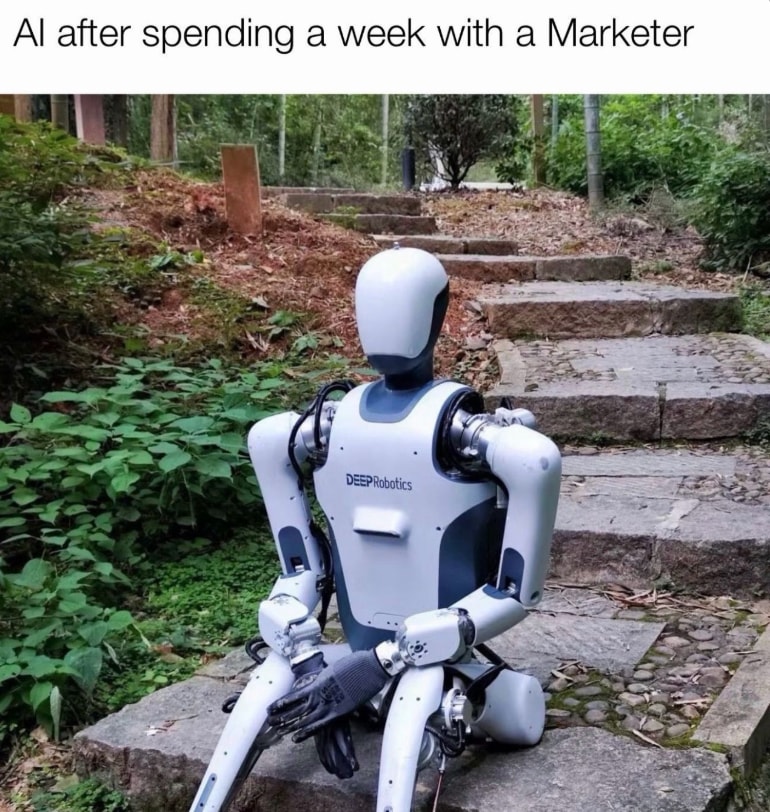 Before we all log off for the holidays, here are a couple of dates for your calendar: 🤖 12/15 → Organic Growth in the Age of AI: The 2027 Playbook Your friend, Daniel | ||||||||
|