 | ||||||||
| | ||||||||
Hi! Kiah here. Welcome to Fintech Takes Banking, my weekly newsletter where I highlight things I think are interesting or important for bankers and the surrounding environs. Today's newsletter is a recap of American Fintech Council’s 2026 Policy Summit. It's always an honor to be a part of these events. My friend Jason Mikula and I were fortunate enough to come in a day early to speak to two working groups, and listen to the actual policy experts working in these areas. And if I can be a little sentimental on this, the week of Thanksgiving: An extremely entertaining conversation at the excellent Spencer Fane dinner with Fenway Summer's Casey Williams about "You Can See Everything" reminded me how lucky I am to be part of a fun, stimulating and intelligent group of people. It's not cheesy or weird to have industry friends; you're in fact very lucky. (Also: ask for our opinions 👀) Was this email forwarded to you? Sponsored by MX Blocking customers’ AI agents is a short-term response, not a long-term solution. Banks that plan to restrict all AI access will merely become the roadblock for customers — or give them a reason to leave. There’s another way. Banks can give agents a safe way in and establish clear guardrails for how it can operate. MX has a proposed a set of principles that it urges AI developers and platform providers that want to work with banks to adopt. The eight principles cover: Agentic banking can be safe, consented and accountable — but only if the banking industry builds the rails before significant agentic traffic arrives. 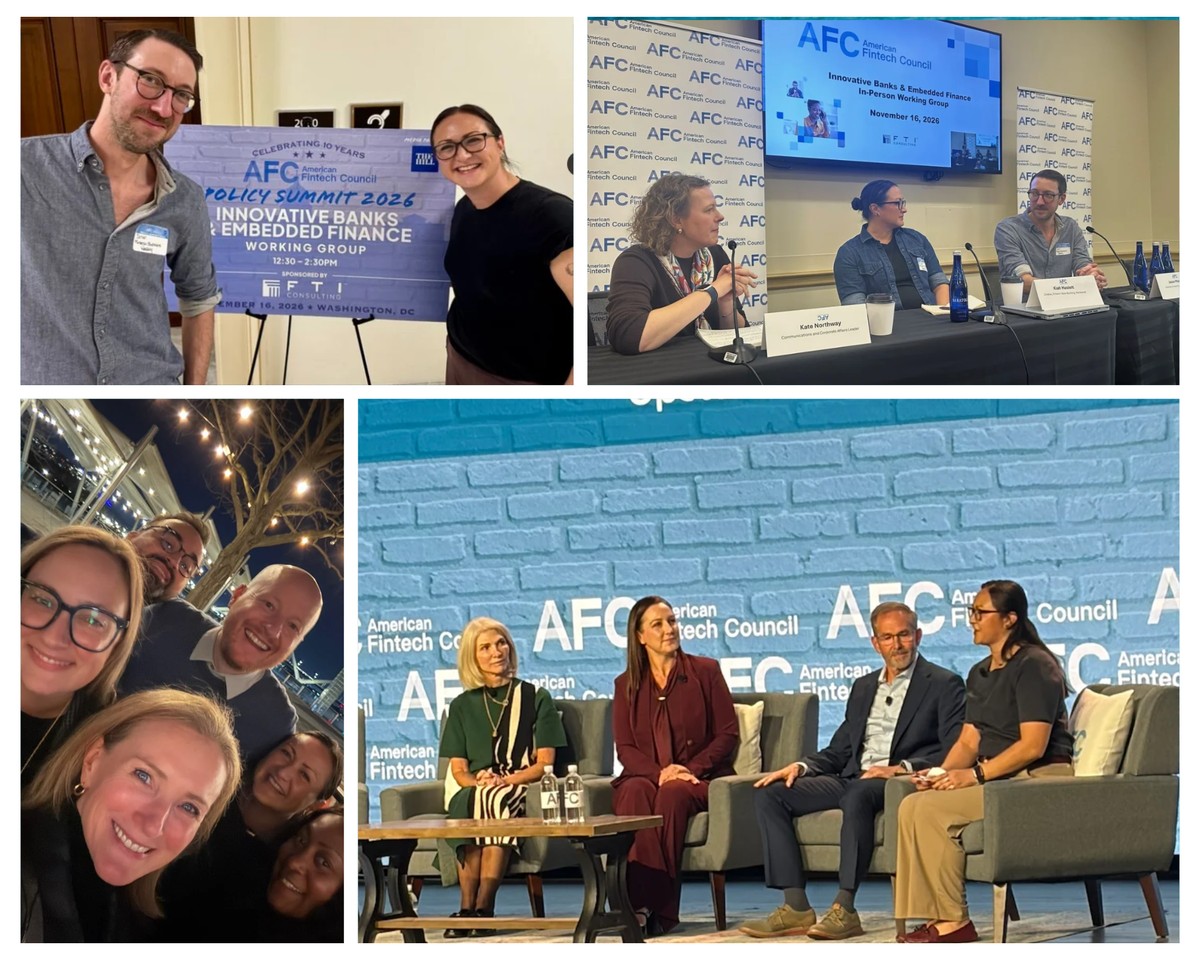 Apparently friends take photos of their friends' panels at conferences? Recording their panel seems way less useful? Seems suss. Seeing the Trees in the Bank Regulatory ForestLast year, federal bank regulators laid out their vision of the future of financial services at the American Fintech Council’s 2025 Policy Summit. It was broad and strategic, and due to some confirmation timing quirks, there was a sense that everything was just getting started. At that summit, agency heads promised they would work together to rightsize regulation and supervision for banks. Since then, they’ve promulgated various policies to do just that. The American Fintech Council’s 2026 Policy Summit was more tactical. Fewer visions, more updates, and a vibe that wasn’t dissimilar to an annual review. Re/De-RegulationThere may be an inverse relationship between the amount of regulation and the amount that gets written about it. At least initially, it seems that as regulation lessens — excuse me, rightsizes — the more I find myself writing about it. Last year, I wrote:
In August, the Federal Deposit Insurance Corp. and the Office of the Comptroller of the Currency finalized a joint rule that limits matters requiring attention, or MRAs, to items deemed material risks. The agency heads said they hope this leads to fewer findings focused on process and procedure and more attention paid to risks that can sink a bank. Comptroller of the Currency Jonathan Gould added that the OCC will soon finalize a rule distinguishing substantive violations of law from other violations. "We want supervisory criticisms, particularly ones where there's an explicit expectation of remediation, to be ones that meet a materiality threshold where there's a true potential risk to safety and soundness or an actual violation of law or regulation," said FDIC Chairman Travis Hill during his fireside chat this year. What does this look like in practice? At the OCC, agency leadership is trying to narrow the exam scope through qualitative and quantitative limitations, so supervisors spend less time “examining the kitchen sink” or “going down rabbit holes,” Gould said. As part of this, the OCC has “literally [put] quantitative limits as measured by workdays” around how much time an examiner can spend on site. Hill said the FDIC is training all of its examiners on the new rule, and that during the rulemaking he held biweekly case-study meetings with examiners from across the country. Still, he acknowledged that consistent application of a new interpretation by a geographically dispersed workforce of thousands is very much "a work in progress." And it remains to be seen how successful these efforts will be amid broader staff cuts. A recent Bloomberg article reported that the deluge of bank charter applications has been met by an internal staffing crunch at the OCC, creating holes in examination teams. Tech SupportAs material risk narrows, regulators’ orientation toward technology has broadened, perhaps wider than some had imagined in the limited time the agency heads have been installed. Last year, I wrote:
This year, Hill and Gould restated their openness toward the wide range of bank and fintech partnerships and technology companies applying for charters. Gould reiterated the position that the OCC is “agnostic” about how banks decide to access technology, balance sheet capacity or other partnerships they form with service providers. The FDIC, OCC, Federal Reserve and National Credit Union Administration all recently extended the comment period for proposed third-party risk management guidance to Dec. 16, with Gould saying on stage the 2023 guidance was too prescriptive. There are other types of partnerships as well. The FDIC remains involved with a proposed standard-setting body for fintechs that are interested in partnering with banks, but is increasingly looking to maintain some distance once the group gets going. Trey Maust, the FDIC’s chief innovation officer, said the agency involvement would be "limited to observer status only," so examiners "can rely to some extent on the artifacts or the outcomes of this during the examination process." But openness doesn’t mean passiveness. The OCC issued a supervisory framework for bank’s use of “We will use those to the extent we think appropriate to drive changes in third-party service provider behavior rather than trying to, very indirectly and imprecisely and I would argue ineffectively, try to drive behavioral changes in third parties by putting pressure on the banks that are the link,” he said. I, for one, will believe they’re use the BSCA when I see it! New Kinds of New BanksBut while many banks may appreciate this shift from the agency heads in reducing regulatory burdens, the competitive and technological environment has amped up. Some of that is due to regulators’ own actions and approvals. Last year I wrote:
For banks, that could mean competing directly with tech firms that have applied for bank charters of their own. The wave of charter applications — the type of companies applying, the charters they’re applying for, the speed at which approvals are coming in — has been one of the biggest stories of 2026. Gould, whose agency has received 49 applications over the past 18 months, couched the charter wave and approval activity as merely following the agency’s statutory requirements and applicants believing in the agency’s transparency. "I was embarrassed at the record of new bank formation in this country after the 2008 financial crisis," Gould said. But he added that fintechs’ interest in charters isn’t a bad thing, and fintechs that believe they can meet the agency’s statutory factors and supervisory standards should have the option to apply for one. So far, 28 or 29 of those applications have received preliminary conditional or final approval, he said. Some of those approvals are national trust charters, which have plenty of critics. Gould wasn’t asked about, and didn’t bring up, the Independent Community Bankers of America’s lawsuit seeking to prevent it from approving additional national trust charters for crypto firms. I was fortunate enough to moderate a conversation with chartering guru Michele Alt, whose real title is partner at Klaros Group, along with Annie Delgado, the CEO of the proposed Upstart Bank, and John Marion, the president of the proposed Affirm Bank. Upstart Bank received conditional approval for a full national charter from the OCC in July; it has applied to form a holding company with the Federal Reserve Bank of San Francisco. Affirm Bank applied to form an industrial loan company in Nevada in January. Annie and John shared the work their firms did to determine whether and why to apply for a charter, which charter they chose and the work they needed to do before and after submitting their applications. Michele discussed the need for banking expertise in the proposed institution and the challenge that fintech applicants can have adding a second side of the balance sheet to their operations. [Author’s note: AFC records sessions — I don’t have my own recording because ya girl was busy moderating, but a recording may later be available!] The Brief DIDMCA Update You Didn’t Ask ForOne surprise for me was that the implications of the recent midterm elections were not a major area of focus of a policy summit held in Washington, especially given the size of the shift in Congress. There are always politicians at this event, so I was surprised this theme wasn’t more dominant. To be clear: not a complaint, just a surprise. But there was one sneakily political issue emerging from the states that could be addressed by Congress, and that is DIDMCA. I should’ve known that writing a three-part series on the conflict and questions around interest rate caps and policies invoked some ancient banking curse that would force me to write periodic updates about this tortured topic; I was just hoping to make it to 2027 without uttering those letters. No such luck! On Nov. 9, a coalition of 18 attorneys general submitted a letter to House leaders urging them to reject H.R. 7866, a bill from Rep. Warren Davidson, R-Ohio, that would clarify that a state’s opt-out affects banks chartered in that state only. The coalition was led by Oregon’s attorney general, and it’s no surprise that Colorado signed on. The other signers, interestingly, are Arizona, California, Connecticut, the District of Columbia, Hawaii, Illinois, Maine, Maryland, Massachusetts, Michigan, Minnesota, Nevada, New Jersey, New York, Virginia and Washington. Davidson spoke about his bill at the summit, titled the “American Lending Fairness Act” or ALFA for short [Author’s note: 👎🙄]. He said it’s “urgent” that the bill get passed during the lame-duck session, potentially riding in a year-end vehicle like the National Defense Authorization Act or a continuing resolution. “I think there's a chance. Maybe slightly better than 50%, I'd say, not 60%, but in the 50s, there's a chance,” he said. He said the odds of a hearing and markup are “improbable” after Democrats take the House in January. Nothing is Permanent Except ChangePerhaps it's fitting that this year’s policy summit was so tactical. Agency heads telegraphed their strategy last year: recalibrate and refocus regulation and encourage innovation. They’ve done that pretty consistently since then, even if banks haven’t universally loved how those actions were performed. And in a speech Gould gave the next day, he promised the OCC would “double down” on these efforts over the next two years, so expect more of the same. The totality of these moves is reshaping what the financial services industry looks like, what money looks like. The exams look at fewer things. Dozens of new banks are on the way, and they look different from the wide swath of banks today. We are having — if I can say this — increasingly stupid fights between states that have potentially massive consequences. We didn’t even really talk about Durbin at the summit (other than me)! This all creates indelible marks on the banking industry, on the banks that are operating today. That’s the point, Hill said during his fireside chat. He’s thinking about the “durability” of the policy changes his agency is effecting, and hopes that taking “thoughtful and balanced” approaches means these changes stand the test of time as administrations and agency heads change. “Elections have consequences and so of course, future people who are running these agencies will be able to have their own priorities and opinions,” he said. “But what we want to do is try to maximize the likelihood that the changes that we put in place are gonna stand the test of time.” Sponsored by ElevenLabs How can banks reduce service costs without losing customers? FROM THE VAULT What’s on my mind and filling my time: 🦛 RIP Fiona! I thought this Defector essay about her life, death and celebrity and the intersection with zoos was really interesting. It also reminded me of one of the reasons why I didn’t like “Remarkably Bright Creatures”: It was pretty pro-animal captivity, despite its main character being born and dying in the wild (spoiler). 📦 Starting the gift guide in time for Black Friday: the Shark Glossi 2-in-1 Blow Dryer Brush and the Ultimate French Butter Sampler Trio (the price of this makes me feel better about also spending $100 on three Bordier butters recently). Not affiliate links! 🎙️ On Bank Nerd Corner: I talked about Lead’s recently published white paper that examines how agentic finance challenges existing bank regulation with Erica Khalili, the bank’s cofounder and chief legal and risk officer. 💬 Talking shop: I will literally talk about banks with anyone, but I have the most fun when it’s with people who actually run them. Finity is a private community for fintech and banking operators. It’s free, but you do have to apply, which I respect. Bankers, please join so the fintech people stop outnumbering us. 🛫 Catch me at: Piper Sandler’s Balance Sheet Strategy Seminar on Dec. 7 in New York. I'm extra grateful this week to have you as a reader! Thanks as always. Feel free to reply to this email and let me know your thoughts! - Kiah | ||||||||
|