| ||||||||
| | ||||||||
| Hey Marketing Bestie, Us marketers sure can learn a lot from our Marketing fore-fathers and fore-mothers. Consider this a parade for the greatest marketing campaigns in memory. Welcome to Marketing Classics 411, a new kind of ancient history. In place of hieroglyphs, expect to decipher the campaigns of yesteryear. Professor Millennial teaches every Tuesday (remotely), via electronic mail. Class is now in session. Was this email forwarded to you? 🎪 MARKETINGLAND FESTIVAL IS BACK: MARCH 4 In 2025, 8,000+ Marketers showed up to a free, virtual Marketing festival. With a DJ. And a costume contest. This March, we're doing it again, and I'm hosting with Jay Schwedelson. The theme: the Great AI Reset. 📅: Thu, Mar 4, 2027 Pick your land (or mix all 3): → Brandland: positioning that survives AI sameness Plus games and prizes. It's a festival, not a webinar. Grab your free pass. WHATEVER FLOATS YOUR MOAT How Macy’s Turned A Launch Event Into A 100-Year Holiday TraditionEvery year, millions of Americans wake up early on Thanksgiving morning to watch a 3.5-hour commercial. Nearly 4M stand out in the cold. More than 30M tune in from home. The only bigger televised event in the U.S.? THE SUPER BOWL. The only thing that ever stopped it? WORLD WAR II. It’s a tradition as American as a gigantic apple-shaped balloon. A Big Apple spectacle, now in its 100th year. Believe it or not, it was meant to be a 1-and-done launch event. For a local audience. This is the story of… the Macy’s Thanksgiving Day Parade. 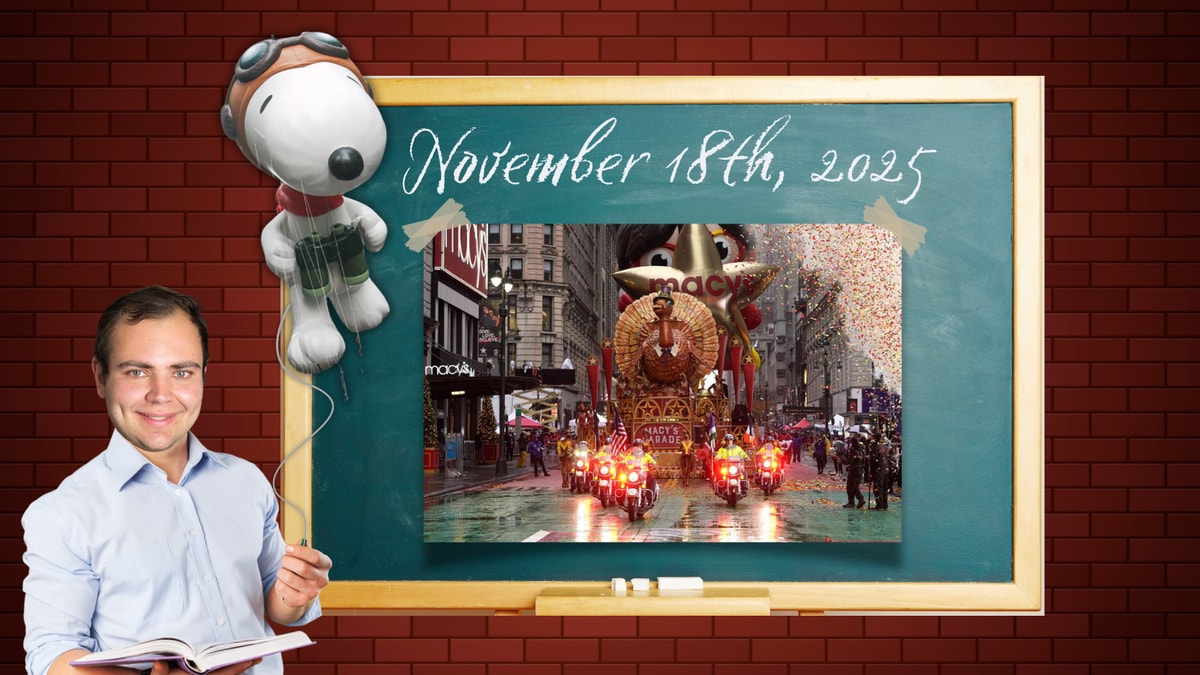 Macy’s is a New York City shopping institution. It innovated the way we shop (or used to shop), by introducing: 🛍: Money-back guarantees 🛍: llluminated window displays 🛍: Department store Santas 🛍: The modern-day escalator But Macy’s, founded by a whaler-turned-retailer named Rowland Hussey Macy, had a humble beginning outside the Big Apple. 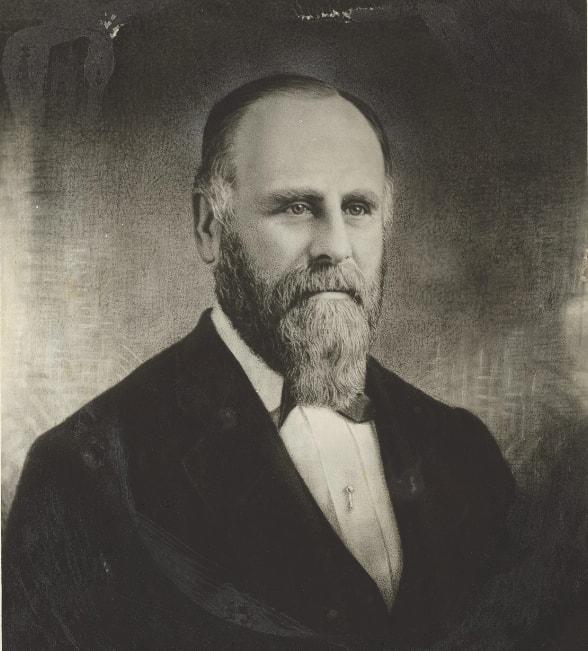 The Macy’s star logo was inspired by R.H. Macy’s tattoo. So metal. It opened in Haverhill, Massachusetts in 1851 as a dry goods store. When the business flopped, R.H. Macy took his ambitions to New York, where he’d have more customers. Luckily, he had 1st-mover advantage. Almost. Macy’s wasn’t the 1st NYC department store, but close enough. It pre-dated Bloomingdale’s, Bergdorf Goodman, and Saks 5th Avenue, as well as budget options like Woolworth’s. When it opened on 6th Avenue between 13th and 14th Streets in 1858, Macy’s was the city’s only “uptown” dry goods store. In 1902, it moved to 34th Street. (Now considered “midtown” or “Herald Square” by tourists and “the 7th circle of hell” by New Yorkers.) Macy’s started with 1 storefront and slowly took over the rest of the block. By 1924, it was the world’s largest department store, with 1M square feet of retail space, including an impressive toy selection. 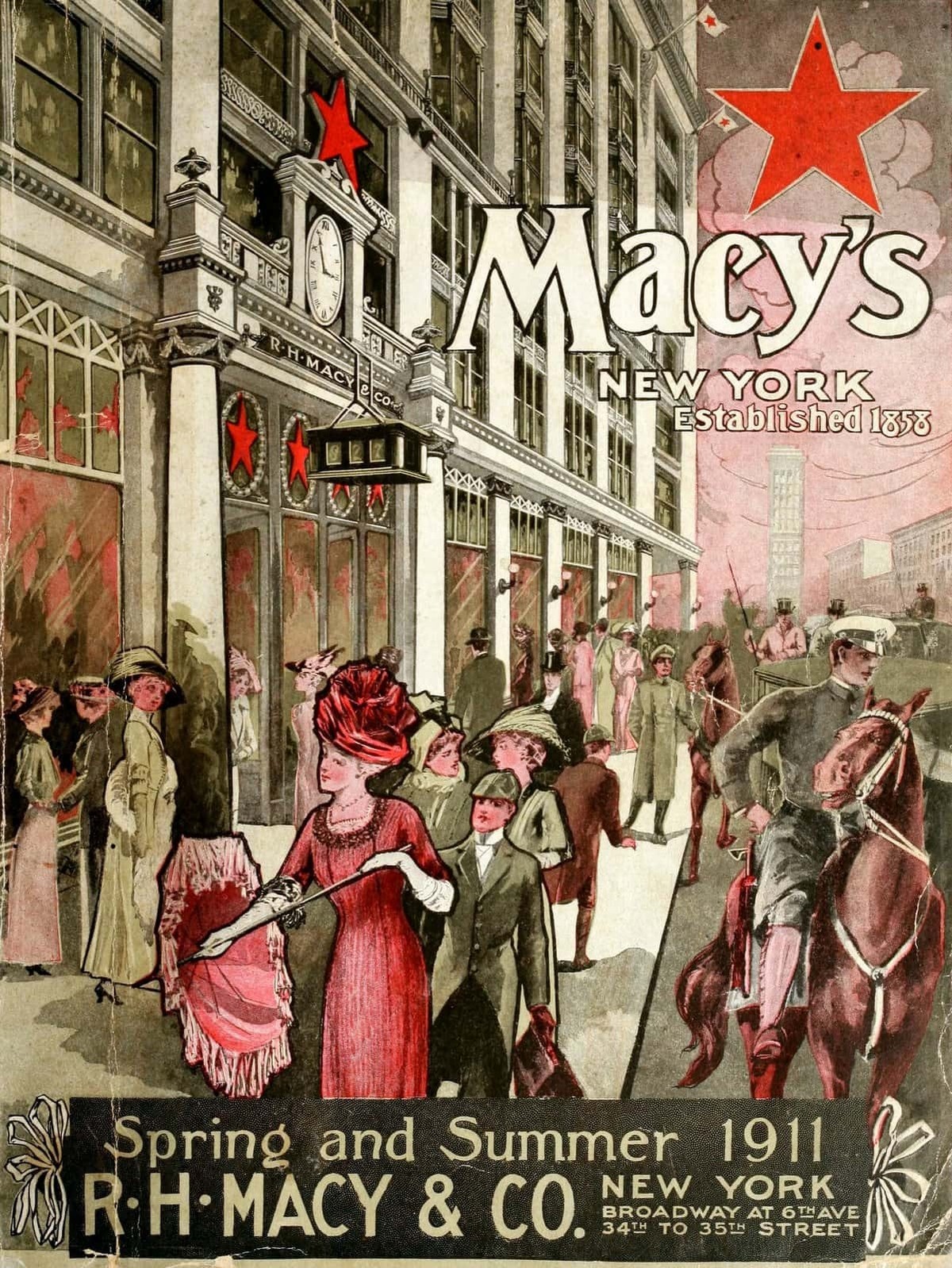 They came, they saw, they shopped. Macy’s wanted to do something BIG to attract holiday shoppers to the new mega-store. THE FIRST HURRAHIf you’ve never heard of Gimbels, ask your grandparents. It was Macy’s older, more established rival. In 1920, Gimbels was the 1st department store to organize a Thanksgiving parade, out of its flagship in Philadelphia. The event was a sensation. It still exists, even though the retailer went out of business in 1987. Macy’s took a page from the Gimbels playbook and planned a bigger, wilder, longer parade in NYC. 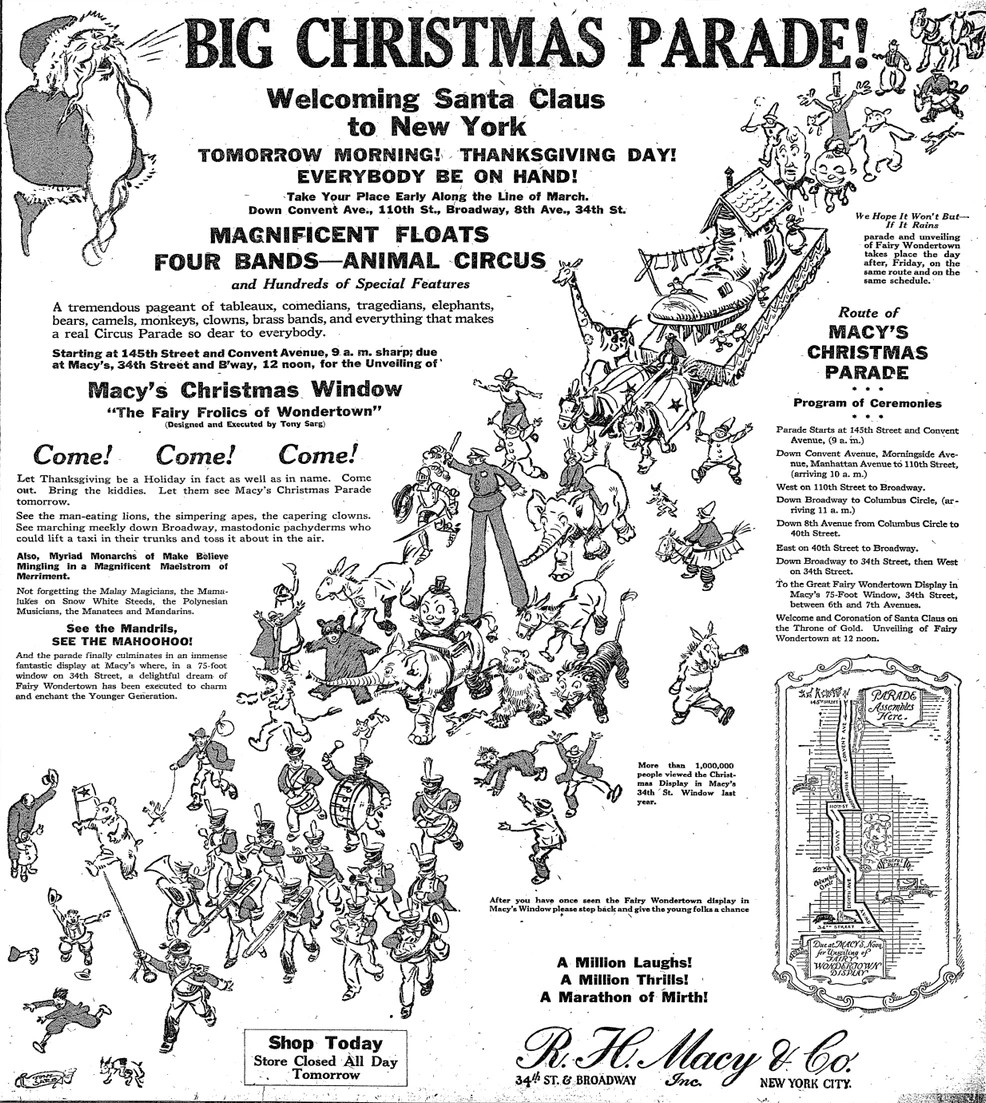 The first parade ad, from November 26th, 1924. So much copy! It ran full-page newspaper ads promoting the Macy’s Christmas Parade. Never mind that the event was on Thanksgiving morning. Store employees dressed in costumes and walked in the procession. 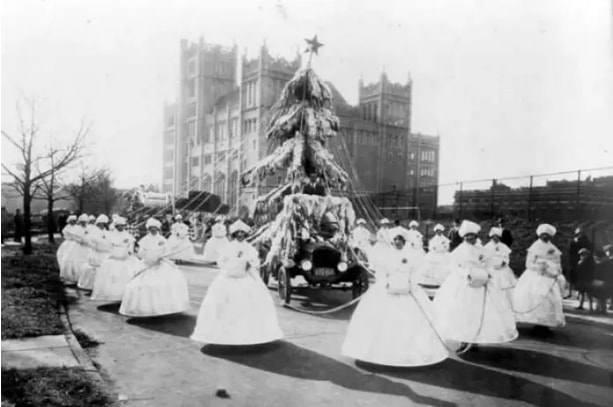 It’s giving festive Handmaid’s Tale. There were bands, clowns, horse-drawn floats inspired by Mother Goose stories, and a traveling circus of animals borrowed from the Central Park Zoo. 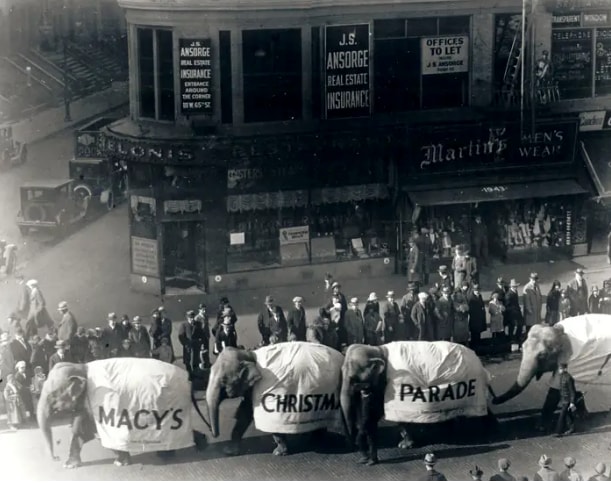 Welcome to the trunk show. Macy’s branded the event “a marathon of mirth,” and they weren’t wrong. The parade route stretched 6 miles, from 145th Street to 34th Street! For the grand finale, Santa Claus left his sleigh float and ascended to a throne above the store’s main entrance. He blew a trumpet, and Macy’s unveiled its holiday windows. If the parade’s 250K spectators weren’t familiar with the store before, they knew it now. This parade turned Macy’s into the department store that brought joy, wonder, and holiday magic outside for everyone to experience. …Basically, they called dibs on Santa. Macy’s had reigned on Gimbel’s parade and wooed a new generation of customers. The rest is A STORY, NOT A STOREOver the years, the parade evolved into the well-oiled and inflated event we know today. Borrowed zoo animals, which growled and scared kids, were replaced with rubber balloons in 1927. If you’re picturing a larger than life Felix the Cat, think again. The 1st balloons were mounted on poles and carried by handlers. You’ve probably seen bigger holiday lawn decorations. 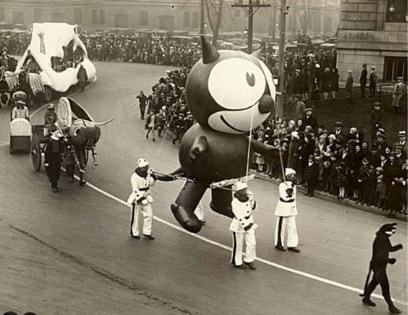 Not underwhelming. Or overwhelming. Just… whelming. In 1928, helium was introduced. Now, balloons could float high above the crowds for greater visibility. Balloons became the stars of the event. Some were toy soldiers or animals, but the most iconic were cartoon and book characters. After the parade, balloons were released into the sky. New Yorkers were invited to capture and return them to Macy’s for a reward. The stunt prolonged the parade buzz, but was retired when it almost caused a plane crash. Oops! The parade route was eventually shortened to a sensible 2.5 miles. And in 1931, leadership finally decided to rename it the Macy’s Thanksgiving Day Parade. (Imagine the meetings!) 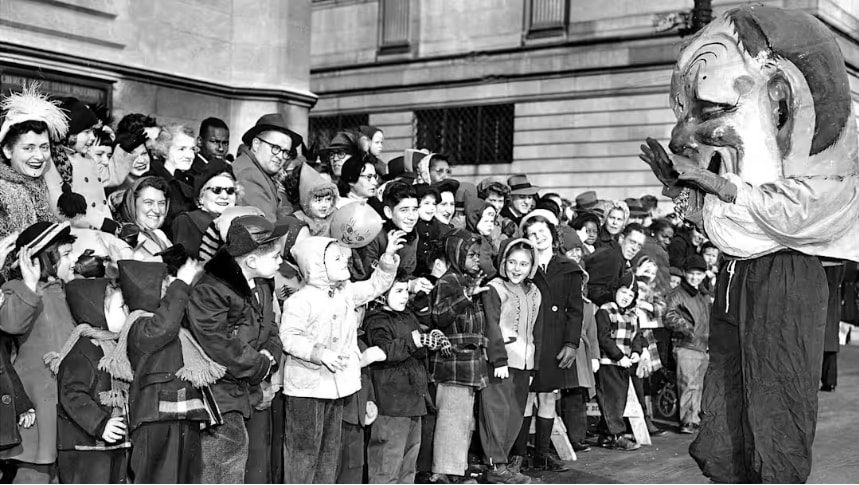 Before kids evolved to be terrified of clowns… Through all the changes, the parade’s goal and spirit remained consistent: 🎄: It was a brand activation that nudged parents and kids to think about Christmas. 🪀: It NEVER promoted specific products or sales. ✨: It created unbelievable moments that made everyone feel like a kid. Each year, the parade told a slightly different story with new balloons, floats, and performances. But it was always the same happy ending: Santa at Macy’s. From 1924 to 1950, NYC radio station 710 WOR broadcast from the parade’s starting line. Hosts described the sights, but it had to be seen to be believed. Macy’s scored again with Miracle on 34th Street, the 1947 holiday classic about a department store Santa who—NO SPOILERS! 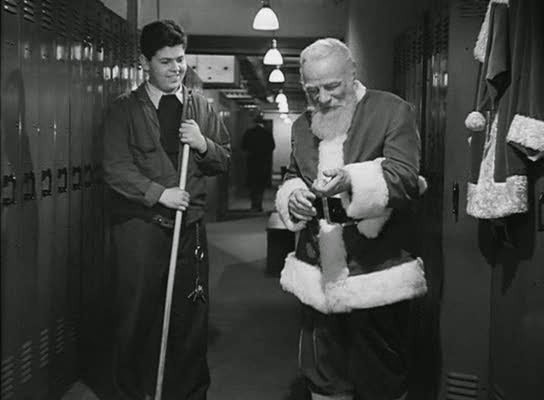 Starring the Macy’s employee locker room as itself. The film was shot on-location at Macy’s, mentioned Macy’s by name, and featured real footage of the 1946 parade. But that was only the beginning. (And no, I’m not talking about the Millennial Miracle on 34th Street from the 90s.) In 1948, the parade got its BIG BREAK and was broadcast on national TV for the 1st time. NYC’s favorite holiday parade was officially an American pastime. PUT IT IN PRACTICEThe Macy’s Thanksgiving Day Parade promotes holiday shopping without mentioning sales or products. Kids see it as entertainment, not an ad. Adults see it as entertainment that’s technically an ad. Here’s your homework: 1️⃣. Audit your marketing calendar for recurring campaigns and brand moments. These can be tied to holidays or brand-specific tentpoles. 2️⃣. Time to be honest. Look at individual campaigns and ask yourself: Is this genuine ritual material, or just a promotion? 3️⃣. Brainstorm ways to turn promotions into something more meaningful. Make ‘em a bigger story about your brand, customer, or mission. SEND IN THE BRANDSMacy’s calls its Thanksgiving parade its “annual gift to the nation.” The spectacle costs over $13M each year. Brands and media keep it afloat. NBCUniversal pays Macy’s millions of dollars for exclusive broadcast rights, including live broadcast, streaming, and social media. Then, NBCUniversal brings in $50M+ in ad revenue from brands eager to reach the 30M viewers who tune in. The average ad spot during the parade costs $900K. 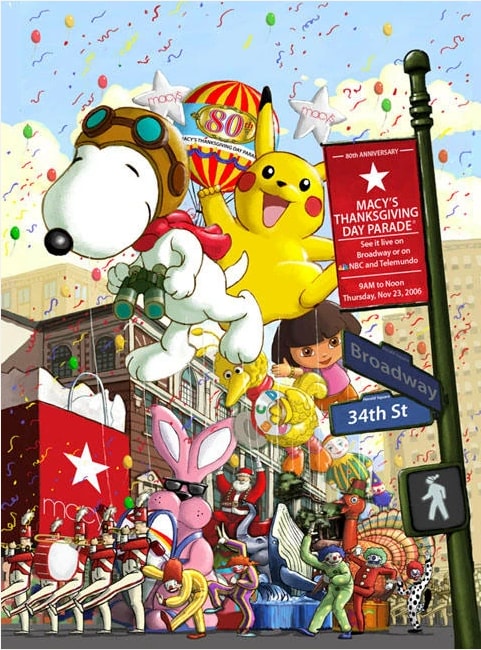 I’m with the brand(s)! Macy’s makes money off brands, too. Tom Turkey and Santa are owned by Macy’s, but other balloons, floats, and performances are pay to play. 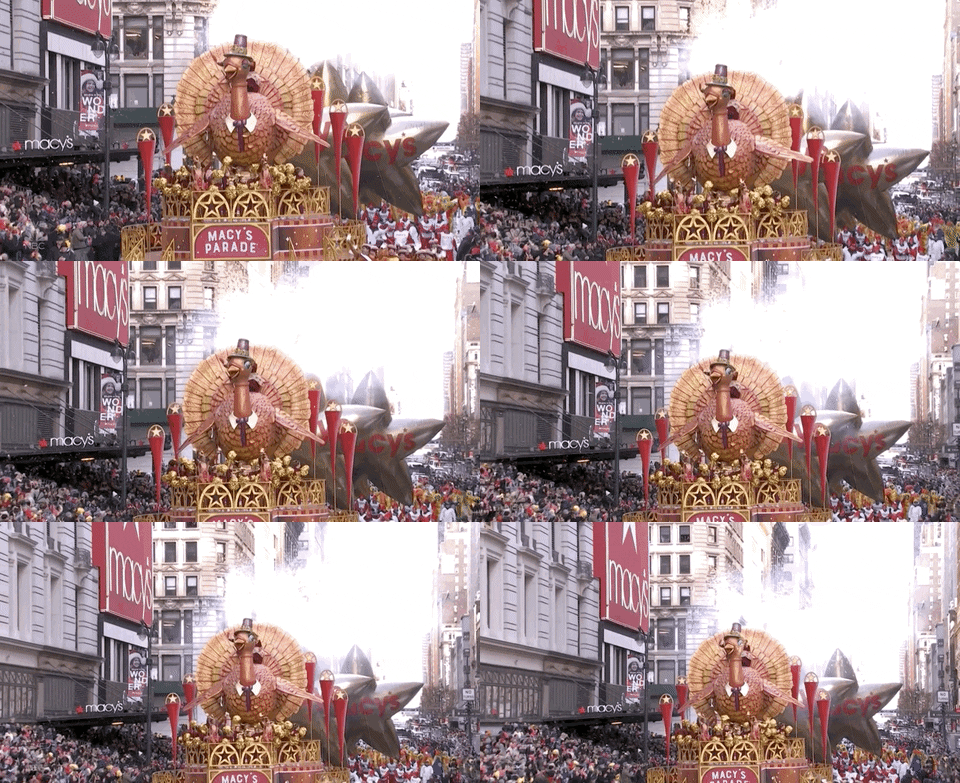 Tom Turkey, unbothered by the menu. Brands can sponsor staple balloons or invest in something custom. The only requirement is that their moment resonates with an audience between the ages of 1 and 100. Balloons are divided into 2 categories: 🎈: Giant helium character balloons 🎈: Heritage and novelty balloons that aren’t tied to existing IP These days, giant balloons are mostly characters from movies, TV shows, and cartoons. Like Snoopy, Spongebob Squarepants, and Pikachu. 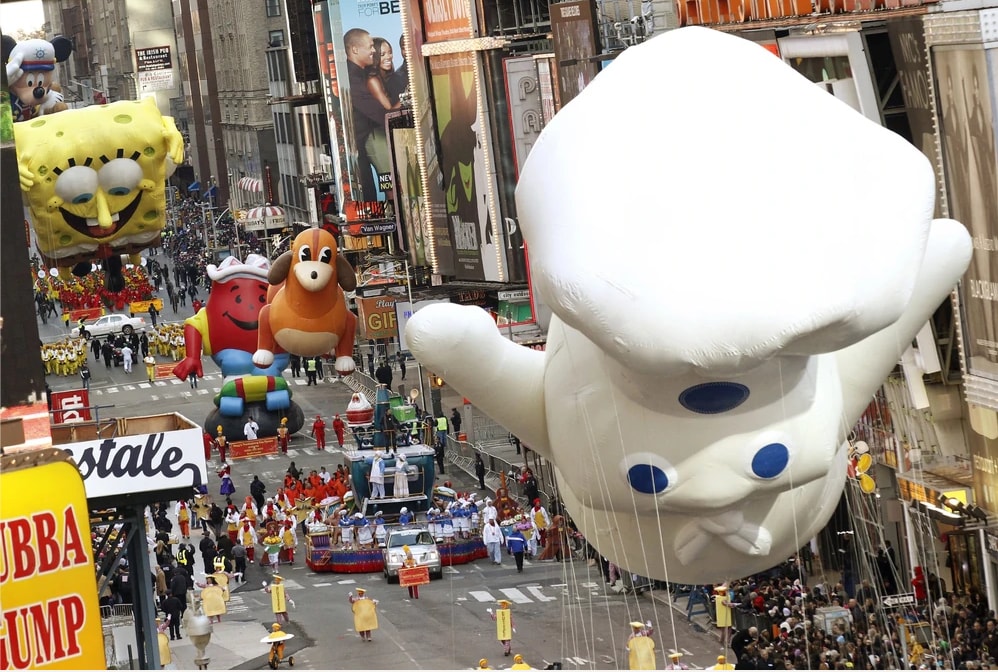 Hey, I’m floating here! Brands with recognizable mascots, like McDonald’s, Aflac, and Pillsbury also get in on the fun. Heritage and novelty balloons function like starter balloons and come in a few models: 🎈: Balloonicles, vehicles wrapped with a balloon 🎈: Balloonheads, inflatable heads worn by performers 🎈: Trycaloons, powered by adult tricycles 🎈: Floaloonicles, hybrid float-balloon-vehicle A new balloon will run your brand at least $200K, but with inflation…who knows? AND WE’LL ALL FLOAT ONThe Macy’s Thanksgiving Day Parade is 1 of America’s most resilient holiday traditions. It marched on during the Great Depression, after President Kennedy’s assassination and 9/11, and through the pandemic. Only WWII could stop it, because helium and rubber were conserved for the war effort. Months after it ended, balloons were back in the air. 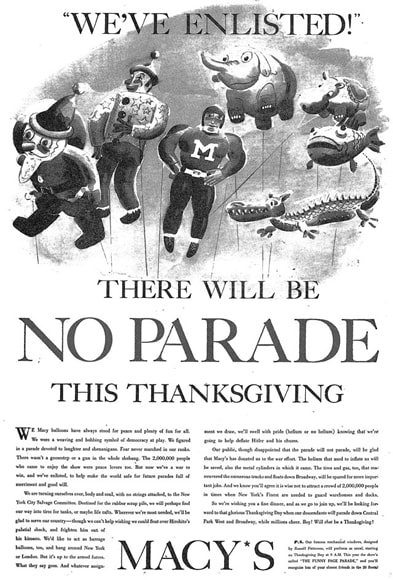 Well-played. These days, it feels rare and special to share in a collective spectacle. Even if we’re just watching from the sofa. In 2025, the parade reached 34.3M viewers. An all-time high. For the 3rd straight year! 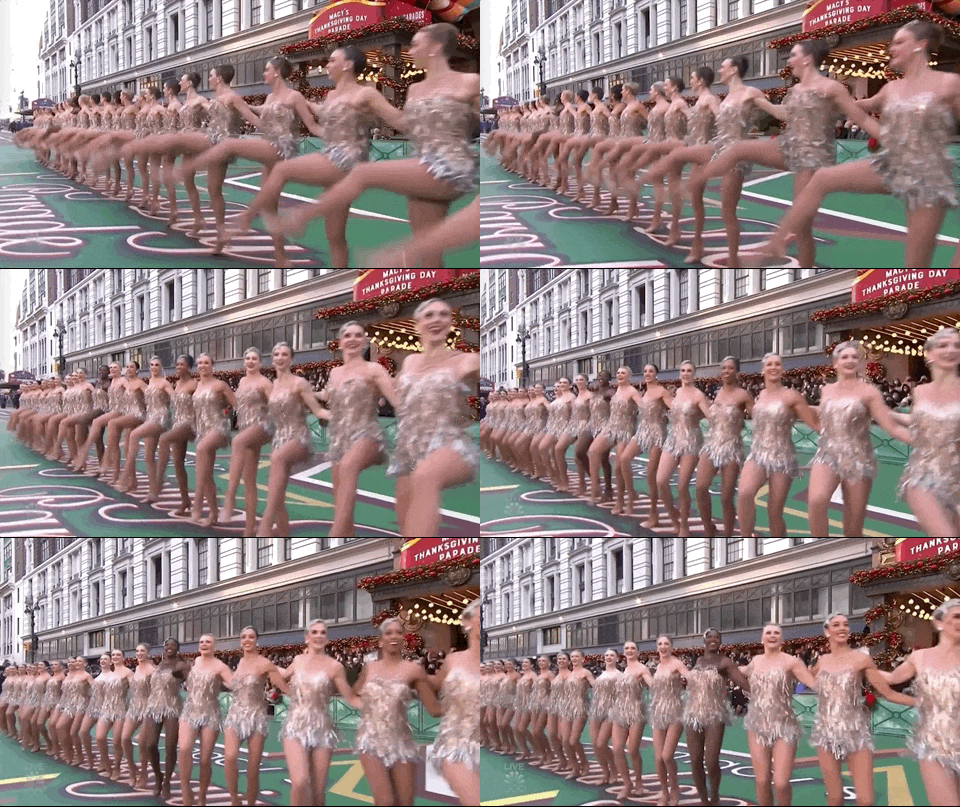 Still kickin’! Now, the parade’s gearing up for its 100th anniversary. Instead of 25-35 giant character balloons and 3-4 balloonicles, Macy’s will launch a record-breaking 28 floats and 100 inflatable elements this year. Including a new Macy’s character named Billie Brightpaw, who appears throughout the 100th Parade capsule collection. 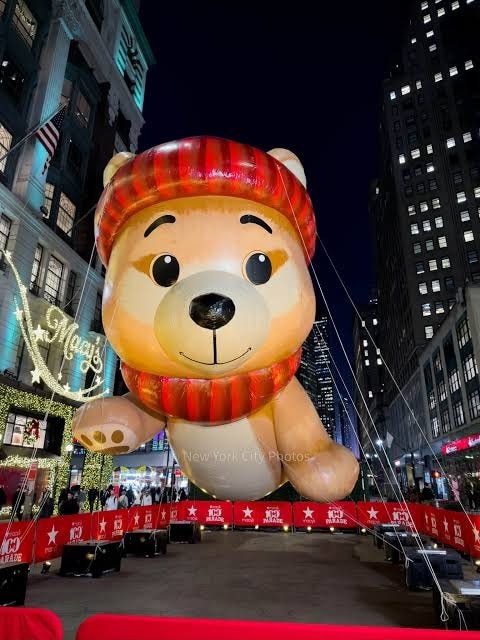 A hot new balloon has entered the villa. If you want to wax nostalgic about On Wednesday night, NBC will air its 5th annual Countdown to Macy’s Thanksgiving Day Parade special. Then the BIG EVENT starts at 8:30 AM on Turkey Day. Who’d have thought a department’s store experiential marketing event could become a tradition that feels bigger and more festive than America’s Semiquincentennial and New Year’s Eve? Not Macy’s, back in 1924. Not the 1st New Yorkers who watched in wonder. But that’s the power of Marketing. Sometimes it inspires more than buying. Sometimes it becomes a genuine celebration. I think that’s something to be thankful for. MARKETING CHEAT SHEET (WHAT TO LEARN FROM THIS STORY): 1️⃣. Lead with emotion, not a sales pitch. 2️⃣. New stories. Same happy ending. 3️⃣. Link and build. Sponsored by Roku Question to wrap this TV story: is your attribution showing what your TV ads CAUSED? Or just what got credit? MARKETINGLAND 🏰 Some of the best marketing lessons I've learned came from other marketers. So I'm amped to announce that on Dec 3rd, every marketer on Marketingland will be able to start their own newsletter. Yes, you. 🫵 A few founding writers are already on board:
Check out the rest here, subscribe to a few, or join the waitlist to start your own. 👀 IN A MEME  Ahh, the bell has rung. Please be sure to do the reading (follow The Marketing Millennials on LinkedIn and me, Professor Millennial, on X). Off you go, passing period is only 11 minutes and there’s already a line at the vending machine that sells Billie Brightpaw plushies. Until next time, Professor Millennial | ||||||||
|