 | ||||||||
| | ||||||||
| In partnership with
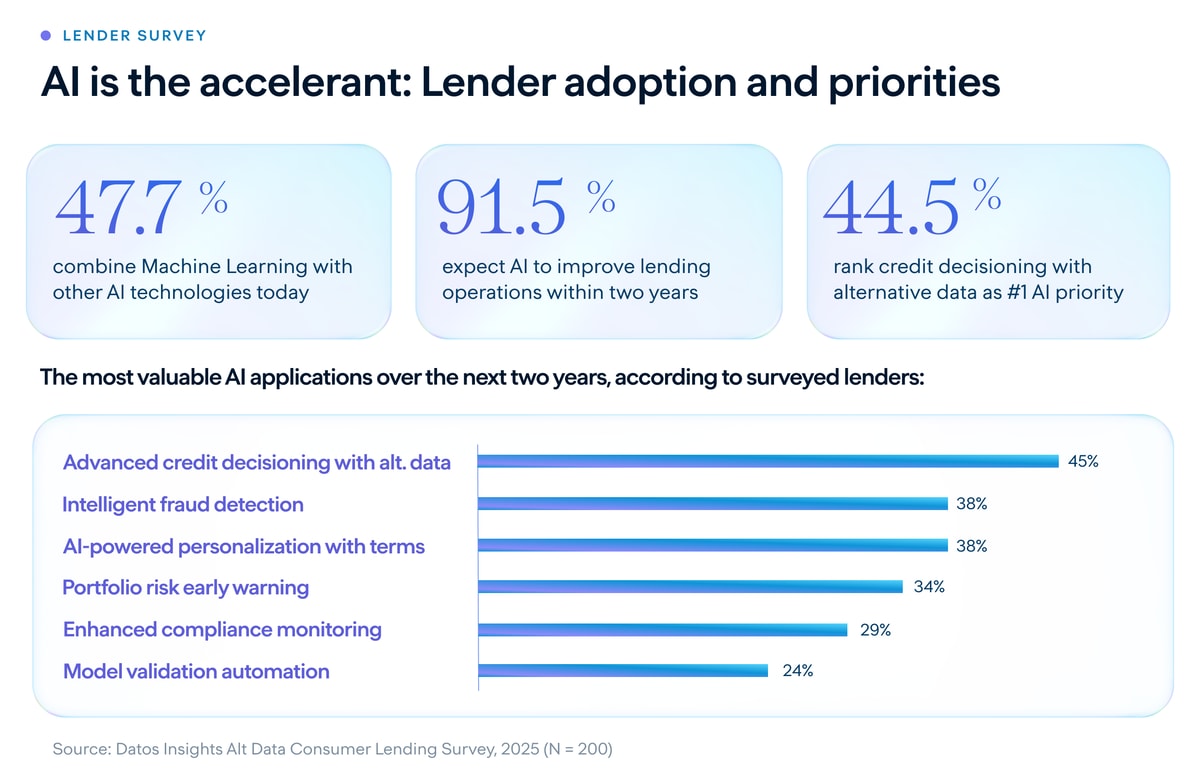
Happy Monday, Fintech Takers! I’m on my way to Washington, D.C. for the AFC Policy Summit. If you’ll be there tomorrow, let me know and we’ll find a time to say hi. Later this week, I’ll make the cross-country trip to San Diego for Fintech NerdCon (though not on the NerdBird). I’m expecting an abundance of excellent content and conversations, plus plenty of sunshine. In the meantime, fintech! Let’s talk about fintech! - Alex P.S. — There was absolutely no way to see this coming! I’m shocked! Shocked, I say! P.P.S. – If stablecoins are on your 2027 list (or about to be), save an hour on Dec. 15. I’m hosting a year-in-review, digging into which 2026 launches are moving real money and whether banks or issuers end up owning the rails. Was this email forwarded to you? Sponsored by Plaid Welcome to our last installment of Uncovering the Credit Blind Spot, the series where I've explored how cash flow data is helping lenders make smarter credit calls. Most lenders are investing in AI, but the ones profiting most are feeding it better data. In their most recent report, Datos Insights and Plaid found that 44.5% of lenders rank advanced credit decisioning with alternative data as their #1 AI priority.
Better credit decisions are a top priority. See how your peers are approaching it.  Pavement, Cairo (1891) by John Singer Sargent. 3 FINTECH NEWS STORIES#1: How Did OpenAI Get Chase On Board?What happened?OpenAI introduced a wallet for dots, the always-on AI agents inside ChatGPT. The wallet will, initially, be available only for U.S. ChatGPT Pro users over 18 years old:
So what?The big news here is that ChatGPT Wallet runs on network tokens, all the way through. A lot of agentic commerce today uses single-use virtual cards, which merchants hate. They complain the cards get classified as commercial, cost more to accept, and make returns harder.1 Mastercard’s CEO recently called the virtual card “a bridge to get ready for a fully tokenized transaction.” ChatGPT Wallet appears to exist on the other side of that bridge. The other thing worth noting is the lack of a toll. OpenAI isn’t taking a commission on wallet purchases during the initial rollout. Compare that to Apple, which launched Apple Pay in 2014 and reportedly extracts 15 basis points from issuers on every credit transaction. OpenAI already tried owning and monetizing agentic commerce with Instant Checkout, but it didn’t go exactly as planned. This time, instead of trying to sell a solution to merchants, it’s trying to give a solution to the card networks and the issuers for free. And that brings us to our mystery guest: JPMorgan Chase. OpenAI says it built the wallet with Visa, Mastercard, and Amex. But the help center lists a fourth name: Chase. The bank gets its own setup flow: You have to be the primary cardholder, have the Chase app installed with biometrics on, and approve the connection inside that app before the card will load. Then, like everyone else, you approve every single purchase biometrically in ChatGPT. This is the same bank that has been blocking third-party AI agents from taking actions on behalf of its customers (including making purchases with their Chase credit cards, most recently) and that has been unwilling to sign onto Visa’s Intelligent Commerce (VIC) platform. So what changed? One possibility is that Chase quietly signed up for VIC, but I doubt it. The bespoke in-app enrollment looks much more like a bilateral deal, which is Chase’s preferred way of doing everything.2 If so, what’s in that bilateral agreement? What problems does it address for Chase? I don’t know, but we can guess by poking at what’s still unsolved for issuers, even with humans biometrically authorizing each transaction:
Exactly one company has put an answer to that last question in writing: American Express. Its Agentic Commerce Experiences (ACE) framework comes with Agent Purchase Protection, a pledge to cover cardholders when a registered agent makes an authorized-but-wrong purchase. It’s narrow. The protection only kicks in for registered agents that send authenticated purchase intent, and Amex hasn’t published the coverage terms. Amex’s EVP and Head of Global Innovation has confirmed that ChatGPT Wallet is the company’s first ACE integration. So here’s my follow-up question: Is a ChatGPT dot a registered agent? If it is, Amex cardholders are first in line for a protection that Visa and Mastercard cardholders don’t have. If it isn’t, then “first ACE integration” stops sounding quite so meaningful. Amex can make that promise (in theory at least) because it’s the network and the issuer. In Visa and Mastercard land, someone has to convince each issuer individually to get on board. That’s what a Chase-OpenAI bilateral agreement (if such a thing exists) would be for. It would provide Chase with some mix of richer authentication data, a kill switch, and a say in what comes next. Maybe indemnification too. The terms for ChatGPT Wallet tell users that OpenAI may share records to help with a dispute but won’t decide or pay for refunds or chargebacks, unless the law requires it or OpenAI “separately promises otherwise.” What does “separately promises otherwise” mean in this context? I have no idea, but I have a feeling Chase might. #2: Plaid Wants to Be the Gatekeeper for Agentic FinanceWhat happened?Plaid launched a new product — Agent Detection — today:
So what?This is not a direction I expected Plaid to go, but it’s smart. And absolutely dripping with irony. It’s like if a really clever young person figured out the perfect way to cheat on all his homework and tests in high school, graduated at the top of his class, got accepted to a very prestigious university, and then went, simultaneously, to his university’s administrators to sell them a tool for detecting his approach to cheating and back to his high school to sell the students a study guide. Plaid built its business on screen scraping.3 It used the leverage it created via screen scraping to force the big banks into bilateral data access agreements and into providing consumer-permissioned access to transaction data via APIs. It has sold access to those APIs (governed by their bilateral agreements) to AI companies that want consumer-permissioned read access to bank transaction data.4 And now it is selling banks a product that will allow them to detect and block AI agents that are trying to screen scrape them. Put simply, Plaid is using the leverage it gained by going around the banks to get their data in order to stop other companies from going around banks to get their data, which will strengthen Plaid’s competitive moat as the only authorized path to banks’ data. Plaid says that its agent detection product is trained on device, behavior, and network intelligence across hundreds of institutions for financial logins, which allows it to discern (with a high degree of accuracy) the differences between humans and AI agents. I’m guessing that network intelligence is supplemented by Plaid’s own extensive experience building and maintaining bots to scrape banks’ websites, as well as its more recent experiences facilitating connectivity for leading AI agents like Claude, ChatGPT, Muse, and Perplexity. And now that it’s playing both sides in agentic finance, Plaid can move from read-only to read and write. Here’s how it describes its vision for that next phase:
My guess is that Plaid is going to try to pitch banks and fintech companies on outsourcing that work to Plaid, rather than building the infrastructure to facilitate governed write-access to AI agents and a control panel for customers to manage their AI agents themselves. This strategy likely won’t work with the biggest banks and fintech companies5, but it doesn’t have to. If Plaid can get the next tier of banks and fintech companies on board, build out a more robust B2C brand around Plaid Portal, and keep the AI companies from trying to scrape the banks and/or build direct integrations with them, it’ll be in a very advantageous position. #3: Are Co-Brand Cards a Solution to Merchants’ Agentic Commerce Anxieties?What happened?Imprint raised some money:
So what?To me, the most interesting part about this news is its relationship to agentic commerce, and Imprint certainly doesn’t shy away from the topic in its press release:
I think Imprint is onto something here, and to see why, it helps to remember that merchants have fought this exact war before. For 20 years, the great fear in retail has been getting disintermediated. First it was Google, which inserted itself between merchants and their customers and then charged the merchants rent to get them back. The industry’s answer was to build direct relationships. Email lists. Loyalty programs. And, above all, the mobile app: A little piece of real estate on the customer’s home screen that no aggregator could touch. AI agents are about to make that real estate a lot less valuable. A sufficiently capable AI agent doesn’t care how nice your app is. It doesn’t see your home screen takeover or your carefully tuned checkout flow. It just goes and gets the thing done. And for the customer, that experience is (theoretically) so much better that no amount of UI investment will win them back. Every merchant interface, from the website to the app, will be a layer an AI agent can (and often will) route around. But there’s one layer the AI agent can’t route around: Somebody still has to pay. We just talked about how ChatGPT Wallet works. The AI agent finds the product, fills the cart, and then charges a card the user already chose, with that card’s rewards intact. The top of the commerce stack is up for grabs. The bottom isn’t. If your brand’s card is the one sitting in the wallet, you’re still in the transaction, even if you never saw the customer. And if you own the bottom of the stack, then (in theory) you can climb back up. The payment credential tells you what your customer buys everywhere, not just from you. Rewards give them a reason to tell their AI agent “use my Walmart card” or, better, “buy it from Walmart.” Imprint’s MCP server is the logical next step: An interface built for the AI agent instead of the human. It’s the mobile app, but rebuilt for a customer who never opens mobile apps. Now, this isn’t a perfect solution for merchants’ agentic commerce anxieties. Not every merchant has the right to win in payments. The customer’s wallet is a very competitive place and you have to have a strong brand and value proposition to earn a spot in it. Additionally, a credit card isn’t a mobile app. Anyone can download a mobile app. You have to apply for a card, and get approved. This, incidentally, is one of the reasons why I think Imprint Access (the company’s new deposit-secured card with the same rewards) matters more than it looks. It widens the top of the funnel. Finally, even if you have a card in the customer’s physical/mobile/agentic wallet, you still have to earn the transactions. AI agents are ruthless comparison shoppers. If your co-brand card is a mediocre deal, a good AI agent will say so. The relationship only persists if the value exchange is meaningful. Still, if I’m a merchant watching ChatGPT learn to shop, I’d rather fight for a spot in the customer’s wallet than keep polishing a mobile app that AI agents will never see. Sponsored by Plaid Fraud won’t wait for your next model update, and risk leaders are rethinking more than just the frequency of those updates anyway. 2 READING RECOMMENDATIONS#1: WTFintech is Happening in November? (Allon Advisors) 📚I meant to share this when it came out. An excellent summary of what’s going on at the intersection of finance and policy, especially in regard to the blue wave and its impact on regulatory and legislative priorities. Subscribe to WTFintech6 here, if you haven’t already. It’s excellent. #2: Obituaries (by Ben Thompson, Stratechery) 📚An interesting-if-somewhat-dark take on the Jensen Huang situation. Thompson clearly knows this topic inside and out and he does a good job articulating (in the most rational terms) why the tech ecosystem is so alarmed by Huang’s ouster. The comparison to the banking industry was particularly interesting to me. *Bonus: The Last Mile Problem for Stablecoins (by me, with BVNK) 📚A stablecoin transfer can settle in seconds, but a dollar stablecoin sent to Mexico doesn’t transfer pesos in the recipient’s bank account. Those pesos have to come from somewhere. I wrote about the economics of that last mile, and why the path to nirvana may run through the very institutions stablecoins were supposed to leave behind. Read it here! 1 QUESTION FROM FINITYThere are a TON of interesting questions being asked in Finity (our digital community for fintech and banking nerds). I’ll share one question, sourced from the community, each week. However, if you’d like to join the conversation, please apply to join! Now that FICO’s stranglehold on the credit scoring market is starting to slip, it seems likely that the company will become more active in both product and business development and more willing to take risks. This will, I think, be a great thing for the industry, as FICO has a lot of great assets to build with, especially its people.What would you like to see FICO build?If you have any thoughts on this question, reply to this email or DM me in Finity! Thanks for the read! Let me know what you thought by replying back to this email. — Alex Footnotes 1.Issuers (apart from Cross River Bank, which issues virtual cards for Stripe Link) also hate the use of virtual cards in agentic commerce. They prevent customers from earning rewards and make managing disputes and chargebacks much more difficult. 2.For example, JPMC does allow AI agents to retrieve customers’ financial data (with their permission) using its approved integration with Plaid, which it has a bilateral agreement with. Among other things, that bilateral agreement guarantees that JPMC gets paid by Plaid for its customers’ data. 3. Plaid would argue that it had no choice because banks weren’t going to open up API access to their customers’ data. So, in our analogy, let’s imagine that the teachers at this kid’s high school were really mean and unreasonable and, thus, cheating on homework and tests felt completely justified. 4.I think Plaid is, by far, the leader in enabling AI agents to access financial data. No other data aggregator even seems to be in serious consideration. 5.JPMC will want to control everything itself, as its integration with ChatGPT Wallet suggests, and Mercury and a few other fintech companies have already built their own MCPs and customer control panels. 6.The name is giving me flashbacks! | ||||||||
|