 | ||||||||
| | ||||||||
Hi! Kiah here. Welcome to Fintech Takes Banking, my weekly newsletter where I highlight things I think are interesting or important for bankers and the surrounding environs. Was this email forwarded to you? Sponsored by ElevenLabs Banks have been burned by automation that promised to make customer service cheaper and better but ultimately worsened the experience. And now they’re being told to add AI?! Customer-facing AI needs to clear model risk, security and compliance reviews, which can stall out projects. And it needs to correctly handle delicate calls like fraud, hardship or complaints. ElevenAgents is an AI agent platform for voice and chat developed by a research company that builds its own speech models. ElevenAgents gives banks a way to safely deploy natural-sounding voice and chat AI agents. Their agents follow fixed rules and regulated steps, creating audit trails that risk teams can approve. The bank sees and controls every step, and customers get better service experiences. Rent to Own?I've always viewed banking as a service as a business line that all but guarantees a community bank’s independence. There are a couple of reasons for this. First, embedded banking ostensibly gives community banks a way to make enough revenue that eventually translates into increased valuations and justifies independence. Second, the complexity of the business line would create a shallow pool of acquirers who would be interested in digesting a bank and these relationships. This theory has occasionally been challenged over the years. But a series of acquisitions has me questioning whether my theory was wrong or if it needs to be updated — and what it tells us about the evolution of the banking as a service space. These acquisitions are a subset of a broader trend in the fintech/bank partnership space: the charter push, said Jason Hardgrove, CEO of DR Bank. The bank, which has $912 million in assets and is based in Darien, Connecticut, is involved in the sponsor banking space; Jason said some of the fintechs seeking to obtain charters include his bank's friends, clients and prospects. The window for fintechs to become the banks that they rely on, either through M&A or de novo application, has only been open a couple of times before. Jason sees the same playbook unfurling today. In the past, M&A had been the more popular option for these fintechs; it’s how Lending Club and SoFi acquired their institutions. This time, more seem to be interested in establishing their own banks. Sezzle, Mercury Technologies, Avant and Upstart have all applied for national bank charters. OneMain Financial, Affirm, Klarna, Upgrade, Flex and PayPal have applied for industrial loan charters. (This newsletter doesn’t have enough time or space to list out the national trust bank applicants.) Year-to-date, new charter and conversion applications from the Federal Deposit Insurance Corp. and the Office of the Comptroller of the Currency are up 28% from 2025’s full-year totals, according to a fintech trends report from First Citizens innovation banking team. Approvals are up 71%. And the authors noted that the time to deal approvals has shortened by about two months. It remains to be seen how all these nascent endeavors will work out, and each carries its own risk. It can take years for a de novo bank to become profitable and established; Varo, which elected this option, has struggled in the years since it was awarded its charter in 2020. But owning an existing bank, with legacy tech, can come with its own issues. Then add sponsor banking partnerships on top of that, which may need to be migrated or unwound, depending on which direction the buyer intends to go with the business line. Owning a BaaS bank may feel like a shortcut for a fintech looking for an institution that shares alignment, said Sam Haskell, the founder of the investment management firm Colarion Partners and the author of the Five Points newsletter, which occasionally covers the BaaS space. But he pointed out that pricing for sponsor bank partnerships is now extremely competitive, and may generate returns below what the buyer seeks. “Banking as a service is a really tricky business with lots of potholes,” he said. “It’s tentacles go in all different directions, all different business lines.” There have been a handful of announcements in the last 12 months, but especially in the third quarter. We can’t get into all of them today, so I’ve included an overview of some of the BaaS banks that have sold, along with three transactions we’ll look at more closely to see what they tell us about the future of sponsor banking and the remaining players in the space. Selected Deal Announcements
A Long EngagementEvery six months, Chime Financial has reevaluated whether it made sense for the company to maintain its sponsor bank relationship versus owning its charter, President and Interim Chief Financial Officer Mark Troughton told me. For years, the benefits of not owning a charter exceeded the benefits of owning one, but that “changed quite dramatically” in the last year. Chime felt like it had grown to a size where the charter made sense in terms of economies of scale. The fintech is also doing more lending than it had a year or two ago; even if the loans have shorter durations than traditional bank loans, they carry a “significant” cost of funds. Longer-term, the fintech sees the “velocity and speed” of innovation becoming increasingly important to its ability to compete, especially when thinking about where it can use artificial intelligence. Even though Mark said Chime's bank partners have been amazing, it was still managing two sets of external approvals and compliance review, in addition to its own internal process. Owning the bank charter streamlines much of that. Additionally, regulators have shown they are open to new and innovative entrants into the bank space and would consider applications in a timely manner. This made the fintech more interested in undergoing the rigorous and involved process. In September, Chime agreed to acquire one of its partners, Enid, Oklahoma-based Stride Bank, for $590 million in an all-cash deal that valued the company at 150% of tangible book value. The deal will be immediately accretive to Chime’s earnings per share upon closing, and the fintech expects to net $100 million in deal synergies that come from eliminating sponsor-bank fees, expanded lending and lower funding costs. The charter doesn’t change the fintech’s strategy or business model; it brings in a part of its supply chain that sat outside of the company. Chime is already intertwined with the $5.4 billion Stride from a people, processes and technology perspective, which “is about as smooth a shift as you could possibly want in the context of acquiring a charter,” Mark said. “A huge portion of our customer base is already on them; we know each other,” he added. “This is really just expanding an existing relationship, rather than acquiring a new entity and having to learn them and their processes, [them having to] learn our products, and us developing a new relationship with their regulator.” Once the deal is approved, Stride will become Chime Bank, N.A., and Chime will become a bank holding company. Chime will move over accounts and relationships at its other partner bank, Bancorp, and consolidate them at its bank unit. Chime plans to keep assets below $10 billion for the foreseeable future. After that happens, Chime will need to add BHC-related duties and responsibilities, including managing its liquidity and treasury. Chime shares some important similarities with other fintechs that acquired banks the last times the charter window was open, such as Happen Bank, formerly LendingClub, and SoFi Technologies. They were well-established and sizable fintechs, and in the case of Happen, had been public for a while. The internal rigor of building bank-level compliance, coupled with external compliance with a regulator, may have helped these companies establish name recognition and familiarity with the industry and regulators. On the bank side, Sam said 50% of Stride’s revenue came from Chime, making it an asymmetric partnership. Looking back, he said Stride management may have wished to diversify their embedded banking business line, or the overall bank, to make them less vulnerable to this specific acquisition offer. BaaS Sold SeparatelyStride’s deal price was within the median of deal pricing for the third quarter. The $123.8 million price that Reinbeck, Iowa-based Lincoln Bancorp, the parent company of Lincoln Savings Bank, agreed to in September was 105% of TBV — barely over book. Lincoln Savings has a traditional community bank, with 16 branches across Iowa. It also has an embedded finance division, LXSB, with several fintech clients. Lincoln explored a sale with three banks in 2024 and 2025 before the introduction to Wichita, Kansas-based Equity Bancshares at the end of 2025. Those conversations continued throughout 2026 until the announcement in September. The deal is expected to be 5.1% accretive to Equity’s 2027 EPS, excluding one-time costs, and the pro forma bank expects to earn back the tangible book value dilution in less than three years. LXSB doesn’t show up anywhere in Equity’s deal announcement, investor presentation or deal call. There was information about LXSB in Equity’s filing that contains the background of the merger. LXSB had $103.8 million in deposits at the bank at the end of June, down about 11% from balances at the end of 2025. Total deposits in this division that were moved off-balance sheet through the deposit network relationships were $198.7 million at the end of June. Lincoln Savings “was extremely inefficient and struggling to turn around,” Sam said. He added that the bank entered partner banking to make up for the financial underperformance, but it didn’t work. The bank’s efficiency ratio was above 80% since June 2022, hitting 100% last year. Its return on average equity collapsed from 6.59% in June 2022 to -5.80% in June 2026. Nonperforming assets rose from 0.87% in June 2022 to 3.26% at the end of June. To compare the general range of financial metrics, below is a table of selected financials from several BaaS banks in the first quarter of 2026, compiled by Cole Gottlieb in a “Fintech Unpacked” newsletter in June 2026. 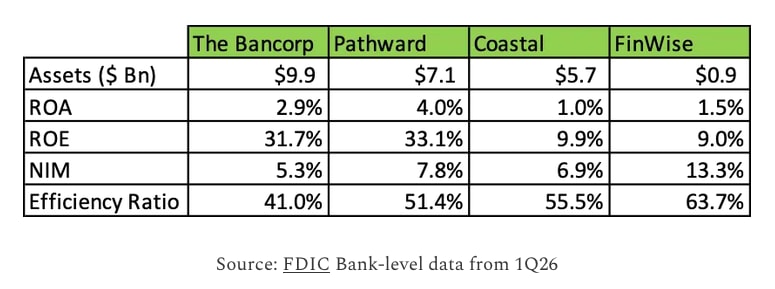 Equity may not be interested in the business line, focused more on core customers and rolling up banks in the Midwest. He also pointed out that the combined bank will have about $9.1 billion in assets, and may be less interested in the incremental interchange income that comes from the business line. Lincoln Savings declined to comment; requests for comment from Equity Bancshares were not returned. In the end, Kansas City, Missouri-based nbkc bank filed an application with the FDIC to acquire LXSB for an undisclosed price and terms, according to an Oct. 30 announcement. In the statement, nbkc bank CEO Michael Bartkoski said the transaction was a “natural fit” that would strengthen the deposit base and add “significant momentum” to the bank’s 13 BaaS relationships and 3.6 million end customers. The Course Never Did Run SmoothOf course, not all fintech acquisition bids for a BaaS bank will work out. In December 2025, Enova International announced it agreed to acquire New York-based Grasshopper Bancorp, the parent of Grasshopper Bank, for about $369 million. Grasshopper was established in 2019 as a digital-first bank that used BaaS to grow customer relationships. The deal valued the $1.6 billion bank at roughly 250% of tangible book value. A little more than nine months later, Enova withdrew its applications and the parties agreed to a mutual termination this month. This particular transaction attracted the attention of 20 state attorneys general, who asked federal banking regulators to deny the application. Their concerns were that this acquisition would “circumvent state interest-rate limits,” according to a September PYMNTS article. “While regulators have recently encouraged nonbanks to voluntarily come into the banking system to level the playing field and promote more consistent regulation, the bank application process has not evolved enough to clearly articulate the standards for nonbanks like Enova, who serve customers whose credit needs have traditionally been met mostly outside of the banking system,” said Steve Cunningham, Enova’s CEO, in a company call held after withdrawing the application. “Without these clearly articulated standards, the process is susceptible to influence political pressure and outside advocacy, independent of the merits of the application itself.” Last Banks StandingDespite these half-dozen acquisitions in 2026, there remain plenty of banks engaged in banking as a service. But the charter push from fintechs, including the ones that elect to buy a bank rather than establish one, may indicate a maturation of fintechs to become the banks they need to operate. Where does that leave the BaaS banks? Jason at DR Bank isn’t worried. He said the charter rush “doesn’t spell the death of the sponsor banking model — it validates and legitimizes it.” As major fintech companies in the partner banking space, like Mercury and Chime, make a bid to become banks, Jason said there are plenty of opportunities for sponsor banking partnerships. Many fintechs still find bank partnerships to be valuable and don’t want to become banks at this time. And he thinks this graduation of fintech partnership to bank ownership strengthens the BaaS business line and pipeline. “The regulators can't possibly say banks partnering with fintechs isn't a good idea if they're giving fintechs charters,” he argued. Even if regulators eventually close the charter window, he doesn’t think it’s likely that they’ll try to shut down BaaS and partner banking along with it. For a decade, the sponsor banks have been something of a gatekeeper along the supervisory perimeter. In letting some nonbanks have greater access to the banking system, they’ve endorsed the fintech partners and established the regulatory expectations and standards they would need to follow. And now, they’re potentially preparing them to become banks or bank holding companies themselves. Why these BaaS banks agreed to be acquired likely says something about the combination of the sale price against future prospects of the individual seller. But it does indicate that partner banking is no guarantee of independence, nor a great deterrent for a potential buyer at the right price. FROM THE VAULT What’s on my mind and filling my time: 💫 Twinkle twinkle: Astronomers and folks in space tech are debating, yet again, whether Vincent van Gogh’s ‘The Starry Night’ was based on observable constellations, or was his imagination. 🎣 Here fishie fishie: I read with GREAT interest in this Bloomberg News article that some of these tuna carving events that restaurants (or the symphony, if you live in Nashville) can result in guests eating a pound of sushi-grade tuna and taking some home?! Makes the three-figure price tag a little more bearable? 🎙️ On Bank Nerd Corner: I finally tackle a topic I have avoided for 15 years: federal preemption. I couldn’t do it without my guest, Susan Seaman, a partner at Husch Blackwell. 🛫 Catch me at: AFC Policy Summit on Nov. 17 in Washington. Piper Sandler’s Balance Sheet Strategy Seminar on Dec. 7 in New York. Thanks for reading! Let me know your thoughts. An addendum to last week's newsletter: For Halloween this year, I went as Jenny from the beloved children's story "Girl with the Green Ribbon." Easy enough costume, mostly from the closet, and you will find out who read the same messed up children's book as you did, or who has absolutely no idea what's going on with the ribbon. 10/10 recommend. - Kiah | ||||||||
|