 | ||||||||
| | ||||||||
Happy Friday, Fintech Takers! And Happy All Hallows' Eve Eve! If you have little kids, I hope you’re ready for the fun and excitement (and likely a few tantrums). In my household, we have a Dr. Ryland Grace (and Rocky), a Creeper Nutcracker (Minecraft/Tchaikovsky crossover!), and an Angelina Ballerina … plus whatever costumes my wife and I choose at the last second. I hope y’all have a safe and enjoyable holiday weekend. - Alex P.S. — Patrick Stewart died this week, which is just awful news. In addition to all of his other incredible work, Star Trek Next Generation is the best Star Trek show, and the gap between it and number two isn’t close. Captain Picard is one of my all-time favorite characters and only Stewart could have brought him to life. I included my top five favorite TNG episodes at the bottom of today’s newsletter, as a tribute to him. Was this email forwarded to you? Sponsored by Persona Every fintech company wants to grow. Every examiner wants proof that growth isn't coming at the expense of customer risk controls. The temptation is to tighten the rules for everyone. Unfortunately, good customers tend to get caught in that net, too. Persona takes a more intentional approach to AML, bringing KYC, KYB, dynamic risk scoring, and continuous monitoring into one system of record. The idea is to make compliance more responsive to actual risk, versus treating every customer like a potential problem. Difficult, Not ImpossibleA challenge in consumer finance — perhaps the challenge — is that products are rarely fun to use, profitable to offer, and a net positive for customers’ financial health. You want all three. Profitability is important because, well, that’s the whole point of running a business in the consumer finance industry. Fun is important because it drives growth and engagement. And financial health is important because, in an ideal world, everyone working in consumer finance wants to feel like they’re helping make the world a better place. The trouble is that you can usually only get two of the three, at most. Fun and profitable is relatively easy. You find a financial services activity that has a negative expected value for the average user, but that is fun enough that they will engage in it despite the negative EV and then you sell access to the other side of the transaction to someone who wants to make a lot of money and doesn’t care if consumers are getting hurt. Zero Days to Expiration (0DTE) options and memecoins are good examples. Profitable and financially healthy is extremely difficult. Mortgage is really the only product category that gets close and only because the U.S. government and the financial industry have done a great deal of engineering to make the 30-year fixed rate American mortgage the unique product that it is.1 I asked Claude to plot major consumer finance products on a two-axis chart (profitability and financial health) and categorize each by how fun they are to use and its analysis generally matched my intuition: 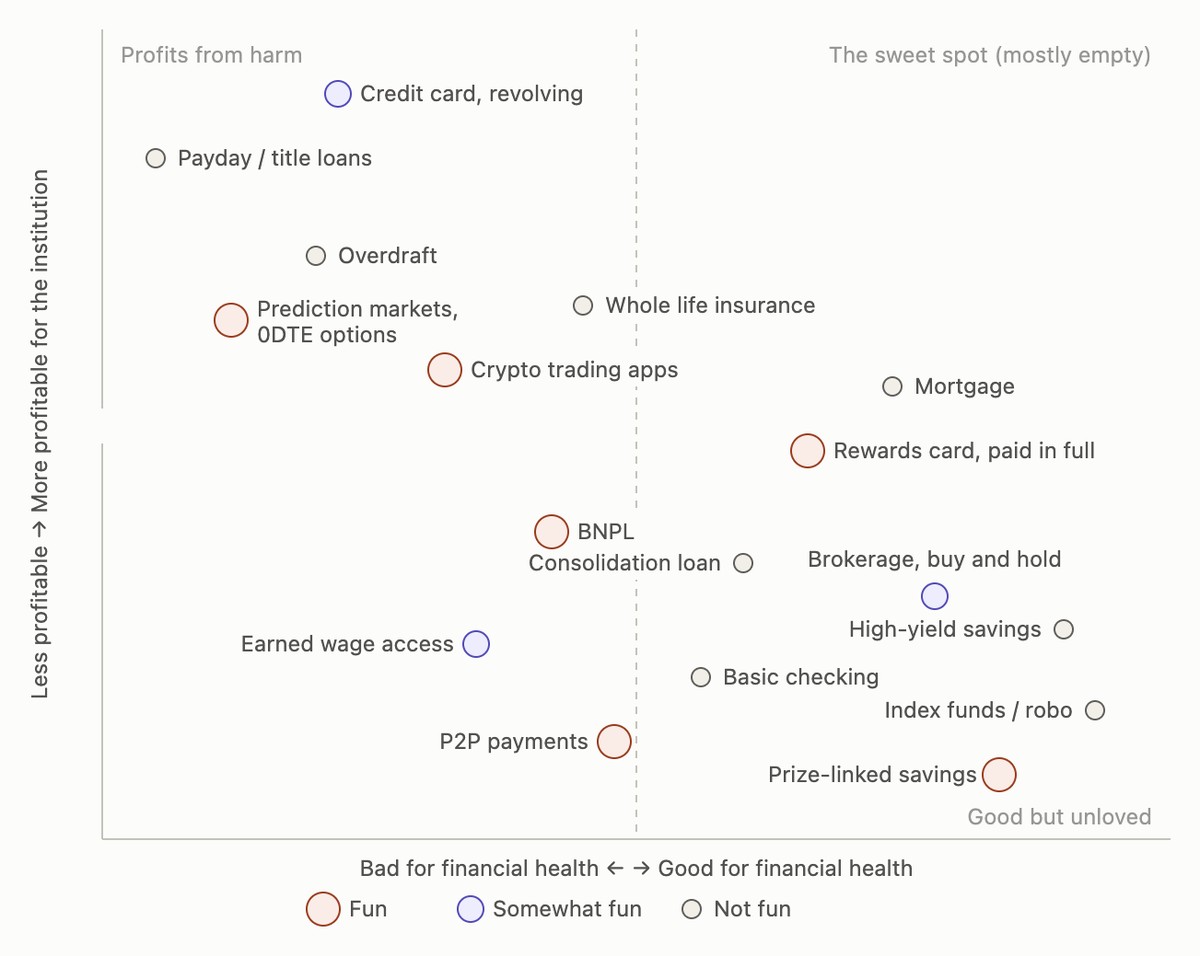 A rewards credit card paid in full every month was the only product that it flagged as potentially being fun to use, reasonably profitable to offer, and good for users’ financial health. And, as we know, that’s only possible because transactors (low risk, lower profitability) are subsidized by revolvers (higher risk, higher profitability) and Claude flagged revolving credit card accounts as extremely profitable, financially unhealthy, and only somewhat fun.2 The good news is that the profitability constraint is not quite as binding as it seems. Building a single product that is both financially healthy and profitable is extremely difficult. However, a well-constructed multi-product business model can create space for less profitable products, as long as those products support and reinforce the more profitable ones. Checking accounts and savings accounts funding various lending products is the classic example in banking. The bad news is that the fun constraint is, on the surface, harder to solve for. Humans’ pleasure-seeking brains tend to prioritize activities that are fun and enjoyable right now, and, unfortunately, many of those activities tend to produce bad long-term financial outcomes. This creates quite a dilemma in fintech, an industry that is almost entirely funded by venture capital and that is, consequently, hyper-focused on growth and engagement. I genuinely think that most people building in fintech want to build products that help improve consumers’ financial health. However, when push comes to shove, the tendency is to default to optimizing for growth and engagement, which means maximizing the fun. And the better we get at designing for growth and engagement, the more we assume that it’s the only way to build and that time and money spent on any other objectives is a waste. And that’s why, in the year of our Lord 2026, we get news stories like this:
A billion dollars for Kalshi? Truly, what the hell? This is a baffling decision. The only way that it makes sense is if you assume, as an investor, that the only way to generate an acceptable return in fintech in 2026 is to pour as much gasoline as possible on whatever addictive, fast-growing, negative-EV trashfire you can find, and just not worry about the collateral damage when that fire burns out of control. We must reject this premise. We can make financially healthy consumer finance products more fun and engaging — and, therefore, more successful — if we invest sufficient time and money into the attempt. I might not be able to generate quite the same financial return for Sequoia and Wellington if I took their billion dollars and used it to hire away all the best product designers and marketers from Kalshi and assigned them to build a consumer finance product that was both engaging and fun and effective at improving users’ financial health and well-being. But I bet I could get closer than they’d think. And we’d all go home at the end of each day feeling much better about ourselves.3 Start With SavingsTo get more specific, I think we need to devote a lot more time and money in this industry to making savings products more compelling and effective. There are two reasons why I think this. First, saving money is the definition of delayed gratification. It’s not inherently fun. It doesn’t feel rewarding in the short term. It’s the financial services equivalent of eating your vegetables or flossing your teeth or waking up early to go to the gym. It’s not a category of products that sells itself. It’s a category of products that needs all the help it can get. Second, it deserves that help. Liquid savings is the factor most strongly linked to consumers’ financial well-being. And it’s not particularly close. When the CFPB surveyed Americans using its financial well-being scale, it found that liquid savings did more to separate people with high and low well-being than any other variable it measured. Adults with less than $250 in the bank averaged a score of 41 out of 100. Adults with $75,000 or more averaged 68. Vanguard found something similar last year: investors with at least $2,000 in emergency savings reported 21% higher financial well-being than those with nothing set aside, even after controlling for income, education, and total financial assets. It’s not just that being rich feels good. The cushion itself seems to matter. The reason is pretty simple. Financial shocks aren’t rare events; a car breaks down, a kid gets sick, hours get cut. When there’s cash in the bank, a shock is a speed bump. When there isn’t, it’s the first domino to tip over, and the next dominoes to fall are financially damaging: An overdraft, a payday loan, a missed car payment, a hardship withdrawal from the 401(k). The Urban Institute found that low-income families with $2,000 to $4,999 in savings weather income disruptions better than middle-income families with no savings at all. In other words, savings can matter as much as income. And it doesn’t take much to start moving the needle. Even $250 to $749 meaningfully reduced the odds of missing a housing payment. And savings doesn’t just protect consumers; it protects the other financial products they use. JPMorgan Chase Institute’s research found that a liquid cash buffer was a far better predictor of avoiding mortgage default than how much equity a borrower put down. Borrowers with less than one month’s payment in reserve defaulted at five times the rate of those with three months saved. Vanguard found that participants with $2,000 in emergency savings contributed more to their 401(k)s and were dramatically less likely to cash them out when they left a job.4 Which brings me to some personal news. SaverLifeI am absolutely delighted to share that I’ve joined the Board of Directors of SaverLife, a nonprofit focused on helping people improve their financial well-being. This will be my first-ever time serving on a board, and it’s a bit of a divergence from my SOP, so I wanted to explain why I’m doing it. I thought we could accomplish this with a quick six-question Q&A: #1: You don’t normally serve on boards or get involved with specific companies in the financial services space, right?Correct! My primary job is writing this newsletter and I think that is easiest when I analyze what’s happening in this industry from an objective, outside perspective. I think having personal commercial interests in individual companies (via board seats, advisor relationships, or angel investments) compromises that objectivity. At some point in the future, my stance on this might change. However, today I take a distinctly Jeffersonian stance on entangling alliances. There will be rare exceptions to this rule, and SaverLife is one. Because SaverLife is a nonprofit, I have no personal commercial interests in it, and, as such, my objectivity remains intact. #2: I haven’t heard of SaverLife. What is it?SaverLife was started in 2001, with a focus on helping low-to-moderate-income households build assets through individual development accounts (IDAs), which are a savings product that matches personal deposits into the account with public or private grant funds for specific wealth-building asset goals, such as buying your first home. During its first decade, it actually built one of the largest IDA programs in the country. Over the past decade, the organization has built a national, technology-enabled platform focused on encouraging and incentivizing savings. Anyone can become a SaverLife member and download the app. The product allows members to link their bank accounts and earn cash rewards, prize entries, and challenge payouts for depositing money into their savings accounts. It also includes an online community, personal financial management content and tools, and a network of vetted nonprofit and for-profit service providers in areas like credit counseling. Today, we have more than 850,000 members nationwide and we’ve helped those members deposit $1B into their linked savings accounts. #3: So, it’s a nonprofit, but it has a consumer-facing fintech product that its members use? That sounds like an unusual combination.Yes, it is! And that’s one of the reasons I’m so excited to join the board. SaverLife occupies a unique position in the market. Unlike other nonprofits in the financial health space (which are absolutely fantastic, by the way), SaverLife has a fintech product in market that hundreds of thousands of people are using on a regular basis. That gives us a boots-on-the-ground perspective that others lack, and it allows us to put theories for how to increase the personal savings rate or reduce household debt levels to the test. And unlike for-profit consumer fintech companies that are focused on improving their customers’ long-term financial outcomes (of which, I am thankful to say, there are quite a few), SaverLife doesn’t need to generate revenue. We are almost entirely funded by philanthropic grants, which pay for the development and maintenance of our product as well as the cash incentives and direct giving that we do through the product to our members. This gives us the freedom to prioritize the product features and financial health interventions that result in the best outcomes for our members — including many that would never make it to the top of a for-profit company’s roadmap — and to share what we learn publicly so that the rest of the industry can benefit. #4: Is SaverLife leaning in on AI?We are! We are in the midst of significantly redesigning our product in order to take advantage of the unique capabilities of LLMs, and the early results are extremely encouraging. AI allows us to deliver a much more personalized and well-tailored experience to each member, based on their unique circumstances, priorities, and goals. By being able to understand and shape the product around each member’s unique context, we can enable millions of different journeys — some oriented around savings, but others anchored on different financial goals like paying down debt or earning more money — within the same platform. And the more members that engage with that platform (and the more frequently they engage), the faster we build a new source of collective intelligence that can help inform future product roadmap decisions, as well as broader industry and policy conversations. Exciting stuff! #5: How are you going to help SaverLife?Well, step one for me is to learn as much as I can. I’m brand new to the role and, at the moment, I’m focused on coming up to speed on the organization and the product and getting to know the fantastic team at SaverLife better. Once that’s done, my hope is to be able to help increase awareness of SaverLife in the industry and to channel some of the insights and generosity of the Fintech Takes community — which I have benefited enormously from over the last seven years — back to the SaverLife team and product. #6: How can I help SaverLife?There are a bunch of different ways, if you’re so inclined. Most obviously, we’re a nonprofit, so if your organization offers philanthropic grants that might be a good fit for SaverLife’s mission or product direction, we’d absolutely love to get connected. We’d also love to get your feedback and ideas. The SaverLife product is available to everyone. Download it. Try it out. And send us your thoughts on how we can improve it. Or, if you have ideas for how modern fintech building blocks — open banking, AI, etc. — can be assembled to help people save money or pay down debt or better optimize their finances, send them our way! Rejecting CynicismIt’s easy to be cynical about fintech. On the last day of Money20/20, after spending hours immersed in the sights and sounds of the Venetian casino and having one-too-many conversations with fintech operators who were laser-focused on growth and utterly uninterested in their customers’ financial well-being, I had a mini existential crisis. I literally went outside by the canals, hunched down, put my face in my hands, and just took some deep breaths. It was a bad moment. However, immediately after Money20/20, I got to spend a few days in person with the SaverLife team in San Francisco. I was reminded that building consumer finance products that are both fun and engaging and financially healthy is difficult, not impossible. I think SaverLife can be a meaningful catalyst in making that task seem more possible and I’m excited to help. Sponsored by Veriff There was no shortage of talks about AI fraud at Money20/20. But amid doomsday scenarios, what does this stuff actually cost businesses? Quite a lot, apparently. According to research cited in Veriff's latest analysis, financial services businesses that experienced deepfake fraud reported an average loss of $603,000. Veriff digs into both in a new article, which translates into five minutes well spent. THE FIVE BEST EPISODES OF THE NEXT GENERATION (AND WHY PATRICK STEWART MADE THEM GREAT)#5: Q WhoObviously an important episode because it introduces the Borg, who are the signature villains for Picard and for Star Trek overall. However, my favorite part is when Q is trying to annoy Picard into letting him join his crew by trapping him in a shuttlecraft. Great stuff.5 #4: DarmokOne of the best episodes in any Star Trek series. It shows Picard’s diplomatic prowess, which isn’t a muscle he gets to flex as much as you might expect in TNG. He does so here, and it makes for a great episode.6 #3: The Best of Both Worlds (Parts I and II)I’m cheating and including both episodes into one spot on the list. It’s my list and I can do what I want! Honestly, it surprised me that this one ended up at number three. The end of part 1 and the introduction of Locutus is an all-time TV moment. #2: The Measure of a ManThe greatness of Stewart as Picard was that he’s equally credible and impressive commanding a starship in battle, negotiating a treaty with an alien race, and (as he does in this episode) dominating an argument in a court of law. Atticus Finch in space, basically.7 #1: The Inner LightThe obvious number one in my book. An unbelievable hour of television that only Sir Patrick Stewart could have made work. The whole thing is built around his performance and he absolutely nails it. WHERE I'LL BETwo more to go! We can do this!!! ✈️ AFC Policy Summit | November 17 | Washington D.C.I’m moderating a panel on agentic commerce, which means that it’ll be non-stop questions and a lot of “I don’t know” and “We’ll see how things develop” in response. ✈️ Fintech NerdCon | November 18-20 | San DiegoStill some room at the dinner that I’m hosting on Wednesday night at NerdCon. The focus is on lending, so if that’s an area you spend time in, let me know and I’ll get you on the list! Thanks for the read! Let me know what you thought by replying back to this email. — Alex Footnotes 1.And, obviously, that product category hasn’t always been safe or profitable, as we most recently experienced in 2008. 2.I guess the lurking dread you feel as you wrack up balances and just pay the minimum monthly payment detracts from the fun? 3.This really isn’t a crazy notion. When companies that are focused on helping consumers improve their financial health get sufficient time and resources, they often succeed! Chime raised billions of dollars from VCs and built the largest and most successful consumer neobank in the U.S. Ditto for Affirm, which set its sights on reducing revolving credit card balances to zero and has grown into one of the most successful non-bank lenders in the modern fintech era. 4.Research from Commonwealth also supports this idea, as Tim Flacke and I discussed on this podcast episode. New investors are much more likely to stay invested if they have some liquid savings to absorb unexpected expense shocks. 5.Every episode with Picard and Q is must-watch television. Two great ones that didn’t quite make the cut here are Tapestry (“Is there a John Luck Pickerd here?”) and Deja Q (“You fell asleep.”) 6.Nerd trivia question: At the end of the episode, Picard is reading a book in his ready room. What book is he reading? 7.If this is your preferred version of Picard, also make sure to watch The Drumhead in season 4 of TNG. An outstanding episode that nearly made the cut here. | ||||||||
|