 | ||||||||
| | ||||||||
Hi! Kiah here. Welcome to Fintech Takes Banking, my weekly newsletter where I highlight things I think are interesting or important for bankers and the surrounding environs. Was this email forwarded to you? Sponsored by MX Legalized betting is increasingly part of consumers’ lives, often available on their phones in a few taps. Betting on matches heightens the participation of the spectators watching in the stands or at home. Data-driven insights tied to customer spending patterns could help banks identify early signs of financial risk, so they can help consumers better manage their money, reduce financial stress and avoid a crisis. 2026 Money20/20 Download: Banking Heavyweights, the Hunt and Pillowgate A small assortment of what I got up to during Money20/20. Today’s newsletter recaps the 2026 Money20/20 USA conference, held at the Venetian in Las Vegas from Oct. 18-21. Come for the updates on banking regulation and one superregional bank’s response to agentic finance. Stay for the palace intrigue and #pillowgate. Dispatch 1: Views from Main StageMoney20/20 USA is not a banking conference, even if many banks attend. That leads to a strange mix of companies that want to disrupt banking, companies that are entering banking and companies that want to work with banks. Some of the biggest tradfi banking heavyweights speaking at the conference were Federal Deposit Insurance Corp. Chairman Travis Hill and PNC Financial Services Group Chairman and CEO Bill Demchak. Personal AI agents have been on Demchak’s mind. On stage Monday, he expressed exasperation and annoyance at the companies creating them, echoing comments he made in the bank’s Oct. 15 earnings call. This includes swearing that PNC will “never” allow AI agents like Meta’s Muse to execute verbal or written commands to transact on a customer’s behalf inside their financial account. “No, that's shut out from coming into our system. They're welcome to see information you want to share — through traditional API connections and our connections through Akoya — connect in, look at the data, share what you want,” he said. “But the notion of [transacting] … we'll never let it happen. There would have to be a massive liability shift.” He called the firms building AI agents for consumers “kids in a room with a new toy” who are “messing around with money.” PNC, for the time being, is in good company. Banks that are prohibiting external AI agents from moving customer funds include JPMorgan Chase & Co., Citigroup, Bank of America Corp. and The Charles Schwab Corp., according to PYMNTS. One major recent concern is that some of the agents the banks detected may have tried to execute actions that were not requested by the user, according to a PYMNTS summary of an Axios report. Demchak acknowledged that the adoption of AI agents underlines that customers want agentic control of their financial information. He said financial institutions could build an agent with proper authentication that can organize and set up transactions, while still ensuring consumers confirm the action through a control function. FDIC Chairman Travis Hill took a broader, more measured scope in a fireside chat on Tuesday morning. The regulator is evaluating what personal AI agents can do, as well as their downstream costs and effects, but Hill said it’s still in the “very early innings.” In general, he said the agency under his leadership has adopted a more forward-looking and open-minded approach to innovation, while still being mindful of its responsibilities as a regulator. Other areas of innovation work include the FDIC’s facilitation of a standard-setting body for fintechs that want to work with banks. Hill said the main objective of the standard-setting group is to make it “easier and more seamless” for community banks to partner with third parties. The group, which was first reported by Bloomberg Law in August, would set standards, which independent assessors would use to certify vendors. Community banks could rely on those assessments in due diligence and onboarding. “We've been trying to help set it up, but ultimately it will be run by the industry, not a governmental entity,” Hill said. “And secondly, it would be completely voluntary, so there'd be no mandate for participation, and no negative inference for anyone who doesn't want to participate.” The agency has focused on improving the process to apply for deposit insurance to encourage more bank formation. This includes a new review process where applicants could have their applications reviewed by the chartering agency, whether that’s a state or the Office of the Comptroller of the Currency, and the FDIC concurrently. Hill said this would more closely align application timelines and review with the chartering authority, creating a more streamlined and efficient process. It would also provide contingent authorization within 120 days and then approval within the next 12 months, giving the bank-in-formation time to turn in additional information, raise capital and complete key steps. The FDIC is also trying to shore up the parity of state-chartered banks through a proposal it released in September. The proposal is intended to give state-chartered banks operating in states where they don’t maintain a branch the same preferential legal treatment as national banks, in response to actions by various state legislatures that could lead to unequal treatment between banks, such as the Illinois law banning interchange on tax and tips and Colorado and Oregon’s interpretation of their DIDMCA opt-outs. It would be in effect in places where a host state law has been preempted for national banks and would apply to out-of-state state banks providing the same services in that location. It’s unclear how successful this law might be over time. A Simpson Thacher memo about the proposed rule called it a “significant shift” in how parts of the FDI Act are applied. It also highlighted that recent decisions from the U.S. Supreme Court in Loper Bright and Corner Post raise questions about whether the agency can interpret the underlying law this way. Dispatch 2: #PillowgateMonday night, I attended the Column party with my friends, Jessica Kendall of Spinwheel and Jason Mikula of Fintech Business Weekly. Column had taken over Cote for the conference and placed several embroidered, branded throw pillows in all the booths. It is a tantalizing item of merch, and we (I) got permission for Jason to take one at the end of the night. The flight back to Europe is long, and I’m sure a pillow would be welcome. I took this photo after we left the party and before he peeled off to go back to Treasure Island. I didn’t know it, but these were some of their last moments together. 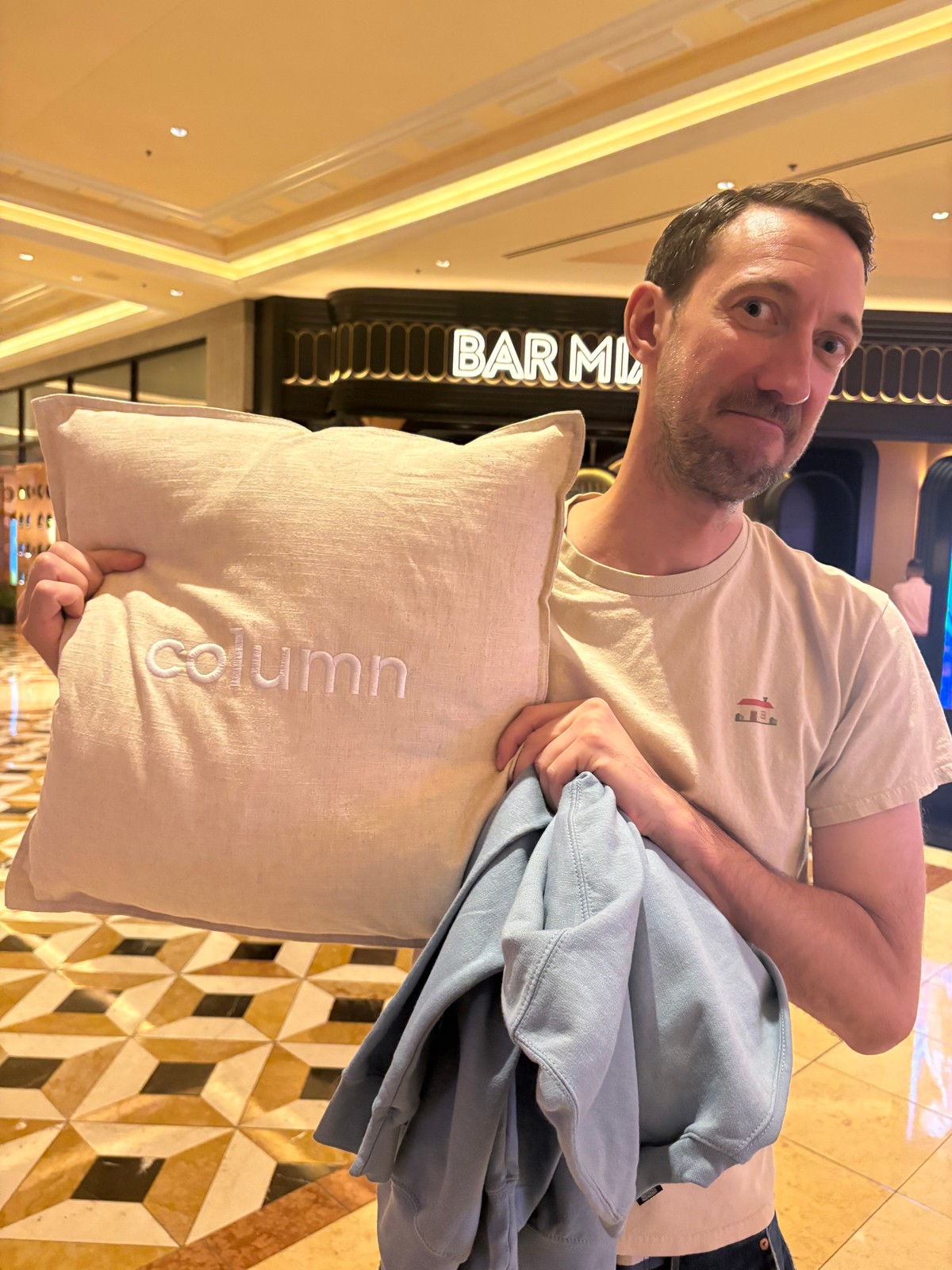 Their last moments together Less than an hour later, I got a text: the pillow had been SNATCHED. On the way out of the Venetian, Jason was accosted by a woman attending Money20/20 who had concerns about his coverage. This confrontation lasted for 20 minutes and at the end of it, she took the pillow from his arms and absconded with it! I shared the news about the pillow-snatching with Column the next day. A company spokesman sent me the following statement: “While search parties scour the Venetian for the original pillow, a replacement has been dispatched to Mr. Mikula. If you need a bank with the technology and interior decor to help you build at the frontier of financial services, please reach out at [email protected].” Also, to be clear: This is funny, but don’t do this! Don’t be this person! It’s actually fine to ignore someone if you don’t like their reporting, or maybe send an email, or have a more measured conversation during daylight hours in a social setting if you feel the need to say something. But don’t confront someone at night while they’re walking back to their hotel room, talk about your concerns at length unprompted and then take their items! My only hope is that this woman woke up confused the next day about how exactly she acquired this pillow and, if she subscribes to this newsletter, apologizes to my friend for stealing it. Dispatch 3: The HuntMoney20/20 is certainly an experience. But for all its overstimulation, it can be easy to have a small, myopic conference experience: avoid the expo hall or only pass the booths on the way to the stage you’re headed toward. Avoid the crowded spots. Avoid eye contact if you’re running from meeting to meeting. Never leave the Venetian. Forget to let the sun shine on your face. To commemorate the last year at the Venetian and commit to experiencing the conference and its attached resort casino, I created a scavenger hunt for myself with lots of input from attendees. Playing the scavenger hunt forced me to do things: get off the Strip, stay at an event until 11 p.m., gamble and try to win. Walk to Treasure Island. Find someone walking around with bare feet. Take a meeting at The Starbucks. The lucky, or unlucky, person who agreed to take this meeting with me was Jason Hardgrave, CEO of DR Bank. Another Jason who is also a great sport and a fun person to talk to! The line by 9 a.m. on Tuesday barely fazed our barista, who said it was twice as busy on Monday at 6 a.m. (You sickos.) We talked about the conference’s hype cycle magnification and the urgency that can create for bank attendees — until the next big thing at next year’s conference. 2026’s was obviously stablecoins and agentic AI. Jason observed that people’s confidence tends to be inversely related to how much they actually know. Still, he has a soft spot for Money20/20 because of the serendipitous meetings that seem impossible to replicate in any other situation. We chatted about projects in the queue at DR Bank, which has $912 million in assets and is based in Darien, Connecticut, as well as some of the broader trends around novel bank charters and the competition that stablecoins pose to bank deposits. Jason said he believes that customer-centric businesses will increasingly beat traditional banks that are slow to move money or cling to the float for revenue. He pointed out that banks have been able to offer real-time payments since 2017, but many still don’t or don’t offer it widely, which is why stablecoins’ speed and cost pose a real threat “I think it's a reshuffling of the deck, and I think the spoils should go to the winner,” he said. “And now that this charter push is happening, I think it's a real threat to regional banks, large banks, small community banks that are like, ‘I'm still going to hold the money for three days. It's my God-given right. It's my float.’ Not your float.” After we watched Hill's fireside chat, we parted. I had other small tasks to accomplish or items on the scavenger hunt to find. I needed to find a Patagonia vest — did you know there are a lot of vests that aren’t made by Patagonia? I needed to find swag or a business card from a company that had received a bank or trust charter in the last two years, which required a full lap around the expo hall until I found BitGo’s booth. (BitGo's national trust charter conversion was approved in December 2025.) While I did that, I could peer into booths for the most expensive or best quality swag, or the most practical swag (answers: Chanel compact mirror, given to attendees at a breakfast, and a Baggu bag). I shared my hunt with friends and on LinkedIn so others could play along. My accomplice for some of the tasks, who actually destroyed me, was the aforementioned Jessica Kendall. She topped the leaderboard with 39 items and 60 points total. I came in at second, with a distant 16 items for 46 points. The secret to her win was bonus points: five extra for every five items in a category, plus 10 for finding the cringiest thing. What was that, you ask? She caught a guy flossing his teeth on the expo hall floor. Longtime readers of this newsletter will recall that the same thing happened last year — is it the same guy that no one has stopped, or is there another guy who does this? How does this keep happening? There are a lot of unknowns about what Money20/20 will look like when it moves to the Las Vegas Convention Center next year. Will the invisible cloud of cigarette smoke hang over the hall? What will replace restaurant row (A Google review said “some food court style offerings”)? How annoying will it be if staying on-site isn’t an option? Will it be really nice to not walk through a maze of slot machines and gaming tables, or will I be weirdly nostalgic? In our quest to “actually gamble,” Jessica and I ran into two guys at the Palazzo who were in town for FABTECH 2026, North America’s premier metal forming, fabricating, welding and finishing event that was held at the Convention Center. They did not seem to understand my line of questioning, but reported that the food is fine and staying at a hotel that’s 15 minutes away isn’t super annoying. But for all of their nonchalance, it did occur to me: the two of them were in the Palazzo at 11 p.m. and they probably wouldn’t have had a pillow snatched from them. Viva la Venetian. Sponsored by MX How valuable is it to be a customer’s most-used credit card? FROM THE VAULT What’s on my mind and filling my time: 🏈 Touchdown! John Urschel, who had previously played professional football for the Baltimore Ravens, just published a math paper! Never too late to pursue your dreams. 🎃 Annual reminder that: no one knows how large or heavy pumpkins can grow. The world record for heaviest pumpkin was broken again this very month, with a 3,156 lb. pumpkin in Rhode Island!!!! 🎙️ On Bank Nerd Corner: I'm bringing you a guest episode of Darling Consulting Group’s “On the Balance Sheet” podcast, where DCG Executive Managing Director Justin Bakst and I discussed what technology and demographics could mean for deposits. 🛫 Catch me at: AFC Policy Summit on Nov. 17 in Washington. Piper Sandler’s Balance Sheet Strategy Seminar on Dec. 7 in New York. As always, thanks for reading! What's everyone going for for Halloween? I am traveling to a wedding this weekend and the welcome party has a costume contest, so for the first time in years, I made myself come up with a costume! Will report back. - Kiah PS: Reece's Take 5 are the best Halloween candy. | ||||||||
|