 | ||||
| | ||||
| Hey good folks and happy Friday! Sorry for a late newsletter this week. I wanted to make it a good one. Let’s go. Well, it happened. We launched a post sign-up survey and found that 40% of our prospects are using LLMs to evaluate us. More, in those evaluations, we are showing up unpromoted ~80% of the time. And yet, in our attribution data, we are only seeing AI as a referrer <2% of the time. Why? Well, for all the reasons we all know. These folks find us on the LLMs or in AIO, and then they go directly to our homepage or Google us, and often land on a branded paid search ad. Our direct and branded paid search channels are green, green, green––up significantly year over year. We’ve seen this directionally in Profound. In September, we had 54% AI visibility, blowing past our competitors (and what many others say is best-in-class in the industry). 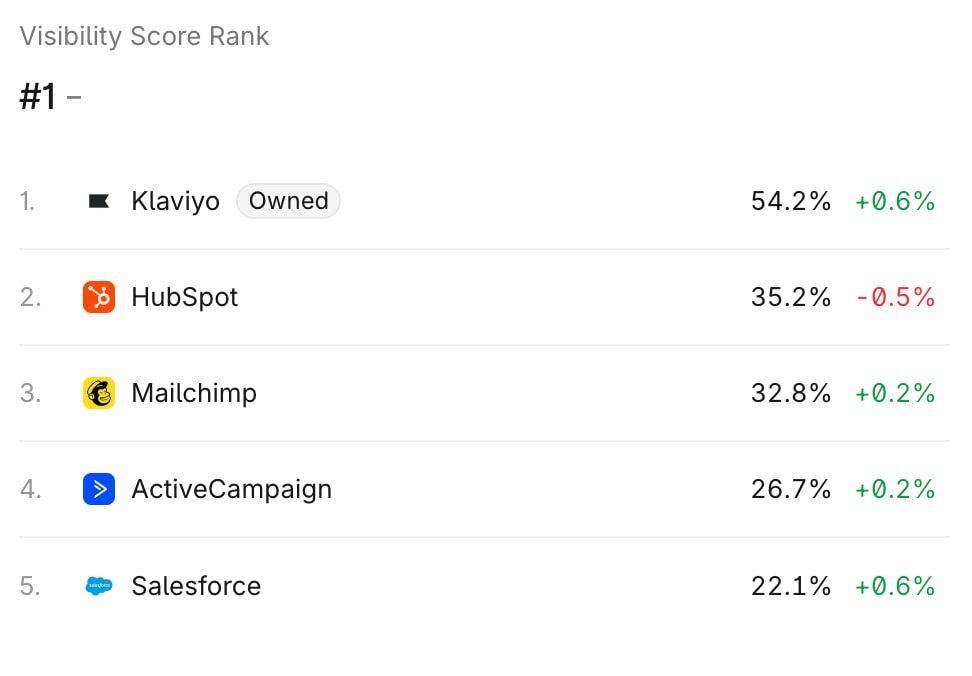 We’re trending up to 64% so far in October. All of this to say, our AEO strategy is working. This is our playbook. The AEO PlaybookWe are building a high-volume of authoritative, interconnected, machine-readable content that when a prospect asks an AI system a question about marketing automation, ecommerce, SMS, segmentation, email, or increasingly Klaviyo’s next set of strategic categories, Klaviyo has a strong chance of becoming part of the answer. Our goal is not simply to “rank in ChatGPT.” It is to maximize Klaviyo’s presence across the entire AI-mediated buying journey. Our goal is to be discoverable, be cited, be accurately described and, of course, be recommended. And we need to do this across:
This is how we are doing it. Play 1: Build across the funnel, at volumeThe first play is simple in theory: have the best answer to more of the questions buyers ask. Our content strategy intentionally covers the full funnel:
If a topic materially influences whether someone understands, evaluates, compares, or buys Klaviyo, we should have an authoritative Klaviyo-owned source for it. Today, that means maintaining our existing strength in several core categories, and expanding where we are weaker. We use Profound to identify these areas. “Weaker” to us means AI visibility in comparison to our competitors for a topic/category. How we executeWe maintain high publishing velocity—roughly 200–375 pieces of content per month—not for volume’s sake, but to systematically fill gaps in product, feature, use-case, and market coverage. We’ve built a custom AI content production tool in which we have skills chained, and automation built in from our project management platform and through to our CMS. Every piece gets edited (which we’ll chat about below). We then measure citations to those pages, and how that influences the category. We are seeing new assets get cited within a week, but refreshed assets get 154% more citations than net new. Play 2: Leverage the core site & a subnavOur strongest-performing assets are pages that give AI systems concrete, authoritative information about what Klaviyo does. That is why the core website matters so much, not just our blog. Core site pages account for approximately 46% of Klaviyo-owned citations, and CoreX pages (our subnav pages that are the backbone of our performance content program) are cited roughly 58x more per page than the average page. Play 3: Make everything easy for machines to find and understandAEO has an information architecture component. Our subnavigation work is designed to make important Klaviyo assets more discoverable to both users and bots, following patterns used by large authoritative websites (and our competitors, honestly. We watch, y’all!) Our assets also include:
For us, we work on the model that important information should never depend on a machine figuring out our site architecture on its own. Every priority asset should be easy to crawl, internally linked, structurally consistent, and connected to the rest of the topic cluster. Play 4: Own the sources outside Klaviyo.comLLMs do not build answers from owned websites alone. They synthesize from the broader information environment. That means our AEO strategy also needs to deliberately influence the independent sources AI systems trust. Today, that includes especially:
We’re increasing the amount we’re publishing on YouTube, for example, 95% MoM (at least in the last month). And we’re seeing that our organic views there are out pacing competitors, all of whom have far larger channels. Play 5: Keep humans in the loopVelocity matters. Accuracy matters more. We use AI aggressively to accelerate drafting, localization, and, soon, repurposing—but humans remain responsible for the final product. That protects:
How we measure AEOTraditional attribution is not sufficient for AEO. That may be the most important lesson from the signup survey. A prospect can discover Klaviyo in ChatGPT, then Google “Klaviyo”, click a paid search result, and sign up. Our analytics will say paid search. The customer will tell us that it was ChatGPT that deserves the credit. Both are technically correct, but not assigning influence to AEO in this scenario means we get unfunded or, worse, our leadership will think we aren’t doing a great job. Our product research validates this and shows that fewer than 2% of AEO-driven signups were being attributed to AI, and recommended evaluating organic and direct demand together, monitoring branded paid search, and adding an always-on signup survey. So our AEO scorecard will now include four layers. 1. VisibilityAre we appearing in relevant answers? Measure:
Impressions matter here, too. 2. CitationsAre AI systems using Klaviyo as a source? Measure:
3. RecommendationAre we simply mentioned, or are we actually being recommended? Measure:
We’ll also use a post sign-up survey to get qualitative feedback here. 4. Business impactFinally, connect AEO visibility to demand without pretending last-click attribution tells the whole story. Monitor:
What we want to know is: as AI visibility rises, do we see corresponding increases in branded and direct demand—and do customers tell us AI influenced their decision? The playbook tl;drCover every commercially important question, publish the strongest possible source material, make it easy for machines to retrieve, reinforce it across the web, keep it accurate, and measure the demand AI creates—not just the clicks it sends. We have so much more work to do to move faster and clean up and optimize, etc. But that’s the work. That’s what keeps the playbook functioning. A NOTE ON THIS ADVICE You do you! One content marketer’s best practices aren’t always right for another one, though I do try to distill out the main concepts and core practices I believe everyone can benefit from. That said, you must use good judgment when deciding whether to take advice given from folks on the internet. I am an expert, and this advice comes from my direct experience, but I am not smarter than you, and I have nothing to gain or lose because of what you do. Thank you so much for reading. Let me know what you think by replying to this email. Very excited to be here with y’all. Tracey | ||||
|