 | ||||||||
| | ||||||||
 Hello! Kiah here. Welcome to Fintech Takes Banking, my weekly newsletter where I highlight things I think are interesting or important for bankers and the surrounding environs. Thank you to everyone who joined us for the Fintech Takes Banking coworking day in Nashville! I had such a great time working alongside you at the Malin and socializing at Jackalope afterward. Today's newsletter has its inspiration in my recent deposit series (you remember, from a couple weeks ago). Was this email forwarded to you? Sponsored by Taktile KYB automation nails the easy calls. It's the harder cases where the right decision isn't obvious: incomplete records, contradictory information, context that only makes sense once a person looks at it. Giving Up the GhostI saw a ghost recently while writing my deposit series. Perhaps I shouldn’t have been surprised. Some people who believe in ghosts think an entity’s energy or presence is anchored or bound to the living world because of unresolved issues. And this ghost has a lot of unresolved issues. The sources I spoke to for my newsletter could also see and feel the ghost. They talked about the ghost. And like Ghostwriter, it forced me to acknowledge its existence throughout my newsletters. I thought it would fade away once I stopped paying so much attention to it. To my surprise, at the end of September, there was another retelling of the ghost’s untimely death, just in time for spooky season. The banking industry and its regulators are haunted by the ghost of Silicon Valley Bank. And it turns out we're all still telling ourselves ghost stories about it. The Long Tail of FailureSilicon Valley Bank wasn’t the only bank to fail in the spring of 2023. But when we think about the lessons from that time of banking stress, it’s the bank that’s primarily discussed. You can see this in regulatory postmortems, the academic research and the late September publication “Probative Inquiry into the 2023 Financial Sector Stress Events” by Starling Insights. “Signature Bank” appears 11 times and “First Republic” appears 10 times; in contrast, “Silicon Valley” appears nearly 150 times throughout the 365-page report. Federal Reserve Vice Chair for Supervision Michelle Bowman commissioned Starling Insights to study “potential deficiencies in the supervision of SVB” by either the Federal Reserve Board’s Division of Supervision & Regulation or the supervisory staff of the Federal Reserve Bank of San Francisco. The firm’s report is trying to determine whether “supervisory staff might have acted to prevent or mitigate that bank failure and, if so, to learn what may have impeded timely remedial action,” according to the opening letter. It also tries to ascertain whether San Francisco Fed supervisory staff or leadership unintentionally contributed to Silicon Valley’s deposit run. Unlike the contemporaneous reports produced in the weeks after the failure, or in the same year of the failure, Starling’s report needs to justify its existence. It’s been three years, and so little has changed in response to the failure. Today, uninsured deposits are growing, and the deposit insurance limit remains unchanged. Regulators and policymakers quickly lost interest in making these reforms, so why retell the ghost story today? 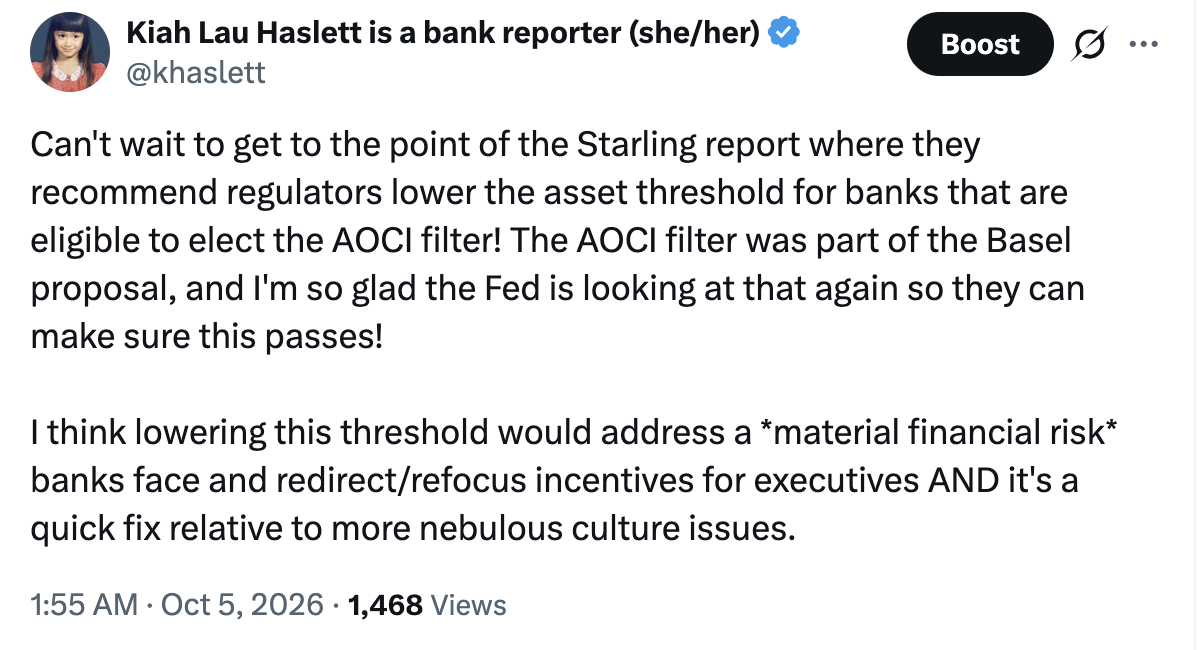 A modest proposal, from yours truly The Starling report is part of the narrative-building effort around Silicon Valley’s ghost story, even as it tries to revisit and correct it. The word “narrative” appears 55 times in the report. In this version of the story, regulators and examiners are central actors sharing potential culpability for the firm’s failure as much as the bank management team tasked with running the bank. This story mentions what management of the failed bank did, but it is about what examiners did in response. Memento MoriMany banks in 2022 were still awash in liquidity related to the pandemic and used it to load up on low-yielding bonds, including Silicon Valley Bank. By the end of 2022, unrealized losses on securities would hit $620 billion at institutions insured by the Federal Deposit Insurance Corp. But the bank was unusual in that it had tripled between 2019-21, due to customers depositing their newly raised capital at the bank, according to Starling. The bank deployed those deposits into a securities portfolio that would eventually hit 50% to 60% of total assets by the end of 2022. Nearly 80% of those bonds were classified as held-to-maturity. It’s not nothing to classify a bond as held-to-maturity. I wrote a year ago that “bonds marked as HTM meant the bank had the positive intent and ability to hold [the asset] to maturity.” HTM securities are reported at amortized cost, whereas securities marked available-for-sale are reported at fair value each quarter. The change in value wouldn’t appear in earnings, but would need to be recorded in the “accumulated other comprehensive income” line item and in the tangible common equity, or TCE, ratio."
Starling pointed out the unrealized losses on Silicon Valley’s bond book, both AFS and HTM, meant that the firm was “insolvent on a fair-value basis after [the third quarter of 2022].” This was legible and readily observable, even if it’s not how most people think about banks. Banks can have lots of unrealized losses and still operate. And maybe that can explain some of the regulatory and supervisory oscillation that the Starling report found.
The magnitude of the gambles the bank was taking seems obvious now, and that’s an important takeaway from the ghost story. But I’m willing to believe that these risks might not have been as obvious in the six months prior to the bank’s failure. Slowly, and Then All at OnceOn March 8, 2023 — the same day Silvergate Bank announced it would liquidate and wind down operations — SVB Financial Group announced it would reposition its balance sheet through several actions, including:
If the plan had worked, it would have repositioned the balance sheet and made Silicon Valley Bank more asset sensitive, shored up the bank’s net interest income and net interest margin and improved profitability. The investor presentation detailing the restructuring mentions the bank’s “ample liquidity” of liquid balances and low loan-to-deposit ratios as one reason why it took these actions. Some within the Federal Reserve Board remember reacting positively to the capital actions and how it could finally convince staffers at the Board that they should take action on the bank, according to Starling. One staffer thought that regulators would “finally” recognize and react to the bank’s problems, downgrading its rating and issuing corrective supervisory actions.
This is not what happened. The bank had been slowly suffocating on low revenue and tightening liquidity. Instead of the actions reassuring stakeholders it was on a stronger, more sustainable earnings in a high-rate environment, they started the bank’s implosion, and caused the sudden and swift death due to an unprecedented deposit run. Why? Autopsy ReportI think it’s reasonable to observe that most banks have a depositor base that is different from their shareholder base. For the most part, depositors are likely indifferent and insensitive to the financial results and performance of a bank. It turns out this is a stabilizing force that’s also pretty easy to ignore. Silicon Valley Bank’s depositors weren’t the intended recipients of the balance sheet restructuring. However, they were a group of people who were information-sensitive to that type of announcement in a way that’s not true at other banks. The announcement invited depositors to take a closer look at the bank’s balance sheet. Sure, a $2 billion loss and incomplete capital raise sounds bad. But depositors discovered something worse: “a readily legible indication of the losses embedded in the much larger held-to-maturity portfolio,” according to Starling. By the end of 2022, Silicon Valley Bank had about $91 billion in its HTM portfolio, the unrealized losses of which “roughly equaled stockholders' equity,” according to the report. It is true that HTM losses are excluded from AOCI and regulatory capital ratios, and this exclusion mostly makes sense for the banking industry. You’re not supposed to really do anything with these securities, so not much happens with or to them.
But it’s also true that these figures are available publicly, people can do math and they can respond as they see fit. And we know now that the depositors understood — in a way that bank management didn’t — that they had something to lose if the bank couldn’t remediate its financial weaknesses. Ninety-four percent of domestic deposits at Silicon Valley Bank were uninsured at the end of 2022, according to a May 2026 study from FDIC researchers. Uninsured deposits can be the best funding for a bank, or they can be the worst, depending on the situation. It creates huge potential concentration risk if they move. In addition to the number of uninsured deposit accounts, Silicon Valley Bank’s depositors were also networked among each other. The bank had deposit concentration both in size and in industry: something that was likely as much of an asset as it was a large liability. One reason banks need to cultivate deposit diversity is so that depositors have weak information networks with each other. In the Starling report, the same Board staffer recalled that when the intended capital actions “reached the Risk function, the head of the Risk function immediately reacted, according to [Board Staff 3]’s recollection: ‘That bank’s going to fail. Oh my God, that bank’s going to fail.’” The next day, March 9, the stock crashed 60%, throwing the viability of the capital raise into question. Depositors withdrew $42 billion during operating hours, with $100 billion more scheduled before regulators closed the bank before it opened on Friday, March 10. Starling spoke to Mark Watson, who joined Silicon Valley Bank as head of management in September 2022. He told the firm that the bank’s risk management approach hadn’t changed “from Wednesday to Friday.” “It was a financial issue,” Starling wrote. “In Watson’s view, the acute vulnerability SVB faced in 2023 arose from its financial position and the reaction to its announced securities sale and capital raise.” A Ghost of a Chance?I think Watson is probably onto something here. The bank had long-running, entrenched problems that had stemmed from deliberate decisions that may have, many quarters ago, appeared reasonable. Put a flood of deposits in safe securities since the bank didn’t make many loans. Interest rates are low and were extremely slow to rise in the prior rate cycle. It’s prudent for a bank to cultivate core customers who bring their large operating accounts to the bank and who tell their friends. Silicon Valley Bank shows how bad management decisions compound. The bank traded credit risk for interest rate risk. Interest rates could be slow to rise — or quick. Sticky large deposits become flighty and hot. It could’ve been simple and straightforward to address these issues when they were smaller — but management didn’t, so they metastasized. Waiting becomes expensive; complacency becomes deadly; moving deliberately can create indecision; strengths can become fatal flaws. The Starling report also demonstrated how bad or lax supervisory responses to these management decisions can compound. These can sometimes be independent observations — bad management decisions, lax supervisory responses — but I feel like in the ghost story of Silicon Valley Bank, one of these is dependent on the other. Still: Why does any of this matter now? It’s been three years — why am I writing about this? Why is Starling writing about this? Why is Bowman talking about this? Why does the order of events of the failure and the conclusions and lessons from its aftermath matter? To the extent Starling has revisited the strange events of 2022 and spring 2023, I have as well. In my case, it’s hard to write about the deposit environment today without anchoring some part of the story to how Silicon Valley Bank became a ghost in the first place. By almost any metric, the bank was an outlier, but it was in good company. Lots of banks threw their pandemic-era liquidity into low-yielding, long-term bonds that they do not hedge. Most deposits are above the insurance limit, and most banks see uninsured deposit accounts as a good thing. They’re worried about competition for deposits and keeping the cost of funds low. And most importantly, the banking industry is entering another interest rate cycle. “Many bank bond portfolios continue to be burdened with low-coupon bonds and mortgage-backed securities (MBS) that have suffered extension risk as prepayments slowed,” wrote veteran bank analyst Jeff Davis at the end of September. “Worse for banks and other investors in the ‘carry trade’ is when short-term funding costs rise, too, and thereby narrow the spread.” He highlighted three banks that announced balance sheet restructurings in early autumn and hinted more would be announced in the coming weeks. The banks all reclassified their HTM bonds as AFS as part of the restructurings, a move that means they may not be able to classify securities as HTM for two years as a penalty. They then sold the AFS securities that had nominal yields, some of which were as low as 1.4%. They needed to make these moves, Davis wrote, because this interest rate cycle could be tough for bank profitability, relative to the 2022-23 cycle. “Deposit pricing competition is intense, and balance sheets are not as liquid as was the case in 2022,” he wrote. Banks are in a better place, but haven’t made so much progress that similar fears and concerns won’t rear their heads. Unrealized losses on securities at banks today were just under $330 billion, according to a recent article in The Wall Street Journal, citing data from the FDIC. Those losses have gone from over 33% of Tier 1 capital in the third quarter of 2022 to around 14% as of the second quarter this year, the article said. I don’t think a balance sheet restructuring should necessitate a deposit run; it’s truly weird it did. But it’s hard for me to buy the argument that Silicon Valley Bank was anomalous in the industry, with such obvious and serious risks visible to everyone. That it was exceptionally mismanaged or that regulators were negligent at their jobs. How can I? Just last month, three banks fully reclassified their HTMs so they can sell securities with a 1.4% yield. I tell myself a different version of the ghost story. The story of Silicon Valley Bank is a story about how it’s easy for banker and regulators alike to make assumptions that seem prudent but turn out to be wildly optimistic, and it’s hard to change our minds. It’s easy to make decisions that seem safe but turn out to be unwise, but hard to undo our actions. That history rhymes because so little changes from crisis to crisis. And that, most importantly, the story we tell ourselves about ourselves matters, so we need to get it right. FROM THE VAULT What’s on my mind and filling my time: 🤏🏻 Big small joy: Miniatures are having a moment! This delightful Bloomberg News article included a firsthand account of what it’s like to go to miniatures camp, and it reminded me of the impressive — but small — collection of miniatures at the University of Nebraska. 🎙️ On Bank Nerd Corner: I sit down with Jason Lazzerini, EVP and chief digital officer at Central Pacific Bank, and Matt West, chief revenue officer at MX, at MX Money Experience Summit for a discussion about deposits. 🎬 Bonus podcast: I was a guest on the [ indistinct chatter ] podcast, where I discussed bearer bonds with host Jason Cilo, who provided a pretty thorough overview of their cameos in TV and film in the 1970s and beyond. 🛫 Catch me at: Money2020, Oct. 18-21, in Vegas baby! Ya girl will be moderating a couple of conversations, stay tuned for that. And make sure to sign up for Fintech Takes the Court on Oct. 18 and either play or spectate/commentate with me. AFC Policy Summit on Nov. 17 in Washington. Piper Sandler’s Balance Sheet Strategy Seminar on Dec. 7 in New York. As always, thanks for reading. Let me know your thoughts on this and other ideas! - Kiah | ||||||||
|