 | ||||||||
| | ||||||||
 Happy Monday, Fintech Takers! I hope you had an enjoyable weekend. I deleted Twitter off my phone and went up into the mountains to cut down trees and chop wood. It was just what I needed. And now we’re all back at it. - Alex P.S. — I'm co-hosting a small group of lending and payments executives for an intimate dinner in San Diego on November 18 (AKA Fintech NerdCon). If that's you, apply to join us! Was this email forwarded to you? Sponsored by Nova Credit Every new technology hits a moment when it makes sense to stop thinking in terms of use cases and start thinking in terms of infrastructure.  During Intermission by Alexandre Lunois. 3 FINTECH NEWS STORIES#1: Can it take action? And how much does it cost?What happened?Monarch announced that it has hit $100M in ARR and has acquired MBI, the B2B-pivoted version of HMBradley:
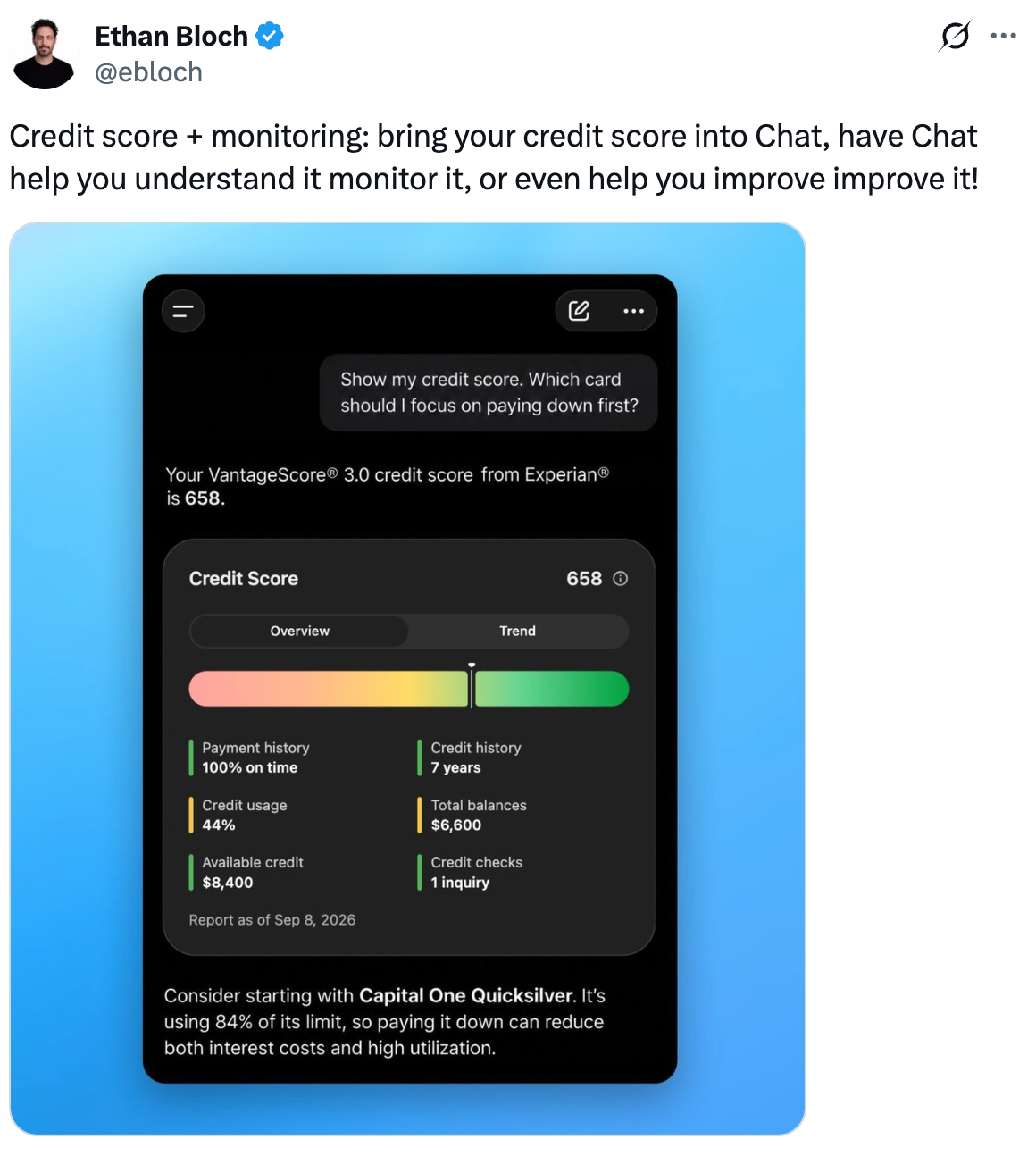
Meanwhile, OpenAI announced that credit score monitoring is now available through ChatGPT’s personal finance capabilities through an integration with Experian:
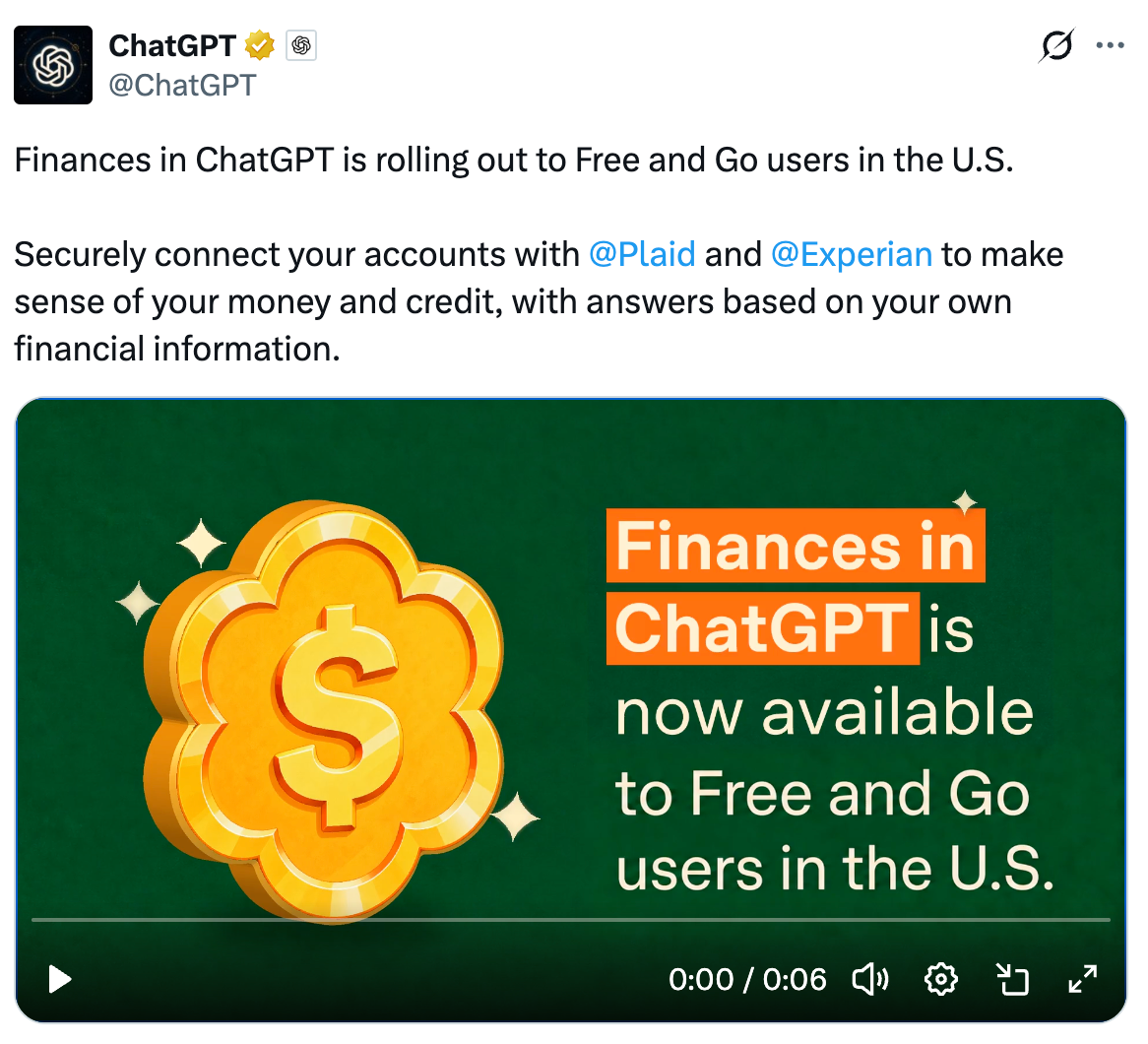
And those personal finance capabilities are moving from being available only to ChatGPT Plus ($20/month) and Pro ($100-$200/month) to being available to all ChatGPT users in the U.S.:
So what?I’m just so delighted that the AI boom has breathed new life into the personal financial management (PFM) product category. I’ve written about how AI, as a technology, changes some of the fundamental assumptions and limitations of PFM. So I won’t rehash those thoughts here. Instead, I’ll give you two different ways to look at these most recent news stories. The first is through the lens of functionality. While OpenAI has undoubtedly made some significant upgrades to ChatGPT’s personal finance capabilities over the last couple of months1, the functionality is still very much on the ‘read’ side of the read/write divide.2 ChatGPT can’t cancel unwanted subscriptions or move money from a lower-yielding savings account into a higher-yielding one, even if it can and will suggest those actions to users. Compare that to two products that are assuredly making OpenAI nervous right now — Muse and Instinct — which can, agentically, take actions on behalf of users, including making payments and canceling subscriptions. They don’t allow users to open new financial accounts or move money between accounts, yet. But that’s not outside the realm of possibility in the near future. And Monarch, with this new acquisition, seems to be headed down a similar path. The core product already offers an in-app AI assistant. And now, with MBI, Monarch is adding a deterministic money routing system (what MBI calls “Routines,” which are its system of automations for saving and moving money) that seems tailor-made to act as the agentic finance harness for an LLM. The second lens is the business model. OpenAI is making ChatGPT’s personal finance capabilities available to its millions of free users in the U.S. Monarch is not free and that is by design, as the company emphasizes on its website:
It’ll be interesting to see who ends up being on the right side of this debate. Monarch’s 1 million members and $100 million in ARR works out to about $100 per member, or, roughly, one subscription each. The company’s revenue growth is, by design, tightly coupled to member growth. However, the concern is that much of its recent growth came from the shutdown of Mint, which drove a 20x surge in signups, and that it won't last. Can Monarch find ways to generate more revenue without fundamentally altering its business model or incentives? Might it resurrect something like HMBradley and generate additional revenue by becoming a full-service neobank for its members? Might it spin up a version of MBI’s current business, selling modular banking infrastructure to banks and credit unions? Might it try to do both? And for OpenAI, the company certainly has enough money to make its personal finance capabilities available, for free, to the vast majority of ChatGPT users. But for how long? Connecting to a user’s bank account data in a persistent, ongoing fashion (via Plaid) isn’t free. OpenAI is going to lose money on free ChatGPT users connecting their bank accounts. That can’t last forever, but the initial solution that OpenAI has come up with for monetizing free ChatGPT users (advertising) is a tricky fit in personal finance. The company could certainly partner more deeply with Experian to bring lenders looking for new customers into the chatbot, and (depending on how the new open banking rule turns out) maybe do the same on the consumer-permissioned bank transaction data side as well.3 However, if it does so, it risks alienating users by compromising the quality of its recommendations in order to keep its advertisers happy, which is the exact reason that Monarch charges a subscription fee. #2: Don’t Touch Our Deposits!What happened?Mission Lane has received conditional approval from the OCC to form a bank:
And the Independent Community Bankers of America (ICBA) sued the OCC over a different niche bank charter:
So what?I'll be honest: I didn't know that there was such a thing as a credit card bank charter (this is why you hire Klaros.) However, it's a great lens for understanding what banks actually care about. Think of bank charters as a pick-two menu. There are three things that a fintech company with bank aspirations typically wants to avoid: Becoming a bank holding company, state opt-outs from interest rate exportation, and expensive funding for loans. You can dodge two of them, but never all three. 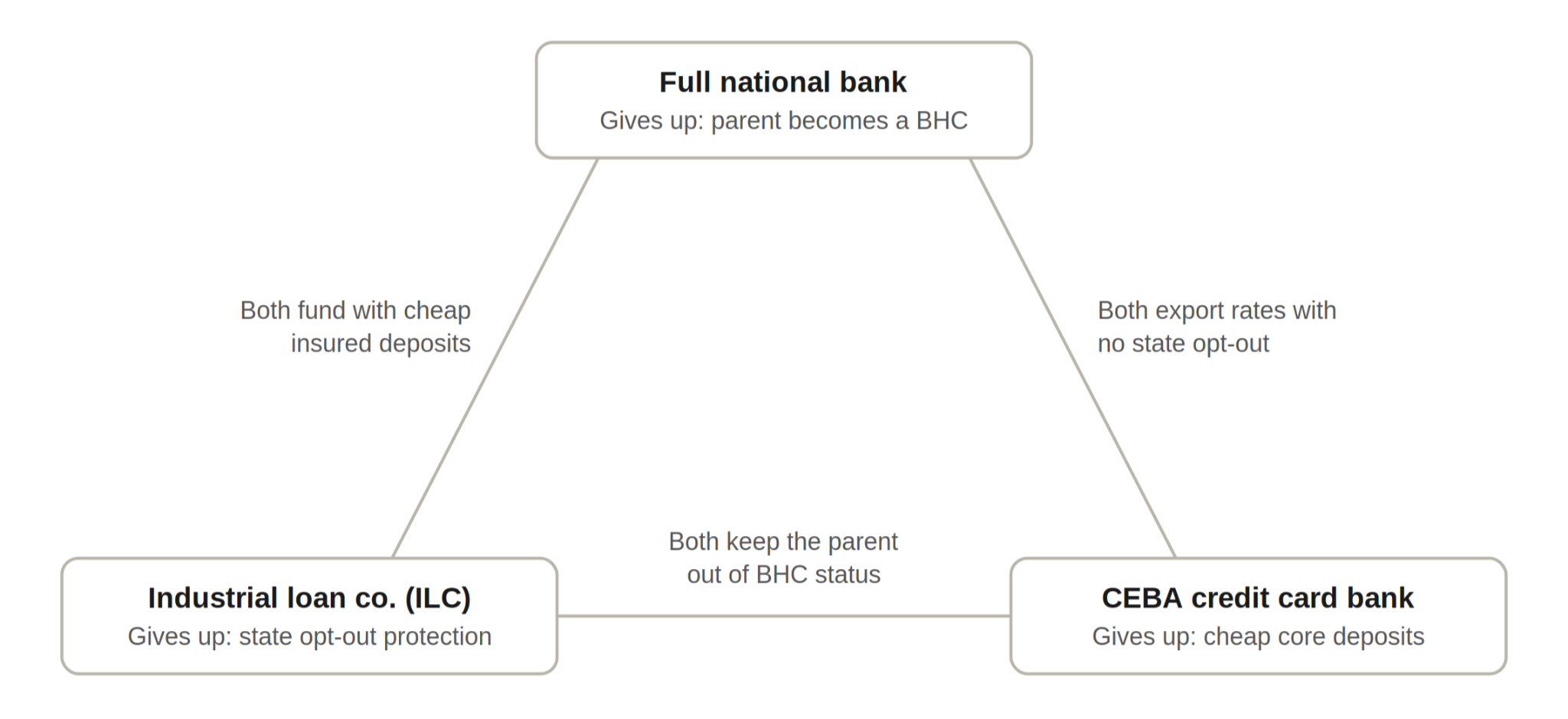 A full national bank gets cheap deposits and rate exportation, but the parent company becomes a BHC. An ILC gets deposits and avoids BHC status, but as a state charter it's exposed to fights like Colorado's DIDMCA opt-out. A CEBA bank gets full national-bank preemption and no BHC status for the parent company, but the price is deposits. CEBA banks can't take demand deposits, or savings and time deposits under $100,000 unless they collateralize secured cards. Mission Lane clearly chose to prioritize not becoming a bank holding company and avoiding the state opt-out fight over interest rates, rather than trying to optimize its funding costs. This is probably a wise decision given that the company already has robust secondary market funding for its receivables, has never built deposit products before, and its target customers (sub-prime and near-prime consumers) may not have a large amount of deposits anyway. You’ll notice I didn’t include national trust bank charters in my graphic above. From my vantage point, they don’t fit, as national trust banks are limited to fiduciary and related activities, and lending isn't what they're chartered for. However, from the perspective of the banking industry, the concern isn’t on the lending side. It’s on the deposit side. The repurposing of national trust bank charters by crypto companies and stablecoin issuers has incensed the banking lobby, which views it as a way to enable these companies to functionally offer deposits and payments capabilities — within the regulated banking perimeter — without the corresponding duties and compliance obligations. That’s why the ICBA is suing the OCC over national trust bank charters and why neither the ICBA nor any other bank trade association is likely to make a peep about Mission Lane and CEBA. Specialty bank charters that enable competition with a lighter regulatory touch are fine … as long as they stay on the lending side. However, on the deposits side, the message is clear: Keep your hands off. #3: We Like Our Duopoly, But Not YoursWhat happened?U.S. card issuers have been given the green light to pursue a class-action lawsuit against Apple:
So what?Class certification is a procedural step, not a verdict. But it's worth pausing on how strange this class is. This is three credit unions — Affinity, GreenState, and Consumers Co-op — asking to represent every card issuer in the country, including the biggest banks that negotiated these terms with Apple directly back when Apple Pay was being set up in 2014. That’s profoundly odd. Apple Pay is a much worse deal for large issuers that have substantial credit card portfolios because the Apple Pay fee for credit cards (15 bps on each transaction) is much more punitive than the fee for debit cards (a $0.005 flat fee on each transaction) in most cases. It’s also worse for large issuers on the debit card side, because their debit card revenue is capped by the Durbin Amendment, while their smaller competitors remain unencumbered.4 It’s also more than a little ironic. The antitrust argument against Apple Pay essentially says that Apple excessively monetized its half of a market duopoly (tap-to-pay on iPhones and Android devices) that card issuers felt they had no choice but to participate in. And yet, the same card issuers that are making this argument benefit, hugely, from the (arguably excessive) monetization of a market duopoly that merchants feel they have no choice but to participate in (Visa and Mastercard). You can’t be pro free markets when it suits you and an antitrust crusader when it doesn’t. Come on, man. Sponsored by MX
Banks hesitant about open banking usually call it caution. Brady Stanger, Managing Director of MX's Open Finance Strategy, argues it functions more like isolation: usage-based fees on data access and extra authentication layers each cut the institution off a little further from the ecosystem where innovation is happening. And the decline is gradual enough that nobody notices until it's entrenched. MX found 59% of consumers already expect their provider to use their data to personalize their experience. Stanger's new blog post makes the argument for staying connected, and for how to do it without losing control. 2 READING RECOMMENDATIONS#1: Visa, Mastercard & Stripe's stablecoin is here (by Simon Taylor, Brainfood) 📚Good density here from Simon, both on stories I was aware of and stories that hadn’t crossed my desk! #2: The Art of Doing Financial Engineering (by Marc Rubinstein, Net Interest) 📚Nobody I trust more to untangle the relationship between financial services innovation and the AI buildout. This piece alone is worth the price of admission. 1 QUESTION FROM FINITYThere are a TON of interesting questions being asked in Finity (our digital community for fintech and banking nerds). I’ll share one question, sourced from the community, each week. However, if you’d like to join the conversation, please apply to join! Do you think OpenAI will eventually loosen its restriction on placing ads near sensitive user data and context? And if so, when?If you have any thoughts on this question, reply to this email or DM me in Finity! Thanks for the read! Let me know what you thought by replying back to this email. — Alex Footnotes 1.With the introduction of credit score monitoring (specifically VantageScore 3.0) Credit Karma is likely getting very nervous. 2.That was too rhyme-y … my apologies! 3.OpenAI’s current policies prevent ads from being placed next to highly sensitive user data and context. So, presumably, ads for financial products would not be served up directly in the same chat where a user is reviewing their bank transaction data or credit score. However, it should go without saying that these policies can change and, in fact, I would expect them to change at some point given the profitability pressure OpenAI will eventually be under. 4.GreenState Credit Union has roughly $11B in assets, so it’s not Durbin-exempt. However, it was until 2022, and one of the ways it got above $10B was by acquiring community banks, which, as a not-for-profit organization, seems a bit dodgy. Like, perhaps you shouldn’t be the one complaining about unfair market competition! | ||||||||
|