| ||||||
| | ||||||
| Happy Tuesday Hospitalogists, This week’s feature comes from my Claims Denied conversation with Niyum Gandhi of Mass General Brigham and Travis Messina of Regent Surgical. We discuss why MGB partnered instead of building, and picked Regent after scanning the full market. Travis and Niyum also share their AI frameworks, and I’ve included infographics for both. Give me a shout with your take. I'm curious where you land on the ownership question. Meanwhile, let's get together: Tomorrow's virtual event: Building the VBC Playbook for 2027 and Beyond → If you touch VBC, you'll want to RSVP. 11/2-11/3: Hospitalogy AI Retreat → An AI retreat for healthcare executives. Travel costs covered. Also, golf. Apply. 11/15: Happy Hour at HLTH → Killer venue. Open bar. Join me. Was this email forwarded to you? The system that could build anything, and didn'tEvery health system I ever valued ran on the same reflex: when it wants a capability, it builds the capability. Buy the dirt, hire the team, own the P&L, plant the flag. That's the holding company instinct wearing an integration costume, and I've watched it bury good ideas under the dead weight of leadership distraction more times than I can count. So in the opening 10 minutes of a recent Claims Denied podcast, the sharpest thing Niyum Gandhi, CFO of Mass General Brigham, said had nothing to do with surgery. It was that MGB looked straight at that reflex and refused it. When MGB went hunting for ambulatory capacity, leadership declined to default to building everything in-house. Niyum's logic: MGB is world-class at bench-to-bedside cancer research and good at running ICUs, and doesn’t have a lot of experience operating ASCs at scale. So the real choice was burning years assembling a mediocre internal competency, or partnering with someone who does this for a living. MGB scanned the full market, talked to every operator of size, and chose Regent Surgical on operations, development chops, and what Niyum called cultural alignment. Normally the phrase “cultural alignment” is filler. Here it carries weight, and Travis Messina, CEO of Regent Surgical, who joined Niyum on the podcast, explained why. Regent stocked its leadership bench with people who've actually lived inside health systems. Travis himself came up through health system corporate development and home care, and his team treats an ASC network as one input into a partner's enterprise objectives rather than the objective itself. Plenty of management companies go build the best ASC network in isolation and then wonder why nobody uses it. Regent's pitch is that it understands the host organism it plugs into. I buy that pitch. The physician-ownership heresyHere's where I dug in, because I couldn't help myself. Back in my valuation days I stared at ASC ownership rosters all day, and the one constant was physician equity, every time, like it was structural. The whole industry got built on the premise that surgeons need skin in the game or the cases never materialize. So when Niyum told me MGB is building these centers with no physician ownership at all, I pushed back and asked the obvious: what's in it for the doctor? His answer reframes the entire debate, and I thought it was one of the sharper takes on incentive design I've heard in a while. His philosophy: the most important move on individual incentives is removing the bad ones, not inventing new ones. For a case that can be done safely in an ASC, the ASC is better for the patient, full stop. MGB's surgeons already do what's best for patients because that's why they walked through the door. Hand them an equity stub and you've added nothing, because the interests already line up. You'd only ever need to intervene to kill a perverse incentive, like HOPD margin flowing straight into physician comp, and MGB never had that landmine planted in the first place. Niyum was honest about the qualifier, which is that this playbook is market-specific. MGB isn't running "build it and recruit the docs." These are physicians already employed by or operating inside the system, part of an ecosystem they chose to join. This is not a 3-doc private group splitting cases across two hospitals and shopping for an ASC stake. So the alignment levers Travis walked through look different: consolidate a surgeon's cases from 3 or 4 scattered sites into 1, geo-map centers to where physicians live and clinic, hand them clinical service line leadership in the new building, let them design the OR and keep their own pre-, peri-, and post-op team. All real. None require a cap table. So who does own them? Regent and MGB each hold an equity stake in every center. Travis said Regent wants to be an owner alongside its health system partners, but not in the legacy 50/50 joint venture. Most ASC-eligible cases sit in HOPDs and are increasingly performed by employed physicians, so he thinks the outsized share of the economics belongs to the system. Travis pointed out that the industry's own mechanics forced this evolution anyway. With physician employment upwards of 70%, roughly 6,000 Medicare-certified ASCs nationally, and management companies already holding about a third of them, the inventory of independent going-concern centers to buy into has dwindled. When there's little left to buy, you build de novos, and de novos fed by employed-physician bases don't lean on the old ownership model. "I don't care what the margin is"Best moment of the episode: Niyum's answer on the HOPD-to-ASC margin question, which is the exact thing every other CFO I talk to loses sleep over. Ask whether a given orthopedics case earns the same margin in a Regent ASC as in an MGB HOPD, and he'll tell you he genuinely has no idea, because he never asked anyone to model it, because he doesn't care. His only question is whether the ASC case clears the bar of being a financially sustainable service. If it does, he has total faith the freed hospital capacity backfills with a patient who needs it more. Sounds like CFO heresy until you sit with the arithmetic, and then it's just correct. MGB is jammed across GI, ophthalmology, and orthopedics, with wait lists measured in months. Move a minor GI procedure into an ASC and you don't have to win the margin argument. You liberate an OR and a bed for someone stuck on an 8-month cardiac surgery queue. Strictly better use of a hospital OR. Site-of-service stops being a reimbursement debate and becomes a throughput one. Travis added the nuance the rest of the country needs to hear: MGB has the high-class problem of being able to backfill, and most systems don't. When Regent models conversions for partners without that demand pressure, it assumes no backfill whatsoever, because nobody knows if the next patient through that OR is a CABG, a commercial outpatient, or a Medicaid case. Glide path matters, because peak acute utilization is arriving with the boomers regardless of who's ready, and you cannot stand up an ASC strategy the same year demand crests. The health plan he won't let you call a health planI wanted to poke the $3B insurance arm, because systems have been dumping their plans for years and provider-sponsored plans carry a famously ugly track record. Niyum corrected my vocabulary before he'd even answer, and the correction is the whole point. He calls it an integrated care delivery and financing system, not a provider-sponsored health plan, because MGB isn't a provider funding an insurance side hustle. His thesis is that integrating delivery and financing produces better longitudinal outcomes, and that the value scales with patient complexity. For a healthy 32-year-old commercial member, which is me, integration buys a little experience lift and not much more. For a dual-eligible CHF patient slipping through every crack the system has to offer, integrated delivery and financing is where the real outcome and cost story lives. That's why MGB's growth tilts toward government programs while keeping a broad-network commercial book to catch people across life transitions. Worth flagging: this is the opposite of the narrow-network funnel strategy that torched so many provider plans, the one where you grow the plan to herd members into your own beds. Niyum called that a bad strategy, with all due respect to everybody currently running it, which is about as spicy as a sitting CFO gets on tape. Then he closed with the tightest MA bet I've heard out loud. Penetration sits north of 50% today. If you believe it lands higher than 25% a decade out, then Washington has to make the model sustainable in this post-V28 world, current dislocation notwithstanding. MGB answers to no quarterly earnings call, so it gets to play the 10- or 20-year game while everyone else sweats the print. Cambridge, robots, and tech, oh myCambridge de novo, one-line justification: MGB has a roughly 25,000-patient endoscopy wait list. Travis walked the process. Regent starts by analyzing a partner's ASC-eligible volume currently trapped in HOPD settings, filters for what's clinically appropriate to migrate (some colonoscopies still belong in an HOPD in case a complication needs the floor), factors in the lowered screening age juicing demand, and builds the pro forma bottoms-up off procedure room throughput. Then comes Massachusetts approval, which, because it's Massachusetts, isn't a CON but a "determination of need." Niyum noted with visible delight that wherever an industry-standard term exists, the Commonwealth invents its own. This administration has cleared roughly 15 ASCs, well ahead of its predecessor, because ASCs are cheaper and the cost containment mandate is real. Approval hinges on demonstrable need, not market protection. On technology, Travis lit up. Regent runs surgical robots in about a third of its centers, pushing acuity into the ASC in ways that genuinely surprised me: general surgery, early oncology, including prostatectomies and tumor resections in a couple of locations already. He doesn't see cardiology as the next total joints and is betting on general surgery and oncology instead. Given the outcomes he described, I'm not betting against him. On AI, Regent runs Claude across the org as an Anthropic shop, and Travis is focused on the administrative side rather than the clinical side, since an ASC is a simpler clinical setting with less need for ambient listening and easier coding. The AI frameworks I’m stealingI’m stealing both of their AI frameworks. In fact, I told them I’d create infographics around them for the newsletter, so I included those here. First, Niyum’s framework. He buckets AI into four. One: work that simply wasn't possible before, like pathology foundation models and protein folding on the research side, where MGB goes early. Two: things they already do that AI does better, like sharper poor-outcome prediction feeding care management, also early. Three: efficiency plays where the ROI accrues to the human and you don't claw the hours back, which is ambient documentation against clinician burnout, where MGB went early because burnout is real. Four: restructuring the full workflow to reclaim hours as financial ROI, like AI-enabled virtual nursing, where MGB deliberately goes late. Logic is the tell. If it improves an outcome, sprint, because medical error is still a leading cause of death. If it only saves money, you can afford patience. 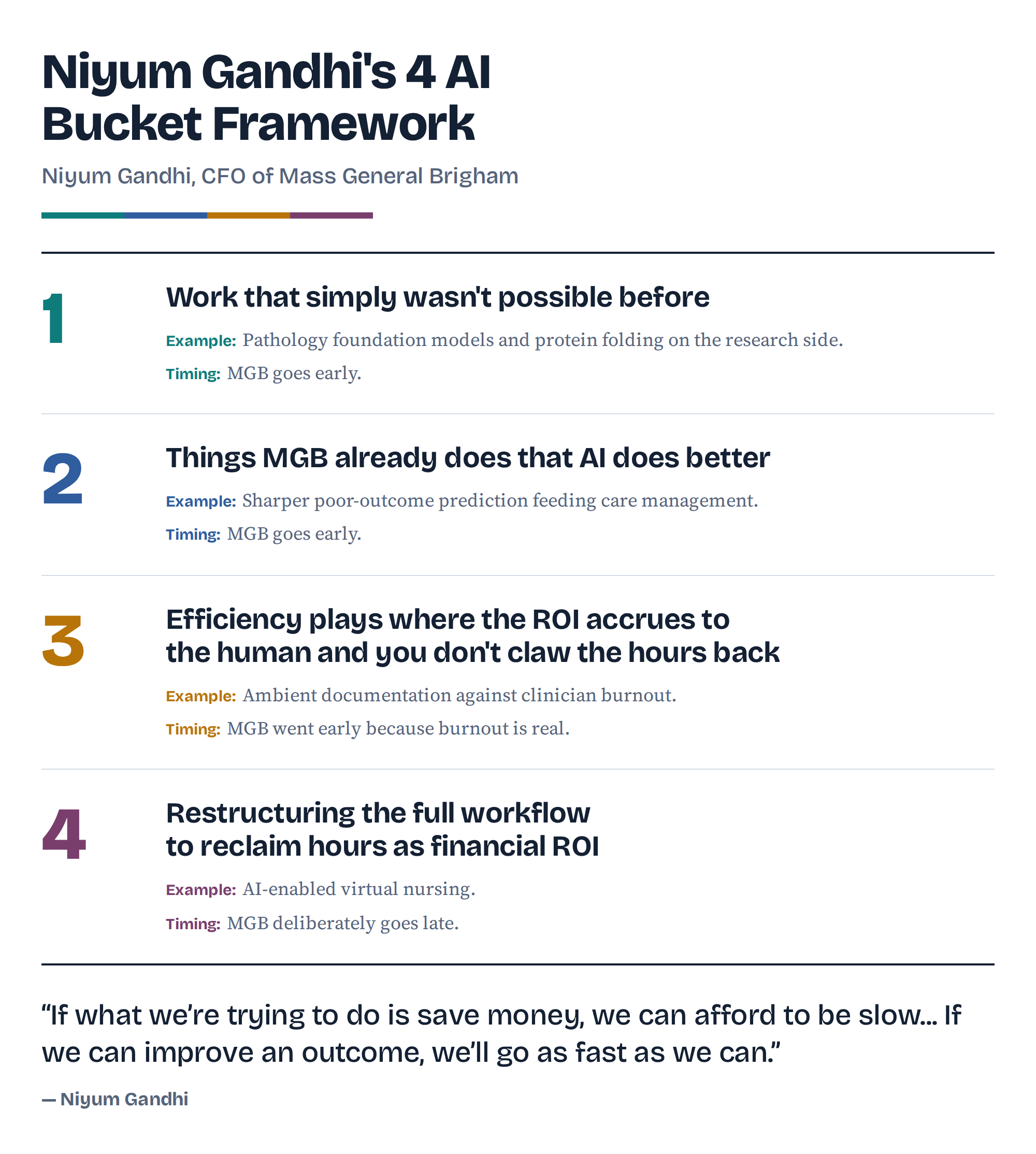 Second, Travis’s framework. He runs three lanes. One: general AI use. Every team member is expected to get fluent with the foundation models, and Regent doesn't chase ROI here. He’s fine with the gains accruing to the individual because the culture redeploys that time toward partners. Two: a data platform that fuses internal clinical, financial, and operational data with external unstructured sources, with foundation models on top. The point is to move past retrospective decision support and ask prospective questions about operations and physician recruitment. That's where he sees tremendous ROI. Three: agentic work, which he acknowledged can drive job dislocation, though he doesn't view it that way at an earlier-stage, fast-growing middle-market company like Regent, and says that's where Regent differs from scale players like MGB. Regent started by mapping spend by department, focusing on the higher-spend areas, then broke workflows down to individual roles and asked whether each task is functionally verifiable and whether it's augmentable, automatable, or eliminable. Travis was clear that this means redesigning the workflow, not bolting a tool onto the old process. Because growth will far outpace the hiring Regent needs to do, headcount in some departments may stay flat while volume climbs. Travis credits Eric Larsen's numerator-denominator logic: if you're growing, you don't have to shrink the denominator, you can outrun it. 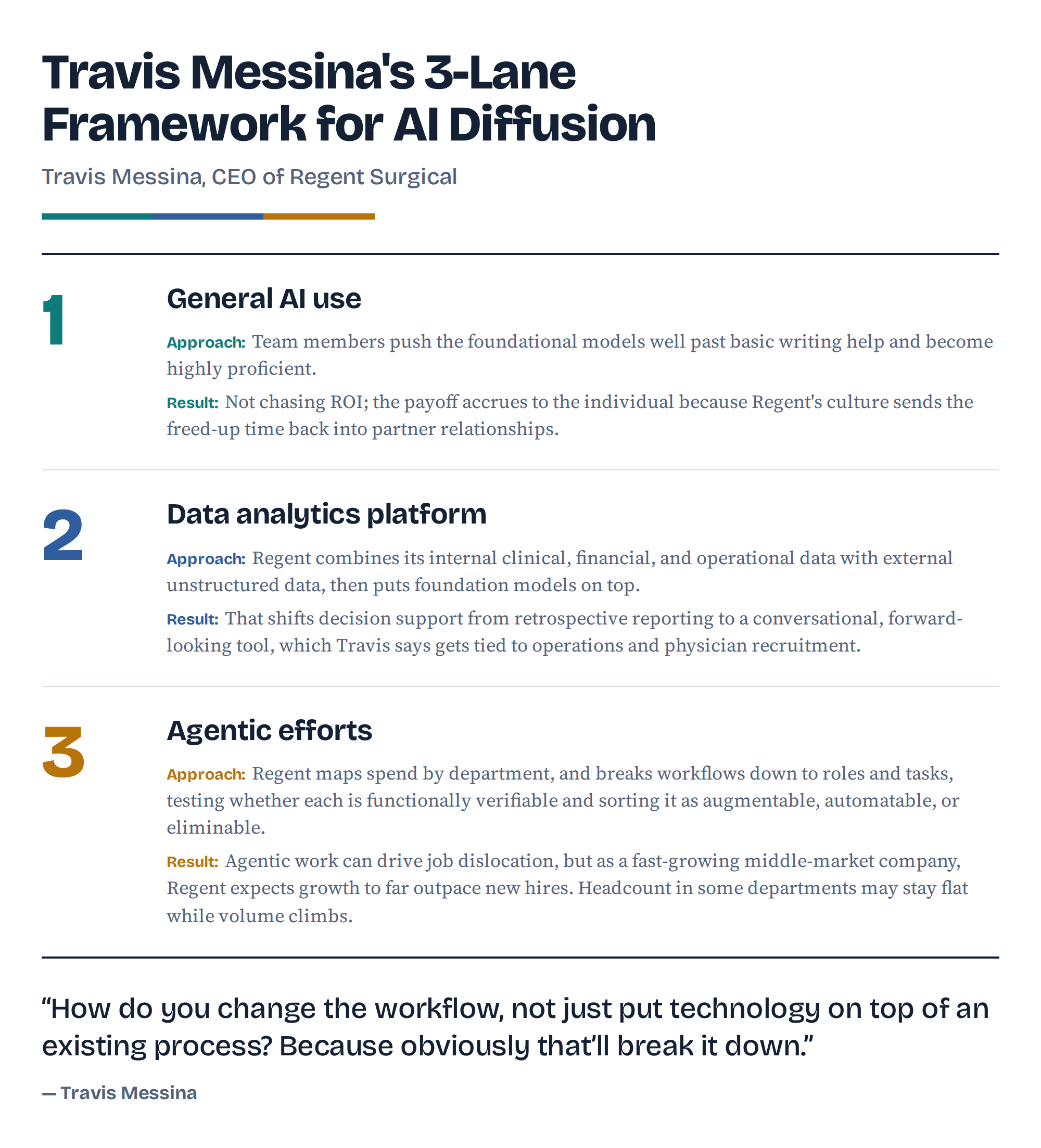 From a finance perspective…I signed off by joking I’d title this podcast "MGB CFO Doesn't Care About Money," which is unfair and also basically accurate. Niyum's arc, from economics undergrad to bank-serving consultant to sitting in board meetings where money didn't come up for hours, is really a story about choosing which conversations are worth being in. From a finance seat, that's a rare place to operate. For an industry staring down peak utilization, it's also a structural advantage most operators lack the patience to copy. Sponsored by R1 Healthcare doesn't need more revenue cycle software. It needs a system for making all of it work together. R1's Revenue Operating System vision outlines what comes after the era of fragmented tools, siloed workflows, and incremental gains. See how Phare OS, with 20 years of RCM intelligence embedded in the system, translates clinical reality into payer-ready, auditable financial outcomes across the full revenue cycle.  MISCELLANEOUS MADDENINGS: COLLEGE FOOTBALL EDITION
Thanks for the read! Let me know what you thought by replying back to this email. — Blake | ||||||
|