 | |||||||||
| | |||||||||
 Happy Monday, Fintech Takers! I don’t know if anyone who works in Montana’s state government reads this newsletter, but on the off chance that they do, I’d like to make a request: Can we please have a Montana money transmitter license? I’ve enjoyed my home state being the answer to the trivia question, “What’s the only U.S. state that doesn’t require an MTL?” But enough is enough. The DOJ just seized about $84.2 million from Capstone Ltd., a Montana-registered company that allegedly operated as an unlicensed money transmitter across at least six states while telling banks like Wells Fargo and JPMorgan it was an IT services company. The Financial Times identified the two crypto firms behind Capstone as Tether and Bitfinex, who moved money through it via Dominica-licensed EQIBank, though neither faces charges and both deny knowledge of the alleged misconduct. The complaint also ties Capstone's accounts to a fraud scheme in which scammers impersonating FBI agents pressured victims, reportedly including elderly targets, into payments that were then converted into Tether's USDT. The state of Montana certainly isn’t responsible for this, and I’m not sure having a Montana MTL (MTMTL?) would have made any difference. But still! This is embarrassing! The Montana Division of Banking and Financial Institutions seems to want the state to have an MTL. Get on it Montana State Legislature! - Alex P.S. — Our virtual event on friction is on Wednesday and it’s not too late to register! If you spend any time at all thinking about digital onboarding UX, conversation rates, or negative selection, it’s one you’ll enjoy! Was this email forwarded to you? Sponsored by Cross River Bank, Member FDIC Most platforms run on someone else’s bank core. Cross River built their own.  Joseph Grimaldi as "Joey" the Clown, c. 1810. 3 FINTECH NEWS STORIES#1: Money In and Money OutWhat happened?Ramp is getting into AR:
So what?Ramp tends to design its products so that the financial services components support and reinforce the value proposition of the software components, and vice versa. On the ‘money out’ side, the expense management software and the financial product (the Ramp card) are designed to work synergistically. Technically, employees can use non-Ramp cards for purchases and get reimbursed, but the core value proposition that Ramp sells CFOs on — understanding and controlling spend proactively — depends heavily on the card, and Ramp’s business model (the core expense management software is free and monetization comes primarily through card interchange fees) reinforces the importance of using both the card and the expense management software. On the ‘money in’ side, the coupling isn’t as tight, but you can see the same thinking is present. Ramp launched an embedded bank account (in partnership with Increase and First Internet Bank) in January 2025. The product emphasizes speed, safety, and the ability to earn yield on idle cash. The new accounts receivable product automates invoice creation, customer communication, and reconciliation by matching incoming payments that hit a business’s bank account against outstanding invoices. That last bit of functionality doesn’t require the customer to have a Ramp bank account, but it would not surprise me if Ramp is actively working on ways to enrich the capability for customers that do. More concretely, Ramp is already providing a financial incentive for AR customers to get a Ramp bank account. The AR product has a free tier and a paid tier, and (in typical fashion) is also monetized through fees on payments. ACH credit and check payments are free. Card payments run through the customer's own Stripe account at Stripe's standard rates. And ACH debit payments are free if deposited into a Ramp bank account, but cost 0.8% (capped at $5 per transaction) if deposited to an outside bank. Where it will get really interesting — if Ramp is able to grow adoption of its new AR product — is the opportunity for Ramp to connect the ‘money out’ and ‘money in’ sides of its business. Ramp has been thinking this way for a while. When it launched Flex in August 2022, letting Bill Pay customers have Ramp pay their vendors upfront and repay Ramp in 30, 60, or 90 days for a fee, CEO Eric Glyman noted that "our customers' vendors are now on Ramp," giving the company visibility into when bills were coming due and how and when its customers should pay them. In other words, years before it held a single deposit, Ramp was using its position on the 'money out' side to see into its customers' supplier relationships, and to insert itself, as a lender, into the gap between when a vendor wants to get paid and when a buyer wants to pay. AR is what could turn that one-sided view into a two-sided one. Every vendor getting paid through Ramp Bill Pay today is a natural prospect for the (free) AR product, and every time both payer and payee are on Ramp, the transaction could get better for everyone. The payment could move as an internal transfer between two Ramp accounts rather than over ACH. Reconciliation stops being a matching problem, because the buyer's AP workflow already knows exactly which invoice it's paying (today, Ramp's cash application only auto-matches exact amounts, leaving partial payments and missing remittance details for a human to sort out). And the credit opportunity gets much bigger. With a seller's receivables history on one side and a buyer's cash balances and payment behavior on the other, Ramp would be better positioned than anyone to underwrite trade credit, paying the seller today, collecting from the buyer in 60 days, and keeping the spread. Add the AI agents Ramp is deploying on both sides of the ledger, and it's not hard to imagine Ramp becoming the place where a buyer's AP agent and a seller's AR agent meet to settle an invoice, negotiate terms, and decide who finances the difference. The catch, obviously, is density. A closed network is only as valuable as the share of a customer's counterparties inside it, and at 70,000+ customers, Ramp has a long way to go before in-network payments are the norm rather than the exception. #2: Bluevine Misses Its WindowWhat happened?A bank is acquiring a fintech company:
So what?These are my favorite types of acquisitions (don’t tell the others!) because banks and fintech companies are valued in very different ways and, because of that, a fintech acquisition needs to be a slam dunk.1 Otherwise, you risk Mike Mayo embarrassing you on an earnings call. I like this acquisition for Valley. The bank has been trying to reduce its dependence on brokered deposits and retail CDs, which this deal should help with. It opens up a new base of small business customers for the bank to cross-sell into (about 99% of Bluevine's deposits come from customers who don't borrow from it). And it gives Valley better digital acquisition infrastructure and 180 new engineers and R&D staff. As for Bluevine, this strikes me as another example of the importance (and inherent uncontrollability) of timing in company building. Check out this timeline:
And now it’s being acquired by Valley for $340M, which is roughly 1.3x what its equity investors have poured into it over the last 13 years, despite having acquired 175,000 active small business customers and $2.1 billion in deposits. That’s obviously not ideal. And the clear missing step in the timeline I laid out above is the acquisition of a bank charter. The normal playbook in fintech is to start out by building and rapidly scaling a lending business, taking your lumps early on and refining a differentiated and sustainable approach to customer acquisition and underwriting. Then you get a bank charter, in order to replace expensive debt facilities with cheap, sticky deposits. And somewhere in there you go public and (hopefully) earn an above-average premium on your tangible book value. The ideal moment for Bluevine to become a bank was probably between 2017 and 2019, when lending had really scaled, but the company had yet to seriously wade into deposits. The problem is that bank charters were nearly impossible to get back then. They could have tried in 2020 or 2021, when LendingClub, Square, Varo, and SoFi all made their moves, but Congressional scrutiny from Bluevine’s prominent involvement in PPP would have made that difficult. They could have tried in 2023, when the value of low-cost deposits spiked. However, by then, regulators had, again, soured on the prospect of fintech companies getting bank charters. Ironically, the opportunity to get a bank charter is available again (Mission Lane just snagged a national bank charter and Avant has applied for one), but Bluevine seems to have missed its window. #3: Whop Whop WhopWhat happened?
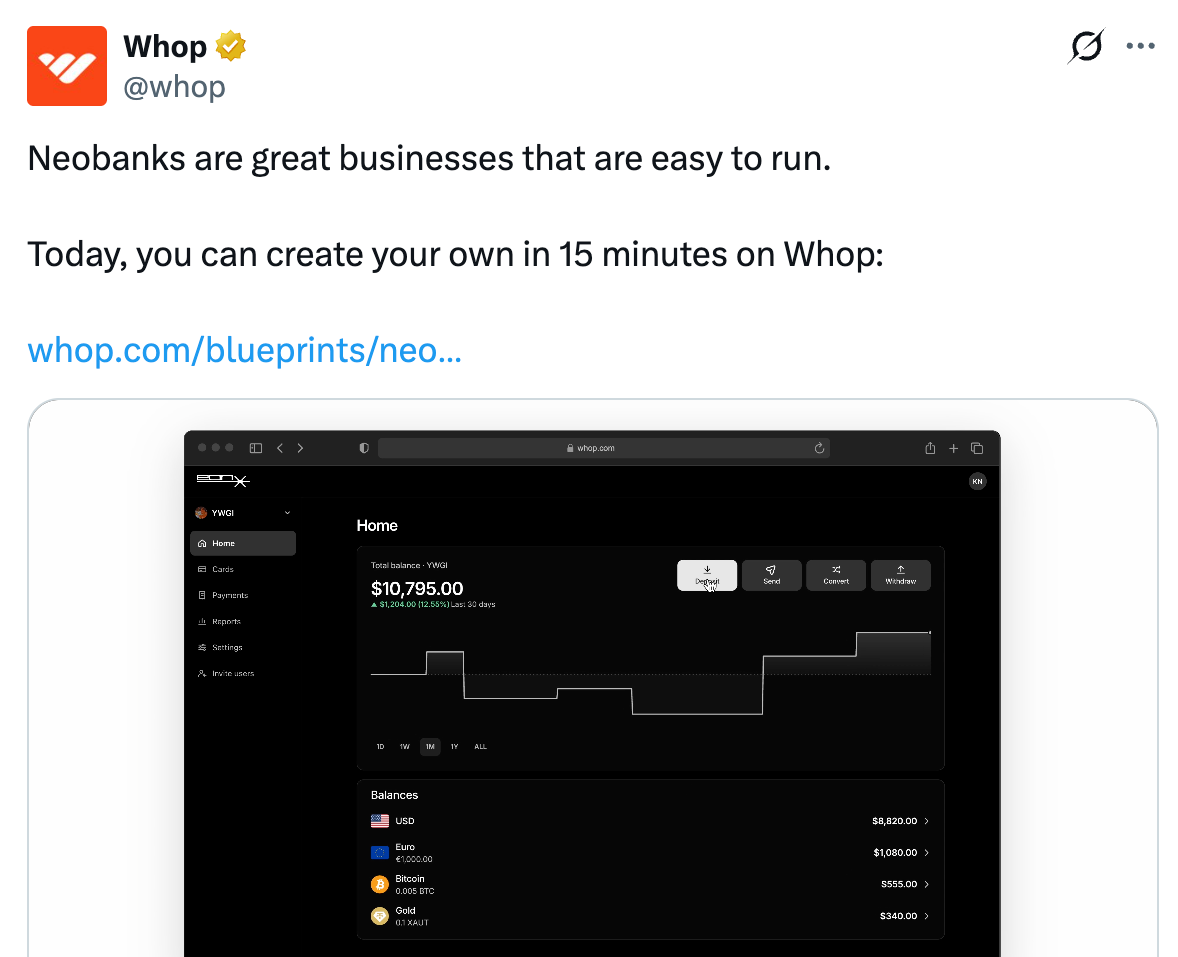
So what?Little-known fact: Every time someone says something along the lines of “banking is a great business and really easy,” there is an FDIC bank examiner somewhere who falls down dead.2 When that same someone follows up by promising to help you launch a bank in 15 minutes … well, I’m not sure what happens. No one has ever said that before, but it’s probably very bad. Maybe the dead FDIC bank examiner’s body self-destructs and annihilates everything within 500 feet? Not sure. If anyone discovers the answer, please reply to this newsletter and let me know. Anyway. One point about stablecoins and DeFi that I have been trying repeatedly to make is that they are quickly becoming the default infrastructure for fintech developers (particularly first-time fintech developers) to build on. There are some valid functionality-based reasons for this, but it’s also kind of just a vibes thing. Here’s what I wrote in May of last year:
Think of BaaS in terms of babysitting, but, in my silly analogy, the kid gets to pick their babysitter. Most banks are the retired grandparents or elderly neighbors; fussy and antiquated and no kid’s first choice. Stripe (which has a robust and well-established TradFi BaaS business, but is leaning hard into blockchain-based infrastructure) is like the cool uncle who has tattoos and doesn’t believe in a set bedtime; definitely preferred over banks, but still clearly not of the same generation as the kid and a little hard to relate to. Whop is like the kid’s peer, except that instead of going to school, this kid runs a sophisticated multi-level marketing scheme out of his parents’ basement, trying to convince other kids to secure their financial freedom by building and selling digital courses to other kids focused on … securing their financial freedom! I’m only slightly exaggerating. I first wrote about Whop a few years ago, and I have remained fascinated by the company ever since. It’s a social commerce platform and digital marketplace, founded in 2021, that enables creators and entrepreneurs to monetize digital products, private communities, software access, and online courses. Those products mostly cluster in a few very financially nihilistic areas, like real estate wholesaling, sports betting, options trading, and crypto investing. Whop supports thousands of active creators, serves millions of buyers, processes over $3 billion in annual payment volume, and generates an estimated $142 million in annualized revenue. Whop raised a $17 million Series A in 2023 led by Insight Partners, followed by a $50 million Series B in 2024 led by Bain Capital Ventures at an $800 million valuation, and a $200 million strategic investment in early 2026 led by Tether, which valued the company at $1.6 billion. Over that time, Whop has evolved into something like an all-in-one internet economy infrastructure provider. It introduced its own end-to-end payment processing and merchant-of-record engine to support global checkout and crypto payouts, launched a blueprints developer framework to let creators build modular custom apps directly onto their storefronts, and built out growth mechanisms like automated referral fees, marketplace affiliate programs, and content creator rewards. Those growth mechanisms deserve a bit more scrutiny. A while back, the company stopped taking a cut of sales made through its marketplace. Today, every creator gets a built-in affiliate program that pays promoters 30% by default. Whop also rewards people who recruit new sellers and pays people per view to post short videos promoting products on TikTok, Instagram, and YouTube. Whop makes its money on the payment and withdrawal fees underneath. These incentives favor whatever spreads fastest over whatever is actually good, which is especially evident in Whop's support for "resell rights" products, which buyers purchase mainly to resell to others and which some competitors ban as get-rich-quick schemes. The latest of these Based on my examination of the product page and Whop’s various terms of service, I should admit that my description — neobank in a box — suggests a far clearer and better-managed offering than what, in reality, is being offered here. The product appears to chaotically combine the following primitives (which are Whop financial services capabilities that have been made available to the creators on the platform):
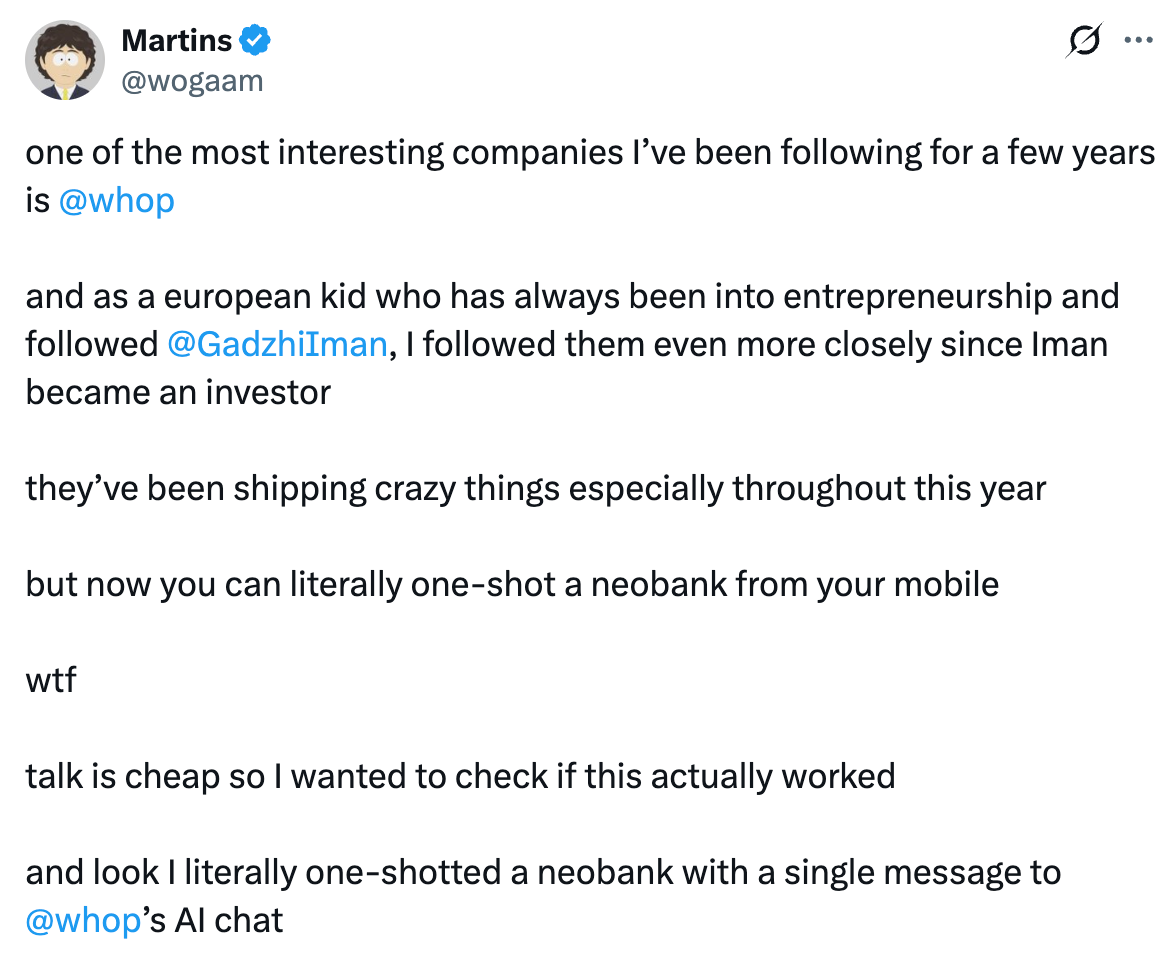
And because Whop has made all of these primitives available to creators through its integrated AI assistant, creators can literally create a neobank through a single prompt:
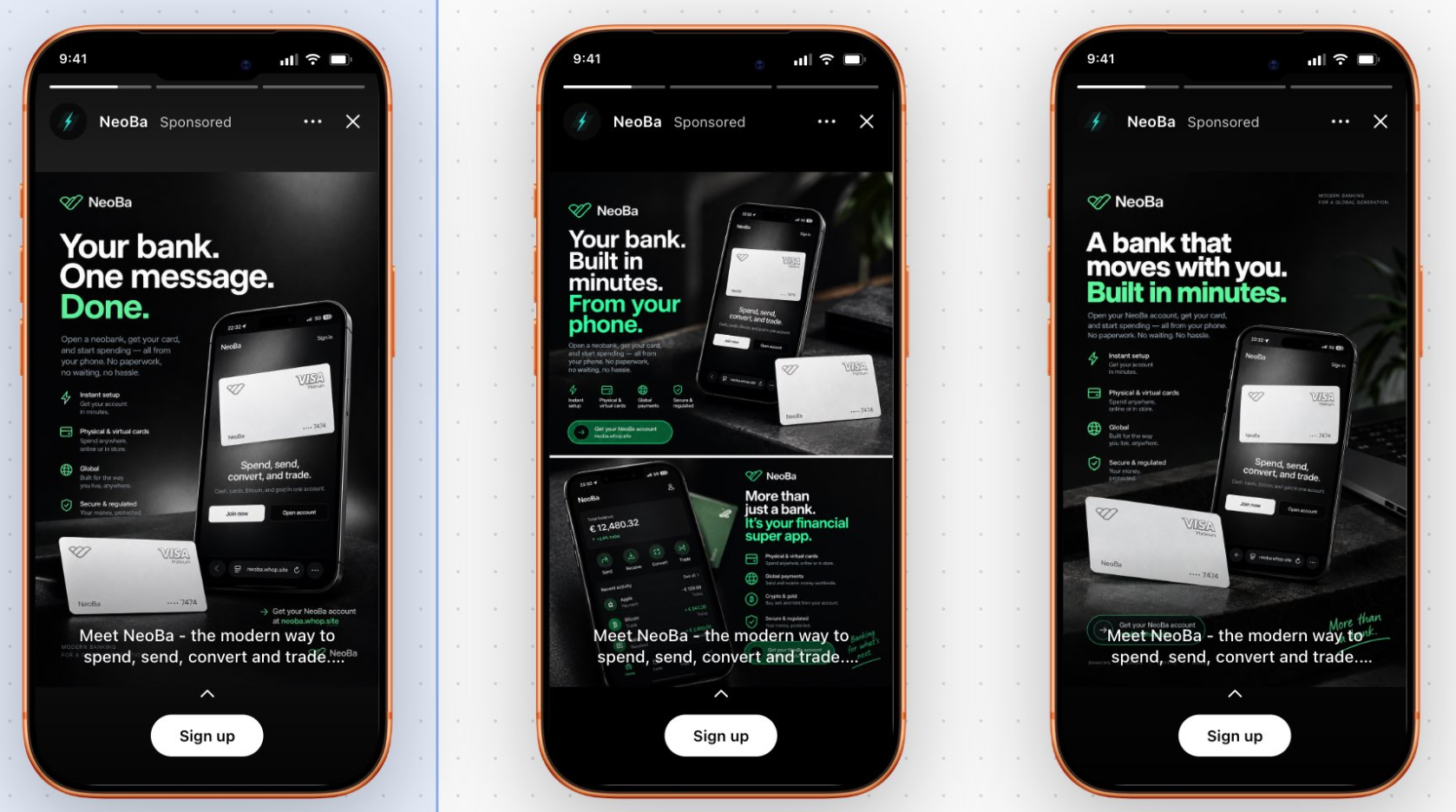
That same creator also shared some creatives that they had cooked up to promote this new neobank, which — if you’ve spent any time thinking about UDAAP — will immediately set off alarm bells:
Generally speaking, you’re not allowed to refer to something as a “bank,” unless it is actually a chartered bank. Neobanks created in 15 minutes or less using Whop’s AI assistant and this blueprint are pretty much the furthest thing possible from the legal definition of a bank. And yet, as far as I can tell, there is nothing stopping a creator on Whop from using whatever language they want to describe the new neobank they had just created. You could, if you wanted, lie and claim that the balances that you hold for customers are FDIC insured. Whop, if it discovered this after the fact, could potentially take action to remove the misleading content or suspend the creator’s account, in accordance with its community guidelines. However, it’s unclear how seriously Whop takes its community guidelines3 and it certainly doesn’t screen any of its creators’ marketing materials before they go live. Quite frankly, it couldn’t, even if it wanted to. The AI-assisted tooling will allow for problematic banking products and marketing to be created far faster than anyone could review them. Whop has essentially built a UDAAP-shaped AI slop cannon. And then there’s the monetization angle. Here’s how Whop’s blog post on the neobank blueprint describes the monetization opportunity for creators:
Hopefully you caught that last part, because it’s important. And terrifying. "You set the fees on all of it” Yes, the creator gets to set the fees. However they want. With no review by Whop or any of the regulated or semi-regulated financial services partners that it relies on behind the scenes. Here’s Whop’s blog post again (emphasis mine):
Ohh my gosh ohh my gosh ohh my gosh there are so many problems with this … I’m starting to hyperventilate … Mary Mother of God … here’s a partial list:
For the moment, this is all still very new and happening at a comparatively small scale. However, it’s very dangerous to be complacent when it comes to infrastructure. Especially when that infrastructure is (to return to my analogy) the babysitter that is the easiest and most fun to deal with. As we saw with BaaS 1.0 and the collapse of Synapse, it can get big and unstable very fast. And the consequences, when it collapses, can be devastating. Sponsored by Lithic Cash-heavy businesses have no way to extend a relationship past the transaction. 2 READING RECOMMENDATIONS#1: Mind the Gap: Democracy and Data Centers (by John Pitts, Open Banker) 📚John called his own number here, and I’m glad he did. This piece is a good mix of history, current events, linguistic appeals to Gen Z, and a warning for those who think about the (sometimes violent) swings in financial services policy. #2: Frontier Overhangs (by Ben Thompson, Stratechery) 📚Thank God for Ben Thompson, one of the only credibly knowledgeable and unbiased voices on the why-are-the-AI-people-scaring-the-shit-out-of-everyone-about-their-own-products question. (Ditto for Derek Thompson, who had an excellent podcast on this same topic recently.) (Also, I really enjoyed this SNL clip … “AI is not a weapon. It’s a tool. A tool for building weapons.”) *Bonus: The 2,000 Years of Rain Problem in SMB Lending (by me, with Parlay) 📚Underwriting expertise used to leave the bank the moment the person who held it did. I wrote about how AI changes that; a silicon underwriter that retains what every deal teaches, so the 400th SBA loan actually informs the 401st. Read and enjoy it here! *This rec is brought to you by one of our fantastic brand partners. 1 QUESTION FROM FINITYThere are a TON of interesting questions being asked in Finity (our digital community for fintech and banking nerds). I’ll share one question, sourced from the community, each week. However, if you’d like to join the conversation, please apply to join! Do you think that AI agents could (if used by bank customers at sufficient scale) cause a bank run, as some are beginning to suggest? If so, how?If you have any thoughts on this question, reply to this email or DM me in Finity! Thanks for the read! Let me know what you thought by replying back to this email. — Alex Footnotes 1.The best dunks in basketball are putback dunks off missed shots. They are tricky to get right and require perfect timing. However, when executed well, they are surprising, ferocious, demoralizing to the opposing team, and often embarrassing for the defensive player who was trying to grab the rebound. 2."Clap your hands Peter. It's the only way to save me. Louder. LOUDER PETER!" 3.It lists digital assets as one of its prohibited products and services, but its neobank blueprint facilitates the sale of digital assets? | |||||||||
|