| ||||||||
| | ||||||||
| In partnership with
Hi ya party people, Spooky season is right around the corner, which means I might become a lil insufferable about one of my favorite times of year. Who’s ready?! 🎃 Today’s Q&A has its own jump scares: First, someone is weighing whether to file an EEOC charge over sex discrimination and wondering what it could mean for their career and their peace of mind. Then, an associate who transferred out wants her old job back, and HR needs to deliver a professional no. Let's look at some answers, and if you wanna make my day and submit your own questions, submit them here! 😍 P.S. This is one of the rare days where AI isn't the main topic of discussion...but unfortunately, 73% of orgs say they invest in AI upskilling, and not a single training topic breaks 27% adoption. Join the HR Therapy next week if you wanna see how we're addressing this massive gap! Sponsored by Recognize Let's chat about your company's culture and what your website is actually telling people! 👀 Wanna know if it tells a story that matches real life? Paste its URL into Recognize’s free Culture Analysis Tool and, in about a minute, you can see what the website says about its culture, values, mission, and vision. The report also points out where the story gets vague or starts contradicting itself! 🔍 Pretty handy if you wanna know whether the website is serving a clear message or a word salad of empty aspirations. Go try the tool and see what it tells you! ASK AWAY 🥀 emotional tolls ✍🏾 Is it worth filing with the EEOC for sexual discrimination and how will this impact my career long-term? Context: If I file with the EEOC - will this impact future employment? Is it really worth going down this rabbit hole for the emotional toll? How do I file against one who is retiring, when she was the one knowing and making the comments? What do I do? 📣 Sondra Norris, Founder @ Strategic Culture Partners: Sorry this happened to you and has you pondering a really tricky and difficult question. This is a very individual question that at the end of the day, only you can answer, with the help of an attorney's free consultation. With the question written as is, it's impossible to discern if you have a claim. Do your research, talk to an attorney (privileged conversation they won't share anything unless you start the case) to find out if you have a case. There are several "qualifying" things they'll talk you through (employer size, how long you worked there, your working relationship; how long ago the conduct occurred; protected class - you're saying sexual discrimination, but you might mean harassment? - severity and pervasiveness of the conduct, employer knowledge and failure to act). Things to weigh: Yes, it's an emotional toll for sure, the cases can be long and protracted and you'll come under scrutiny as well by the company's attorneys. It's not just the person, it's the company - so, even if they're retiring, if the company knew about it and allowed it to go on that might be a pattern which means another person might come along and do damage to others that the company won't deal with. With regard to your future employability, it may or may not come up, there are no guarantees. Do you live in a small town? Work in a small industry? Those things would increase the chances that people will "find out" and react how they'll react. You can't predict that part, so you have to think about how you'll be able to cope with "everyone knowing" vs. "illegal behavior happened and I tried to not allow it to happen to anyone else" vs. "I could have taken action and I didn't do anything." 📣 Anonymous Safe Space User: I’m sorry you’re carrying this. Filing an EEOC charge can be worth considering, but you don’t have to decide whether the emotional cost is worth it before learning your options. The charge generally names the employer, so the person who made the comments retiring does not necessarily end the matter. The EEOC does not make charges public, though it will notify your employer; retaliation, including a harmful job reference, is illegal. That protection cannot guarantee how people will behave, so document the comments, dates, witnesses, and any career impact, and consider speaking with an employment attorney before deciding. Check the deadline soon: it is generally 180 days, or 300 days in some locations. Safe Space members can join this discussion here. Not a member yet? Apply to join here.  ✍🏾 We have a problematic associate who transfered to another department. She applied for her old position. How can we politely tell her no for the position? Context: 740, ar position for a parts, sales, service company 📣 Alexandra E, CHRO @ Credit Union: Oof, been there. Ideally they get managed out of the organization and not transferred…but since they are still within the organization, and now a current associate applying to return to a former position, I would keep the message brief, neutral, and focused on the selection decision. I would not put anything in writing characterizing them as “problematic,” even if performance or conduct concerns are part of why you do not want them back. Something like: Thank you for your interest in returning to the [Position Title] and for taking the time to apply. After reviewing the needs of the department and the candidates for the position, we have decided not to move forward with your application. We appreciate your interest in the opportunity and your continued contributions to [Company Name] in your current role. Thank you again for your interest. I like using “we have decided not to move forward with your application” rather than “we selected another candidate” if you have not actually selected someone yet. It doesn’t create a fact you have to explain later. If they ask “Why not? I did this job before,” that’s where I would be more careful. You can truthfully say that prior experience in the role was considered, but the department is evaluating candidates based on its current needs and expectations. Answers the question without giving them anything to come back to you specifically with. I would avoid getting into the behavioural issues since they were not terminated from the company. The issues were minor enough that their employment was retained, so we don't need to get into the weeds about how much of a pain in the @$$ they were in the last role since they’re still employed. Good luck! 📣 Jess Tannenbaum, Head of People @ Brass Taxes: I agree with Alexandra. You don't owe her a detailed explanation about why you're not moving forward with her application. Simply telling her "Thanks for applying, we've decided to move forward with other candidates" is enough. But the deeper issue I'd want answered before responding to her is why she got moved to another department instead of being managed out or improved in that role. If she's still struggling in her current role, is she being given real feedback, and is that being documented? If she's turned it around and is performing well in the new role, that's good, but you're still not obligated to hire her back Either way, I'd make sure to understand the background and current nuances of the situation clearly before responding to her. That way you can better anticipate and answer her follow up questions. 📣 Alex White, Regional Director, HR @ Washington Duke Inn & Golf Club: I agree with much of what has already been shared, especially keeping the communication professional and avoiding labels like “problematic.” Because she is a current associate and previously held the role, I would make sure HR and the hiring leader are very clear internally about why she is not being considered. If there were documented performance, conduct, reliability, or other job-related concerns, those can be relevant to the decision, but the rationale should be based on legitimate and consistently applied criteria. I would keep the message simple: “Thank you for your interest in returning to the position. After reviewing your application and the current needs of the department, we have decided not to move forward with your candidacy.” If she asks why, I would be truthful without reopening every past issue. If prior performance is part of the decision and was appropriately addressed, it is reasonable to say that her previous experience in the role was considered as part of the overall evaluation. The bigger HR question for me is how she became a “problematic associate” who was transferred to another department. If the transfer was used instead of addressing performance or behavioral concerns, that may be the larger issue to review. On the other hand, if she is now performing well in the new role, that may simply indicate she is a better fit there. Bottom line: keep the rejection respectful and concise, but make sure the organization can clearly explain and support the business reason behind the decision if asked. Safe Space members can join this discussion here. Not a member yet? Apply to join here. Sponsored by HiBob Your AI doesn’t really know your people, but sure, let it make super important decisions! HiBob MCP feeds AI tools live, governed people data, while Slackbot HCM brings trusted answers and HR actions directly into Slack.  🚨 ON YOUR RADAR 🎧 I Hate It Here Podcast: I'm always dropping new episodes with your favorite People Ops leaders! Until we return with a new season of guests, enjoy some of the greatest hits! Check it out on Spotify or Apple Podcasts! 🔎 I’ve seen enough AI stats to wallpaper my entire office. On Sept 29th’s HR Therapy, Dr. Ken and I are gonna decode the numbers: what’s hiding underneath them, and what they mean for your HR team. Come join us! 🚨 Is your compliance plan ready for 2027? Rippling’s virtual masterclass series breaks down the AI, year-end, and global employment rules HR needs to handle before one missed deadline becomes an unreasonably expensive experience. Learn how to stop compliance chaos before it starts!* ❤️ From ‘I Hate it Here’ to ‘I Love it Here’: Your Culture Transformation Roadmap. HR can influence culture change in any organization, and this course teaches you how. Join the Safe Space community to access it! *This one is brought to you by one of my amazing brand partners 📝 RESOURCE OF THE WEEK Each week I feature a resource I love from the Safe Space library that I believe would be relatable to this week's newsletter topic. This week...a lesson about winning at all costs. Check it out HERE ⬇️ 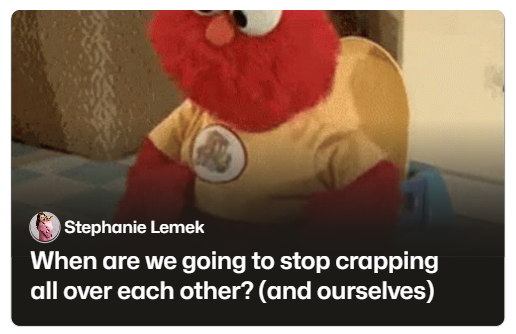 🫂 COMMUNITY HAPPENINGS In-person Meet-ups 🍾 NYC, NEXT WEEK! Join Safe Space members Mhyrynde Noa and Evelyn Tsai at Mad Dog & Beans Mexican Cantina on Sep 29 at 5:00 PM EDT for food, drinks and great convo. No forced ice breakers, just people who get it. Grab your spot 👉 here! Asheville, Charlotte + Philly - your fall in-person meetups are in the works! Stay tuned 👀 🫶 NEXT WEEK! Beyond the Month: Prevention That Outlasts the Calendar: Stephanie Lemek is hosting Beyond the Month on Sep 30 at 1pm MST. Suicide prevention shouldn't end when the ribbons come down. She's walking through how to build it into how you actually run things, policies, manager training, the whole system. Grab your spot 👉 here! FRIDAY FUN 😎 i'm a mystery.png?sig=92adb5f87af69fd74f1ce9e908615a7fb1dd538c10560640487c8964fafdce0c&size=email-body&dpr=2) I know some HR folks that share NOTHING with their coworkers and others that are incredibly close... Where is the line?! It's really up to you to decide! For ex a hard rule for me is no employees can follow me on my private instagram. They've requested the answer is always nope. That's all for this week! I hope you enjoyed! If you have any thoughts, please let me know. I'm allll ears. Reminder: Today is FRIDAY. 🙏 | ||||||||
|