| |||||||||
| | |||||||||
 Hey Marketing Bestie, Currently at Unbound by Hubspot in Boston. Have a meet up today with the Jay Schwedelson at 4pm on the conference floor if you are here please come. It’s technically sold out but YOLO! I still haven’t had a lobster roll so if you see me sad that’s why. I like mine with butter. 🧈 Was this email forwarded to you? Sponsored by Audacy But first, you should really grab a copy of THE NEW RULES OF PODCAST ADVERTISING. 🎙️ Inside: SPARKNOTES FROM THE POD 5 WAYS TO TELL THE DIFFERENCE BETWEEN AI AUTOMATION AND AI INTELLIGENCEDuarte Guerreiro spent over 10 years running marketing teams at Coca-Cola and Sky before getting bored of big corporate and jumping into startups. He thought smaller companies would fix everything. Less politics. Faster experiments. Real accountability. They didn't. Marketing was still in crisis everywhere he looked. So he went looking for why. Why CMOs have the shortest tenure in the C-suite. Why martech went from 150 tools to 15,000 in a decade. Why marketing data is a mess despite all the promises of AI and better platforms. His conclusion: Marketers didn't get worse. Technology got them hostage. Platforms like Meta and Google started dictating what marketing even means. He teamed up with a co-founder who spent years building AI and data systems, and they spent months interviewing over 100 marketers before building anything. His mission: take the word "automation" out of marketing completely. Listen to the full episode here where Duarte breaks down the real difference between automation and intelligence, why AI slop is a trust problem, and why he thinks marketers become MORE essential in the age of AI. Not less. 1️⃣. Automation And Intelligence Are Not The Same Thing. Most "AI" Is Just Faster Automation.Duarte's Take: "Automation, you are setting something up not to reach a specific goal, but to just push out things independent of what the context is, independent of what the impact is. With AI, I thought we were going to get away from that and into real intelligence and context. But what happened with AI was actually the opposite. What people started doing with AI was building more of the same crap they were already building before. It's workflows, automated workflows now with AI, which is even worse than what we had before, because you can do 10x as much, 10x faster. You're not getting better results, you're just putting more slop into your whole marketing operation." What really worries me about AI is that teams reached for AI and used it to do the exact same broken things they were already doing. Just faster. Automation runs a task regardless of context. Send the email. It doesn't ask if this is the right decision to make right now. Intelligence asks a different question: given everything happening right now, what's actually the best decision to get from point A to point B. That could mean reallocating budget, changing the creative, switching channels entirely. Instead, marketing teams out there just automated their old mistakes at 10x volume. More slop, faster. Takeaway: Audit your current AI use. For each tool or workflow, ask: is this running regardless of context, or is it actually making a decision based on what's happening right now? If it's the former, you've built faster automation, not intelligence. Look for the workflows blindly repeating the same action and ask what contextual decision-making would look like instead. 2️⃣. Running A Campaign Isn't The Goal. Hitting The Result Is.Duarte's Take: "Most enterprise teams that I've worked with, they run campaigns and they see it as fact complete, no matter what. It doesn't matter if the campaign actually delivers the result they want or not. The fact that they run the campaign is already work done." You set a budget, pick a channel, choose an audience, write the copy, hit launch. Then you move on to the next campaign. Duarte's watched this happen across enterprise teams repeatedly: the campaign itself becomes the finish line. Launched it. Done. Check the box. But launching isn't the goal. The result is the goal. A campaign that ran and underperformed isn't a completed task, it's an open problem. Here is what he suggested: instead of static campaigns, build systems that loop, checking real-time data and adjusting on the fly until they actually reach the goal. Not until they've technically launched. Takeaway: Stop measuring campaign success by whether it launched. Measure it by whether it hit the actual goal you set. Before launching anything, write down what "done" means in terms of outcome, not activity. Then build in a checkpoint to actually evaluate against that outcome, not just confirm the campaign went live. 3️⃣. AI Slop Happens When You Skip The Judgment Layer, Not Because Of Bad Prompting.Duarte's Take: "I actually don't think there will be much of a difference of a good copywriter versus a bad copywriter using the same LLM for copy. I think the difference will be marginal. Sure, there's endless prompting you can make to try and make it better, but there's a ceiling. And the ceiling is actually quite low in copy. I can smell AI copy ten miles away." Uncomfortable truth time: better prompting doesn't fix AI slop. There's a ceiling on how good raw LLM output gets, no matter how skilled the prompter is. Duarte's point isn't about prompt engineering. It's about what happens after the output. A skilled marketer can spot AI-written or sprinkled copy immediately and knows how to push past that ceiling by their adding real judgment, real editing, real taste. Someone without that judgment can't tell the difference and ships the mediocre version straight through. The failure point isn't the AI. It's skipping the human judgment layer that catches what the AI got wrong or made too generic. Takeaway: Never treat AI output as a finished product. Build a mandatory judgment pass into your process: does this sound formulaic? The fix isn't a better prompt. It's a human applying real editorial judgment before anything ships. 4️⃣. Know Exactly Which Decisions You're Comfortable Delegating To AI. And Which You're Not.Duarte's Take: "The decisions that I'm comfortable the AI making are micro decisions in predetermined workflows. So if you're asking an agent system to pull insights because you want those insights for a specific piece of content, I'm comfortable delegating to the agents where to get those insights. The research I delegate, the data gathering I delegate, the data cleaning I delegate, the data structuring I delegate. Everything after that really I don't. The AI can give suggestions, it can spot opportunities, it can warn you of things, but you ultimately have to decide exactly what the AI is doing." Duarte draws a clear line on which tasks you can give to AI: Research Delegate all of it. What happens with those insights: that stays human. The AI can flag that a subreddit full of your audience is suddenly raving about a relevant topic. It can surface that a specific channel underperformed. But deciding what campaign to build off that insight, deciding whether to pull back spend or push into a new channel entirely: that decision stays with a person. Without that line, you end up with an AI quietly making strategic calls nobody actually signed off on. Takeaway: Draw your own explicit line. List out what you're comfortable delegating (research, data pulls, first-pass analysis) versus what stays human (strategic direction, budget reallocation, creative direction). Write it down. Revisit it. Without a clear line, delegation creeps further than you intended, 1 small decision at a time. 5️⃣. Marketers Become MORE Essential As AI Gets Better. Not Less.Duarte's Take: "It is that AI is not here to replace marketers. That is for me very, very clear. It has never been this clear that marketers in the age of AI will become more important, more effective, more central to a company's success. Companies will need them more than ever." This is the hill Duarte will die on. As AI makes execution cheap and instant, the entire marketing world gets louder. Every brand can now produce more content, more campaigns, more variations, AND do it faster than ever. Which means saturation goes up everywhere. What worked to break through 2 years ago doesn't work today. What works today won't work next year, because everyone's upping the volume simultaneously. In an environment where the volume is turn way up, the thing that cuts through isn't more content. It's the actual human creative risk: connecting two things nobody's connected before. A customer obsession with a specific TV show + a specific phrase they keep using in reviews, turned into a campaign idea. That leap is still fundamentally human. Takeaway: As AI lowers the cost of execution across your entire industry, don't compete on volume. Everyone else is already doing that. Compete on the creative leap: the unexpected connection between 2 data points that becomes a genuinely new idea. Use AI to surface the raw signals faster (what your audience loves, what they're saying), but treat connecting those signals into something original as the part that stays entirely yours. TIS THE SZN (TO PREP) If your holiday Marketing calendar is a note titled "Black Friday ideas???" with 3 blank bullet points, let's talk. On 9/23. Me + 2 smart Marketers + talking specific things to start NOW to avoid the November scramble. All live, so bring your Qs. Register for 6 holiday Marketing tactics, and leave with a take-home checklist & 30-day plan. IN A MEME 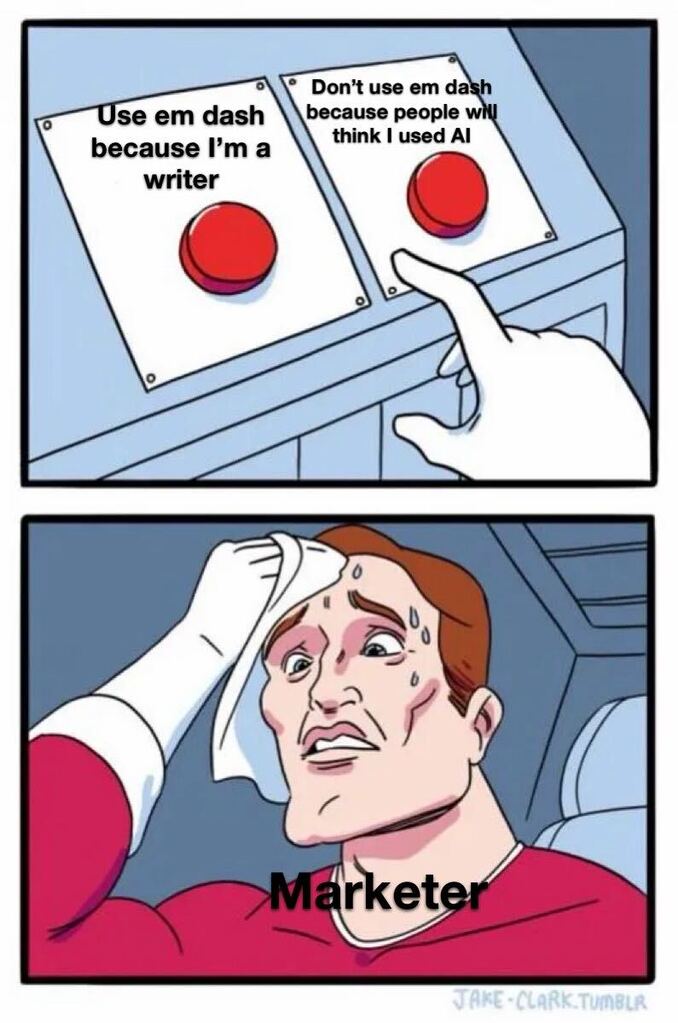 Also, is getting a Boston cream pie worth it? Your friend, Daniel | |||||||||
|