 | |||||||||
| | |||||||||
 Hello! Kiah here. Welcome to Fintech Takes Banking, my weekly newsletter where I highlight things I think are interesting or important for bankers and the surrounding environs. Was this email forwarded to you? Sponsored by Bretton Most banking teams have been told AI will change everything. Very few have been shown how to actually use it. How Technology, Competition and Rates Changed Core DepositsDeposits are the lifeblood of banking, but some deposits are better than others. But which deposits? The business of banking is that a bank takes in funds and lends them out. Many of the funds it borrows can be demanded back at any time, whereas the loans have longer, defined terms. A central historical tenet of this arrangement is that financial institutions would pay very little for the funds they borrow but charge more when they lend them out. That’s the magic of, or scam behind, maturity transformation. Banks have an advantage when it comes to borrowing money from you and me, or from our employers or the cities we live in. They offer valuable services: access to the payment rails through the accounts, and deposit insurance for a large number of accounts. In exchange for these and potentially other services or reasons, these deposits are willingly, thoughtlessly placed at the bank for very little compensation, paycheck after paycheck, invoice after accounts receivable, year after year. There are other types of funding an insured depository could use, but many of their characteristics have drawbacks: the money is closer to market price or is from customers who only seek a rate; it could have a shorter duration; it could require collateral; it could indicate financial stress. They all have their place, and for most banks, that place is behind the gold standard for funding: a core deposit. Stable, Sticky, HotA core deposit is the most important type of funding for banks. From a risk perspective, they reduce the chance of failure and lower the losses to the deposit insurance fund when banks do fail, the Federal Deposit Insurance Corp. wrote in its 2011 study on core and brokered deposits. They have other attractive features too. Core and nonbrokered deposits traditionally have been “stable and lower cost and … reprice more slowly than other deposits when interest rates rise,” the FDIC wrote. “These deposits are typically funds of local customers that also have a borrowing or other relationship with the bank.” That's great, but what are they? Core deposits aren’t defined by statute. The FDIC calculates a bank’s core deposits by adding up transaction accounts, money market deposit accounts, non-transaction savings and smaller time deposits, excluding fully insured brokered deposits under $250,000, on a bank’s Uniform Bank Performance Report. Outside of that, the way that the banking industry defines and thinks about deposits has been rooted in history and Congressional legislation. At the same time, depositor behavior is as technology and novel entrants make it easier to attract and compete for deposits and move money around. “In recent years the FDIC has also observed, as have many in the banking industry, that technological advances and the evolution of the Internet have altered the ways that banks obtain deposits,” the agency wrote in 2011. This creates deposit characterizations and frameworks that are inconsistent, unspecific and too rigid and too flexible at the same time. If the 2023 spring banking crisis showed us anything, it is that the most dangerous thing for a bank to think is that its core deposits are sticky when, in fact, they are running. “Historically, a core deposit was thought of as a low-cost or no-cost deposit. Now the thinking is much more around stability and reliability,” said Justin Bakst, executive director of products and solutions at Darling Consulting Group. “You could have low-cost deposits that are stable and reliable, higher-cost deposits that are stable and reliable and higher-cost uninsured deposits that are unreliable.” The last interest rate cycle may be instructive for executives as they think about how core deposits may shift in response to potential future rate changes. Researchers at the Federal Reserve Bank of New York found that deposit funding dropped about $500 billion at commercial banks between March 2022 and mid-March 2023, coinciding with the Federal Open Market Committee increases in the federal funds rate, according to a May 2023 study. “The initial decline is at least in part due to the fact that banks increase deposit rates more slowly than the federal funds rate, making deposits relatively unattractive for some depositors,” they wrote. 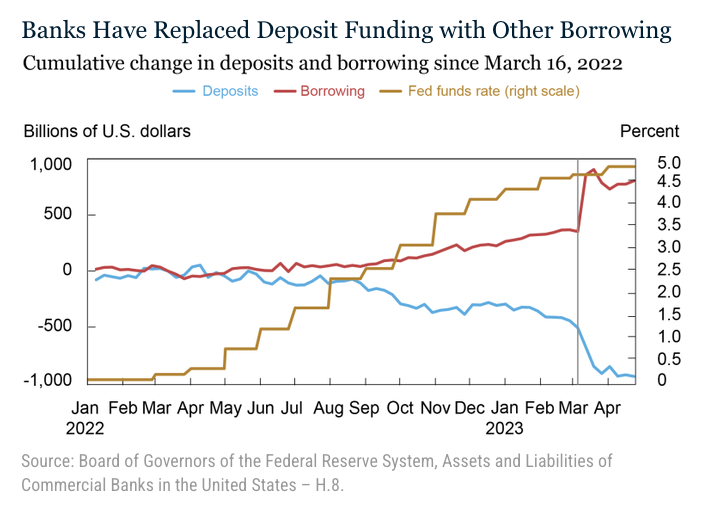 Liberty Street Economics, May 2023 This was before the spring banking stress, which would add another $450 billion in deposit outflows by the end of April 2023. In response, banks replaced the funding with $800 billion in borrowings. Prior to the spring banking stress, the researchers found that deposit bleed occurred at the institutions they classified as regional banks and above. During the stress, the deposit flight was concentrated mostly at the superregional banks. “This environment opened everyone's eyes,” Justin said. "Some of it wasn't just the bank failures — rates actually moved high enough that it made sense to find alternatives because the difference was meaningful.” Core in the Face of ChangeSo what is a core deposit these days? The banking industry, and individual banks, need to create their own context and framework to determine this. “Philosophically, a core deposit is the core account for that company,” said Christopher Marinac, managing director at Brean Capital. “Banks have to be focused on the core customer. Some banks get it, some don't. Banks need to create a core customer profile: a customer archetype that is profitable and for whom the bank excels at serving, based on geography, expertise or something else. Chris said the bank must “create” this core customer type, then hire staff and incentivize them to bring in these types of relationships and get them into specific products. He had a conversation with a community banker recently who was “very unhappy” about how hard it had become to gather deposits. “‘Yeah, because you don't have any core customers,’” Chris said in response. There’s also a cautionary tale for banks when it comes to understanding customer relationships. Chris spoke to a CFO of a real estate company who uses midsized and community banks for loans, because Bank of America won’t service the whole relationship. When other banks ask for funding as part of a loan, the CFO will “park a CD” or open a money market fund. But Chris said this CFO will still ask for an indexed rate or something reasonable, and considers Bank of America to be the company’s primary bank for services like wires and payments. Bankers will start conversations with Billy Guthrie, a deposit consultant at Darling Consulting, by saying, “Let's talk core versus non-core,” he said. He responds by asking them to define what those words mean to the institution before offering observations. Definitions, then analysis. “You need to tell your story around your deposit base, and data is the key to telling that story,” he said. The firm has identified certain attributes that can contribute to a deposit account’s stickiness or flightiness — many of their findings are what you'd surmise. Accounts with operating funds are generally more stable than accounts with discretionary funds. Deposit type, like retail, municipal or business accounts, “clearly impacts” stickiness, as can the size of the account and related insurance coverage, Justin said. Darling’s data also finds “significantly higher attrition” with single-source, high-rate accounts compared to accounts with multiple tie-ins, especially if one of those products is a checking account, Billy said. Having a number of accounts and balances distributed evenly across them influences stickiness, as can an account with direct deposit and discretionary-type accounts connected to it. Other products and services that increase a deposit’s stickiness include payroll, payments, credit and treasury management. Simple, but Not EasyBut the analysis doesn’t end there: financial institution executives need to understand the entire relationship and how to retain it. Keeping these deposits is essential to bank profitability: Darling’s research has found that in a typical organization, 20% of the accounts control 80% of the balance sheet. Uninsured deposits, often from commercial and corporate clients, play an outsized role in the balance sheet. The ongoing challenge for banks is to understand who their best customers are and then how to deepen their deposit relationships in a way that benefits both parties. This customer reflects the bank’s core business, and as Chris said, not every bank is great at this focus. But for the banks that excel at it, their executives have the advantage of clarity: how to grow, where to spend their time, what to spend a dollar on and where the bank will find deposits. It’s simple, but it’s not easy. How does a bank define an ideal, core customer? What data does the bank have that would indicate the stability of a deposit, and how does that change as the relationship or the rate environment changes? How should banks think about interest rates on these accounts — should they let deposits leave over rate, or pay a little more to keep them? Is the move really to prevent other tech competitors from paying competitive rates? “The most important variable [for banks] is to understand what's happening to deposit flows,” Justin said. “Bank deposits over any real time frame are growing, whether you're looking at community banks or large banks. But that doesn't mean the liquidity environment isn't challenging, and it doesn't mean deposits aren't more rate-sensitive than ever.” Those questions about rates? They’re real, and they matter. We’ll look at noninterest-bearing deposits, and the implications of another interest rate cycle, next week. Sponsored by Linker Finance When it comes to AI agents, every department has low and high risk tasks. Yes, even in the marketing department. SOLVING THE WRONG PROBLEM Opening more accounts online isn’t enough to fix your deposit growth problem. The trick is to get them funded, active and retained. I'm talking with Jorge Garcia, CEO of Linker Finance, about why banks keep solving for the wrong metric — and what they should focus on instead. Save your spot or RSVP for the recording. FROM THE VAULT What’s on my mind and filling my time: 🥵 Stay safe and cool! A couple of stories came out last week about the impact of prolonged and repeated heat exposure on the body. Bloomberg News reported on the long-term impacts of heat stoke, including organ stress and muscle damage. NPR reported that heat-related deaths are likely severely undercounted by a factor of five. Their analysis reveals that there are an average of 9,000 deaths a year between 2018-25 where heat played a role. (Somewhat related: I ended up not going to the Husker game because it was in the low 90s by 11 a.m. and I did not want to needlessly suffer.) 🍗 Caviar and nuggies: This article about The Rich in The Hamptons in The New York Times (written by Daily Nebraskan alumna Dionne Searcey, who was not happy when I told her about this plan) inspired me and some friends to do a chicken nuggets and caviar tasting on Monday. We sampled McDonald's, Wendy’s and Burger King, among others, alongside this convenient caviar tasting flight kit from Costco. 🎙️ On Bank Nerd Corner: Catherine and I discuss "Mad Money," a forgettable crime comedy movie from 2008 about three low-level Federal Reserve employees who conspire to steal currency that about to be destroyed that is loosely based on a real central bank heist. 🛫 Catch Me At: FDATA’s 2026 Summit on Sept. 17 (and the coworking day the day before!) in Toronto. CBA Committee Summit on Sept. 23 in McLean, Virginia. MX Money Experience, Oct. 4-6, in Park City, Utah. Money2020, Oct. 18-21, in Vegas baby! Make sure to sign up for Fintech Takes the Court on Oct. 18 and either play or spectate/commentate with me. Thanks for reading! Let me know your thoughts. - Kiah | |||||||||
|