 | |||||||||
| | |||||||||
 Happy Wednesday, Fintech Listeners! I trust your week has been going well so far. I have a couple of events to put on your radar:
— Alex Was this email forwarded to you? Sponsored by Taktile The most interesting AI opportunity in business underwriting sits between yes and no. The “maybe” is where credit teams burn time: ambiguous cases, fragmented evidence, and signals that tell you something's wrong but not what. Agentic AI can do much of that investigative work before an underwriter steps in, connecting evidence and narrowing what needs human judgment. When a clear read on an ambiguous borrower gets cheaper, applications that used to sit in the "too hard" pile are worth digging into. The pool of potential borrowers expands, and lending volume follows. 3 BIG IDEAS FROM THE PODCAST 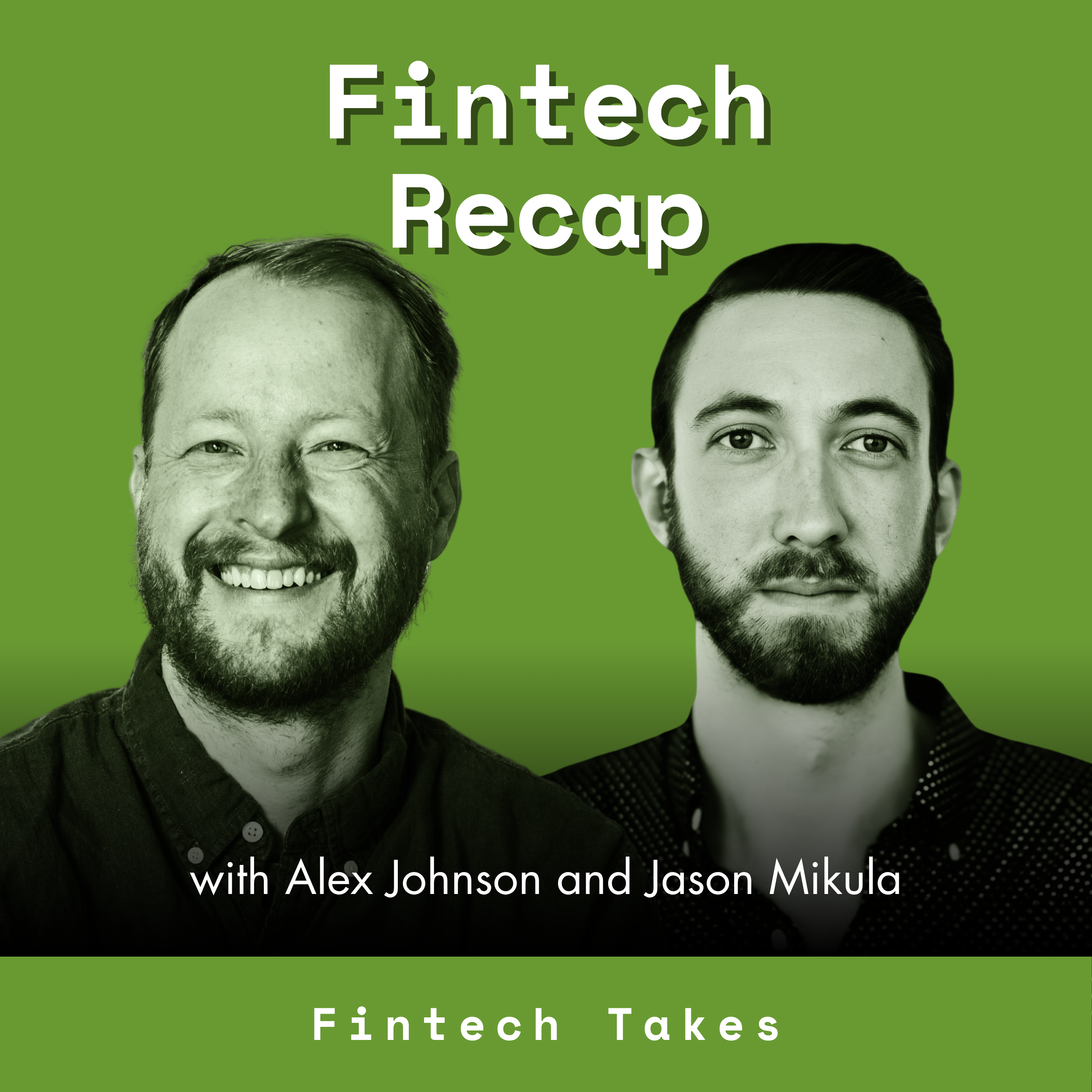 This week on Fintech Recap, Jason Mikula and I dug into some late summer (or is it early fall?) contradictions, like a bank that thought it had offloaded risk it hadn't, a proposed set of standards that promises two opposite things in the same document, and an OCC charter review that graded three applicants on three different curves. (And before the Seasonal Purists come for me … yes, I know fall officially starts September 22. But Labor Day, fashionably later or otherwise, always feels to me like the unofficial border crossing between summer and conferenceland. I mean, fall.) Tune in for the full conversation here And read below for my three big ideas... #1: The OCC Knows How To Ask Hard Questions But Why BotherThe OCC's bank charter application decisions this summer offer a very useful natural experiment: Three applicants, two different charter types, one wildly inconsistent standard. Wise, applying for a national trust bank charter, was denied after the OCC found it couldn't demonstrate an effective AML/CFT program and that its organizers lacked familiarity with national banking laws. Crucially, the OCC looked past the trust subsidiary itself to Wise's broader business, which had entered into a multistate, AML-themed consent order less than a month after filing, reasoning that a charter meant to strengthen the parent's business should be judged against that parent's track record. Bunq, applying for a full-service national bank charter, was denied over a leadership team with no U.S. banking experience, no unsecured lending experience, and a proposed CEO who'd run the operation part time from abroad. And World Liberty Financial, co-owned by the Trump family and the UAE (among other investors), saw its subsidiary, World Liberty Trust, receive preliminary conditional approval to operate as a national trust bank, including issuing and redeeming USD1, holding reserves, and providing digital asset custody (which may or may not be, in Senator Elizabeth Warren's words, the most brazen act of self-dealing our financial system has ever seen). The interesting part isn't that World Liberty got approved. It's how the OCC explained the difference, twice over. World Liberty Trust got the opposite treatment on both fronts. When commenters raised conflict of interest and concerns over foreign investment, the OCC said those issues fell outside its review because World Liberty Financial and its foreign investors weren’t parties to the application. With Wise, the parent's record was fair game because the charter existed to grow the parent's business. With World Liberty, concerns about the parent belonged somewhere else. The management team standards tell the same story. World Liberty Trust's proposed president, Zach Witkoff, is also World Liberty Financial's co-founder and CEO; his application describes experience building USD1, running Witkoff Capital, and working in real estate (not operating a trust bank). That same lack of relevant experience sank Bunq's CEO. And the character and experience bar that doomed Bunq apparently had nothing to say about other World Liberty co-founders like Chase Herro, whose résumé includes four arrests before turning 18, or Zachary Folkman, who previously co-founded a company called Date Hotter Girls LLC. When identical standards produce opposite outcomes depending on who's asking, they stop being a reliable predictor of anything. That should worry anyone planning a charter application around what the OCC says it cares about. 🎬 DIRECTOR'S COMMENTARY It’s a very odd experience to discuss World Liberty Financial and its newly-approved national trust bank on a podcast. It seems blindingly obvious that the OCC never would have approved the charter application if the company wasn’t owned by the President of the United States, and yet, very few folks in the industry seem willing to say this out loud? Take the bank trade associations as one example. They have been railing against the OCC’s decisions to grant national trust bank charters to crypto companies. They have argued that doing so will severely harm the safety and soundness of the U.S. financial system. And yet, when it comes to World Liberty Trust’s national trust bank charter application, they were silent. I understand the business rationale, but still. How can I take the bank trade associations seriously now? How can I take anyone seriously who isn’t willing to admit, publicly, that this decision is completely absurd? #2: When Credit Risk = Counterparty RiskCoastal Financial, parent of Coastal Community Bank, swung from $12 million in profit in Q1 to a $42 million loss in Q2 after taking a $68.8 million credit expense tied to one fintech lending partner, which Jason identified as LendingPoint (and wrote up properly in his newsletter here, which you should read). The structure is what makes this interesting. Jason explained that most bank-fintech lending partnerships move most of the receivables off the bank’s balance sheet, or close to it, typically keeping only 5% for the purpose of establishing true lender status. Coastal and LendingPoint did it differently. Coastal held the loans itself, recorded a provision for loan losses, and booked a credit enhancement asset representing the value of LendingPoint's promise to indemnify it against fraud and credit losses. Functionally, Jason said, Coastal traded direct borrower credit risk for counterparty risk. Instead of asking only whether borrowers would repay, Coastal also had to ask whether LendingPoint could make good on its indemnification promise if they didn’t. At the end of the day, the credit losses are the counterparty risk. If the loans deteriorate, they also drag down the financial condition of the very counterparty that’s supposed to reimburse you for them. The contract cleaves "borrower risk" from "counterparty risk” more than the actual economics do. Put another way, "we'll solve that contractually” is an awfully tempting sentence in bank and fintech partnerships, and it comes up constantly. But if the other side contractually owes you $100 million, do they have it? Can they get it? And will they give it to you? I think Coastal’s $42 million loss is actually banking working the way it’s intended to. Current expected credit loss is how we make sure that we know, well in advance, what problems a bank’s lending portfolio might cause. Sure, a $42 million loss probably doesn’t feel great, but that’s kinda the point. #3: A Quick Rant, and Some Required ReadingJason and I like to close Fintech Recap on what we can’t let go of, so here’s my rant. I've been tracking all the fair lending stuff that's been happening under this administration pretty closely, to the point where I end up fairly inured to it. It takes a lot to shock me at this point. The FTC has proposed a policy statement Concerning the Suppression of Accuracy in Artificial Intelligence Systems, and you know what? I’m kinda shocked by it. Here's the thrust: If a lender tunes an AI model away from raw accuracy for any reason, including to comply with a state fair lending law, and doesn't publicly disclose that it did so, the FTC could treat that as a deceptive act. Adjust your underwriting model so it doesn't disproportionately shut out a protected class and you're now looking at potential UDAP exposure. It's a proposed policy statement, not a rule or statute, so it may not have teeth or go anywhere. But the underlying legal theory is novel enough (and disturbing enough) to warrant attention, I believe. I've recently written about the FTC's suppression Suppression of Accuracy in Artificial Intelligence Systems in a Monday newsletter here, where I held up this collision to the light, using Illinois's new disparate impact law as the example. And even more recently in this past Monday’s newsletter here, if you’re looking to understand how federal fair lending enforcement got hollowed out enough that this kind of trap became possible in the first place. Read them both, whether you missed those stories or not, and come scream into the void with me. WHAT I'M LISTENING TO #1: A Traveling Credit Score (Cash Flow Conversations) 🎧I don’t think I’ve ever been more excited to record a podcast than I was when we recorded this one. #2: Shared Responsibility in the Age of AI Agents (Agent of Record) 🎧One of the more thoughtful conversations you’ll ever hear on AI governance in banking. *Bonus: Cash Flow Conversations (by me, with Nova Credit) 🎧FICO's value wasn't math; it was trust. In Episode 7: A Traveling Credit Score, Juan Hernandez, who leads underwriting across Block, walks through the score they built without any credit report data, why it outperformed in an A/B test, why they partnered with Nova Credit to distribute it, and why the hardest part of alternative data is convincing lenders to believe in a new set of numbers. Listen here! Thanks for the read! Let me know what you thought by replying back to this email. — Alex | |||||||||
|