 | ||||||||
| | ||||||||
 Hello! Kiah here. Welcome to Fintech Takes Banking, my weekly newsletter where I highlight things I think are interesting or important for bankers and the surrounding environs. This newsletter is coming to you as I transit to Austin, where Workweek is having its annual Upfronts event. There will be some exciting announcements coming later this week — some of you will be lucky enough to hear them in person. If you're not on-site, keep refreshing LinkedIn. 🙂 Was this email forwarded to you? Sponsored by MX Artificial intelligence is here, but customers aren’t fully sold on financial AI agents. Revisiting the $250,000 LimitMany things have changed in the banking industry since 2008. The deposit insurance limit isn’t one of them. The 2023 spring banking stress seemed to focus the banking industry, depositors, regulators and lawmakers on an urgent, but familiar risk: uninsured deposits that could run faster than previously thought possible, fueled by an invisible network connecting depositors and spreading the contagion. After the panic subsided, there was the standard postmortem exercise, the requisite desire to try to prevent a similar thing from happening. One potential change was deposit insurance reform. “Once Silicon Valley failed, everybody gave a lot of attention to it and realized we have a problem here,” said Christopher Marinac, managing director of Brean Capital. “Customers have very chunky deposits that are way outside the $250,000 limit, and most customers are not focused on trying to spread them around.” Setting an appropriate coverage level is an essential part of effective deposit insurance regimes, according to the 2014 principles issued by the International Association of Deposit Insurers. Deposit insurance coverage should be “limited, credible and cover the large majority of depositors but leave a substantial amount of deposits exposed to market discipline.” Most depositors shouldn't need to monitor how their depository institutions are managed, but more-sophisticated depositors should remain motivated to stay vigilant and keep their deposits in well-run banks. In May 2023, the Federal Deposit Insurance Corp. issued a report that revisited deposit insurance coverage and potential reform. The agency outlined three options: maintaining the current limited deposit insurance framework, unlimited coverage for all deposits and depositors and targeted coverage that would offer different insurance limits for various account types, including potentially higher limits for business payment accounts. Congress then took up the mantle of that third option — twice. Rep. Adam Schiff (D-Calif.) introduced the Deposit Insurance Reform Act of 2023 in June 2023. In November 2025, two Senators released a bipartisan proposal to expand deposit insurance coverage to $10 million for noninterest-bearing transaction accounts, which U.S. Treasury Secretary Scott Bessent supported. But these efforts stalled, and there wasn’t universal agreement on their necessity, implementation or cost, according to American Banker. "A lot of smart people in the industry, particularly from the advisory community, have pushed for higher limits,” said Nathan Stovall, managing director at Performance Trust. “But I've heard banks push back: ‘Our liquidity is fine. Why am I going to pay up for somebody else who doesn't know how to do that?’” The deposit insurance limit today is still what it was on May 9, 2023, but there’s no shortage of ideas of how it could be changed. Let’s look at some of them. Indexed to InflationCongress is responsible for increasing deposit insurance coverage in the United States, and they have increased it seven times to keep pace with inflation and help smaller institutions remain competitive. The current insurance limit of $250,000 was established in 2008; at the time, some groups argued this insurance cap would restore the coverage level that the $100,000 limit provided in 1980, according to the FDIC’s deposit study. 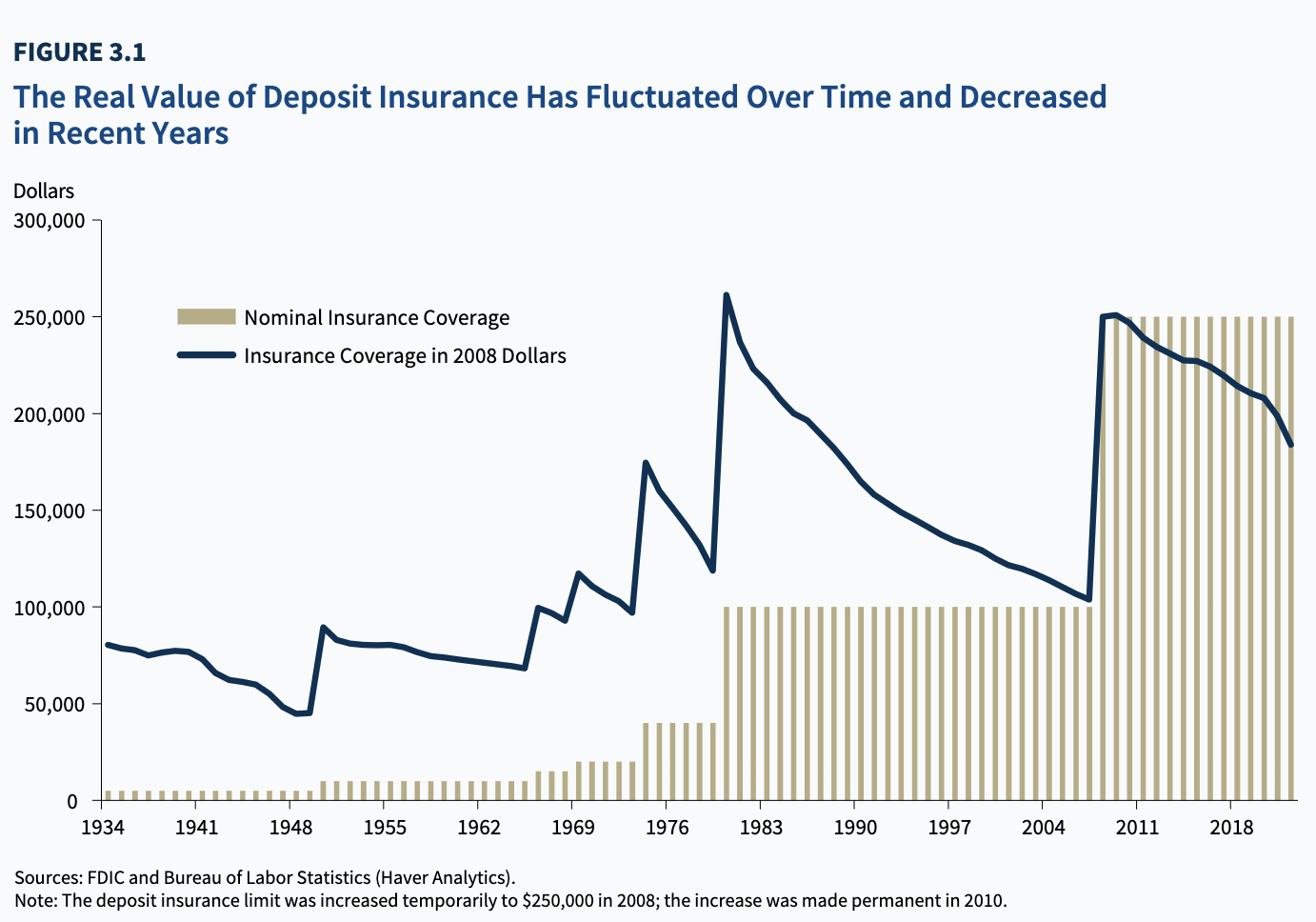 Source: FDIC May 2023 Insurance Reform Study Guidelines from the IADI suggest that countries consider inflation levels when determining their insurance coverage limits, but more than 90% of countries do not index their deposit insurance coverage to inflation. Today, only six have mandatory reviews and adjustments, according to a 2022 paper from IADI researchers. In Mexico, Uruguay and Tajikistan, deposit insurance coverage is expressed in an inflation-protected index and no formal change is necessary to alter it. In Peru, El Salvador and Ecuador, coverage is expressed in fiat money plus inflation protection but is formally changed by an administrative body. There could be some downsides to inflation-indexed insurance, the researchers wrote, including that frequent changes in insurance coverage may negatively impact depositors or confuse them. It could also reduce depositor discipline and increase the moral hazard: if inflation and insurance coverage are rising, riskier banks could offer higher rates to attract more deposits, which might appeal to more-informed borrowers who would otherwise impose discipline on the banks. Secondary Deposit InsuranceOf course, the FDIC doesn’t have to be the sole provider of deposit insurance, and in Massachusetts, it’s not. In 1934, the legislature established a private, industry-sponsored deposit insurance fund that applied to deposit accounts above the federal deposit insurance limit at financial institutions headquartered in the commonwealth. “The unique combined insurance coverage afforded by the FDIC and the DIF ensures deposit balances are fully protected. Since the DIF was established, no depositor has ever lost a penny in any Massachusetts savings or cooperative bank,” according to the group’s website. The last bank to fail in the state was Butler Bank in 2010. As part of this additional insurance coverage, the Massachusetts DIF conducts ongoing monitoring to assess the financial condition, performance and risk profiles of its member banks, in addition to the bank's regular exams. The DIF itself is examined “regularly by the Massachusetts Division of Banks and audited annually by an independent auditor,” the agency said. Don Musso, the chairman and CEO at the management consulting firm FinPro, was inspired by the Massachusetts DIF to establish a captive insurer for uninsured deposits at community banks. FinPro has started and will manage the Alliance Consortium, which banks can join so they can participate in Community Bankers Insurance Alliance. “If you look at the top risks in banking right now, No. 1 is still liquidity,” Don said. “We have more capital than ever, earnings are great, asset quality is strong. But liquidity continues to be the No. 1 risk banks face.” CIBA is a captive insurer, which allows a homogeneous group to insure themselves. Don estimated that CIBA will need about $200 million in equity, which translates to a founding membership of about 70 to 100 banks, but would ideally have about $1 billion in equity and 400 to 500 member banks. Banks will need to meet eligibility rules in order to qualify for CIBA insurance, but it is open to banks in every state. Initially, membership will be limited to institutions with less than $10 billion in assets, but Don wants to eventually allow banks with up to $25 billion in assets. Don said the appeal for banks is a deposit play. Members of the Alliance will be able to advertise the unlimited coverage, which could interest customers in the community that keep uninsured funds at banks seen as too big to fail. There is also, of course, the issue of negative selection and moral hazard. To address that — and provide an additional value to banks — the Alliance will provide complimentary access to FinPro’s risk analytics platform, which calculates a score based on quantifiable and qualitative material financial risks. It allows members to save on an enterprise risk management system, while giving the Alliance a way to monitor the financial conditions of members. The Alliance will also collect its membership’s quarterly deposit data to calculate insurance coverage, including situations that qualify for pass-through insurance from the FDIC. If a member bank shows signs of risk, FinPro will send a risk mitigation team at its expense to the bank. The bank will also be required to implement a risk mitigation plan and set up a virtual data room. While that sounds generous, Don said these steps will save CIBA the cost of an insurance payout down the line, make it easier to manage insurance payouts after failure and result in stronger member banks over time. Initial reception of the Alliance and CIBA has been “really good” from regulators and banks, Don said. Fiserv has made a strategic investment in FinPro and is a founding member of the Alliance, including providing the data lakes that could be needed. At the time of my conversation with Don, Alliance was working on the operating agreement and insurance policies, soliciting the banks on the board for comments and taking nonbinding expressions of interest. It’s not clear what traction CIBA will get, and when it could start providing secondary insurance. HaircutsJamie Dimon is arguably not a disinterested neutral observer when it comes to deposit insurance reform (and he might have a deposit account above the limit, given his $1.5 million base salary and $5 million cash bonus in 2025). Dimon is the chairman and CEO of JPMorgan Chase & Co., which had $5 trillion in assets at the end of the second quarter. It is the largest bank in the country by assets and is often perceived as “too big to fail” should it experience severe financial stress. Deposit insurance reform made an unusual appearance in his 2025 shareholder letter. Dimon proposed an upfront statutory cap on the percentage an uninsured depositor would lose in the event of a bank failure. “With this plan, a small portion of the uninsured deposits would be immediately available to cover losses and communicated to depositors in ‘peacetime’ while the bulk of uninsured deposits would be protected in a resolution,” he wrote. “[P]erhaps capping the maximum loss on uninsured deposits upfront would put an end to ad hoc involvement by the government once and for all.” He added that a well-chosen percentage could reduce the run risk of these deposits, since depositors would be assured that they wouldn’t lose all of their uninsured funds. Dimon’s proposal hasn’t been seriously debated. But his idea of mandated regulatory haircuts might have roots in how the FDIC has historically managed bank failures. Before 2008, 63% of bank failures resulted in losses for uninsured depositors; those losses totaled an average of 3.7%, according to a 2025 paper by Michael Ohlrogge, a professor at New York University’s School of Law. “People have this notion that if an uninsured depositor ever takes a loss at a bank, the country is going to fall apart. It's just not true,” he told me on an episode of Bank Nerd Corner. (Super quick brag: This episode was cited in a footnote of a January speech by Comptroller Gould!) One reason uninsured depositors used to take losses more frequently was that the FDIC conducted more partial bank sales that would split a failed bank’s assets among a set of buyers. The policy wasn’t to impose a haircut — it’s just what happened at the end of the receivership. The bank failed, uninsured depositors got their insured deposits, the bank was sold for parts and the uninsured depositors got a cut of whatever was left, which usually wound up being 97% of their deposits. That seemed to change in 2008; now, it’s more common for the winning bidder to assume most, if not all, of the bank’s deposits. Michael’s paper argues that this makes uninsured deposits de facto insured — no reform needed! (Author's note: The way I want to live in a world where a certain large stablecoin issuer took losses on its uninsured account when it failed...) It is not free for the FDIC to provide this protection to uninsured depositors at the moment when their inattention is most costly. Michael found this shift has given uninsured borrowers an extra $4 billion in protection at banks that failed after 2008, while the agency’s receivership and resolution costs have increased by about $45 billion. Have We Tried Doing Nothing?One argument that the status quo is fine is that a compelling product already exists and works pretty well, should a borrower or bank be so inclined: reciprocal deposits. Reciprocal deposits were created in 2003 by a company now called IntraFi and were first available for large certificates of deposit. There are now several firms that run reciprocal deposit networks and can cover several deposit types. Banks in a reciprocal deposit network farm out a large deposit to other banks in the network in exchange for an equal, or reciprocal, amount of deposits. The customer has one account to manage but has more of their deposits covered by insurance. Congress has revisited the classification of reciprocal deposits over the years, even as the deposit insurance level stayed stuck at $250,000. Reciprocals became more popular after legislation in 2018 changed their classification from fully brokered deposits to a bifurcated approach where deposits under a certain threshold aren't counted as brokered and those over do. This is especially true at banks with between $1 billion and $100 billion in assets, according to 2024 research from the Federal Reserve Bank of Cleveland. They found that 44% of commercial banks reported some reciprocal deposits in their 2023 year-end call report. Then 2023 happened. Reciprocal deposits increased 20% at the midsized banks that were already the heaviest users. Several banks increased their usage of reciprocals so much that they approached or exceeded the threshold that would cause the excess to be classified as brokered. “Some banks faced confidence problems and turned to reciprocal deposits to reassure their uninsured depositors by making them insured,” they wrote. Reciprocals made up 30% of PacWest Bank’s deposits in the spring of 2023, while they surpassed 20% at Western Alliance Bank. The researchers wrote that their usage may have helped the banks stave off their own runs during the spring. The question, of course, is whether depositors will request this product, whether their banker will suggest it and whether they will stay in it even as the perceived run risk of uninsured deposits recedes. The same could be true for CIBA, for haircuts, for inflation-indexed coverage. Chris pointed out that even today, many small and medium-sized businesses don’t seem focused on their uninsured deposits. He sits on a couple of nonprofit boards and said none of them are worried about the amount of money in their accounts that isn’t insured. Why should a bank point this out to a large, inattentive depositor? If depositors aren’t paying attention, why should anyone else? Isn't it better if no one thinks about the deposit insurance limit and if they could potentially lose amounts above it? The need for reform is a bit hypothetical. Three years ago, uninsured depositors almost lost a lot of their deposits in three bank failures —but they didn’t. The consequences of doing nothing were avoided, with the small cost of a systemic risk exception and a special deposit insurance assessment. In so many ways, what was good enough for banks and bank customers in 2008 no longer cuts it in 2026 — except the deposit insurance limit. The risk of doing nothing is that the next time this situation happens, bank regulators will have to take the same steps over again, and we’ll repeat the same debate. The debate about whether and how to reform deposit insurance demonstrates the paradox of insurance. If you’re prudent and cautious, you’ll pay for it but likely never use it, so you’re often subsidizing someone else’s realized risk. But it’s useful to have when you need it. FROM THE VAULT What’s on my mind and filling my time: 🔬 So cute and smol: The leaf sheep, an underwater slug the size of a grain of rice, won The Guardian’s 2026 Invertebrate of the Year. It’s solar-powered, neon and inspired a Pokémon: What’s not to love? PS: When I sent this article to friends, one wrote back, “I haaaaaaate that a worm is one of the longest animals in the world 🤮” The more you know! 🧀 Prime tranches of a cheese-backed security: Every so often, the world rediscovers that Italian bank Credito Emiliano has a warehouse to age wheels of Parmigiano-Reggiano it has accepted as collateral for loans. Cheese lovers the world over, including me, are grateful for this valuable and important service. And since it’s 2026, there is now a blockchain. 🎙️ On Bank Nerd Corner: Alex and I talk standard-setting initiatives and why we think it’s so important to get it right, bank charter watch and a reader’s question. ✈️ Catch Me At: Workweek Upfronts 2026, right now! FDATA’s 2026 Summit on Sept. 17 (and the coworking day the day before!) in Toronto. CBA Committee Summit on Sept. 23 in McLean, Virginia. Money2020, Oct. 18-21, in Vegas baby! Make sure to sign up for Fintech Takes the Court on Oct. 18 and either play or spectate/commentate with me. 🎧 Bonus Podcast Rec: Episode 4 of Agent of Record, with Parlay Finance and me, is now out. Unfortunately, I have some bad news: Former Acting Comptroller Michael Hsu told me and Alex that clicking “allow once” repeatedly on Claude while zoning out is not, in fact, human in the loop. We talked about AI’s category problem and got Mike’s thoughts on how policymakers, regulators and bankers can think about liability and governance in the face of this rapidly changing technology. Listen now!* Thanks so much for reading! Let me know your thoughts on whether the deposit insurance needs to be reformed, and how. Also, Alex and I had a lot of fun with the reader question! Feel free to reply to this newsletter with questions you want us to answer (or I will prompt you for one at a fall event!). - Kiah | ||||||||
|