Hospitalogists,
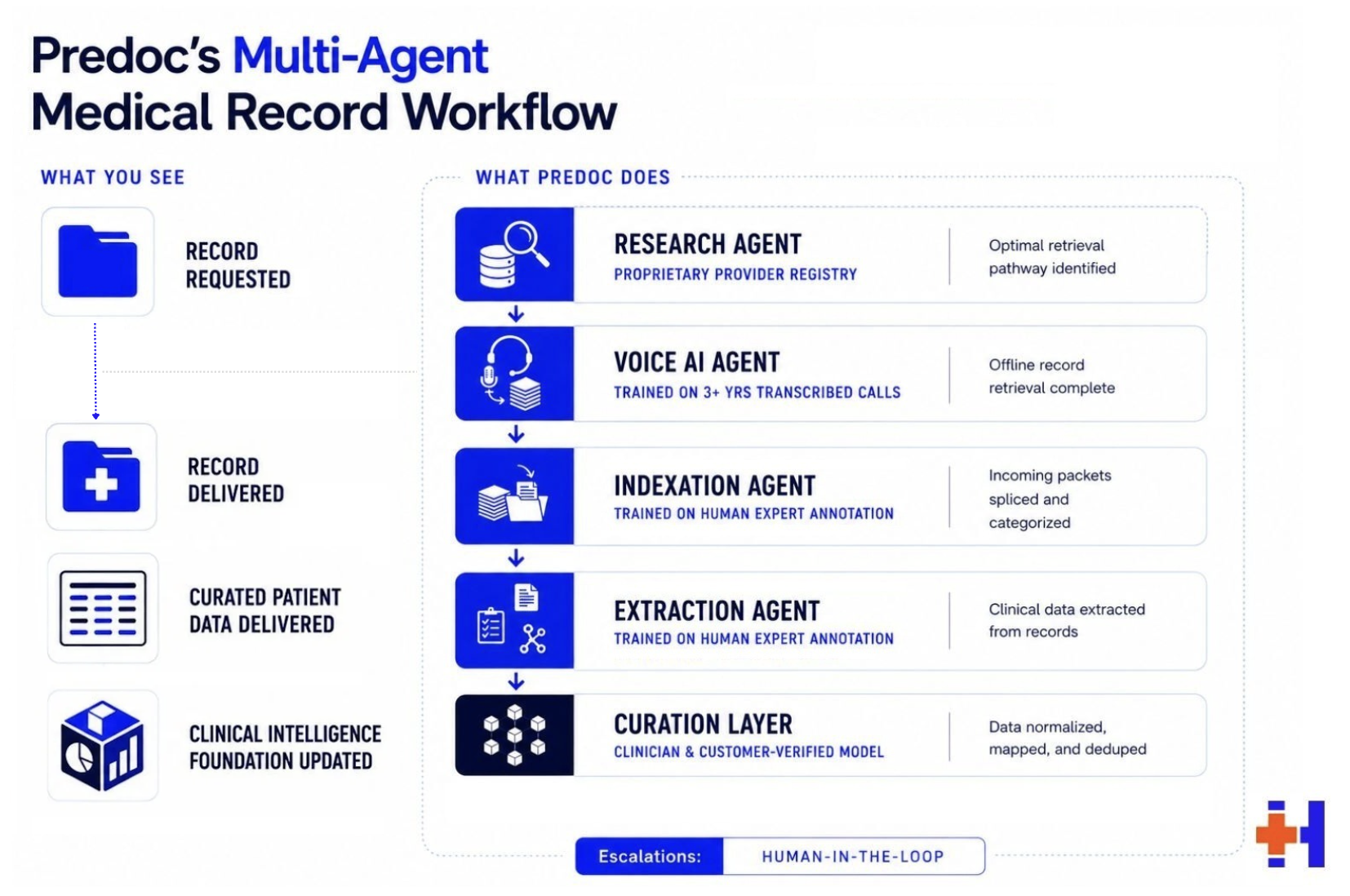
"Multi-agent systems" has officially entered the healthcare buzzword hall of fame, right up there with "value-based care" and "interoperability." Everyone's throwing agents at everything and calling it innovation. But every so often, a company actually shows their work. And that's exactly what Predoc did with a piece on how they built the multi-agent architecture behind their medical records retrieval and curation engine. Turns out, the answer isn't the model. It's whether you understand the workflow well enough to break it into its simplest parts. It's a useful blueprint for any healthcare exec trying to figure out what "building with AI" should actually look like in practice or where AI can have the highest impact.
Big thanks to Predoc for partnering with us on this one. Here’s my personal take. |
|
|
|
How They Built This: Predoc’s Framework for Multi-Agent Records Retrieval |
Here's the thing about offline medical records retrieval (what’s not on the HIEs): it's notoriously difficult, unglamorous, and exactly the kind of workflow most AI vendors avoid because it's messy. There are no standardized formats or clean APIs to draw on. It’s fax machines, IVR mazes, and a whole lot of institutional knowledge trapped in someone's head or a sticky note. And when the records come back, they’re a thousand pages of blurry fax.
Predoc decided to live inside that mess instead of abstracting it away. That story, The Multi-Agent System Behind Complete Medical Records, is less a product pitch and more a playbook for how to actually build a multi-agent system that survives contact with reality.
If you're evaluating where to plug AI into your health system's workflow (or where to build vs buy), Predoc lays out a framework based on first principles that’s worth a read. |
4 things worth digging into |
-
Bespoke work is the opportunity, not the obstacle. Predoc makes the case that the most valuable automation opportunities aren't the clean, standardized tasks. Those get commoditized fast. It's the messy, facility-specific, exception-riddled workflows that are actually defensible. I think that's right, and it's a useful gut-check for any exec evaluating an AI vendor's ROI or worth buying.
-
The dataset is your moat. Predoc built its system on 300K-400K provider-research tasks, nearly 3 years of transcribed retrieval calls, and millions of reviewed record pages. The foundation models are swappable. That accumulated, structured "tribal knowledge" is not.
-
Start from first principles. Break the workflow down into its simplest parts. Bound each job, structure the handoff, escalate the exception. Predoc lays out how they gave each agent a job (research, voice, indexation, extraction, curation) and a structured output the next agent can act on immediately. When something doesn't fit, the agent escalates to a human, and that resolution gets fed back into the system.
-
The numbers back it up. I was pretty intrigued by some of the results in this piece: A 2-week-plus turnaround compressed to a median of 3 business days. Provider-research time down 70%. First-pass retrieval success up nearly 50%. 94.6% of pages indexed without human intervention.
The bigger theme I keep coming back to: this is a case study in systems of intelligence sitting on top of disorganized, disparate systems of record. Predoc's real output isn't "faster fax retrieval." It's a normalized, longitudinal clinical data layer that other applications can actually query. Big thanks to Predoc for sitting down with me and showing their work on this one. |
Thanks for the read! Let me know what you thought by replying back to this email. — Blake |
|
|
|
{if profile.vars.board_room_user_fitness == true}The conversation doesn't have to stop here
Keep learning and connecting in the Hospitalogy Network
EVENTS | FEED | LIBRARY | DIRECTORY
|
|
|
|
{/if}{if !profile.vars.board_room_user_fitness && profile.vars.board_room_user_fitness != false}
I'm building a community of leaders in strategy, finance, and ops at hospitals and health systems to help us connect, learn, and grow together. |
|
|
|
{/if}Workweek Media Inc.
1023 Springdale Road, STE 9E
Austin, TX 78721 Want to ruin my day? Unsubscribe. |
|
|
|
|