 | ||||||||
| | ||||||||
| Hello! Kiah here. Welcome to Fintech Takes Banking, my weekly newsletter where I highlight things I think are interesting or important for bankers and the surrounding environs. Was this email forwarded to you? Uninsured Deposits are Growing. Is that a Good Thing?Three years after their flight led to the closure of three large banks, uninsured deposits are growing again at banks. Of all the types of funding a bank can use, deposits are the most highly prized. They may come with a broader customer relationship, they tend to stick around for years and they are often cheaper than other types of funding. But they do carry risk; they are the “short-term funding” part of maturity transformation. They can be withdrawn on demand whenever a need or panic strikes; many withdrawals can become a run. Of course, not all deposits carry this risk equally. Some are insured. But many are not. “Large relationships are the best relationships a bank can have,” said Billy Guthrie, a managing director and deposit consultant at Darling Consulting Group. “They typically provide the most growth opportunities; they fund most of the balance sheet — but the fact is they're large. If one of them leaves, it creates a bigger hole in the overall liquidity picture.” A Brief and Recent History of Uninsured DepositsUninsured deposits exist because insured deposits exist. The deposit insurance limit in the United States today is $250,000, and it’s not hard for some depositors to exceed it. While the industry knew they had posed heightened funding risks relative to their insured counterparts, they received “zero airtime” up until March 9, the day after SVB Financial announced a partial capital raise to restructure its balance sheet, said Christopher Marinac, director of research at Brean Capital. On that day, depositors withdrew $42 billion during operating hours, with $100 billion more scheduled before regulators closed the bank the morning of March 10. After SVB failed, the narrative around uninsured deposits changed. Once prized, they became risks that needed to be managed and received greater attention from depositors, banks, policymakers and regulators. Before the changeover in administration, the Federal Deposit Insurance Corp. issued a request for information on deposit data. Banks don’t “report comprehensive data on the composition of insured and uninsured deposits nor the characteristics of those deposits,” according to a statement from Chair Martin Gruenberg issued at the same time as the proposal. The RFI sought information on “characteristics that affect the stability and franchise value of different types of deposits” to understand how different deposits behave, especially during financial stress. The FDIC also wanted to know how banks measure the stability of different uninsured deposits, the types of deposits that banks collect and maintain data on and whether collecting additional data could better inform the agency’s or industry’s understanding of depositor behavior. This RFI was interesting because it seemed to indicate the U.S. deposit insurer was, to some extent, flying blind when it came to a wide swath of deposit risk. Gruenberg said in his statement that “the FDIC does not have historical data on banking industry trends for different types of insured and uninsured deposits, including how depositors would behave in times of stress.” It’s not clear what, if anything, happened with this request, especially under the tenure of current Chairman Travis Hill. More broadly, the industry has moved on — mostly, sort of — from these big questions and concerns. But it remains true today as it did on March 10, 2023: Understanding, managing and supervising this important subset of deposits has gotten more complicated in the past several years, and the FDIC has limited visibility into these deposits before failure. This is true even as uninsured deposits have grown in the U.S. banking industry, going from about 24% of total bank assets in the first quarter of 2000 to about 42% in the first quarter of 2022, according to a February literature review from the Basel Committee on Banking Supervision on nonmaturity deposit stability. They have increased every quarter for the last seven consecutive quarters, according to data from the Federal Deposit Insurance Corp. In the first quarter of 2026, domestic deposits rose 2.1%, or $389.7 billion — uninsured deposits made up $233.5 billion of that, according to the FDIC. And they are driving the industry’s deposit growth. Deposits in the banking industry increased 3.9% in 2025, aided by a 7% increase in uninsured deposits, according to the FDIC’s 2026 Risk Review. They ,ade up 43.3% of total deposits held at U.S. commercial banks at the end of 2025, according to the Federal Reserve Bank of St. Louis. 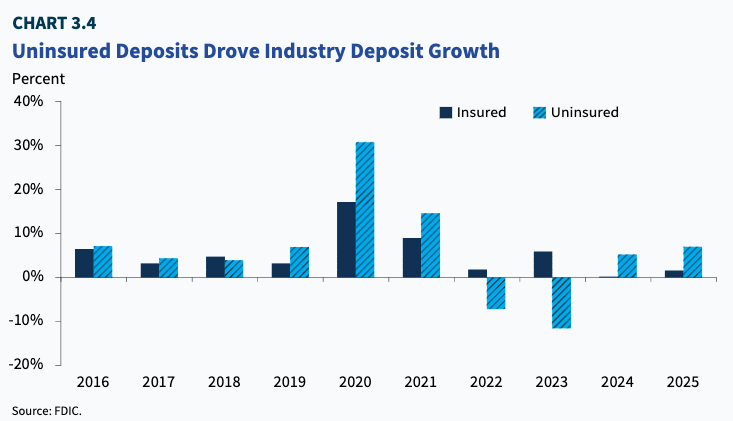 Source: FDIC 2026 Risk Review Today, the salience of the uninsured deposit run risk seems to have faded; perhaps the focus on uninsured deposits in 2023 was anomalous, and we have returned to baseline. You likely didn’t open this newsletter with a racing pulse, full of adrenaline and concern that an impending crisis was building. You’re not confused or scared or wondering what to do. Uninsured deposits are a reality of the banking industry, they’re a reality for depositors and they’re mostly a good thing! Except when they’re not. So let’s look at three factors or variables that may make a large deposit more or less risky for banks. Variable 1: Depositor ConcentrationBefore its failure, Silicon Valley Bank prided itself on understanding its core customer demographic, which, as the name indicates, were innovative technology companies often headquartered in or around Silicon Valley. Many of these customers were venture capital funds or were funded by venture capital, both of which would keep deposits at the bank. This led to a concentration of accounts with funds above the insurance limit. Ninety-four percent of domestic deposits at SVB were uninsured at the end of 2022, according to FDIC researchers in a May 2026 study examining deposit flows at the failed banks. Three-quarters of First Republic’s deposits were uninsured and 72% at Signature. An underappreciated risk at the time was that the owners of some of these accounts were connected. The Basel literature review also found evidence that uninsured depositor concentration — as well as the depositor’s sophistication — impacts depositor behavior. SVB had a concentration of uninsured deposits; it also had a concentration of depositors. “The likelihood or severity of runs may be higher when a sufficient share of depositors has concerns about other depositors’ behaviour or a bank’s solvency and is also able to coordinate or communicate in some fashion,” the Basel Committee wrote. That depositor concentration worked against it, as an information whisper network activated around the balance sheet restructuring announcement. Depositor concentration became an amplifying risk factor for uninsured accounts, which themselves carry run risk due to their lack of insurance coverage. Of course, concentration is a familiar risk factor for banks, usually focused on the other side of the balance sheet. “We do it on the asset side; I think it should apply on the liability side too,” said Nathan Stovall, managing director at Performance Trust. Rather than merely looking at the size of these deposits, Nathan thinks banks need to consider whether deposit accounts are concentrated in an industry or the percentage of uninsured deposits relative to total liabilities. They may want to think about managing risks if one depositor makes up more than 10% of deposits, for example. “It’s just another part of your asset-liability management tool kit. If you're heavily exposed to one customer or one industry, there's business risk,” he said. “A high level of uninsured deposits isn't necessarily problematic. Concentration within that group is the concern.” FDIC researchers attempted to ascertain the run risk of different uninsured depositors at Silicon Valley, Signature and First Republic during each institution’s run. They found differences in behavior — run risk, essentially — among uninsured depositors. Unsurprisingly, the top or largest depositors had “a significantly higher run rate than depositors in the next lower percentile rank,” according to the FDIC. They also found that financial companies were more likely than nonfinancial companies to run. A financial company that was in the top 1% of depositors at each bank had higher run rates than their nonfinancial peers in the 1%, but both “generally had higher run rates than companies in the next lower percentile rank,” they found. Variable 2: A Place to Put the MoneyA running deposit needs to go somewhere. Having a second account made it easier for depositors to wire funds out of a failing bank and into a different one. “Given the speed of the run at SVB, depositors may have found it easier to transfer their deposits to other banks if they already had an established relationship with another bank,” FDIC researchers wrote. At SVB, about 20% of depositors that sent an outbound wire transfer between March 7 and March 17 sent the funds “exclusively to destination accounts to or from which the depositor had wired money in the previous six months.” These depositors were responsible for wiring 43% of the $150 billion in deposits that was wired out of SVB. At Signature Bank, about 49% of the total $80 billion in deposits that were wired out between that observation period were sent to destinations that the depositor had wired money to or from in the previous six months. At First Republic, which would not fail until May, 42% of the $99 billion in deposits that were wired out in that observation period were to destination accounts that had received or sent money in the previous six months. Customers that didn’t have business accounts set up at other institutions were in a different situation. This was a golden opportunity for firms that could set up business accounts quickly for customers looking to transfer funds in the days after the closure of Silicon Valley and Signature. Mercury Technologies, a fintech focused on providing banking services to businesses, saw nearly 8,700 new customers in the first few days after Silicon Valley Bank closed and notched $2 billion in funds that it deposited at partner banks, according to a July 2023 article in TechCrunch. It also launched a reciprocal deposit product that offered deposit insurance up to $5 million and a sweep product that allowed customers to move excess funds to money market accounts. Between April and June, 17,000 new customers moved funds to the fintech. This lesson that companies and individuals should have multiple bank accounts may be a behavioral change that sticks around, Chris said. He said businesses may now think it's prudent to have a secondary account, and banks may have pitched it to customers as part of deposit gathering initiatives or as a condition of a loan or other services. It may not be a 50/50 split of a customer’s deposits, Chris said; it might be 80/20 or 90/10, but it’s still divided among banks. Variable 3: High-Stakes Account LabelingSome uninsured deposits are the funds of the account holder; they’re operational funds of an enterprise, or maybe an individual’s personal account. But some uninsured deposit accounts are a bucket of funds that may carry deposit insurance for some or all of those funds — if they’re labeled correctly when a bank is closed. That’s a big if, apparently. When Signature failed, initial public estimates were that 90% of its deposits were uninsured. FDIC researchers involved in the May 2026 deposit study believe that figure is closer to 72%. Why the difference? The researchers reviewed a spreadsheet of Signature’s computations of uninsured deposits for its 2022 call report. The spreadsheet included detailed calculations of the bank’s estimates of uninsured deposits for individual depositors, which allowed researchers to compare it to the FDIC’s. “The largest differences appeared to be in the treatment of deposits in accounts owned by third parties with pooled funds from their customers,” researchers wrote. “In the spreadsheet, SBNY summed all deposits in brokered CDs and estimated that only $250,000 of these deposits in brokered CDs were insured.” The bank assumed there was only one beneficial owner of the funds in all the brokered CDs, but the FDIC treated these brokered CDs as fully insured under pass-through insurance. Brokered CDs made up 3% of total deposits at the end of 2022. The researchers generously wrote that the bank’s insurance assumption for brokered deposits was inconsistent with their understanding but added they “did not observe—and SBNY also likely did not observe—the number of beneficial owners, nor that all titling and recordkeeping requirements necessary for pass-through insurance were met.” The inconsistent labeling went beyond brokered CDs. Signature also summed all deposits from depositors, regardless of deposit type, and assumed only $250,000 of those deposits was insured. The researchers found an example of a “major residential mortgage servicer with business deposits and multiple large passive escrow accounts” in the spreadsheet that was “listed as having total deposits equal to the sum of both types of deposits.” Signature estimated this depositor “was the single beneficial owner of the funds in every one of the large accounts holding commingled funds of its customers” and would get only $250,000 of insurance. The FDIC researchers approached this account differently. “By our methodology, we gave the business deposits $250,000 of deposit insurance coverage and assumed that the passive escrow deposits were fully insured by pass-through deposit insurance coverage, resulting in the mortgage servicer having a much higher share of insured deposits,” they wrote. “However, we did not observe—and SBNY also likely did not observe—the number of beneficial owners, nor that all titling and recordkeeping requirements necessary for pass-through insurance were met.” It’s not clear if this depositor was aware of the labeling and calculation discrepancy. It may not have mattered — “substantially all” deposits of Signature were assumed by Flagstar Bank. But there remains no good way for depositors to verify or validate their insured deposit status, especially for pass-through situations like these, with the FDIC. What to Do About This?The 2023 spring banking stress revealed the magnitude and speed that uninsured deposits can leave a bank. But not all deposits behave the same, not even those above the insurance limit. Multiple accounts, a networked depositor base and a nuanced understanding of the types of deposits in the account can make it hard for bankers and regulators to truly understand the risk that these deposits pose to a bank and how that changes over time. Back in 2023, as the apex of the spring banking stress subsided, regulators, bankers and depositors began to ask themselves an important question: What should we do about the risk of uninsured deposits? Should the deposit insurance limit be increased? That question, the debate and the potential options are the focus of next week’s newsletter. Sponsored by Linker Finance Most bankers skip the most important budget question: “Can the bank show exactly what last year’s budget did?"  FROM THE VAULT What’s on my mind and filling my time: 🦝 Who would want a raccoon as a pet?: The Atlantic wrote recently that raccoons may be domesticating themselves as it increasingly interacts with humans. My concern is that humans are evolving to be dumber, as evidenced by the people who keep them as pets. 👍🏻 A short list of things I enjoyed recently: The new albums from Death Cab for Cutie and addictive pop-punk emo covers of pop songs from Our Last Night. The books “Kin” by Tayari Jones and “The Exquisite Torment of Loving Your Enemy” by Brigitte Knightley. Pizza and cheddar goldfish crackers. Using the Navan Edge AI agent to book work travel. 🎙️On Bank Nerd Corner: I’m joined by Blake Madden — the creator of Hospitalogy, host of the Claims Denied podcast and my colleague — to discuss the only bank in the country owned by a health insurer. 🛫 Catch Me At: Workweek Upfronts 2026, Aug. 26-27, in Austin. FDATA’s 2026 Summit on Sept. 17 (and the coworking day the day before!) in Toronto. CBA Committee Summit on Sept. 23 in McLean, Virginia. Money2020, Oct. 18-21, in Vegas baby! Make sure to sign up for Fintech Takes the Court on Oct. 18 and either play or spectate/commentate with me. Thanks for reading! Also, do you have any burning questions you want me to ask Alex during an episode of Bank Nerd Corner? Reply to this email with them, and any comments! - Kiah | ||||||||
|