{beacon}
 | |||||||||
| | |||||||||
 Happy Thursday, Hospitalogists! Today, we’re talking about medical malpractice being ripe for disruption, plus I’m sharing some big news. If you're part of Hospitalogy's membership community, you're going to notice a new name popping up: HIHpoint. I've been sitting on this one for a bit, and I'm excited to finally get to explain it. Short version: it's not a rebrand for the sake of a rebrand. It's a name that actually fits what this community has become. I get into the "why" (hint: solving healthcare’s hardest problems) below. I also have one housekeeping item and it has to do with something else healthcare is trying to solve: the $2.9T admin labor problem. Shrinking headcount is the easy move. Expanding care with the same labor is the actual strategy, and it's the numerator/denominator choice most revenue cycle plans skip. I’m pressure-testing that idea live with Eric Larsen, president of TowerBrook Advisors, along with why a single EHR instance isn't a strategy on its own. Join us August 20 at 1pm ET. Was this email forwarded to you? Sponsored by Navina Most VBC programs don't fail on strategy; they fail on execution. Navina has partnered with Out of Pocket Health to help you avoid the pitfalls with a free course on operating high-performance VBC programs at scale. Get practical lessons from clinical, operational, and financial leaders who are tackling the biggest challenges in scaling VBC today. Three free 90-minute live online sessions (one per day at 12 PM ET, September 15-17) cover:
BLAKE'S BREAKDOWN Insuring Against the Incumbents: Jared Kaplan Is Betting That MedMal Is Ripe for DisruptionI'll be honest: medical malpractice insurance was not on my 2025 bingo card for "most interesting healthcare vertical to dig into." But after sitting down with Jared Kaplan, CEO and founder of Indigo Technologies, for a recent episode of Claims Denied, I came away genuinely fascinated by the parallels between what's happening in MedMal and the broader structural shifts playing out across healthcare finance and AI adoption. Jared is a repeat InsureTech entrepreneur who previously built a lending company that went public, spent time at Goldman in TMT, and then deliberately pivoted into one of the least sexy industries he could find. His thesis: the biggest opportunities to disrupt sit in the most boring, least competitive corners of the market. MedMal might be the poster child. 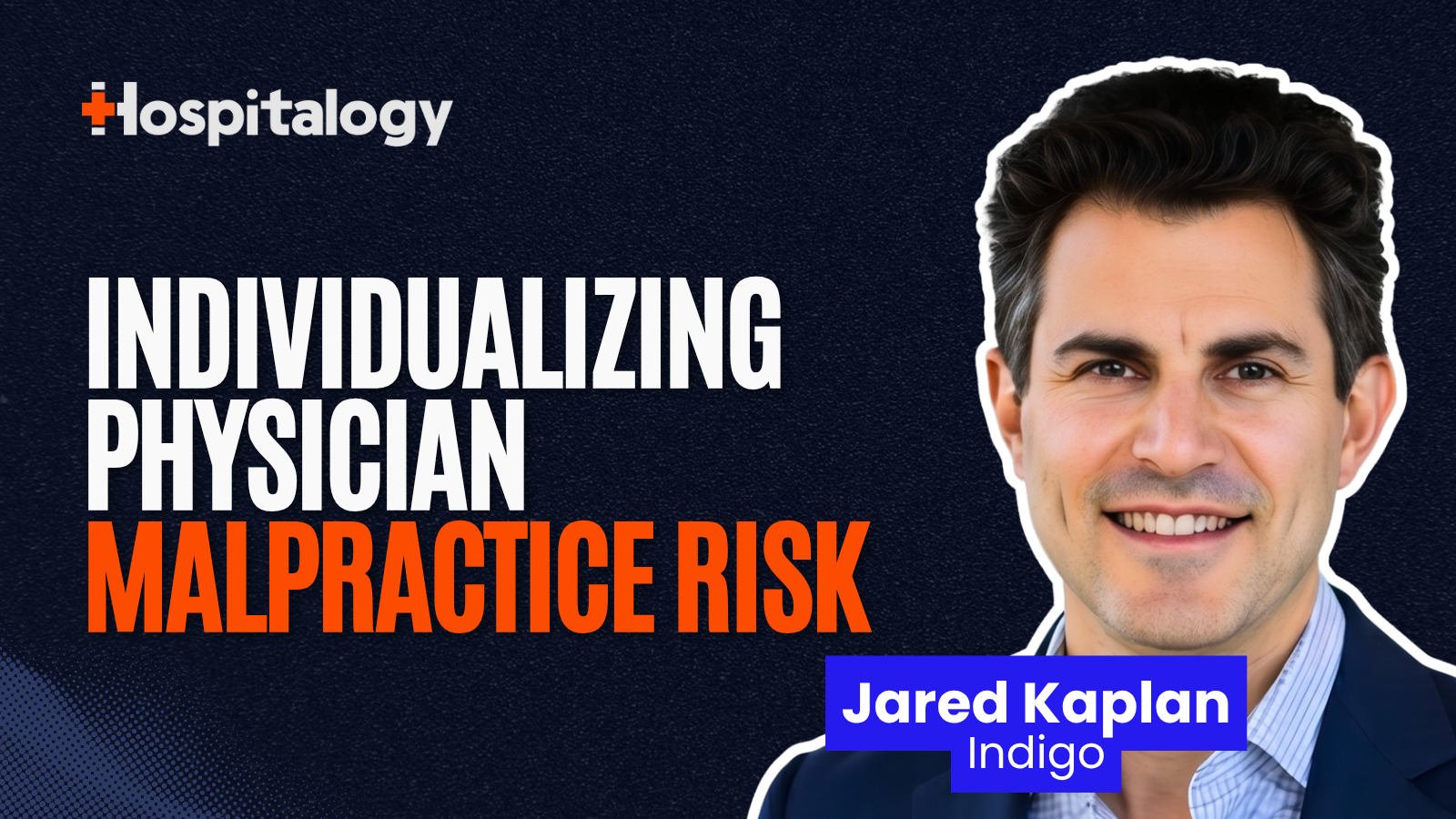 To listen to the full episode, click the image. A $13B market still running on paper applicationsThe MedMal market is roughly $13B, split evenly between independent physicians and facilities buying excess insurance over their self-insured retentions. Physicians are filling out 15-page applications with 300 questions, waiting days to weeks for quotes, and getting underwritten on 3 blunt variables: specialty, geography, and claims history. That's it. Virtually no individualized risk assessment at the physician level, in an industry touching every doctor in America. Indigo throws out the application entirely. They pull data via a physician's NPI and run it through a proprietary model built on roughly 1,500 attributes predictive of malpractice risk by specialty and geography, one that can identify the 20% of physicians driving 60% of claims. Jared told me the predictive power was stronger than anything he'd seen in consumer lending, which is saying something. InsurTech 3.0: growth is no longer enoughJared frames Indigo's entry as InsurTech 3.0. Version 1.0 moved distribution online; version 2.0 (the ZIRP era) poured capital into growth and assumed tech would eventually solve for profitable underwriting. It didn't. Version 3.0 is the correction: you still need to grow fast, but you have to prove your technology gives you a genuine edge in risk selection. Indigo is the embodiment of that discipline, by their account the fastest-growing company in the space, while deliberately constraining volume to protect loss ratios. Jared on Series B investors pushing for exponential growth: "We could do that tomorrow and blow up the business in 3 years, but let's not." That's the exact discipline missing from the 2.0 era, and frankly from a lot of digital health companies that scaled distribution without proving unit economics. The broker problemIndigo sells 100% through brokers. There's no viable direct-to-physician channel because physicians want a trusted intermediary navigating MedMal's complexity. That means Indigo's technology is worthless without broker buy-in, and building that trust as a 3-year-old startup against carriers with 100-year track records wasn't trivial. Brokers spent Year 2 sending Indigo their worst submissions to test whether they'd write anything just to gain scale. Indigo held the line, which cost short-term growth but bought long-term credibility. By Year 3, the tide turned. Jared's favorite evidence is that incumbent carriers are now actively threatening distribution partners who work with Indigo. When the 100-year-old carrier picks up the phone to complain about you, you've struck a nerve. The automation mathIn 2025, Indigo processed 7,000 submissions with 4 underwriters, with automated decisions climbing toward 50%. Jared expects the company to never exceed roughly 100 employees (today, 40). They quote about half of what they see and bind a quarter of what they quote for their best broker partners. They could improve that conversion by flexing on price, but won't, because it would jeopardize loss ratios. The discipline is the product. Nuclear verdicts and the hospital opportunityThis is where it gets really interesting for health system readers. Hospital self-insured retentions that used to sit at $5-10M are ballooning to $15-25M, driven by the nuclear verdict trend (Jared cited a $108M Jefferson, New Jersey verdict) and reinsurers pulling capacity in response. Hospitals can't just terminate their highest-risk physicians, because many are also their highest-revenue generators doing the most complex procedures. Indigo's play is to commercialize its risk analytics for self-insured facilities, helping risk management understand risk drivers, inform credentialing decisions, allocate the internal cost of risk across medical staff instead of peanut-buttering premiums evenly, and optimize how the system buys excess reinsurance. If you're a health system CFO watching your retention double while your reinsurance tower gets more expensive, that's a tool worth a hard look. AI as the "burglar alarm" of MedMalThe most provocative thread: AI-enabled clinical tools eventually getting embedded in malpractice pricing, the way home security systems lower homeowners premiums. Once there's real-world evidence that documentation software or diagnostic AI reduces errors, carriers should reward physician groups for deploying them. And physicians who skip proven safety tools could eventually face surcharges. The timeline is long (Jared estimated a decade-plus), but the direction of travel is clear, and it creates an interesting overlap with VBC's own push to reduce avoidable harm. Where Indigo goes from hereWith $100M raised and the Series B closed, capital priorities are clear: retain more underwriting risk, fund runway to cash-flow breakeven, and build out the facilities analytics platform. The five-year ambition is to be a top-5 physician malpractice carrier with a robust self-insured analytics business. The underlying thesis — a $13B market with concentrated incumbents, archaic technology, and a structural shift in the liability environment — is compelling. It also rhymes with what we've seen play out in health plan administration and VBC risk-bearing entities: incumbents get comfortable, technology creates a wedge, and the startups combining technical sophistication with operational credibility eventually win share. I'm rooting for Indigo, because grow fast, prove profitability, invest in tech without neglecting human trust is the playbook I wish more healthcare startups would follow. Hospitalogy Membership has a new name: HIHpointThe short version: our membership community — the one built around vetted operators trading real advice instead of LinkedIn platitudes — is now called HIHpoint. Here's the "why" behind it. I've been writing Hospitalogy for years now, and if there's one sentence I hear more than any other from the people who read it, it's some version of: healthcare is hard. You've said it. I've said it. Every director, VP, and C-suite exec who's ever closed their laptop after a brutal day and just sat there for a second has said it. It's not a complaint, exactly — it's more like the thing you say when the professional filter finally clicks off. That sentence is now, officially, part of our name. From newsletter readers to an actual networkWhen we first built out Hospitalogy's membership, it started exactly how you'd expect: a group of people who read my newsletter and wanted more. More access, more nuance, more of the stuff that doesn't fit into a newsletter twice a week. That's not really what it is anymore. Membership has turned into something bigger. Roughly 8,000 healthcare strategy, finance, and ops leaders who show up to ask each other hard questions, share what's actually working, and occasionally vent about the thing that isn't. Operators talking to operators. Payors comparing notes with payors. Founders getting real feedback instead of a polite nod. That should tell you everything you need to know: it stopped being "Blake's newsletter, plus some extras" a while ago. The name just hadn't caught up yet. So where does "HIHpoint" come from?HIH stands for "healthcare is hard." Not as a slogan, but as the sentence you drop when you stop performing for the room. Point is the place that sentence earns you. A rally point for solving problems together. A vantage point when you need to see past the regulatory noise and the roadblocks nobody outside the industry understands. A point of connection for people who've spent too long solving the same problems alone, in their own silos, at their own health systems. Put together: HIH names the ache. Point answers it. "Healthcare is hard" on its own just reads as a complaint, and there's no shortage of those in this industry. The point is what makes it constructive. You're not just saying the job is hard. You've got somewhere to go because it's hard. What actually changes (not much, by design)I want to be direct about this, because I know healthcare people are allergic to vague corporate rebrand-speak, and frankly so am I. What's changing: the name and the look. What's staying exactly the same: the people, the events, the peer-to-peer support. My newsletter is still landing in your inbox twice a week (and if it’s not, subscribe here). The Claims Denied podcast is still dropping wherever you already listen (and if you’re not, do it here). HIHpoint will still share the flagship content that built this whole thing in the first place. That part isn't going anywhere. What HIHpoint adds is room to grow beyond my byline. Stay tuned to see what that means. We've got big things planned. Meanwhile, go check out the new look or join us if you haven't already. TOP READS AND RESOURCES
* This resource is brought to you by one of my brand partners who help make this newsletter possible! Thanks for the read! Let me know what you thought by replying back to this email. — Blake | |||||||||
|