{beacon}
 | |||||||||
| | |||||||||
 Hi, Kiah here. I was able to do some investigating on The Address Thing last week. First, thanks to Matthew Goldman for sending me a blog post that reassured me I wasn’t alone with my address issues, but that I was in a small enough minority to be considered an edge case. Second, I hadn’t even thought about how NES was able to turn on the power to my unit, so someone in government could find my address. Third, the suite technically has a different address, since it faces another street — however I can guess what address they use based on some of the mail that’s wound up in my box. Ultimately, I labeled my mailbox, and I’m going to try to catch my regular mail carrier and maybe even visit my local post office to see if, between the three of us, we can get my mail correctly assigned to my box going forward. I did receive my new ID and credit cards. Picture this: In 2026, going to a physical location actually does solve a problem that can’t be solved online. Also, I just wrapped up a four-part series on master accounts. I needed a mental break, and I’m sure you did. Welcome to today’s newsletter! Was this email forwarded to you? Sponsored by Linker Finance Bankers aren’t mind readers. A Lamp, A Box, A BagThere is a uniform, a style, an aesthetic that finance cultivates. It shows up in the design of bank branches and lobbies, in the clothing bankers wear, in their appearances. If I had to list off what the “bankers’ aesthetic” telegraphs through the suits, the marble columns, the tidy haircut and lack of tattoos, it’s that bankers are cautious, serious, conservative, intelligent and understated. Of course, this is all marketing. Aesthetics are about taste and how one interprets and creates visual signals. Bankers’ aesthetics technically have nothing to do with banking; it means nothing that a bank deploys these aesthetics, or disregards them. There are bankers with tattoos and dyed hair, who don’t wear suits (many now don’t wear suits!). There are banks that aren’t in fancy branches replete with marble — there are banks that don’t have branches. These are all just signals. In banking, much of the iconography and aesthetics come from an era of banking that doesn’t exist anymore. Banking is so much more digital these days that some of the items that make up the banking aesthetic just aren’t needed anymore. Still, it’s fun to reflect on them, and nostalgia is in. So for today’s newsletter, we’re looking at three distinct items — accessories — that historically telegraphed “banker:” a lamp, a box and a bag. Bankers LampThe bankers lamp has a name, technically: Emeralite, a portmanteau of “emerald” and “light.” Emeralites are the green lamps that today would most likely be seen in a movie about banking that takes place between 1920 and 1980. The story of these iconic lamps starts in 1909, with a patent filed by Harrison D. McFaddin for “a new, original and ornamental design for lamp shades.” His company, H. G McFaddin & Co., would produce the lamp within the year: a brass base and a glass lampshade that was emerald green externally and white internally. The lampshade was made in a process called “cased glass” that would fuse two or more glass layers with different colors to create a single piece of glass, according to this bankers lamp enthusiast website. H. G McFaddin & Co. used the J. Schreiber & Neffen glass factory in present-day Czechia to make the shades. 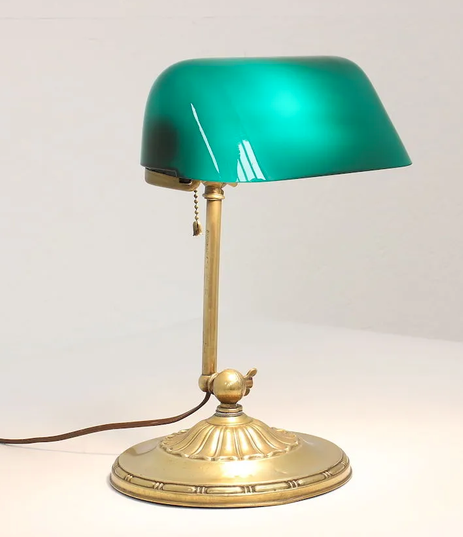 Source: The Bankers Lamp It did come in other colors, but the green shade was the most popular and eventually became the lamp’s signature. It was thought that green was a psychologically soothing color and would enhance concentration and focus (This is why accountants are sometimes shown wearing a green visor). The diffuse green light became associated with quiet, stoic settings — not just banks — where people need to concentrate, like law firms and libraries. Still, financial institutions ordered them in large numbers until supply chain disruptions during World War II forced the firm to move away from its European-made glass shade and make metal shades. The company changed owners and names several times through the 1960s. Authentic emaralite lamps are collectable antiques today, and can go between $500 and $1,200 based on production series and condition (they may require restoration if you buy one!). Those who appreciate the aesthetic without the need for an original can buy replicas, like these from Ghidini 1849. Today, these lamps are not an uncommon feature in movies and have made appearances in films ranging from James Bond, Legally Blonde, There Will Be Blood and 10 Things I Hate About You. Bankers BoxesI recently moved , and so I have become a bit of a box connoisseur lately. The right moving box will fit a decent amount of items but not so many that it’s too heavy to lift when it’s packed. It will be easy to hold with both hands, and you may be able to carry two of them. It will be strong, and good ones won’t need tape. Unfortunately for me, I did not use any Bankers Boxes (trademarked) in my move, and that seems to have been a major mistake. The story of Bankers Boxes starts in 1917. Chicago entrepreneur Walter Nickel entered an elevator in the Lees Building downtown and struck up a conversation with the other person in the elevator, Harry Fellowes, a tailor in the same building. Nickel had invented the Liberty Record Storage Box, which he sold to banks for record storage, but had just been drafted in World War I. The way you know this story takes place in the past is that two strangers are having a somewhat significant conversation in an elevator — I would never! But Fellowes was intrigued by the idea of boxes. He thought demand was about to skyrocket, since income tax had been implemented a few years earlier through the 16th Amendment and wars are not cheap. The legend goes that by the time the elevator doors opened, Fellowes had agreed to buy the box-making business — which would become known as the Bankers Box Co. Banks historically have dealt with a lot of paper that needed to be retained but not actively used — a file folder that would go into a box, sorted by year or customer or department, was the perfect place to put it. Then they could store those boxes with other boxes and access them when they needed the info. There are design features that make the Bankers Box stand out in what I’m sure is a competitive marketplace. The basic duty box is sturdy enough that it has a stacking weight of 450 pounds, which makes it suitable for moderate stacking or shelving, according to Julie Bestry, a professional organizer. They are packed flat, manufactured without glue and take a minute to assemble with no tape needed. 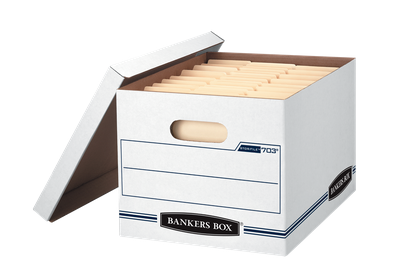 A bankers box TM The company changed its name to Fellowes Manufacturing in 1983 and now offers all sorts of office furniture solutions (a big innovation in the 1980s and 1990s was the shredder), but still makes the Bankers Box. They’ve added features that allow files to hang inside the box itself, as well as shelving around the box that allows them to function as drawers. But modern banks, and law and accounting firms, use so much less paper. Today, if you saw these boxes in the wild, you might think the person is conducting some sort of investigation, or has been laid off. At minimum, they’re moving. Boxes are for storing an item that you don’t need every day, but you don’t want to throw away. It’s not for carrying anything with regularity. You know what is for frequently carrying things around conveniently and ergonomically? A bag. If you are a banker, particularly one who works at an investment bank, there is only one bag for you to carry: A bankers bag. Bankers BagsThe bankers bag did not acquire its moniker because it was used to carry money, although it definitely could. Rather, it is a distinctive bag that New York-based investment banks used to gift their first-year associates. Someone carrying the bag on the subway or on the Hampton Jitney would have worked at a prestigious, high-finance investment and was likely well-paid — thus, the bankers bag. “They were even considered a good way to suss out whether a guy was worth dating in the pre-Tinder days of early-aughts New York,” according to a 2019 article from InsideHook, citing a 2013 New York Sun article that asked single women about the bags. One woman interviewed said, “It means he has a good education and a good job.” It’s a cylindrical canvas bag, usually with two short handles in the middle and a long strap anchored to both ends of the cylinder. The clutch part is the bank name on the ribbon straps or embroidered into the middle. “The simplicity of the design, combined with the durability of materials and manufacturing excellence has ensured its legendary appeal,” Warden Brooks wrote on its website. Warden Brooks claims to have invented the bag in 1978. Joan Killian Gallagher used to sell corporate merchandise that firms could personalize and give to employees. Ties were popular for years, but were becoming a tired (and usually a gender-specific) gift. What other corporate merch ideas did she have? She dreamed up and manufactured a duffle bag. She claimed to have received a “roll of jacquard woven labels for bags that had yet to be cut,” which she decided to use as the ribbon trim that runs around the bag. Warden Brooks bags are made in New Canaan, Connecticut; another bag manufacturer, Scarborough & Tweed, launched in 1992 and also makes its bags in the United States. The bag itself, I’m sorry to say, somewhat sucks. I love bags, I work out and I bring a lot of clothes to soccer games. A bankers bag ain’t it. It can technically fit items like file folders and papers, which would just be placed in the cavernous inside and then potentially acquire a curve as they lay at the bottom of the bag, but I wouldn’t put my laptop in it. I imagine most bankers bags have no internal organizational pockets, no dedicated shoe holder or zippered compartments for dirty clothes. It’s also somewhat dissonant to imagine an investment bank employee leaving work wearing a suit and toting a tube-shaped duffle. I am not the only one who thinks these are design flaws. “They’re wildly impractical for business use,” Bloomberg News wrote in 2015. “The straps aren’t adjustable. There are no zippered pockets, no laptop sleeve, no interior structure at all.” 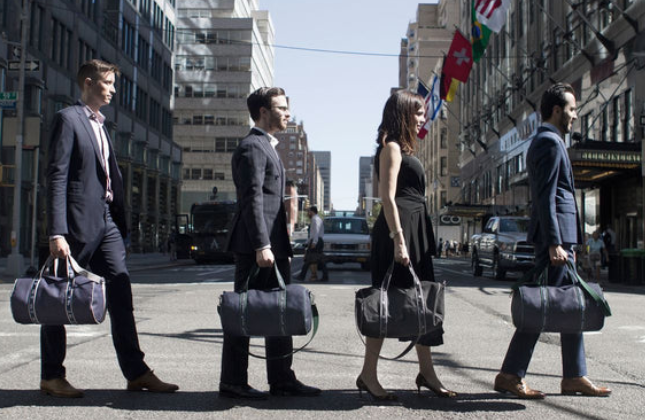 Is this supposed to look cool? Source: Scarborough & Tweed These bags aren’t as ubiquitous as they used to be. The Bloomberg article reported that the last time Goldman Sachs & Co. gave them to a whole class of associates was the class of 2008-09 (hmm, wonder why), but at the time, the bags were still for sale on the firm’s internal website. That gives them an opening today to make a comeback. I think they’re still a unique corporate gift item, especially for financial services firms. Prepsters would probably look amazing carrying one of these, I bet (full outfit: polo, salmon shorts, boat shoes, croakies, maybe a sweater wrapped around the shoulders and then obviously numbers after the name). 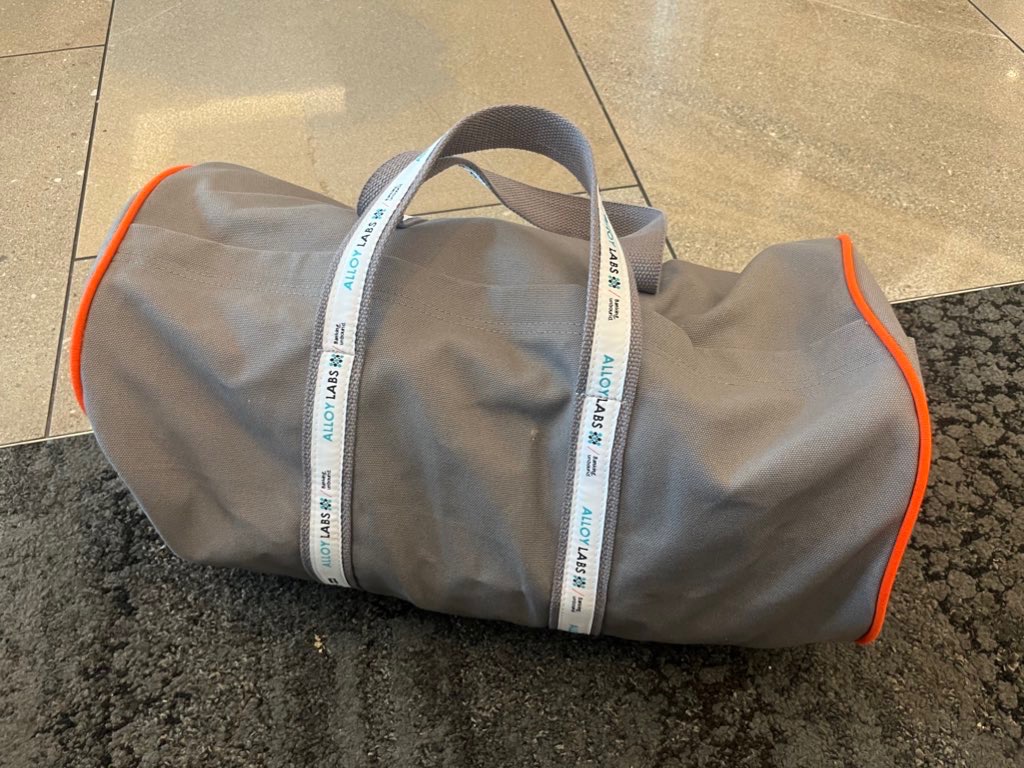 Source: Of course, the only cool bankers bag is the Alloy Labs bag But where banker’s bags excel is as satirical corporate merch. Showtime reportedly made an “Axe Capital” banker bag from the show Billions — I couldn’t find an example, but there’s a fleece vest that’s also funny. InsideHook added that there have been bankers bags for Duke & Duke Commodities Brokers, the fictional firm from the 1983 film Trading Places, and Pierce & Pierce Mergers and Acquisitions from the 2000 film American Psycho. Nostalgia is inWhen I was writing about interest rate exportation, I half-joked that loans aren’t really made in any physical place or branch unless a server farm in Virginia counts. The digitization of banking means that there’s much less paper and much less need for a lamp pointing downward at documents on a desk. The high-flying investment banks still have cache, but jobs at hedge funds, private shops and technology have stolen some of their thunder, especially after the Great Recession. Banking has changed. It has changed in so many ways. A lamp, a box and a bag are all reminders of how much. They all bear the moniker of banking, but the banking industry today barely resembles that era. EVENT SPOTLIGHT: GETTING AI AGENTS OUT OF THE SANDBOX Offline testing is the difference between an AI pilot that stalls and one that ships. Gradient Labs' Neal Lathia has dozens of times. The firms that get AI agents into production start narrow, loop in compliance and security before launch instead and have a clear way to measure impact once it's live. Join me and Neal for a working session on what it actually takes to get from pilot to production, and how to know it's working once you're there. FROM THE VAULT What’s on my mind and filling my time: 💐 Stop and smell the flowers: I saw the Fleurs de Villes’ Gilded Age exhibit at Nashville’s Cheekwood estate and gardens this weekend. If the exhibit comes to your city, go see it! It’s a global touring flower show that works with local florists to replicate a painting, or here, looks from the show. They’re live flowers, so the exhibits last a week. 🐟 Thinking about: what 20-year-old fish sauce must taste like. A small Canadian town is removing 900,000 liters of fish sauce that has been abandoned for more than two decades. Defector interviewed a Vietnamese food scientist about how fish sauce is made and what it might taste like. In other fish sauce food science news, Gastropod did an episode about the Ancient Roman (not Asian!) origins of fish sauce and its relationship to ketchup. 🎙️ On Bank Nerd Corner: Catherine and I discuss the 2010 action heist movie “The Town” with Jerry Clark, a retired FBI agent who specialized in bank crime. Jerry explains what he thinks the movie got right and wrong about bank robberies, shares how law enforcement investigates these crimes and names some memorable cases from his career. Thanks for reading! Feel free to send me any photos you have of these bankers items or have another bank item I should research. - Kiah | |||||||||
|