{beacon}
 | |||||||||
| | |||||||||
 Happy Friday, Fintech Takers! And happy last day of July! I am wishing for a comparatively cool and comparatively smoke-free August. We shall see if my wishes come true. Before we get started, a quick animal trivia question (brought to you by my younger son, who is obsessively interested in such things): You know what the fastest land animal is. The cheetah. But do you know what the second-fastest land animal (and the fastest land animal over long distances) is? The pronghorn. Also known as the American antelope. Fun facts about the pronghorn: It is not related to any species of antelope, but is rather the only surviving species in the animal family Antilocapridae, which is more closely related to modern day giraffes. This lonely lineage grants the pronghorn an incredible advantage, as all of the predators that it evolved to evade have since become extinct (the American cheetah, most notably). Its main evolutionary adaptation is the ability to run really fast (top speed of 55 to 60 mph) for a really long time (35–40 mph for up to 4 miles and 30 mph for a staggering 20+ miles). They live in western and central North America (Wyoming, most notably) and if you see one, take a good look, because you ain’t ever catching it! And now, fintech, - Alex P.S. — I’m going to be talking with Wex about the evolutionary journey of embedded payments and the infrastructure implications of that journey on August 19th. If that sounds like your kind of nerd talk, sign up to join us! Was this email forwarded to you? Sponsored by Fundbox Approved and funded aren't the same thing in small business lending. A business gets the green light, then waits, sometimes for days, for money to show up. Working with Lithic and Mastercard, that funding shows up as a virtual card, tied directly to the business's credit line, ready to spend at a supplier, a vendor, or point of sale. The Challenge of Building a Bundle Around OutcomesToday’s essay is about product bundling, so we are required to start with a certain Jim Barksdale quote:
The important (and often unsaid) implication of that quote is that unbundling is what you do when you are focused on growth and customer acquisition (attack a shitty incumbent bundle with a superior wedge product and steal their customers away) and bundling is what you do when you are more focused on establishing long-term profitability (cross-sell additional products to reduce CAC and increase LTV). For close to two decades, fintech was in its growth and customer acquisition era. Today, it’s firmly in its profitability era, which means bundling! However, while the impetus for suppliers to bundle products together is clear and unambiguous, the same cannot be said for buyers. Consumers are under no obligation to sign up for a bundle, just because the provider of that bundle wants them to. Fintech companies have to give them a reason to sign up (and to stay). So, with that preamble out of the way, I’d like to share my theory about product bundles in consumer finance. A Theory of Consumer Finance Product BundlesMy theory is that there are three main reasons why financial services consumers choose product bundles. The first is convenience. It is easier and faster and less confusing to get five different financial products from a single provider than it is to get them from five different providers. This is an obviously true statement. However, it is less obviously true today, in 2026, than it was in 2006 or 1986. Financial products have become more convenient thanks to the development of digital channels, which have supplanted branches as the most common way that consumers acquire and access them. This technology-fueled convenience helped enable fintech companies to unbundle banks, which had spent decades benefiting from the basic reality that working with multiple banks — and having to frequently visit multiple bank branches — was simply too painful for most consumers to even contemplate. The second is pricing/rewards. This is two different ways of looking at the same basic idea: The financial services provider offers a financial incentive (either a lower price or a set of rewards) for having and using a bundle of their products. This bundling strategy is not unheard of in banking, though it’s not particularly common for a multitude of reasons, including, most prominently, the fact that (until recently) banks’ convenience-based bundles were so compelling that they didn’t need to go any further. The third reason is outcomes. At the end of the day, money is an enabling technology. It doesn’t exist for its own sake. It exists to help us get the things we want. Sometimes the things we want are simple and immediate (a safe place to keep my money, a reliable way to spend my money, etc.), but often the most valuable ones are complex and far away (enough money to live on in retirement, financial security for loved ones, etc.). A well-constructed product bundle that is tailored to an individual consumer’s desired long-term outcomes can, in theory, be a compelling reason to select one provider over another. So, those are the three reasons: convenience, pricing/rewards, and outcomes. I don’t think of them as mutually exclusive alternatives, but rather as building on top of each other, in a stack: 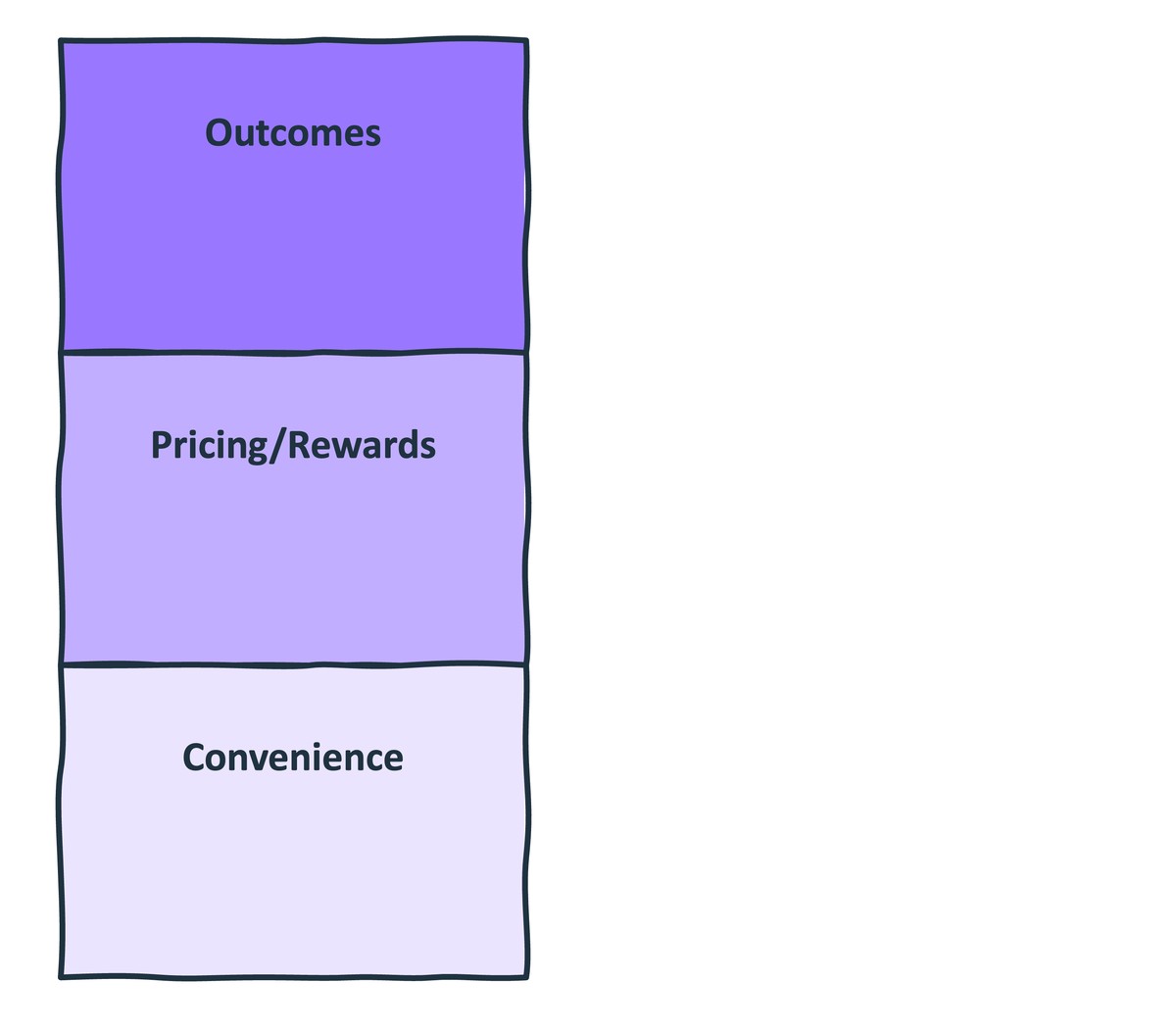 Convenience is the weakest reason to select a bundle because it’s the easiest to deliver. If you can build a website or a mobile app, you’ve met the basic requirement for convenience in 2026. It’s also the easiest for the consumer to verify. You don’t have to take a bank or fintech company’s word that their products are convenient. You just acquire and use them yourself and judge the experience. That said, while convenience isn’t a particularly strong differentiator, it is a prerequisite for the more compelling reasons higher up in the stack. No one is signing up for a financial product bundle that offers amazing rewards if they have to walk into a branch to get them. Pricing/rewards is a stronger reason to select a bundle and similarly easy for the consumer to verify (did I get the price and/or rewards I was promised?) though banks and fintech companies will sometimes try tricky things to obscure the actual economic value being offered, such as converting dollar-based rewards into synthetic currencies like points or miles. However, pricing/rewards tied to product bundles is more difficult to deliver because it requires a level of organizational collaboration that some institutions — particularly large, highly siloed banks — struggle with. Pricing/rewards is also a prerequisite for the layer above it. Financial services consumers are, generally speaking, not willing to accept a significantly worse deal in the short-term, even if it will lead to better outcomes over the long term. The pricing and/or rewards offered in any product bundle need to at least be competitive. Outcomes is, I believe, the strongest reason to select a bundle and, unlike the two layers beneath it, essentially impossible for the consumer to verify. You can judge convenience in an afternoon. You can judge rewards at the end of the month. You cannot judge, in 2026, whether the bundle you just signed up for is going to get you to a comfortable retirement in 2056. And by the time you know the answer, there is nothing you can do about it. The consumer isn't evaluating a product. They're extending trust. Outcomes is also, by a wide margin, the most difficult reason to deliver. It requires a commitment from the customer (you only get the outcome if you actually consolidate and stick with the system) and a lot of work from the provider to tailor the system to each individual consumer and the willingness, by that provider, to be accountable for delivering the outcomes. Each level of the stack is progressively more difficult to deliver than the one below it. However, as you move up the stack, the expenses (and who is required to pay for them) don’t increase linearly. There are breakpoints: 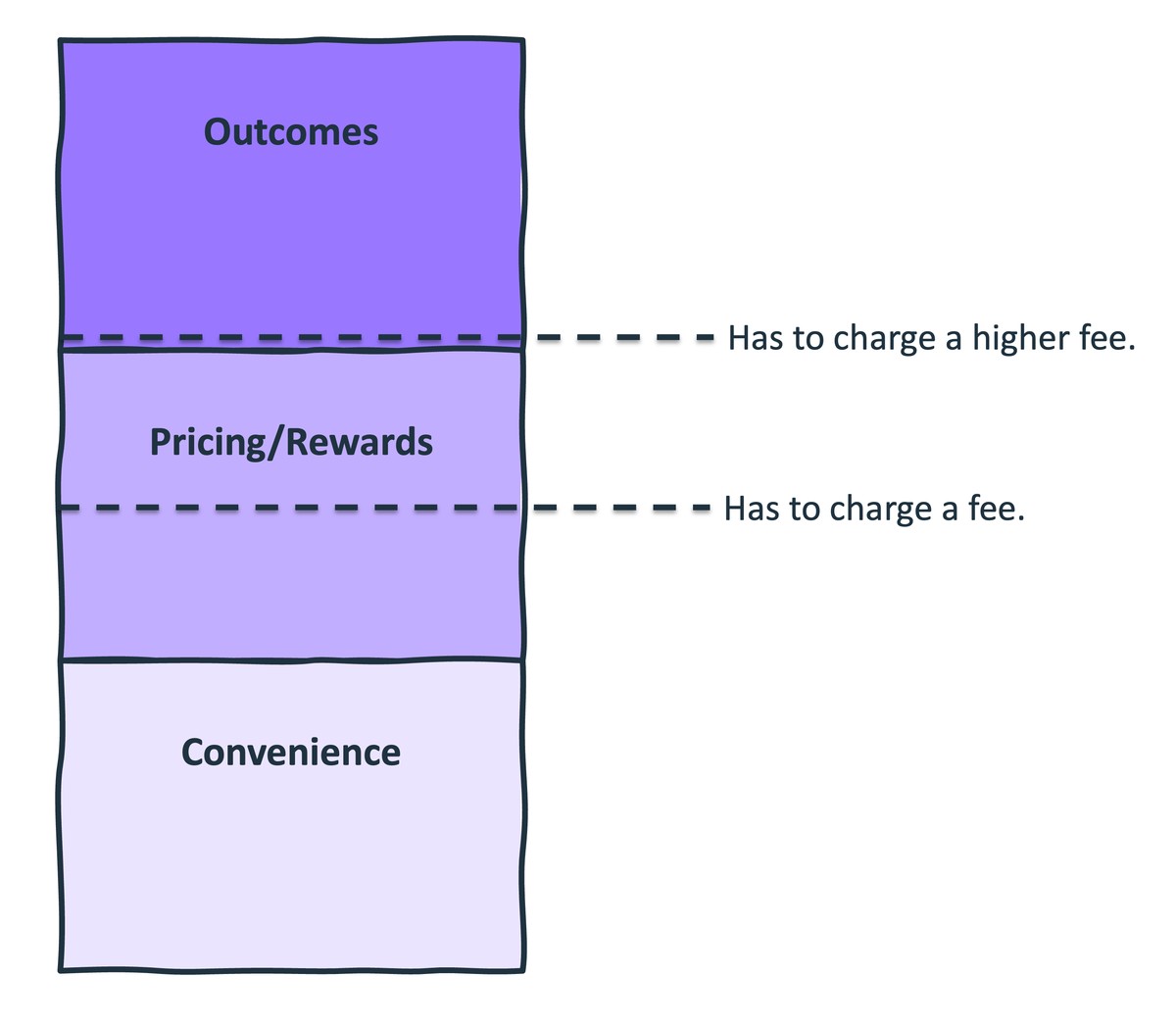 Convenience is cheap. Not free — building and maintaining good digital tools is real work — but it's a fixed cost you pay once and then spread across your entire customer base. The marginal cost of delivering a well-designed mobile app to your ten millionth customer is roughly zero. This is why nobody charges for convenience, and also why nobody wins with it. Everyone can afford it. Pricing/rewards cost more, but up to a point it pays for itself. Every additional product a customer holds lowers your acquisition cost and raises their lifetime value, and you can hand some of that back to the customer in the form of rewards or a better price. Banks can usually hand back more than fintech companies can, because they have a tool that non-banks don't: Maturity transformation. Deposits fund loans, and the spread between them is a form of cross-product revenue generation that can subsidize a lot of generosity. But this only works up to a point. Past it, the rewards cost more than the consolidation is worth, and somebody has to make up the difference. That somebody is almost always the customer, and when you start charging customers fees for product bundles built around pricing/rewards, it turns the bundle into a utilization calculation. You charge an annual fee or monthly subscription, publicly justify it by calculating the maximum economic value of all the perks and rewards it offers (up to $6,000 in annual value!), and privately justify it with the knowledge that most of your customers won’t jump through all of the hoops necessary to capture the full value. Outcomes is not a more expensive version of the same thing. It is a different thing entirely. In the lower two layers, doing the job well and selling more products are the same activity. A better app means more usage, which means more products. Better rewards mean more spend, which means more products. Every dollar you put into convenience or pricing/rewards comes back to you through the products they help you sell. In the top layer, that relationship inverts. What you are selling is a willingness to pursue the best outcome for the customer even when it is not the best outcome for you. Sometimes the right answer is to pay down the debt instead of opening the investment account. Sometimes it's to max out the employer match before funding the IRA you would rather sell. Sometimes it's to leave the money where it is. The job is not to cross-sell blindly, and, consequently, the better you do the job, the fewer products you may sell. That's the first expense. The opportunity cost of intentionally not maximizing product sales. The second expense is that this layer requires trustworthiness that can be verified, precisely because the outcome itself cannot be. And verifiable trustworthiness is both restrictive and costly. It means constraining what you are allowed to sell, documenting why you recommended what you recommended, and putting someone qualified and accountable behind the recommendation. That is not a fixed cost you get to spread across a customer base. It is a cost you pay per customer, which is why this is the layer where the real fees show up. Putting Theory Into PracticeOver the last ten months, three companies have announced products that do essentially the same thing: They add an outcomes-oriented guidance layer on top of an existing bundle of financial products. Three different companies, three different starting points, three different answers to the question of where, precisely, in the stack they're trying to compete. They're useful because they aren't the same. Taken together, they help us map the emerging competitive dynamics in consumer finance. On September 30, 2025, Fruitful announced a product called Money Map. Fruitful is a subscription financial guidance company. You pay a monthly membership fee, you get assigned a dedicated Guide (a human certified financial planner), and that Guide builds you a Money Map: A personalized plan for where every dollar of your income should go. Once that plan is finalized, you hit "Go," and Fruitful opens the accounts, and "Income Split" rules start routing your paycheck according to the plan. Membership is what unlocks the products — Fruitful Cash Accounts paying 4.00% APY, a secured charge card with up to 2% cash back, and managed investment portfolios with no management fee. It costs $48 a month for the Essential tier and $148 a month for Plus. On October 15, 2025, Acorns announced Money Manager. It's a paycheck splitter. Once you have four Acorns accounts open (checking, savings, investing, and retirement) and either a direct deposit of at least $10 or a recurring deposit of at least $50, Money Manager divides every incoming deposit across those account types automatically. The default split is 85% to spending, 10% to saving, and 5% to investing (which covers both investing and retirement), and you can change it whenever you want. Acorns layers goals on top of it — "Milestones" like building up one month’s worth of income — which it generates from the annual income you report at signup. Money Manager requires Acorns Gold, the top subscription tier, at $12 a month. On June 2, 2026, SoFi announced SoFi Coach. It's an embedded AI chatbot, built with the help of SoFi's human financial planning team, that is free for all SoFi members, giving them personalized guidance on tracking, budgeting, saving, and investing. Two things about it are worth noting. First, members can link their outside accounts, which means Coach can look at your other bank accounts, brokerage accounts, and retirement accounts sitting at previous employers. That's a much wider field of view than Acorns or Fruitful. Second, according to SoFi's own disclosures, Coach is already, partially, agentic, able to take certain actions on a member's behalf in the course of a chat. It doesn’t just answer questions. Here's where I'd put each of them in the stack: 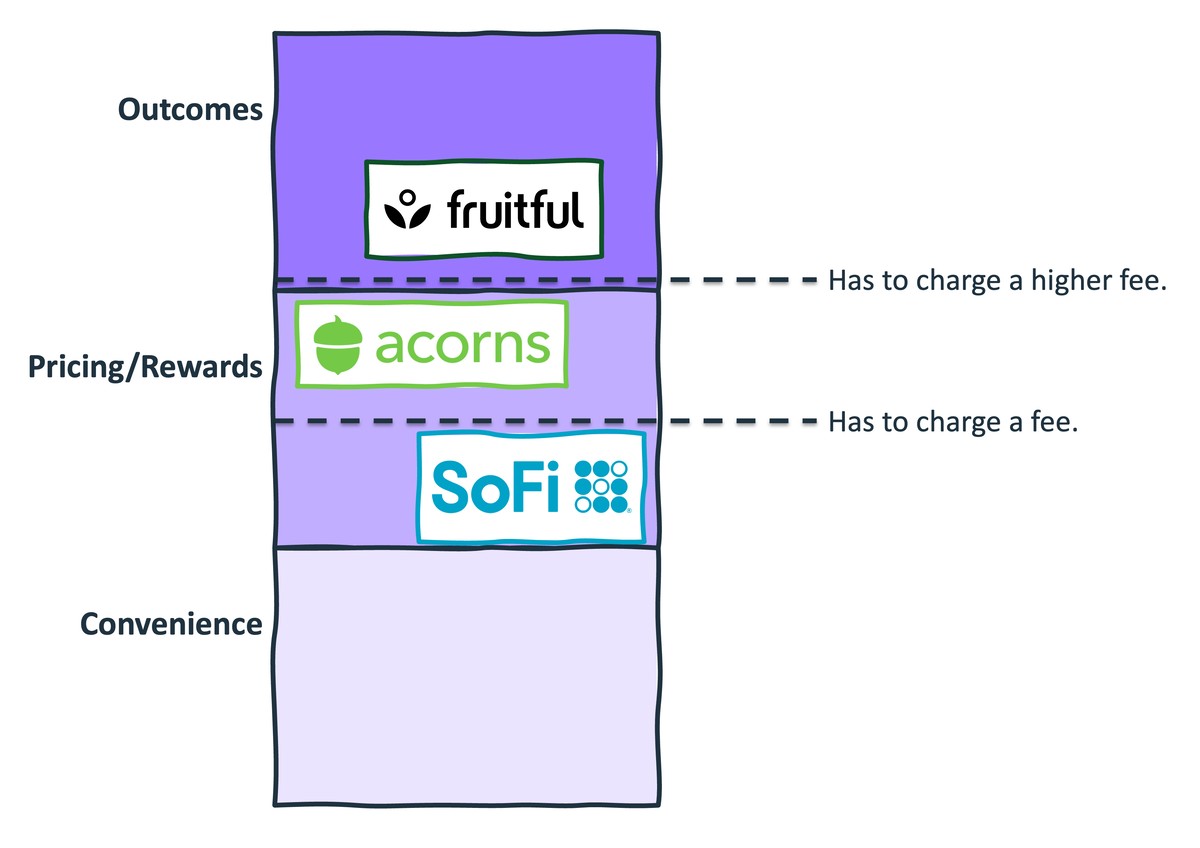 Let's work up from the bottom. SoFiSoFi’s bundling strategy has been extremely successful. The pitch — the more you do with SoFi (giving it your direct deposit, signing up for more products, using the products responsibly, etc.), the more rewarding it is (lower rates on loans, higher rates on savings, early paycheck access, etc.) — has helped the bank reach “escape velocity,” to use SoFi’s CEO Anthony Noto’s term from the company’s Q2 earnings call: 15.8 million members, with 51% of new account openings coming from existing members. Notably, SoFi has achieved this without having to lock all of those pricing and rewards perks behind a paywall. While the company did transition its Plus membership tier (matches on investment contributions, boosted cash back, loan discounts, unlimited access to financial planners, etc.) to a paid subscription ($10/month rather than qualifying through a direct deposit) in March of this year, the number of SoFi members that have opted for the paid Plus subscription is comparatively tiny: 200,000, or less than 2% of SoFi’s 15.8 million members. The reason it can afford to offer a mostly-free pricing/rewards-focused bundle is, of course, that it’s a bank. It ran a net interest margin of 5.98% last quarter and produced $788 million in net interest income. That maturity transformation — turning deposits into loans — is how it can afford to subsidize a rewarding product bundle when non-bank fintech companies cannot. And the fact that SoFi still operates more like a fintech company than most banks is why SoFi has made more progress with this bundling strategy than other big banks, which often lack the ability to get their siloed product organizations to cooperate with each other. And now it’s layering on Coach — an AI-powered financial guidance service — and moving towards the outcomes layer of the stack. On the surface, Coach has nearly everything the third layer requires. It can see across a member's entire financial life, including money that SoFi doesn't hold. It delivers tailored guidance, built alongside SoFi's own human financial planners. And it can act on behalf of members (opening new accounts, transferring money, etc.) If you were assembling the toolkit for an outcomes-focused bundle, this is most of it. But when you read the disclosures underpinning the product, the limitations become clear. Coach's responses are information for you to consider, not financial advice. They are not recommendations. They are based on limited information and may contain inaccuracies. Coach may show you SoFi products on which SoFi earns revenue. And, most importantly: You are solely responsible for any financial decisions you make. Coach is offered by Social Finance, LLC. Not by SoFi Wealth, the SEC-registered investment adviser that SoFi also owns. SoFi has an RIA. It chose not to put Coach inside it. SoFi built the tailoring. It built the widest view of a member's finances. It built the ability to act. And then it assigned every consequence to the member. This is why Coach is free and unlimited access to SoFi’s human financial advisors is locked behind a $10 paywall. The cost of guidance depends almost entirely on whether anyone is answerable for it. If nobody is, you build the thing once and serve it to 15.8 million people. Everyone gets a version of the same reasoning, and nobody has a claim against you when it turns out to be wrong. That's a fixed cost, and fixed costs get cheaper per customer as you grow. True accountability breaks that. To stand behind advice, you have to know enough about each individual to justify it — their income, their debts, their taxes, their timeline, the money they hold somewhere else, the thing they're actually afraid of. You have to keep knowing it as their life changes. You have to be able to show your work, per person, if a regulator asks. And you have to carry the risk that any one of them was badly served, which is a risk that arrives with every new customer instead of being diluted by them. Large language models (LLMs) are, arguably, capable of delivering that individualized guidance (as opposed to traditional robo-advisors, which were not), but it appears that SoFi is not willing to promise that level of accountability, delivered by AI. At least not yet. AcornsAcorns sits above SoFi in our stack and it charges more than SoFi ($12/month vs. $10/month) while offering less. That’s confusing and deserves an explanation. It sits higher because Money Manager asks for a bigger commitment. SoFi wants your paycheck to land in its checking account. Acorns wants your paycheck to be distributed across its four core deposit and investment products, automatically, according to a pre-determined set of rules. That's not just a primary banking relationship, it's a system, and agreeing to it is the kind of commitment the outcomes layer runs on. You can't manage somebody's money toward a goal if their money isn't there and isn't organized. It charges more because Acorns isn't a bank. It has no maturity transformation to subsidize with, no spread to hand back, so a much larger share of the cost of the bundle has to come directly out of the customer's pocket. This is the cleanest demonstration I can offer of why owning a bank matters to the economics of bundling: SoFi and Acorns are competing at roughly the same altitude, and the one with the charter is cheaper. What that $12 buys, beyond Money Manager, is a stack of perks — free tax filing, a $10,000 life insurance policy, a will, a 3% match on first-year retirement contributions. Which is to say it's priced and marketed on exactly the same utilization logic as SoFi Plus. Promote the maximum value, while quietly assuming that most people won't fully capitalize on it. But while Acorns gets a little closer to an outcomes-oriented product bundle than SoFi, it doesn't get all the way there, and the reason for this is noted in the footnotes of its own product page: “Acorns' Money Manager is not a financial planning service.” The tailoring is thin — the default 85/10/5 split is derived from the annual income number you provide when you sign up — and the accountability is explicitly disclaimed. Acorns has built the commitment half of the outcomes bargain and left the other half on the table. FruitfulFruitful is the only one of the three squarely in the outcomes layer, and its much more expensive pricing explains why: It pays for all of the things the outcomes layer requires. It asks for commitment from consumers, at a level far above SoFi and Acorns: A monthly fee, your deposits, and the authority to open accounts and move your money according to a plan. It provides tailoring, and not the algorithmic kind — an actual human with a financial planning credential builds your Money Map and walks you through it. And it accepts accountability. Fruitful's Guides are fiduciaries, registered as investment adviser representatives of a registered investment adviser. Fruitful doesn't focus on cross-sell, and it doesn't vary its price based on how much money you have or how complicated your situation is. There is no footnote carving the plan out of the advice. It also pays the toll on the layer below. Fruitful's 4.00% APY and 2% cash back are not there because Fruitful wants to win a rate war. They're there because you cannot ask somebody to move the majority of their financial life to you while offering them a worse deal than every other provider out there. The pricing has to at least be competitive, or the outcomes conversation never happens. A fair question to ask at this point: How does a company without a bank charter offer a better rate on deposits than most banks? The answer, I think, is that Fruitful's cash accounts are held at Emigrant Bank. This is, by itself, unremarkable. Non-bank fintech companies rent charters all the time. What's unusual is that Emigrant is also an investor in Fruitful. It owns 50%. In a typical banking-as-a-service arrangement, the sponsor bank is a vendor: It holds the deposits, earns the spread, and has no stake in the fintech company beyond deposit volume. Emigrant earns the spread and owns half the upside, which means it might be willing to pass most of the deposit economics through to Fruitful's customers, if that helps Fruitful grow. And the cost of all of this shows up precisely as my theory says it should. Fruitful charges between $48 and $148 a month. It has also already had to reprice: The entry price used to be $98 a month with unlimited access to your Guide. Today $48 gets you three sessions up front and an annual check-in, with continual access to the human financial advisors moved up into the $148 tier. The scalable parts of the bundle got cheaper. The human part got rationed. Accountability is a per-customer cost, and per-customer costs are the ones you can't grow your way out of. Will people pay for outcomes? (And will they always have to?)So where does this leave us? The honest answer is that we don't yet know whether consumers will pay for product bundles that are fully oriented around outcomes. There's a version of the story where they won't. Fruitful has already cut its entry price in half and rationed access to the advisory side of its product. SoFi's paid tier, which includes unlimited appointments with human financial planners, has been taken up by less than 2% of its members. You could read that as the market telling you something. You could also read it as a market that hasn't been asked properly yet. Fruitful is very early, and it's the only company here actually running the experiment — the whole bargain, commitment on one side and accountability on the other, priced honestly. It will be a good test case. I'd like to see what it looks like with a few more years under its belt. My own guess is that consumers do want product bundles built around outcomes, and that most of them are not going to pay $48 to $148 a month to get one. Which makes the interesting question not whether the demand exists, but whether outcomes can be made accessible. That's where AI comes in. Delivering outcomes requires two things: intelligence and accountability. The intelligence is the tailoring — knowing enough about a specific person to build them a system that actually fits, and presenting it in a way they'll stick with. AI is good at this, it's getting better, and it’s collapsing the cost of it towards zero. Accountability is a different problem, and AI doesn't help. If anything, it makes it worse. A human financial planner can explain why she recommended what she recommended. An LLM can't, at least not in a way that will satisfy an examiner. And human planners fail one client at a time, in idiosyncratic ways. A model that is wrong is wrong for everybody at once. Standing behind AI-delivered guidance means accepting a liability that is correlated across your entire customer base, produced by a probabilistic system that nobody fully understands, including the people who built it. So the challenge of building a bundle around outcomes has narrowed to a single variable. Every other ingredient — the commitment, the tailoring, the wide view of a customer's financial life, even the ability to act on it — is now available, at scale, for free. The only thing missing is somebody willing to be answerable for it. MORE QUESTIONS TO PONDER TOGETHER Big news for the endlessly curious (yes, you): I’m collecting your fintech questions on a rolling basis. What’s keeping you up at night? What great mysteries in financial services beg to be unraveled? Think of it this way, if a stranger is a friend you just haven't met yet, your question is a Fintech Takes conversation waiting to happen. One that could headline a Friday newsletter or be answered in an upcoming Fintech Office Hours event. Drop your question here, whenever inspiration strikes! WHERE I'LL BE Event season is about to start! Here's where I'm planning to be. ✈️ FinovateFall | September 9-11 | New York CityMy can't miss fall conference! September in New York is glorious and the fintech conversations will be too. ✈️ Cash Flow Intelligence Summit | September 10 | New York CityNova Credit has rebranded this from the "Cash Flow Underwriting Summit" to the "Cash Flow Intelligence Summit." Come find out why. ✈️ FDATA Global Open Finance Summit | September 17 | TorontoThis will be my first time at an FDATA event and my first time back to Toronto in a long time. If you work in open banking in Canada and want to yell at me for my bad takes in the past, this is your chance! ✈️ AI-Native Banking & Fintech Conference | September 29 | Salt Lake CityThe name of this event is a mouthful, but the content and networking are both A+. Thanks for the read! Let me know what you thought by replying back to this email. — Alex | |||||||||
|