{beacon}
 | |||||||
| | |||||||
Hospitalogists, Yall got any of that BPC-157?  Today’s newsletter is a teardown of the 4 publicly traded hospital operators who have reported Q2 results so far. It’s pretty meaty so enjoy! PS - yes, this is all free but if you wanted to throw me a buckaroo PPS - if you see a typo I’m not fixing it. (But let me know) Was this email forwarded to you? Yep, that's right. I'm a sicko sponsoring my own newsletter. Last year I hosted 50 execs in Austin for an application-only, off-record event on VBC. This year, we're doing it (slightly) bigger and way, way better. And, naturally, it's about AI. Hospital Operators, Q2 2026: The Conversation Shifts to Mix and Resiliency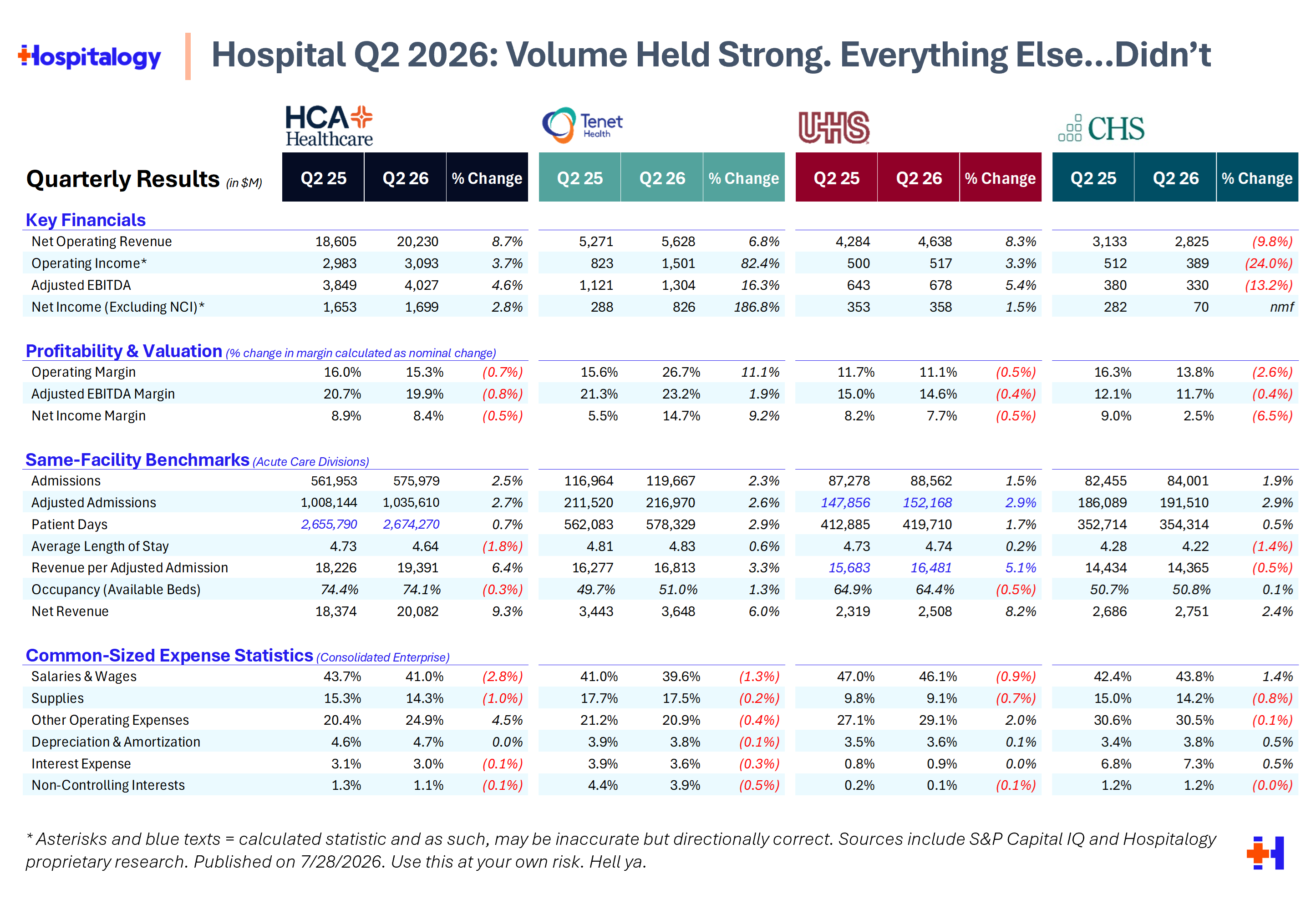 Four operators printed same-store adjusted admissions inside a 30-basis-point band between +2.6% and +2.9%, then produced adjusted EBITDA growth ranging from +16.3% to -13.2%. Demand was less important this quarter while mix and cost structure - e.g., increasingly variables of operating excellence and not macro tailwinds, did more the work. 3 of the 4 operators cut full-year guidance while sitting on larger supplemental payments than they had originally modeled mostly stemming from Florida’s program approval. PS - the most notable exclusion from most of the talk during Q2 was AI and technological transformation. If you want to dive into any of those subjects, you’ll probably have to go to my retreat this November. Sign up here. 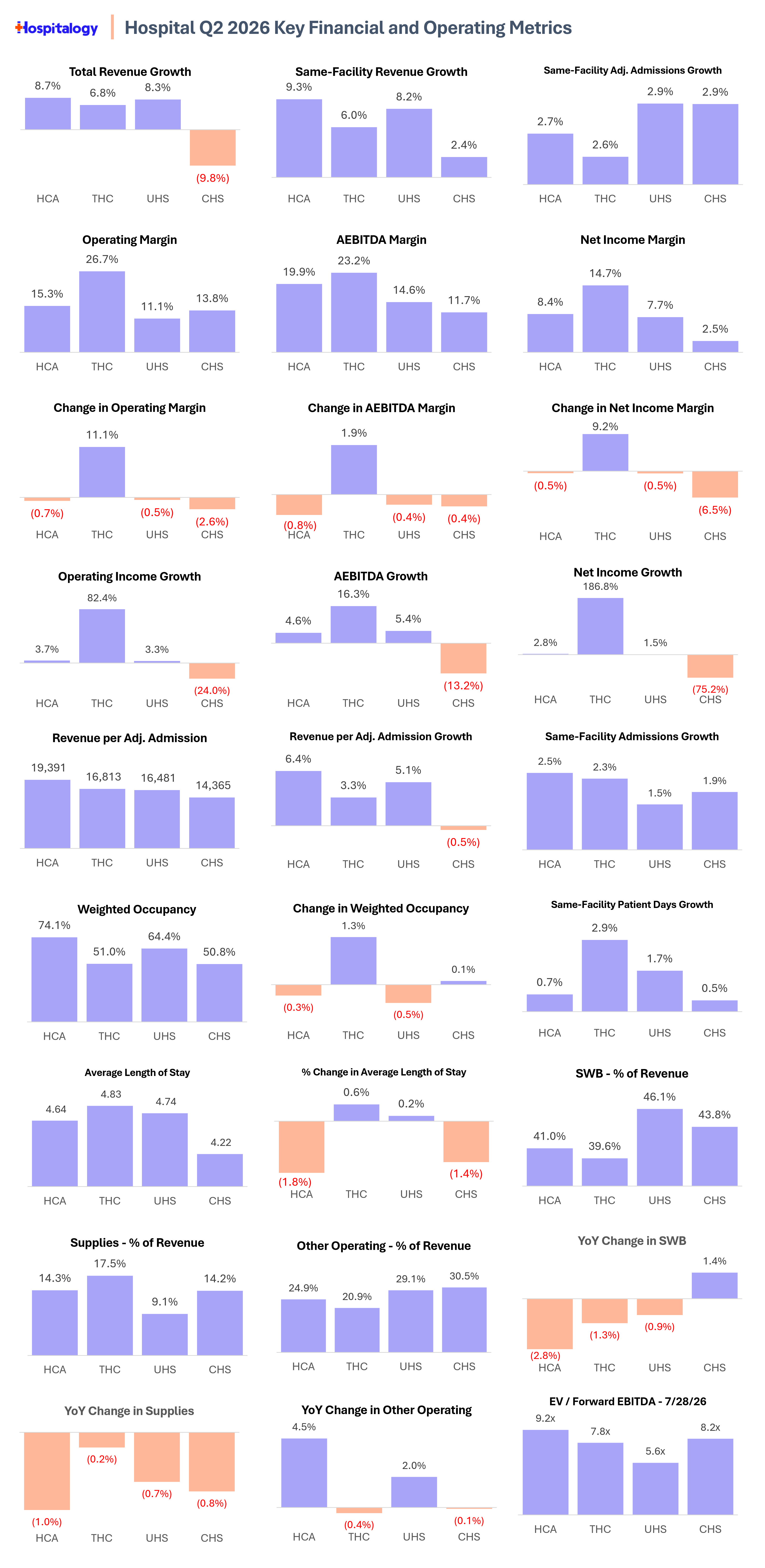 Prologue: Executive Summary and Ranking the Hospital Operators based on Q2 Performance1. Tenet (THC) — begging for an EBITDA multiple re-rate. Strong operating quarter in which the company offset a 17% decline in exchange revenues with solid hospital volume growth (the hospital segment is actually crushing it), disciplined expense management, and technology-enabled efficiency actions, producing $5.6 billion of net operating revenue, $1.304 billion of consolidated adjusted EBITDA, a 23.2% consolidated margin, and $762 million of hospital adjusted EBITDA at an 18% hospital margin. Guidance increase is sustainable long-term and driven primarily by fundamental business strength, including about $100 million of first-half outperformance and $60 million expected to continue into the second half, alongside strong free cash flow, active share repurchases, and continued momentum in USPI’s higher-acuity strategy. 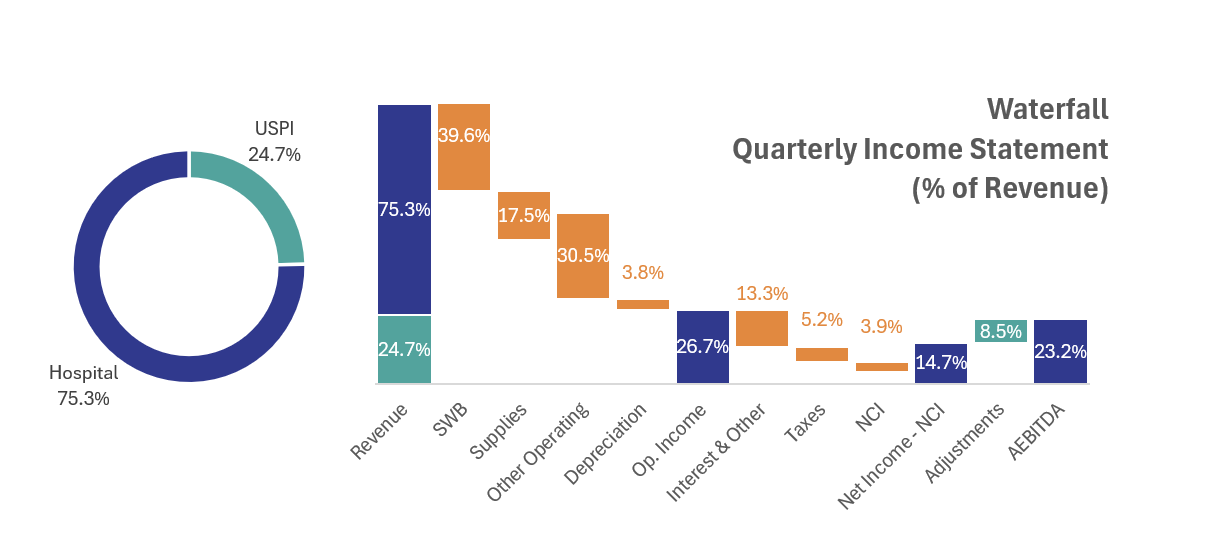 2. UHS — a multitude of speed bumps alongside a quarter of underrated underlying performance. Revenue grew 8.3% to $4,638M and adjusted EBITDA net of NCI 5.4% to $677.9M against $642.9M, with $100M of Florida directed payments in 2026 offset by $101M of supplemental in 2025. Net unusual items ran +$72M against +$76M, so ex-unusual growth was +6.9% and underlying margin fell only 17bps against the 39bps reported. UHS absorbed a $28M malpractice reserve build and $20M of a decertified San Antonio behavioral hospital and grew anyway. 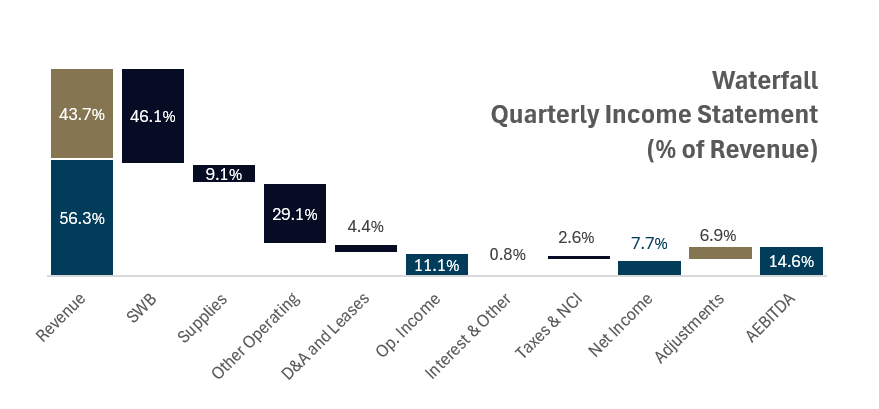 3. HCA — Supplemental payments stymy their ACA bleed, but sets up for a tough 2H. Reported +4.6% adjusted EBITDA and +11.6% EPS. ACA dis-enrollments were offset by a supplemental payment true-up, leaving HCA net ahead for the quarter, but guidance came down $250M at the midpoint even after supplemental assumptions improved ~$550M. Underlying demand and execution were better than the headline pressure suggests, with same-facility admissions up 2.5%, equivalent admissions up 2.7%, ER visits up 3.6%, and insured equivalent admissions excluding exchanges up 3.2%, while management also highlighted improving trends in emergency room visits, cardiac procedures, rehab, and essentially flat same-facility cost per equivalent admission with 1.4% sequential improvement from its resiliency efforts. 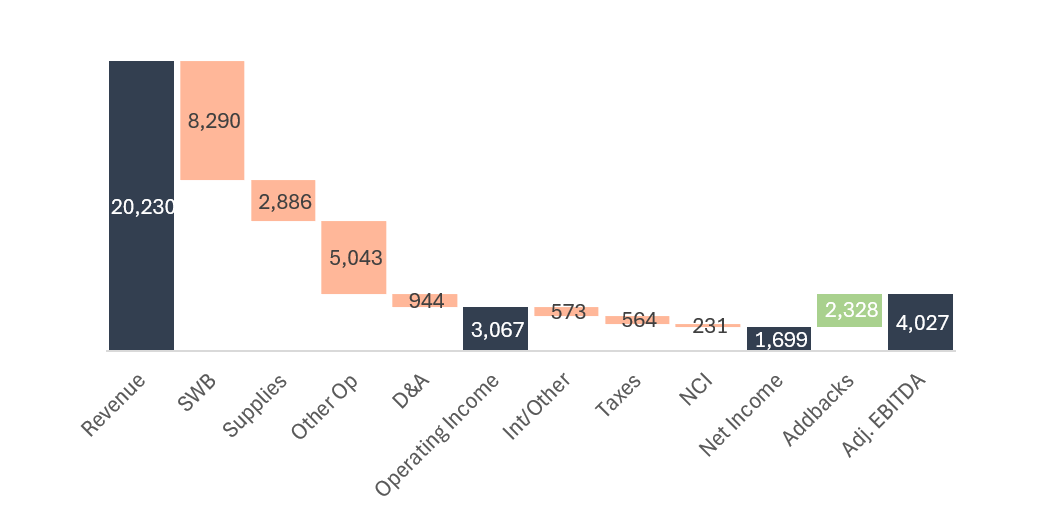 4. CHS — consistently the worst. Adjusted EBITDA fell 13.2% to $330M, margin 45bps to 11.7%, same-store net revenue per adjusted admission went negative at -0.5%, net leverage rose to 6.7x from 6.6x, and guidance fell. Patient / service mix weakened drastically. HALF of adjusted admissions growth (+2.9%) came from uninsured patients - a 110bps increase in uninsured / self-pay visits (now over 6% of visits versus under 5% last year). Weak spot was inpatient surgeries at -3.8% decline (specifically calling out cardiac procedures), same-store surgeries down 0.1%, and management noting softness in elective surgeries. Bright spots include volume strength in clinic visits and orthopedic MRIs, some expense mitigation in supplies and contract labor and positive results with state directed payment programs. Regardless, restructuring moves are likely in play ASAP given CHS’ leverage position. Bankruptcy is on the horizon if things don’t improve. 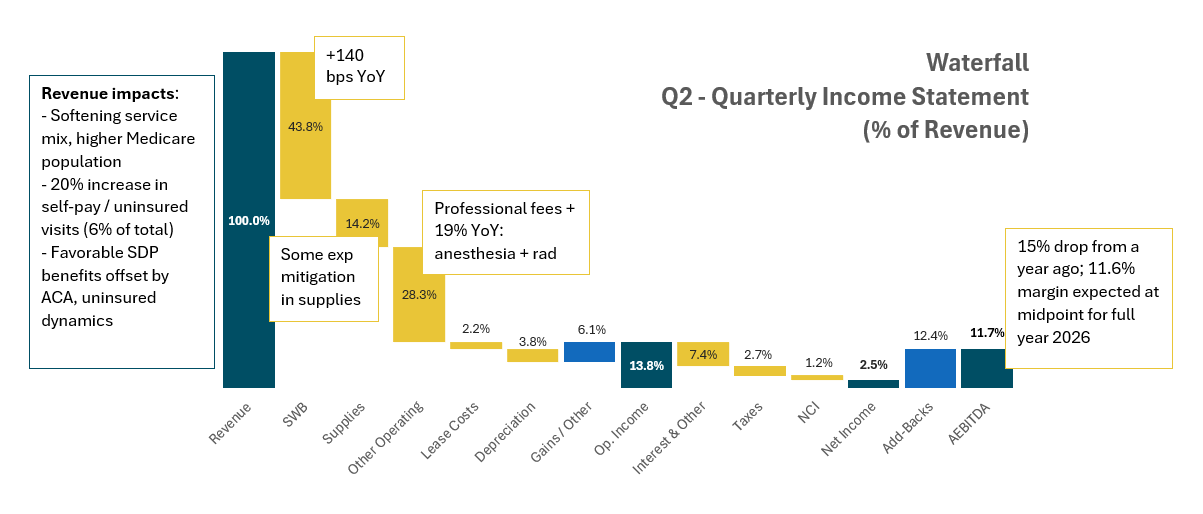 Hospitals DID see a small multiple rebound post-earnings this week and last as Ardent notably trades near an all-time high EBITDA multiple. Look at Tenet sitting at 7.8x. They have to be disgusted: 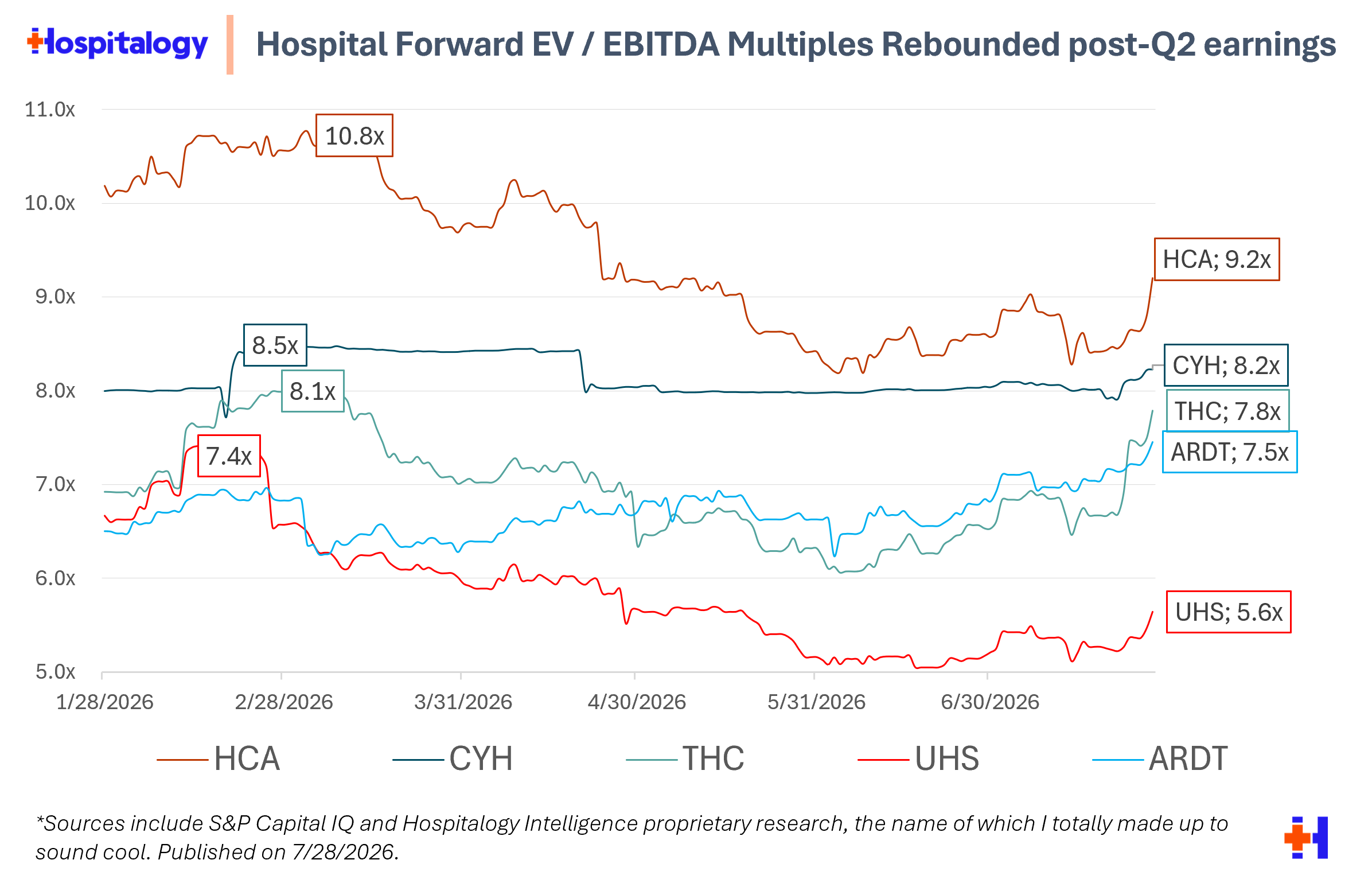 Part I: Key Hospital Macro Themes Entering 2H 2026Most of you Hospitalogists don't run a for-profit operator, but you’re around the ecosystem. You run a nonprofit system, sit on a board, invest in the space, or sell into it. So why do the publics matter so much from an intelligence perspective? These four prints are the cleanest quarterly read we get on provider economics, because everyone else discloses annually and late. Unless you’re sitting inside a dashboard with real time data at your disposal, it’s pretty difficult to get or understand leading data signals in healthcare (e.g., Intuitive Surgical’s volume print). If you have ‘em let me know. So here's what the quarter told us, quantified by operator, and how it translates to the rest of healthcare. Exchange attrition converted to uninsured at roughly 1:1, and all four operators missed on the expected commercial pickupThis was the obvious headline macro event of the quarter. Overall enrollment dropped precipitously, and we were all waiting with bated breath to see the shakeout. As it turns out, the hospital models were off by a bit. Enhanced premium tax credit expiry didn't move people from exchange coverage into commercial or Medicaid. Nope - those folks simply bucked insurance altogether, and then they kept heading straight into Community Health Systems' ERs. Basically all the folks who were on enhanced subsidies went to the self-pay, uninsured bucket. 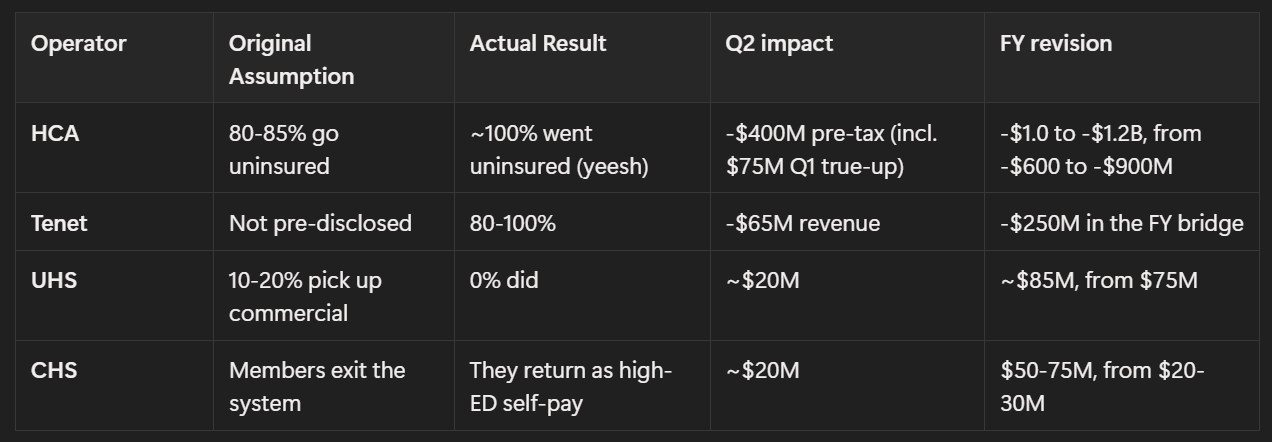 Four management teams, four different assumptions, one shared error meaning they must all use the same consulting firm eh?
Every one of those four has scale, a revenue cycle organization, and a charity care policy built for this. If a 1:1 conversion rate puts HCA down $400M in a quarter, the standalone community hospital operating on a 2% margin with no Parallon-equivalent behind it is in a materially worse spot and won't tell you until its audited financials land next fall. Emergency Medicaid application slowdowns are compounding it — HCA attributed roughly 20% of its uninsured build to exactly that, concentrated in Texas. Supplemental payments decided who beat, and it’s thanks to Florida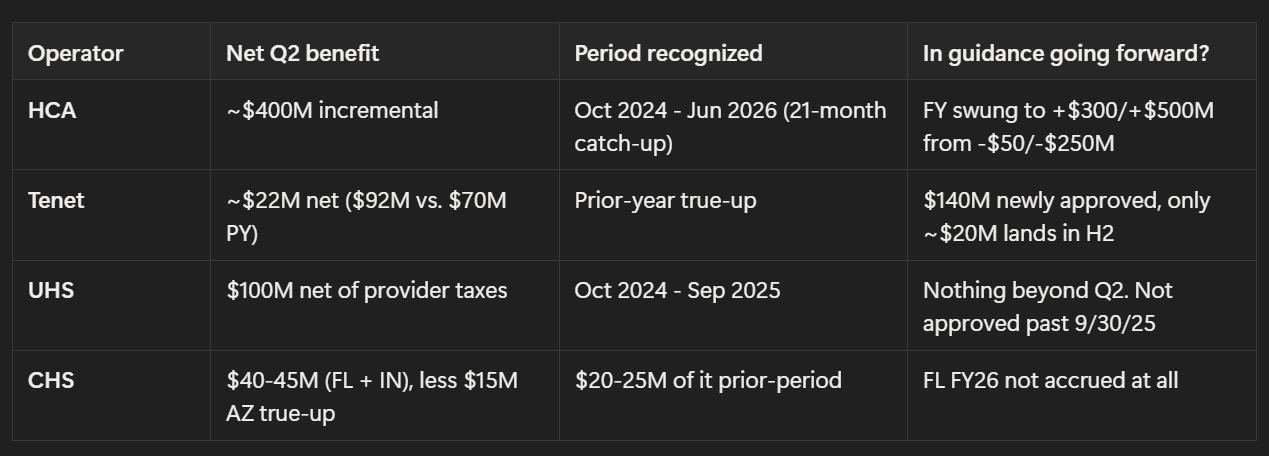 HCA's reported revenue per equivalent admission grew 6.4%. Many of the metrics below (and their other operating expense growth) is overstated given the accounting true-up: 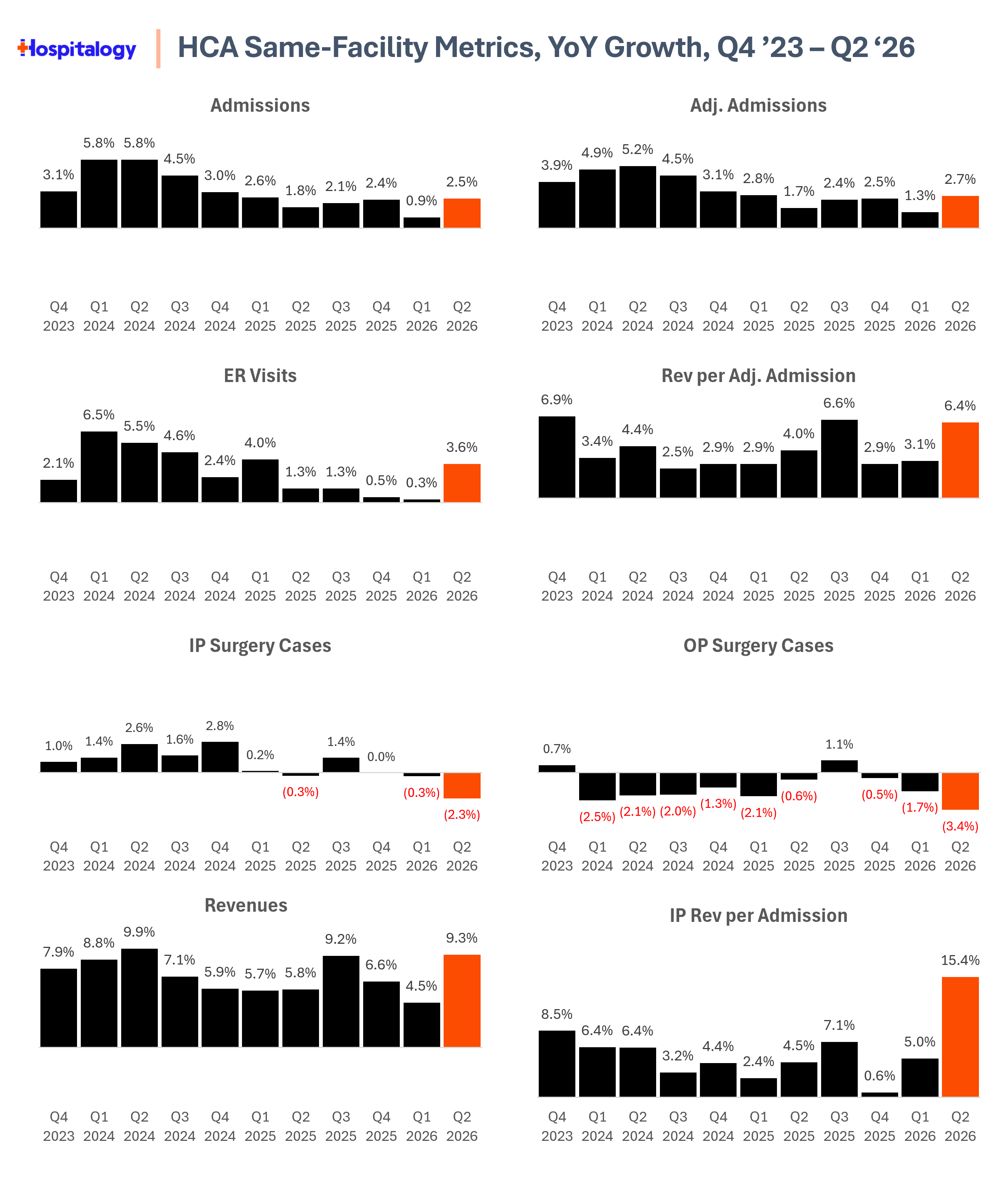 Strip out the entire DPP and that metric goes negative at roughly -0.9% which is disingenuous but crazy to think about the utter reliance on all of these government programs we all are. DPP is a big part of the game, folks. But these programs are there for a reason. Tenet's management made a great defense of DPP economics, and it's directionally correct: these dollars are earned.
Tenet tied roughly $125M of Medicaid revenue growth to real service-line investment across Southeast Michigan, Memphis, and central and desert California, with only $20-25M coming from prior-year true-up. State directed payment programs have quietly become the swing factor in provider profitability, we’re seeing ongoing potential reform happen in this space, and the accounting is inconsistent across operators reporting under the same standards. Supplemental revenues will continue to be a key area for provider organizations to assess - whether in diligence, growth conversations, or resiliency programs. You cannot grow to rely on things that are unpredictable. Just ask my ex (kidding). Supplemental Payments become a Headwind in H2HCA's own revised guidance implies a $100-300M supplemental headwind in H2. Tenet has only ~$20M of its $140M supplemental raise landing in the second half. UHS put nothing beyond Q2's recognition into its forecast because CMS hasn't approved the enlarged Florida program past September 30, 2025. CHS hasn't accrued Florida FY26 at all pending a submission it doesn't control. Long story short: the mechanism that made Q2 look survivable is largely spent. Any H2 beat from this group has to be fundamental, which makes Q3 an interesting one. An Elective Surgery Softening?HCA printed inpatient surgeries -2.3% and outpatient -3.4% same-facility. Tenet held same-hospital surgeries at -0.7%. CHS came in flat overall at -0.1% with inpatient down 3.8%. UHS was -0.8%, disclosed only on the call, and management conceded it doesn't track elective versus emergent at all. CHS named orthopedics as the largest decliner with cardiac soft on deferred cardiology visits and screenings, and then discussed some interesting network leakage dynamics: clinic visits and orthopedic MRIs running well ahead of prior year without converting into procedures. Patients seem to be getting worked up and then not scheduling. Tenet rejected the consumer-pullback read outright and called the pressure geography- and exchange-specific. 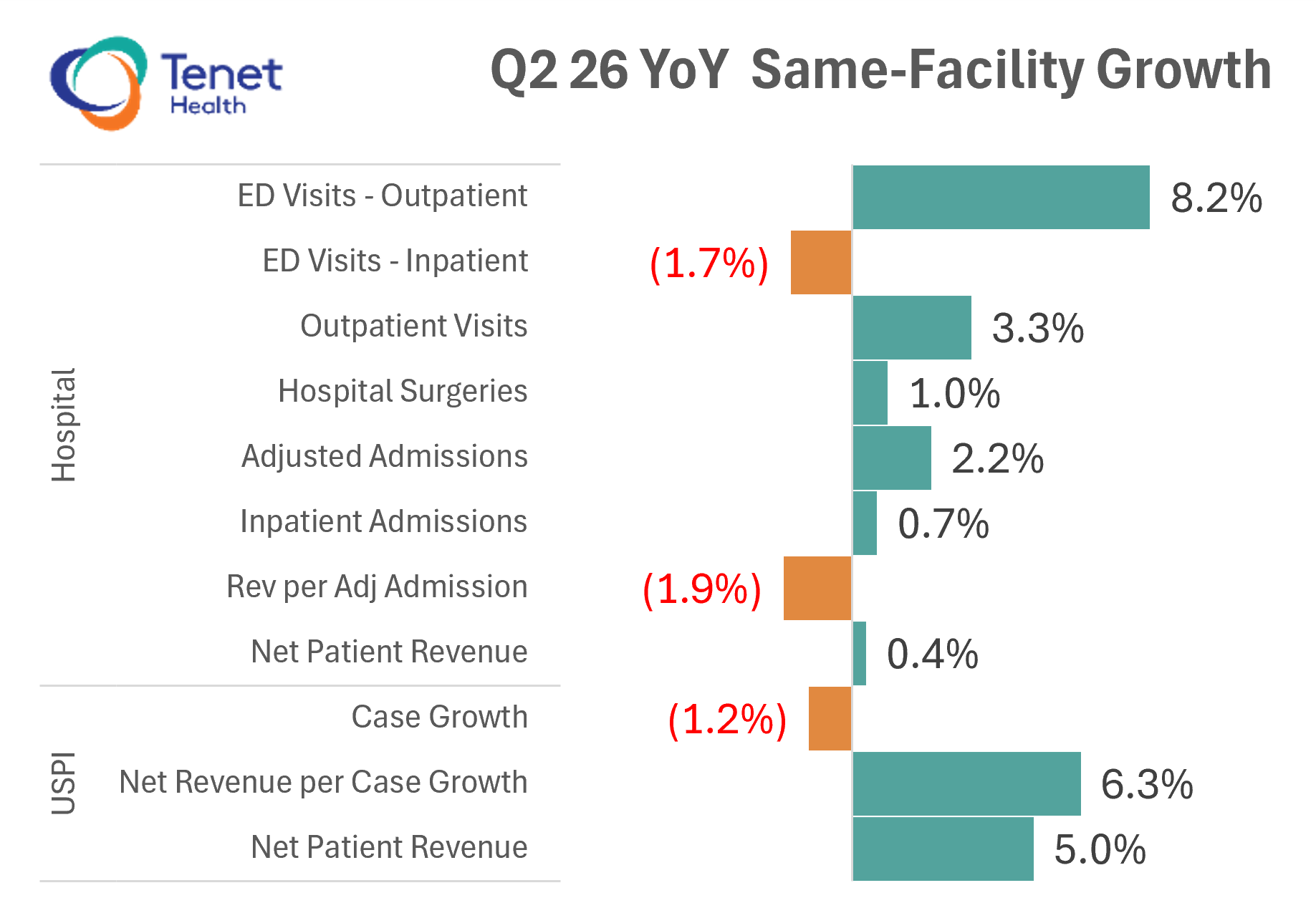 UHS blamed site-of-care migration into ASCs and freestanding imaging. Gee, maybe that’s a good thing. All three explanations can be true in different markets, and that's the point. Local markets matter. Management teams reset toward their long-term algorithmsUsing HCA as the marquee example, demand is moderating back to long-term 4-6% adjusted EBITDA growth trends and frameworks they’ve laid out for years. Back to blocking and tackling. But if you zoom out, things ain't all that bad, are they? 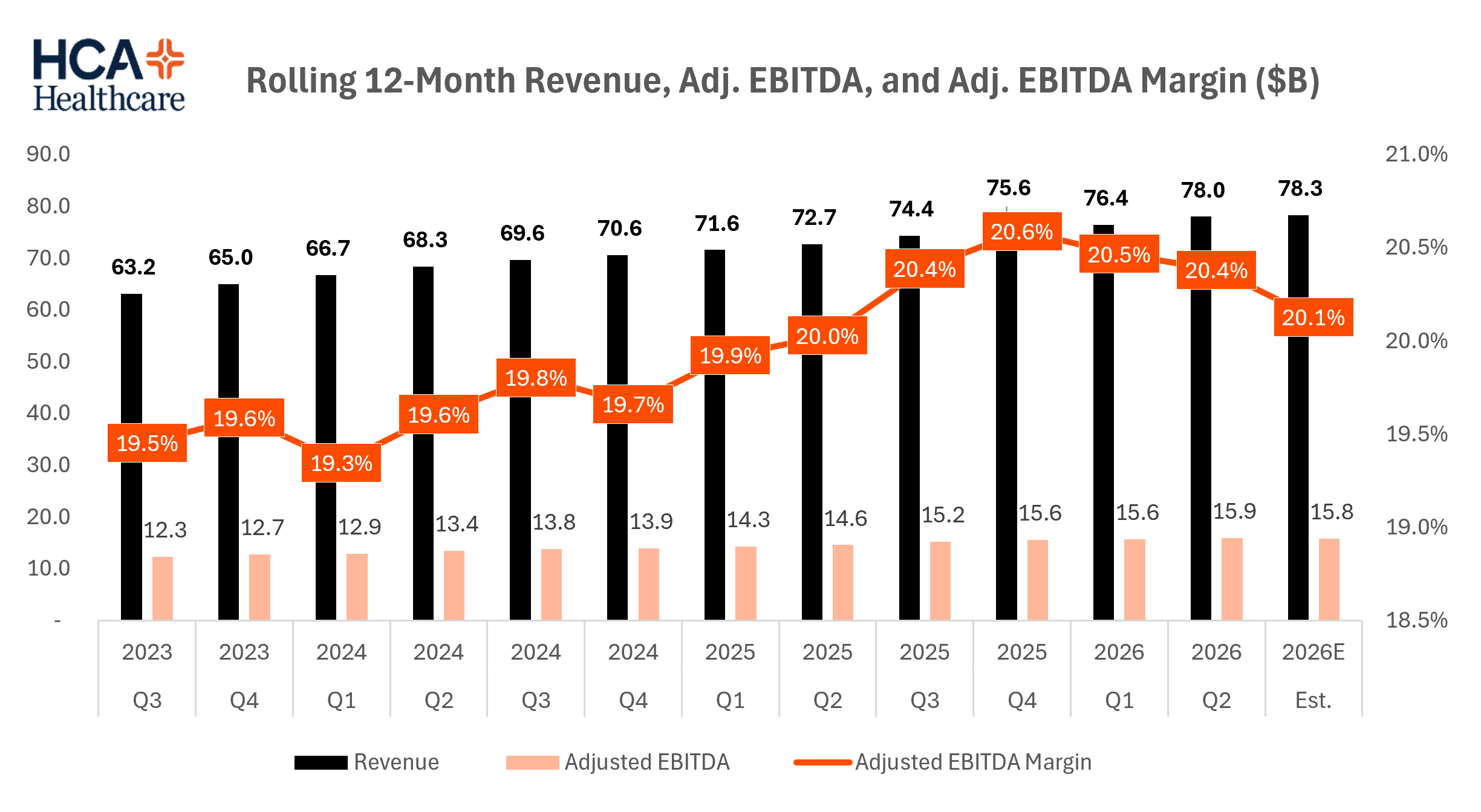 Professional fees are the new margin frontierContract labor has normalized everywhere, and SWB among those not named CHS has been trending down for years now. So the conversation has shifted to professional fees - subsidies for physician groups like anesthesia and radiology are the biggest point of inflation for HCA, Tenet, Ardent, and others. 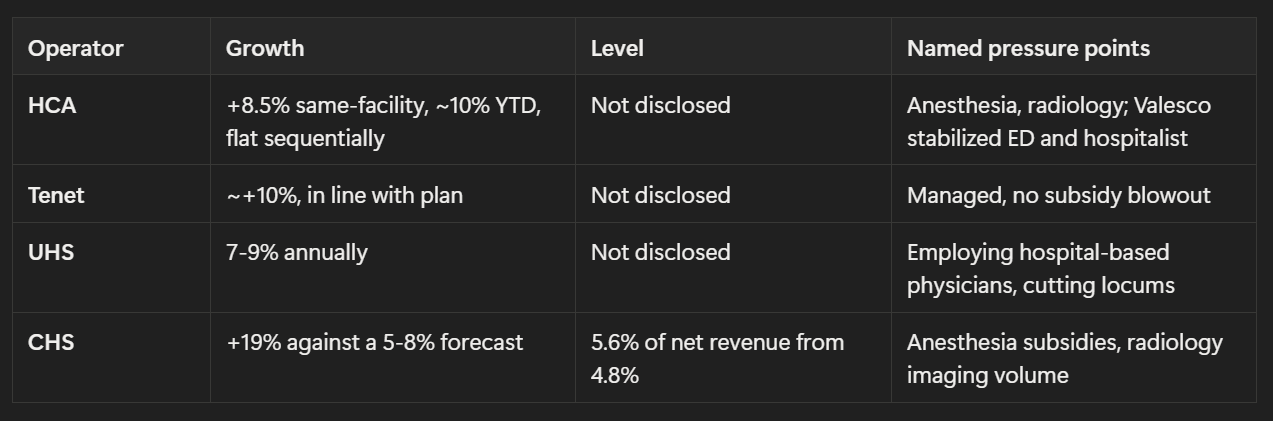 Service line calloutsOutperformance: Tenet's USPI on total joints (+10% off a large base) plus duodenal endoscopy and retinal ophthalmology migrating out of the hospital. UHS on urology, neurology, and cardiology, strong on both inpatient and procedural volume, with revenue-producing capital in robotics and advanced imaging during a period of otherwise tight capital control. HCA on cardiac procedures and rehab. CHS on clinic visits and orthopedic MRIs. Underperformance: orthopedics and cardiac across the board, worst at CHS. HCA's elective third down 6%. UHS behavioral outpatient growing at inpatient's rate against a faster plan. UHS acute occupancy declining on available beds despite 2.9% adjusted admission growth, because 177 newly added beds outpaced census. The M&A and capital environment, in one word: Ambulatory.Ambulatory is the main place capital competes right now apart from a one-off hospital bidding war this month. Tenet is paying 8-10x initial multiples for surgical assets against a deep partnership pipeline, and CHS is buying small ASC stakes even at 6.7x levered. None of the public operators are really buying hospitals while we see some increased merger activity in the nonprofit sector. Tenet is cautious on new builds, HCA's freestanding ASC count went backwards to 118 from 124 (interesting), and CHS is still selling — four Arkansas hospitals at $110M, or $27.5M apiece. Nobody has an AI storyNot one operator quantified an AI-driven margin dollar, named a vendor, or disclosed a platform. Tenet came closest by placing automation inside a 240bps hospital margin expansion without isolating its share. HCA continues to talk about its resiliency program and back-office work. UHS owns a piece of Hippocratic which is a nice balance sheet addition. CHS didn't say the word. For a sector that spends considerable conference airtime on ambient documentation and autonomous coding, distance between the podium and the earnings call remains enormous. Wrapping UpVolume held at every operator, so the bear case built on demand collapse is wrong - at least for now. We’ll see in 5 years when everyone is on a compounded peptide. What replaced the demand question is a bifurcation driven by cost structure, operating leverage, and payor / case mix, and it's widening fast. Whew. That was a doozy. If you made it all the way to the end, reply with the best meme you saw this week.  Hospitalogy Top Reads & Resources
*This read is brought to you by one of my brand partners who help make this newsletter possible! Thanks for the read! Let me know what you thought by replying back to this email. — Blake | |||||||
|