{beacon}
 | |||||||||
| | |||||||||
 Hi, Kiah here. I normally don’t rant in this section (after all, that’s what podcasts are for) but I am in the middle of what is hopefully a small personal existential crisis. I found out on Friday that the U.S. post office does not know that my new apartment’s address exists. My mail has been going to another mailbox in the building that is a suite with the same apartment number as mine. When I put my actual address into the address update system, USPS “corrects” it to the suite’s address and I can’t override it. Naturally, I realized this at 3:30 p.m. on Friday, and spent the rest of the workday trying to get someone from the post office on the phone. You might wonder how big of a deal this is. Apparently it is the season of important mail and important things with my address on it. My renter’s insurance documents are currently invalid. I had to call Chase and ask for a new credit card to be sent to my actual address and not my neighbor (oh yeah, signed up for the Sapphire Preferred before the bonus ended — my 17th credit card). I can’t vote right now. My new driver’s license is in someone else’s mailbox and has the wrong address on it anyway. Also, I am holding off on updating my passport, which expires in less than a year, until I get this address added. Fun stuff! Was this email forwarded to you? Sponsored by MX Your customers’ finances are stressing them out. The Straight, Stable and Narrow (Banking)Are stablecoins a narrow banking back door? In the modern era of U.S. economic history, payments and lending have been bundled together by banks and credit unions engaged in good, old-fashioned maturity transformation. Stablecoins break apart the bundle of payments and lending to focus just on payments. If stablecoins become popular, will banking become narrower? The phrase “narrow banking” was coined by Robert Litan in a 1987 book he authored to describe a 1933 plan from a group of economists at the University of Chicago to reform the banking sector. Under this system, a bank could use those deposits to buy Treasurys or other prime bonds, or it could deposit this money directly in its Federal Reserve account, according to a March policy paper authored by Oz Shy, a senior policy advisor and economist at the Federal Reserve Bank of Atlanta. “The general idea is to reduce or eliminate the possibility of bank failures, bank runs, and the resulting government bailouts by securing depositors’ money even during a run on the bank,” Shy wrote. This makes a narrow bank, or a narrow banking system, very stable, said Joseph Cox, a partner at Oliver Wyman. It doesn’t have to manage credit risk, such as a borrower not repaying the bank, or liquidity risk from too many depositors withdrawing their funds. It may come with less complexity and need less supervision and capital. It’s payments or money at rest. Easy. Boring! Is maturity transformation a scam or magic?That is not the banking system that the United States, or any country in the world, has. Most governments have decided that bank charters should come with the privileges in exchange for responsibilities like payment facilitation, serving as the currency’s law enforcement front line and helping people buy homes. Joseph called this “the social contract” of banking. He said the social contract of banking in the United States includes banks advertising deposit insurance so they pay very little for deposits, lending them out at higher rates and pocketing the difference. This has helped the U.S. form the deepest credit markets in the world. “A bank deposit is more than a payment mechanism — it's a credit creation mechanism,” said Andrew Nigrinis V., an economist at Remington Economics who has written about the potential implications of stablecoins offering yield on commercial banks. “The stability of those deposits is what allows maturity transformation to happen — the ability to lend them out long-term. It's the alchemy of banking: You have demand deposits where people can withdraw them at any arbitrary time, and it supports long-term lending.” But it is a “historical accident” that banks became the tollbooth operators of the modern payment system, argued Austin Campbell, CEO and founder of Zero Knowledge, where he consults on payments and stablecoins in the blockchain space. He said prior to electronic payments and cards, customers borrowed money from banks for large purchases and used wires and checks for transmitting larger sums. Banks were not, as he said, involved in the purchase of a sandwich; cash made up a significant percentage of purchases. But as the electronic payments infrastructure was constructed, it included banks in a major way, granting them a near-monopoly that hasn’t been meaningfully challenged until recently. The payments/lending bundle tightened. But, Austin said, the Chicago plan and its intellectual descendants argue that there’s no reason that payments need to be married to lending. If the banking system was “more modular” — his phrase — maybe it would lessen some systemic risk to the financial system. “Maybe my payment system shouldn't be systemic to the housing market. Separating these to make the financial system more modular probably has financial stability benefits,” Austin said. “Part of why you're bailing out the big banks is they're systemically important, and part of why they're systemically important is because people need to buy food.” Maturity transformation is many things. It is the core business and risk of banking. It is alchemy. It is also unstable: there is always credit, interest rate or liquidity risk to manage, and these risks can be acute at times. An unstable system also carries a contagion risk: a risk of one domino knocking another over on its way down. One recent time the bank space contemplated narrow banking, the answer was “hell no.” (My paraphrase.) TNB, The Narrow Bank, planned to leverage a narrow bank business model and needed a master account. It applied for a master account in 2017 from the Federal Reserve Bank of New York, which asked the Federal Reserve Board for its insights. The Fed was not into it, and the New York Fed declined the application. “The Board became concerned that allowing [interest on excess reserves] to pass through TNB to institutional investors ‘could complicate the implementation of monetary policy, disrupt financial intermediation, and negatively impact our nation’s financial stability,’” wrote Julie Hill, the dean and Wyoming Excellence Chair at the University of Wyoming’s College of Law, in her 2023 paper. “In particular, the Board was concerned that, unlike traditional banks, a narrow bank would earn interest at the IOER rate without being constrained by ‘the costs of capital requirements and other elements of federal regulation and supervision.’” Is maturity transformation a scam for depositors? Every week, the Federal Deposit Insurance Corp. calculates the national rate and the national rate cap for banks. The national rate is an average of rates paid by all banks and credit unions for which data is available, weighted by share of domestic deposits. The national rate cap is the highest rate a less-than-well-capitalized bank can offer on deposits to prevent these institutions from attracting rate-seeking deposits. For the week of July 20, the national rate cap for savings and interest checking was 4.38%. The national deposit rate for savings accounts was 0.38% and 0.07% for interest checking. It seems clear that IDIs enjoy pricing power that allows them to pay very little to customers for their deposits, and their customers don’t know, don’t care or can’t be bothered to do anything about it. If bank customers wanted to get more interest for their deposits, they could. Online banks offer the exact same products at a higher rate, but there are some narrower financial products available to individuals and businesses as well. Government money market funds invest nearly all of their assets in cash, U.S. government securities and repurchase agreements that are fully collateralized by government obligations. Maybe even closer to a narrow bank is Jiko, which was founded in 2016 and acquired a community bank in 2020. Jiko sweeps customer funds from its bank unit to custody accounts at its partners, where it purchases and holds U.S. Treasurys until a customer wants to transfer or withdraw their funds. So does not getting paid the highest rate possible for their bank deposits therefore mean bank customers are being ripped off? Maturity transformation has been protected and preserved at the cost of bank deposits receiving below-market rates. And for many customers, that has been just fine. Are Stablecoins Three Narrow Banks in a Trench Coat?The historically tight bundling of payments and lending is threatening to loosen with the rise of stablecoins and the newly chartered firms that will administer them. Stablecoins are cryptocurrencies whose value is pegged to a financial asset. Most stablecoins are backed by fiat like cash or Treasurys, according to Shy at the Atlanta Fed: The total dollar value of fiat-backed stablecoins at the end of January was $278.9 billion, which is ten times higher than the $27.7 billion value of all non-fiat-backed stablecoins. These stablecoins are the ones most in focus right now due to the GENIUS and CLARITY acts from Congress. With a fiat-backed stablecoin, the payer initiates a transfer by purchasing stablecoins from an issuer with dollars through, likely, an electronic payment. The issuer mints one stablecoin for every dollar transferred and puts these in a wallet that either it hosts or is hosted somewhere else. To use these stablecoins, the payer sends these stablecoins from its wallet to another wallet. Holders of stablecoins can then cash out their stablecoins back to dollars through a transfer. Since the dollars back the stablecoin, the issuer can deposit them in a bank account or purchase government securities. What they don’t do is lend these dollars out. “The structure of reserves is where fiat-backed stablecoins very closely resemble narrow banking and makes them fundamentally different from traditional fractional-reserve banks,” Shy wrote. “Issuers of fiat-backed stablecoins and narrow banks must maintain full reserves that are kept as cash and T-bills.” 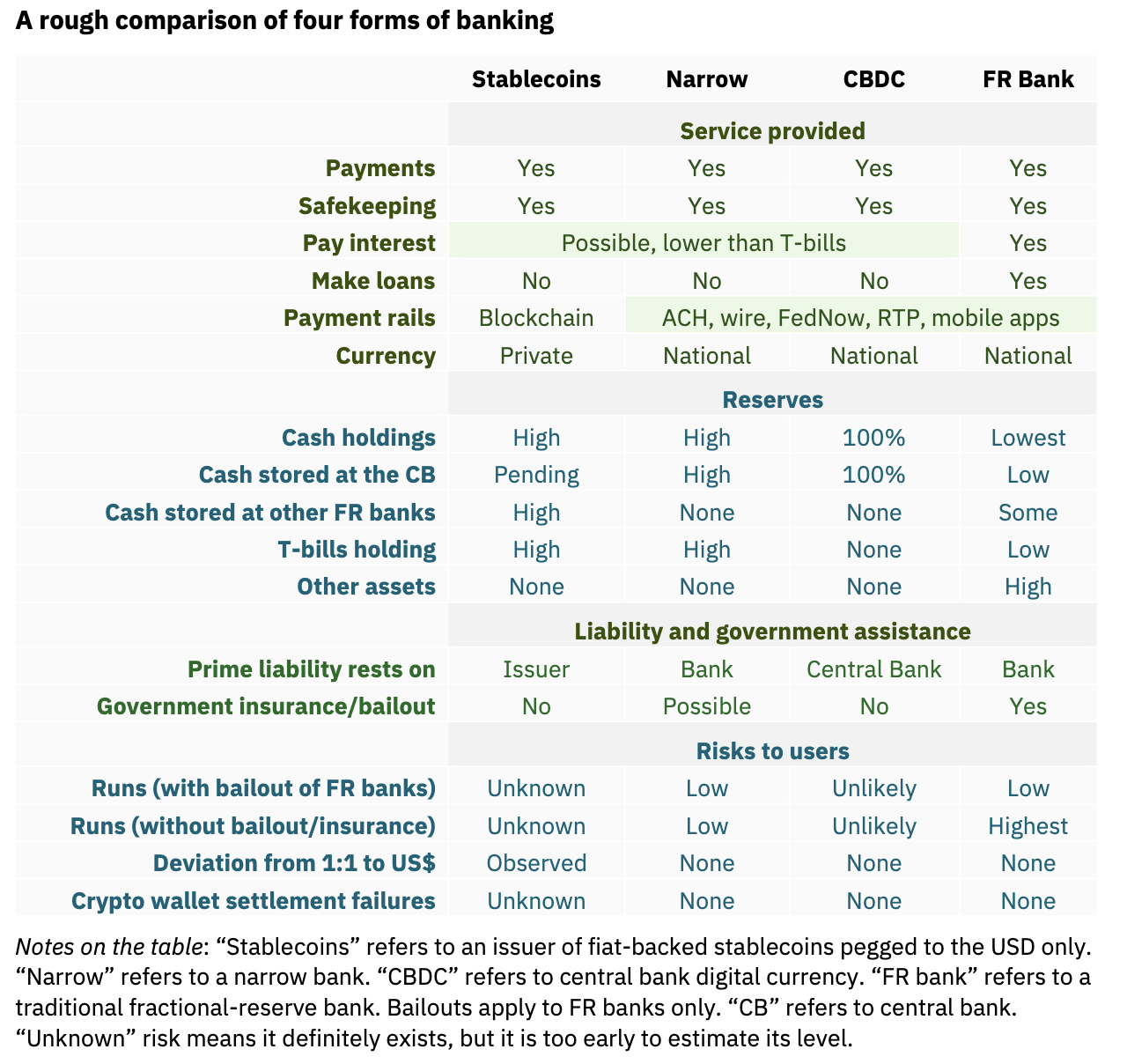 Source: Shy's paper, Federal Reserve Bank of Atlanta Of course, the danger in equivocating stablecoins to narrow banks is the halo and veneer of stability. They have their own set of risks, are not widely used by the general populace and haven't gone through an economic crisis. It’s possible that under stress, they could experience a wave of withdrawals — their very own run — that come with their own set of challenges. Joseph said this idea relates to the “hierarchy of money,” which includes the idea that during stress, the quality of money becomes critical. Money at the Fed is the highest quality of money, then money at a U.S. bank, then a money fund, then offshore, and on and on. It’s not clear where stablecoins will fit into this hierarchy. Will customers leave banks to deposit their funds into stablecoins if they think the bank will fail? Will coinholders cash out their coins and deposit them into banks? Stablecoins can also depeg, or lose their one-for-one value to the dollar, which happened to Circle’s USDC in March 2023 during the Silicon Valley Bank run. Another consequence is that selling Treasurys to cash out stablecoin holders could incur the notes’ unrealized losses. And if the reserves are held in a bank deposit account, that account may have inadequate insurance coverage. But it’s not fair of me to single out stablecoins as a threat to fractional reserve banking, since there is another place where narrow banking is currently thriving: private credit. Private credit loans accounted for about $1.4 trillion, or 10%, of the total debt of U.S. nonfinancial corporations, according to the Federal Reserve Board’s May 2026 Financial Stability Report. Federal Reserve Vice Chair for Supervision Michelle Bowman has faulted 2007-09 financial crisis reform and regulation that made it too expensive and punitive for banks to do this corporate lending. “The effects of the current framework become clear when we examine the incentive structure that it creates. Current capital rules create a perverse incentive—ironically, banks receive a more favorable treatment for lending to private credit funds than for lending directly to creditworthy corporations. This treatment encourages banks to finance intermediaries rather than directly serve end-borrowers,” she said in May. One could imagine a version of this story where, if this was indeed what happened, it wasn’t a mistake or unintended consequence. In this version, it could have been by deliberate design that banks take less credit risk and allow other organizations that don’t take insured, runnable deposits to take more. Banking made deliberately more narrow. Either way, nonbanks stepped in to make those loans and have been pulling lending away from payments for about a decade. Now it's payments’ turn to drift. Narrow Banking: Cool or Nah?In 2017, the Fed decided to kill a proposed narrow bank because of monetary policy concerns. No one else was asked what the bank space should look like, and no one (other than the Fed Board!) got to weigh in. TNB couldn't even bring a lawsuit over it. In contrast, at least Congress voted to create a pathway for payments to be divorced from lending (if any bank trade groups are looking for anyone to blame). But in doing so, were lawmakers actually deciding on whether the United States should have some amount or percentage of narrow banking? “As far as I know, we've never had this policy debate [on narrow banking]. It slid in,” said Andrew. “What stablecoins would essentially do is turn a lot of the banking system into a government money market mutual fund with a really good payment system on top.” Is that a bad thing? If so, for whom? Austin pointed out that in some countries, a portion of payment activity isn’t paired with lending, and that has not adversely impacted the overall banking or payment systems. But it does seem clear that the divorce of lending and payments could cause a reallocation or reshuffling of deposits in the banking industry. If a stablecoin issuer holds customer funds in a bank account, that account will probably be at a big bank, right? But the money itself will have come from some bank account somewhere. “If money is going into stablecoins, it has to come out of something else. Large banks like Chase and Citi will see reductions, but not as much, because they'll be able to make it up in the wholesale banking market,” Andrew said when I asked him what the future could look like. “Smaller banks are going to suffer because they won't be able to make it up in the wholesale market — they'll have to offer higher deposit premiums.” Joseph said a future with a significantly narrow banking regime would look like short-term liabilities paired with short-term assets that carry low credit risk, with long-term loans funded by long-term investments from insurance companies or pension funds, or greater securitization of these assets. Austin thinks the financial services industry could become more modular if stablecoins take off. This would include dedicated payments companies that specialize in moving money effectively, and they would pay lower yields than banks because the activity has less risk. In this future, banks will need to pay higher interest to attract and retain deposits. Austin said banks have a legitimate critique that “an economy where everybody keeps their money at the Fed will destroy credit creation.” But when the argument involves or mostly focuses on pricing and whether stablecoin issuers can pay yield, he tends to view that skeptically. Are banks just mad they may face price competition for deposits that would make them pay anything closer to the national rate cap? There genuinely is an existential debate about maturity transformation and fractional reserve banking, but what seems to have been taking up most of the focus and debate can be described as banks trying to protect the advantage of cheap funding they have from competition. Or being worried about losing deposits to another bank. Fractional reserve banking and maturity transformation require, to some extent, bank customers being happy to leave their sleepy, sticky deposits at the bank and receiving almost nothing for it. It works by banks bundling reserves and clearing with lending — privileges and activities that were permissioned by the charter awarded by the government and this accidental payments tollbooth monopoly. But now, the government is allowing that bundle to unwind. Banks big and small could face market competition for these funds from tech-savvy firms offering better, cheaper payments. The divorce of payments from lending could make banking narrower or more modular. It could make banking more stable, and also more competitive. How many banks will be able to survive that? Sponsored by Linker Finance Business customers are different from retail consumers. AI AGENTS, MINUS THE RISK Wondering how and where to use AI agents within your bank? Ask an expert. Gradient Labs has already deployed AI agents inside the back offices at Wise, Monzo and Zego in areas like KYC, disputes, onboarding and collections. Join me and Gradient Labs’ Neal Lathia for a working session on how to get started with AI agents without adding operational risk. No hype, just a playbook based on real results. FROM THE VAULT What’s on my mind and filling my time: 🌧️ Making it rain: I loved this story about how two farmers and some co-conspirators stole $6.5 million from the U.S. crop insurance program by messing with the rain gauges that the government uses to determine payouts. Stories like these might become more common as prediction market incentivize messing around with these kinds of measurements for profit — oops I meant predicting the future. 💳 Charge off: The rise of electronic payments, consumers expressing their frustration with retailers and more general casualness from younger consumers about ripping others off has led to an increase in chargeback abuse and first-person fraud, Amanda Mull at Bloomberg writes. 🎙️ On Bank Nerd Corner: Alex Johnson and I talk about three stories that are about who controls payments now and in the future, and what banks stand to lose if they're not paying attention. (Is the answer Stripe? Listen to find out!) 🎧 Bonus Podcast Rec: Episode 2 of Agent of Record, with Parlay Finance and me, is now out! Parlay Finance CEO Alex McLeod and I welcome Matt Michaelis, chairman and CEO at Wichita, Kansas-based Emprise Bank, to learn how his bank is experimenting with AI — including building a second brain! If you’re a financial institution exploring AI (and be honest, who isn’t), you won’t want to miss the newest episode of Agent of Record.* *This rec is brought to you by one of our fantastic brand partners. Thanks for reading and sticking with me for Master Account Month. Fingers crossed this is the last newsletter in the series for a bit! - Kiah | |||||||||
|