{beacon}
 | |||||||||
| | |||||||||
| Hi ya party people, I've currently only had like 3 sips of coffee, sooo while my body waits for its daily caffeine intake, I can say it’s been a good, busy week! 🙌 Sometimes you find moments good enough to distract you from the world of chaos at large. Hoping that you find a worthy distraction this weekend! Speaking of chaos…you know what time it is. 😏 For today’s Q&A, we've got a supervisor who treats her cubicle like group therapy but shuts it down the second it's your turn to talk (and blew bubbles?! in your face?! ma'am), and we also have an HR leader watching core values get completely ignored while multiple employees report the same toxic behavior with zero follow-through. Let’s talk solutions! And of course, if you have questions of your own and want a chance to be featured, please submit them here! ASK AWAY 😒 oversharing & neglect ✍🏾 My supervisor sits next to me in a small office, and loves to overshare about her personal life all day every day, at times making it hard for me to concentrate. When I share about myself, or even work-related concerns she redirects the conversation and changes the subject entirely (one time she even blew bubbles in my face) - how can I address this inappropriate behavior with her? Context: Small 3-person HR department, 190 employees, publicly funded non-profit in mental health 📣 Natacha Unelus, Chief People & Culture Officer @ Fierce HR: How’s: “I enjoy talking with you, but I’m having trouble concentrating throughout the day. Could we save our catch-ups for lunch or another set time?” Keep it warm, clear, and about what you need to do your job. 📣 Priscilla Gubatan, Manager, HR Programs & Engagement @ Caltech: Based on some of the great advice already given, I would add brushing up on your Crucial Conversations skills in preparation for bringing the topic up, keeping the conversation on the rails, and continued follow-up that will be needed. Ideally, get really clear with yourself about what you want. You mention "at times" it interferes with your concentration; when you try to share, they change the subject when you talk and once blew bubbles in your face. What times does it interfere, and when does it not? What's the difference or similarity? Do you want to share your personal information with them? How is it affecting your work? Are the bubbles a constant in the office? What's worked for my own sanity is to always answer the question, "At the end of the day, does this matter to me in 1) getting my job done and 2) maintaining my sense of inner peace? If you haven't done Crucial Conversations or need someone to bounce ideas off of, I'm happy to help. 📣 Svetlana Cherches, Sr. Director, People Ops @ Alameda Health System Foundation This question can be answered so many ways. Do you want to provide a teaching moment or do you want to travel the path of least resistance? If you are just trying to keep the peace, Natacha Unelus offers excellent advice - this allows you to make it about your needs, not her behavior. If you want her to reflect on her behavior and you are willing to deal with the fallout of her reaction, which, I am guessing might be totally unhinged, you can let her know how her behavior makes you feel. She sounds like someone who could stand to learn some professionalism and boundaries, but I'm not sure you are the person who is responsible for teaching her. Safe Space members can join this discussion here. Not a member yet? Apply to join here.  ✍🏾 When multiple employees report the same toxic work environment concerns to HR, and discussions with both the supervisor and the supervisor's supervisor have failed to produce any change, what would be your next step? Would you escalate the issue directly to the CEO, as he is next in line, and if so, how would you approach that conversation? Or is there another route you would take first? Context: We are a utility company with approximately 235 employees and investor stakeholders. Our stated core values are accountability, honesty, integrity, loyalty, and passion. Unfortunately, I have not observed these values being consistently demonstrated throughout the organization. In fact, I regret to say that the majority of these principles do not appear to be reflected in the workplace culture or leadership behaviors I have witnessed. 📣 Tammi Burnett, Director of People and Culture @ Rainforest Action Network: There are two pieces here. One is what your work obligation is, and the other is about you. Yes, go to the CEO, but go with lots of data that they can actually use and understand. A good metric to show is how toxicity in a department affects revenue via turnover and time to fill. Or, it might be reputational risk - are employees blasting the company online? Use data to craft a compelling narrative, and deliver it. It's also important to offer concrete, bite-sized solutions. CEOs tend to respond more favorably when you identify the issue and the impact, and tell them how to fix it. The second piece, though, is what you've said toward the end there. At the end of the day, if leadership doesn't care enough to consistently apply rules and uphold values, you're going to be patching holes on the Titanic. That's a dynamic that will likely burn you out and you may want to see how the CEO responds to gauge whether this is sustainable for you long term. 📣 Sondra Norris, Founder @ Strategic Culture Partners: We often want to take these conversations with this context to leaders and managers "everyone says it's toxic here" - unfortunately they're not that helpful without direct connection to business and/or helping leaders and managers see what they should do. And when we do bring them this way, you see what's happening - no response. First, empathy for the supervisors. Being told the working conditions they've created are toxic is threatening to who they are. They've learned this behavior as acceptable and believe it's the behavior that will keep them safe in their jobs. Do they have some personal integrity and responsibility? Of course, but they're doing what humans do inside systems. They will defend their adoption of toxic behavior and blame the employees first. Next, you need an attachment to something about the business. You can do an "unrelated" assessment with the supervisors about their opinions on execution velocity, information flow, and initiative and ownership. You're asking them to evaluate business and operating performance. Attach that further to the goals, objectives, and strategies - their assessment directly feeds into the likelihood that goals, objectives, and strategies will be achieved. (I built this assessment and accompanying results - free to all - it's on my website). Make the point that gaps in any of these are at least in part because you're not getting employees' discretionary commitment and effort - there may be other operational, systemic, process issues as well, don't ignore those. Then take a look at any employee satisfaction and/or engagement data you have (exit interviews, this feedback you've received, surveys). And now you need to make the connection back to discretionary commitment and effort and your company values. Company values don't get embodied for free. Leaders have to earn them. When I look at yours in particular, I see the assumptions leaders are making by using the words accountability, integrity, loyalty, and passion. Present this information. Hopefully with this re-frame at least some of them are able to see and hear it differently. If not … there’s not a lot you can do except try to keep people comfortable. You might try to engage with the supervisors as the layer that is most likely suffering the most. Then you make the last connection: performance > discretionary commitment > conditions at work from leadership. What people need AT A MINIMUM to even think about giving discretionary commitment in any sustained way from their leaders: Predictability Credibility Culture Alignment These aren’t about the business. The business by nature isn’t any of these things – there are too many variables from the outside. People don’t trust BUSINESS, they trust PEOPLE. So it’s not “be transparent about finances” (that helps, but it’s not going to get discretionary commitment) It is about the leaders installing a regular cadence of visible behavior that starts with them acknowledging it kinda sucks to work here right now. They’re not admitting anything except that they lost the plot for a minute and now they want to regain trust. Safe Space members can join this discussion here. Not a member yet? Apply to join here. Sponsored by The Predictive Index AI is stepping into more meetings than ever, and it feels like we're at risk of losing the thing that makes work work, which is knowing the human sitting across from you! 😬  🚨 ON YOUR RADAR 🎧 We're not corporate robots, and we aren’t substitutes for therapists. Stephanie Lemek joins me to talk trauma-informed workplaces, and how more choice changes everything. Check it out on Spotify or Apple Podcasts! 🧠 There’s a good chance your CEO thinks you already have a workforce plan for AI, even if you’re currently winging it. Join me July 28th for HR Therapy, where I'm sitting down with Amanda Arena and Will Self from Aon to build the plan you can run the next day! 🎙️ Why do so many orgs assume good employees will automatically be good managers too? Hogan Assessments' CEO Allison Howell joined me for an episode of The Leadership Divide, and we dragged the entire leadership pipeline to get some answers!* 💰Pay Transparency matters (but it's also difficult). That's why I created this course. Join the Safe Space community to access it, plus everything else you need to stay ahead of the curve. *This one is brought to you by one of my amazing brand partners 📝 RESOURCE OF THE WEEK Each week I feature a resource I love from the Safe Space library that I believe would be relatable to this week's newsletter topic. Today, we’re talking ADA accommodations. Check it out HERE ⬇️ 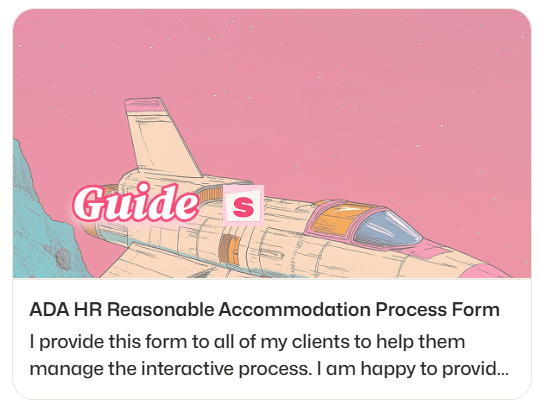 🫂 COMMUNITY HAPPENINGS 📚 Safe Space has a Book Club! We’re currently knee-deep in a pro dev read right now but for our next book we’re looking to dive into any and all other genres. Rachel is currently sourcing book recs for next months read in the main Lobby chat on fable. Join da club here! MUST ATTEND VIRTUALS 💬 NEXT WEEK! Panel Discussion: Disability Pride Month, July 30th - Disability at work is about more than policy talk and best practices. In honor of Disability Pride Month, join Safe Space Ambassadors Lia Seth, MariaElena Martinez and Safe Space member Tammi Burnett for a candid, informative, and fun panel discussion. Plus, tangible takeaways to help your org be more inclusive RIGHT NOW. No prior experience with disability inclusion required — just an open mind and a willingness to listen. Grab your spot to this must attend virtual event here! IN-PERSON MEET-UPS 💐CHARLOTTE AREA! The time to hang out has arrived!! Come hang with your community manager Kat at Aurora Flora Flower Farm in Mooresville, NC in August. We’ll grab some shears, walk the beautiful rows of flowers and gather all the lovely things to fill up our cups. Flowers are on Safe Space!!! Grab your spot here! Keep your eyes peeled St.Louis and Ohio - Safe Space Ambassadors are currently planning your in-person meet-ups for the Fall. #ComingSoon Want to host your own in-person event, shoot Kat a DM here! FRIDAY FUN 😩 i'm overstimulated.png?sig=09166dd704633da3d7013937c57714c8b8661e9450c0d94917dda3929dee6bbf&size=email-body&dpr=2) WHY DO THE QUESTIONS ALWAYS ALL COME AT THE SAME TIME!!!!!!!!!! That's all for this week! I hope you enjoyed! If you have any thoughts, please let me know. I'm allll ears. Reminder: Today is FRIDAY. 🙏 | |||||||||
|