{beacon}
 | |||||||||||
| | |||||||||||
| Happy Friday, Fintech Takers! I hope this week has been good and that you’ve managed to stay cool. Montana never gets that hot, compared to other locations around the world, but, for us, we had a hot week this week and it was deeply unpleasant. In fact, according to research, excessive heat (especially at night) leads to irrational and impulsive behavior and even bad economic and financial decisions. Do you know what that means? AIR CONDITIONING IS FINTECH! (After I read that study and realized this, I’ve just been muttering this statement to myself over and over as a kind of mantra.) Anyway, declaring that certain things are or aren’t fintech is actually very relevant to the subject of today’s newsletter, so let’s get to it! - Alex P.S. — If you’re tired of hearing people pump up agentic commerce even though it's not really a thing yet, you’ll want to attend this virtual event on July 29th. Experts from Persona, Lithic, and Glenbrook Partners are going to be talking about what’s actually happening with agentic commerce and the challenge of adding KYA (know your agent) to KYC and KYB. Was this email forwarded to you? DEEP DIVE Fintech 101A few years ago, I was asked to create a Fintech 101 educational course. My task was essentially to explain, with as much clarity as possible, what fintech is and why it’s important. It was more difficult than I expected, but, then again, teaching always is. You never really realize how little you understand a topic until you try to teach it to someone else. In the process of developing the course, I came up with a few foundational building blocks — observations, frameworks, theories — that helped me explain the fintech industry; its structure and governing dynamics. Those building blocks have been surprisingly useful to me in my work in the years since, and I thought they might be useful to you as well. The full presentation deck for my Fintech 101 Course can be found, for free, in the Fintech Takes Network Library here. It has been newly refreshed and will, hopefully, prove to be a valuable resource for folks in the ecosystem, whether they are new to fintech or not. And for the remainder of today’s newsletter, I thought I’d share a few of those core building blocks from the course, along with some observations about how they apply to this current moment in fintech. How Do You Categorize Fintech Companies?If you don’t have a system for categorizing fintech companies — a taxonomy — you’re going to get lost very quickly. This became clear to me in 2021 when there was so much VC money flowing into fintech and so many new startups popping up every day that it became absolutely overwhelming. The taxonomy I developed is simple, but it has worked well for me. It relies on two questions:
If the answer to #1 is consumers, then you are a business-to-consumer (B2C) fintech company. Think Chime, Cash App, Affirm, or Robinhood. If the answer to #1 is businesses, then we proceed to question #2. If you are helping business customers with something other than providing financial services to their customers, then you are a Business-to-Business (B2B) fintech company. Think Mercury, Bluevine, or Ramp. If you are helping your business customers to offer financial services to their end customers, then you are a fintech infrastructure company. These companies come in two different flavors, tech and banking. Tech infrastructure is everything from front-end interfaces like digital banking and AI chatbots (Kasisto, Narmi, etc.) to backend systems for tasks like fraud prevention and AML transaction monitoring (Oscilar, Sardine, etc.) Banking infrastructure is more commonly referred to as Banking-as-a-Service, or BaaS, and can be provided directly by regulated banks (Bancorp, Column, etc.) or indirectly via middleware platforms (Treasury Prime, Unit, etc.) That’s it. Three top-level categories; B2C fintech, B2B fintech, and fintech infrastructure. Now let’s drill into each of these categories in a little bit more detail. Only Two Ways to Make MoneyMy central observation in B2C fintech is hardly unique: It is defined by the rapid progression between bundling and unbundling, as explained by the famous Jim Barksdale quote: 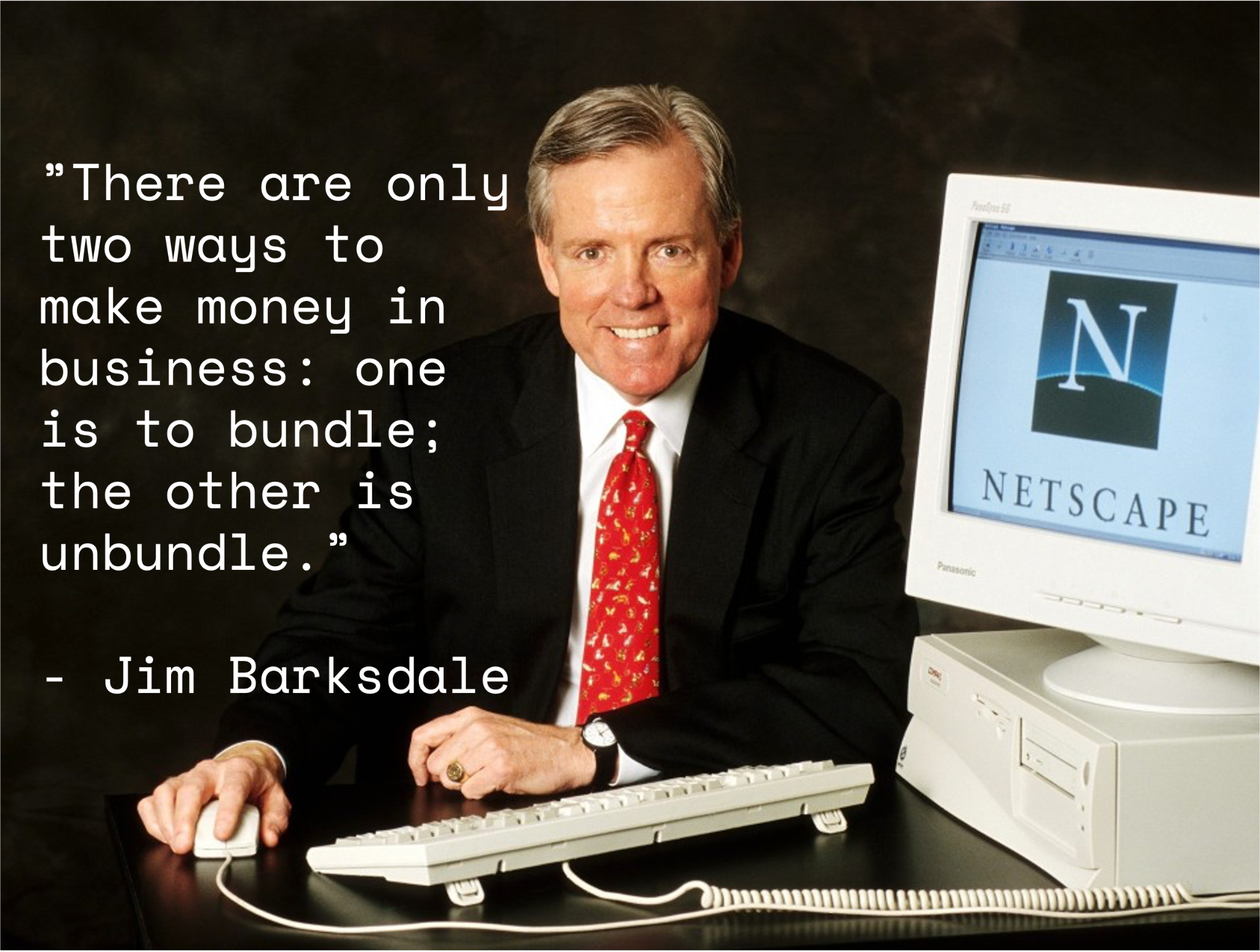 The modern wave of B2C fintech companies got their start by unbundling the banks, picking out a single product, and building a better alternative. What’s been more interesting, from my perspective, has been the work that these companies have been doing in recent years to rebundle around those original wedge products. It has been, I think, more difficult than those B2C fintech companies might have imagined, in much the same way that the streaming platforms (especially the ones not named Netflix) have struggled to achieve the same level of dominance that cable TV providers once enjoyed. That’s the challenge with technological disruption. The same forces that enable you to get a seat at the table makes it very difficult for you (or anyone else) to own the entire table. Starting With Small BusinessIn B2C fintech, it’s common for startups to target customer segments that have, historically, been underserved by traditional banks, such as low-to-moderate income consumers or credit invisible consumers. What those companies eventually realize is that while there are opportunities to make money serving those customer segments, those opportunities are, comparatively, small and risky to pursue. As such, many of these B2C fintech companies, if they survive long enough, move up market and go after wealthier and less risky customers. I’m not sure why, but it took me a long time to realize that the same dynamic exists in B2B fintech. Every new B2B fintech company starts out by going after small businesses. Their initial observation is always something like, “I can’t believe how badly served small businesses are by banks! This is insane!” Then they realize what everyone eventually realizes: Serving small businesses profitably is really hard! Not impossible, certainly, but very difficult. Even when you figure out how to serve one segment of small businesses — VC-backed startups are a popular segment for B2C fintech companies — you are not guaranteed success when you attempt to broaden your target market to all small businesses (as Brex discovered a few years ago). It’s much easier to move up-market, to mid-size and enterprise customers, which is what many of these companies (Stripe, Ramp, etc.) eventually do. Infrastructure is CulturalHere's a pattern that jumped out at me while building the taxonomy above: Fintech infrastructure companies overwhelmingly sell to other fintech companies, and banks overwhelmingly buy from the same small set of legacy core vendors they've always bought from. There's no structural reason for this. A modern fraud prevention platform or transaction monitoring system is just as useful to a $12 billion community bank as it is to a Series C neobank. Arguably more useful! And yet, if you look at the customer logos on most fintech infrastructure companies' websites, you'll see B2C and B2B fintech companies. And if you look at the vendor lists of most banks, you'll see the same three or four names that have been there since the Clinton administration. The explanation, I've come to believe, is cultural. People like to buy stuff sold to them by people like them. A startup founder in a Patagonia vest trusts a sales pitch from another startup founder in a Patagonia vest. A bank COO who has been through eleven regulatory exams trusts a vendor who speaks fluent exam-ese. Neither is wrong, exactly, but both are leaving opportunities on the table because of it. An Artificial Constraint in BaaSIn my early years covering BaaS, I took the structure of the market for granted. That was a mistake. The specific thing I took for granted was that bank charters were nearly impossible to get. And, to be fair, they basically were! In the decade leading up to the 2008 financial crisis, de novo bank charters averaged more than 100 per year. Since the start of 2010, regulators have approved an average of fewer than six per year. That artificial constraint is what created the modern BaaS market. If you were a fintech company in 2015 and you needed access to the banking system, you had one option: Rent it from a bank that already had a charter. This constraint has now gone away. The current administration has been extraordinarily solicitous of new bank formation. At least 18 charter applications were filed with the OCC last year — as many as in the previous four years combined — and Comptroller Jonathan Gould has called the influx "a return to the norm". And even if future administrations take a less aggressive stance, I'd guess we settle into a healthier baseline level of bank formation than the near-zero of the 2010s. This is a structural threat to BaaS. The BaaS business model has always assumed that you lose money on small new programs and make it up when a few of them grow into big companies and stay with you. More available charters creates a graduation problem: Your winners leave right when they start paying off. Mercury — a company built entirely on partner banks — received conditional approval from the OCC to establish Mercury Bank in April. Mercury will not be the last. Competition Among RegulatorsThis one also took me an embarrassingly long time to figure out: Much of the genuinely weird stuff you see in financial services regulation is explained by the fact that regulators compete with each other. This isn't a metaphor. U.S. financial regulators are, in a very real sense, businesses. Most of them are funded not by appropriations but by assessment fees paid by the institutions they supervise. More institutions under your umbrella means more fees, bigger budgets, and more relevance. Fewer institutions means the opposite. Every regulator understands this, and every regulated institution understands that regulators understand this. The canonical horror story is Countrywide. In 2007, Countrywide turned in its national bank charter and moved $88.9 billion of assets to a federal thrift charter, which was a win for the Office of Thrift Supervision (OTS) and a loss for the Fed and the OCC. For the OTS, which depended on fees paid by the institutions it regulated and competed with other agencies to land the largest firms, Countrywide was a lucrative catch. By the end of the crisis, some of the biggest failures — Countrywide, AIG, IndyMac, and Washington Mutual — had all been under OTS supervision. Dodd-Frank killed the OTS, but it didn't kill the incentive. A Federal Reserve study found that banks that switched charters tended to receive better supervisory ratings than similar banks that stayed put, which is consistent with the view that regulators compete for banks by grading new arrivals on a curve. This dynamic is very much alive today. The OCC and states like New York and Wyoming are in the midst of an intense competition to woo stablecoin issuers and other crypto institutions seeking regulatory charters. Charters are the product. Regulators are the vendors. Once you see it, you can't unsee it. Will AI Make Banking Too Efficient?Here's a slightly heretical way to think about net interest margin: It's a subsidy. A tax, really, that most of us pay to banks — in the form of accepting deposit rates well below what our money could earn elsewhere and not refinancing loans when rates drop as quickly as we should — which funds their profit pools, keeps them healthy, and finances the lending that is, arguably, banking's most socially useful function. The size of this subsidy is hard to overstate. For most U.S. commercial banks, net interest income accounts for 60% to 80% of total revenue. And the subsidy exists, mostly, because of inertia. Researchers at Harvard Business School have a great term for this — depositor "sleepiness" — and their research found that this inertia undergirds the $18 trillion U.S. deposit market. As one of the researchers put it, about 60% of bank value comes from the fact that most depositors simply aren't paying attention. Now imagine a world in which every consumer has an AI agent that never sleeps. It monitors every rate, sweeps every idle dollar into the highest-yielding option, refinances every loan the moment it makes sense, and never once feels the psychological friction of switching banks. The sleepy depositor — the keystone for the entire banking business model — wakes up. I genuinely don't know how to feel about this. Part of me thinks it's great. Perfectly efficient markets! Consumers capturing surplus that banks have been quietly harvesting for a century! But another part of me wonders: Do we actually need that subsidy? If AI agents compete away the banking industry's inertia-based profits, who funds the small business loan that doesn't pencil out on a spreadsheet, or the branch in the town that can't quite support one? A Massive Fintech M&A WaveOne final observation: We are at the beginning of a massive wave of fintech M&A. Two forces are driving it. The first is that regulators are, suddenly, very cool with M&A. This is true, in a narrow bank-to-bank sense (Fifth Third's acquisition of Comerica was approved in 99 days, compared to a median of roughly 265 days under the prior administration), as well as at a broader FTC/DOJ level. The second force is that M&A is the only realistic way out for an enormous number of later-stage fintech companies that got trapped between Unicorn and IPO with no clear exit. The math here is brutal. More than 800 private unicorns (across all verticals) are sitting in the IPO backlog, and only 78 exited via IPO or acquisition in all of 2025 — a pace at which clearing the queue would take roughly 30 years. These companies raised at 2021 prices, and the public markets have made it clear they won't pay 2021 prices. Something has to give, and that something is going to be a lot of acquisitions at valuations that won’t be mentioned in the press release headlines. MORE QUESTIONS TO PONDER TOGETHER Big news for the endlessly curious (yes, you): I’m collecting your fintech questions on a rolling basis. What’s keeping you up at night? What great mysteries in financial services beg to be unraveled? Think of it this way, if a stranger is a friend you just haven't met yet, your question is a Fintech Takes conversation waiting to happen. One that could headline a Friday newsletter or be answered in an upcoming Fintech Office Hours event. Drop your question here, whenever inspiration strikes! WHERE I'LL BE There are some great virtual events coming up soon, and planning for the fall fintech season is well underway. Here's where I'm planning to be this summer (virtually) and in September (in person). 💻 Know Your Agent (A New Problem for Old Defenses) | July 29 | VirtualEveryone loves to talk about agentic commerce, but is it, you know, actually a thing yet? What are the problems that will be caused if it does become a big thing in the future? And how might we go about solving those problems? We will be talking about these questions and a lot more in this virtual event! ✈️ FinovateFall | September 9-11 | New York CityMy can't miss fall conference! September in New York is glorious and the fintech conversations will be too. ✈️ Cash Flow Intelligence Summit | September 10 | New York CityNova Credit has rebranded this from the "Cash Flow Underwriting Summit" to the "Cash Flow Intelligence Summit." Come find out why. ✈️ FDATA Global Open Finance Summit | September 17 | TorontoThis will be my first time at an FDATA event and my first time back to Toronto in a long time. If you work in open banking in Canada and want to yell at me for my bad takes in the past, this is your chance! ✈️ AI-Native Banking & Fintech Conference | September 29 | Salt Lake CityThe name of this event is a mouthful, but the content and networking are both A+. Thanks for the read! Let me know what you thought by replying back to this email. — Alex | |||||||||||
|