{beacon}
 | |||||||||||
| | |||||||||||
 Happy Wednesday, Fintech Listeners! I hope your week is going well. I have secured tickets to The Odyssey, which I could not be more excited about. I am a huge fan of Christopher Nolan, Greek mythology (I spent my lunch hours in high school in the library reading Homer … I was extremely cool and popular), and craftsmanship. That last point is why I will be driving 2 hours to see the movie in IMAX. We don’t have an IMAX theater in my hometown, but Nolan shot The Odyssey entirely on IMAX because he is obsessed with the craft of filmmaking, and I want to support that obsession. In an ideal world, I’d love to see the movie in a 70mm IMAX theater, but there are only 20-30 of those theaters in the U.S. and none in Montana. Alas! — Alex P.S. — I’ll be at Money 20/20 this year (Saturday through Tuesday, leaving very early Wednesday) and I’m curious if you’re planning to attend? I’ll be hosting or co-hosting a number of different events, including (of course) our annual 3x3 basketball tournament, and I’d love to know if you’ll be there and if you would be interested in joining any of these events. Could you complete this survey and let me know? Was this email forwarded to you? Sponsored by Persona KYC costs don't scale the way most compliance work does. Persona's new guide covers the six KYC challenges that cost fintech companies the most, along with how to fix each one. Worth reading before the next market expansion tests all six at once. 3 BIG IDEAS FROM THE PODCAST 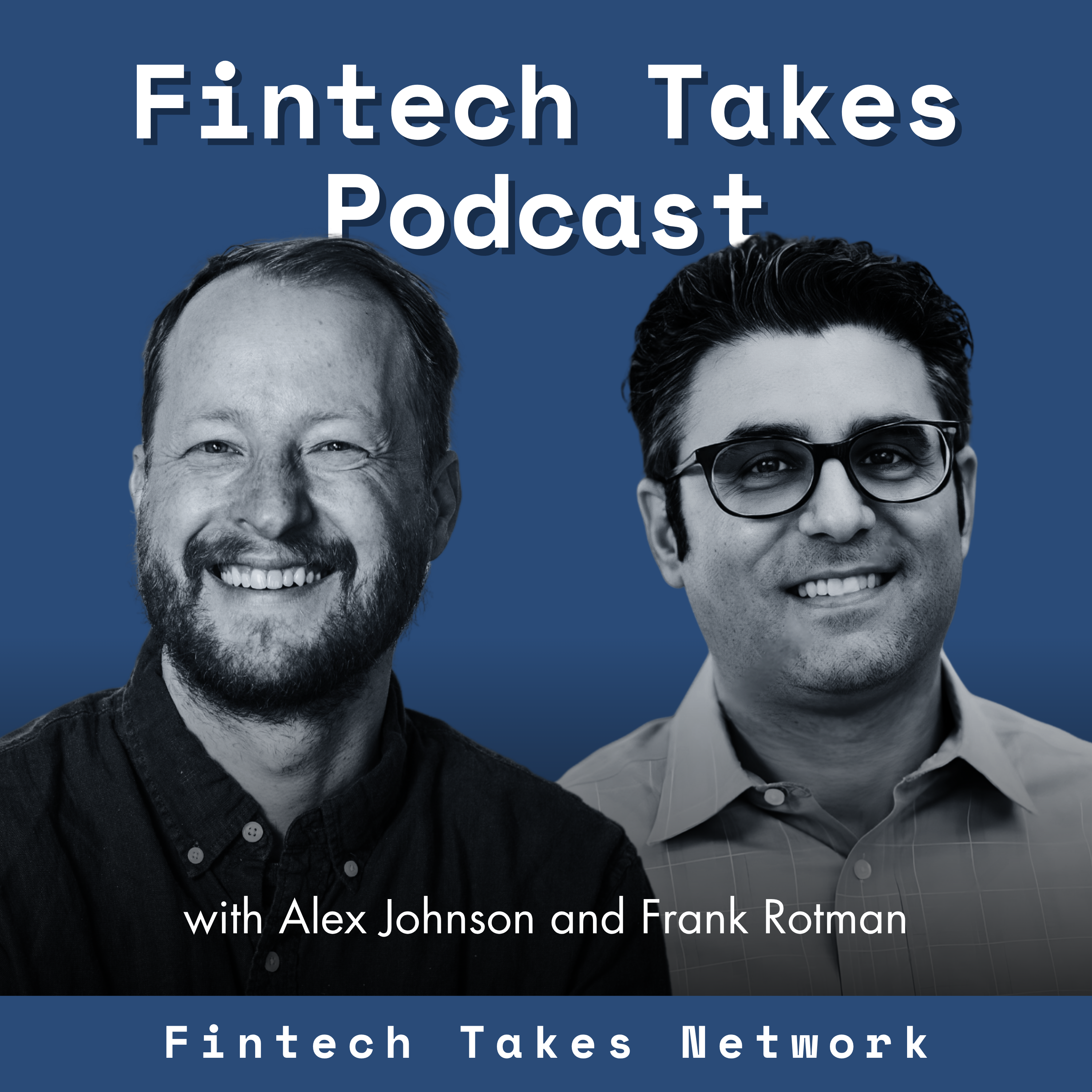 Frank Rotman, founding partner of 37Maru and co-founder and partner emeritus at QED Investors, is back on the podcast this week, and if you've listened before, you know what that means: a wide-ranging conversation, because the man can speak thoughtfully about anything and everything. This time it's financial nihilism, AI's readiness inside banks, student lending, and a whole lot more. Tune in for the full conversation here And read below for my three big ideas... #1: Too Early is the Same as WrongI asked Frank to name an “AI in financial services” investment thesis that he thinks is overrated and one that is underrated, and he answered my question (as he often does) by reframing it. The way Frank looks at AI — which is a field he has been paying attention to for decades — is grounded in his experience as an investor and the importance, when investing, of getting the timing exactly right. In our conversation, Frank observed that almost all the stuff that investors and builders are excited about at the intersection of AI and financial services make sense and will eventually create a lot of economic value. But the word “eventually” is doing a lot of work there. Some AI use cases in financial services are ready now. Frank pointed to ones clustered in the back office, around highly manual and inefficient workflows that don’t touch end customers, like AML. Some other use cases are feasible, if you do enough work to tune the model and wrap guardrails around it, which is work that fintech companies and a few large banks are already doing, but that most of the market is either unable or unwilling to do. And there are some use cases — like the fully autonomous, customer-facing ones — that just aren’t ready yet. Distinguishing between these different categories of use cases and accurately assessing the short-term and long-term commercial opportunities around each is the challenge facing every fintech VC investor right now. Personally, as someone who has no idea what’s happening right now with AI, I don’t envy them that challenge. #2: Help Sailing the ShipFrank has watched the PFM category from the investor's seat for years, and his observations of the space match up with my own. Mint, otherwise known as PFM 1.0, solved a real but narrow problem: getting transactions into one place and sorted (more or less) into categories, which nobody had done well before. The generation that came after it, PFM 2.0, has mostly done the same thing but better (and with a different business model), but it hasn't answered an important question for users: I now know what happened in the past, what should I do next? Businesses manage cash flow through AP and AR, tracking money owed and expected against a forecast. Meanwhile, consumers have never had an equivalent, just a linear list of transactions that already happened. The next generation (PFM 3.0), in Frank’s view, isn't a better dashboard. It's closer to an operating system, one that holds the ten, fifteen, or twenty financial products a person uses and constantly helps them optimize their use. Most people aren't lazy; they're outmatched by the sheer number of decisions required to keep their financial life optimized. In our conversation, I used the analogy of sailing a ship; you're by yourself on a massive ship with more rigging than you can manage, so you leave navigation alone until you're poised to hit the rocks, and only then do you scramble up into the sails. The opportunity with AI isn't smarter categorization, it's finally giving an ordinary person something like a crew to help them sail their ship. #3: A Truth File Hiding in Plain SightBefore he co-founded QED, Frank spent several years building a student lending company; an experience that helped him come to the conclusion that federal student lending is the most predatory lending product ever built. Frank’s definition of predatory is lending money to someone who you know won’t be able to repay it. He ties this definition to lending crises going back hundreds of years, arguing that you can almost always trace them to the same root cause: lending standards detached from a borrower’s knowable ability to repay, which, he says, fits modern federal student lending perfectly. The solution he spent the better part of a year pushing with the Department of Education and IRS goes like this: Every student loan applicant uses a Social Security Number, which the IRS also uses for managing income taxes. If you connect decades of federal student loan records to income data, you’d get what Frank calls a truth file. The truth file holds the incontrovertible outcomes — loan amounts, degrees, incomes earned after graduating, over a long period of time. Having such a truth file would allow policymakers to help prevent federal student lending from veering into predatory territory. A limited (but still useful) policy could be what he calls "know before you go," a disclosure requirement, which I compared to a Schumer box for college degrees (laying out its expected cost and economic outcome). A more robust policy fix could be a hard cap on how much a lender could extend against a given degree's track record, which would force schools to answer a question they've mostly avoided. Like, why an English degree, taught largely through reading assignments and grading, costs the same as one requiring a chemistry lab and specialized equipment. Frank's read on why this hasn't happened is cynical, but, I suspect, accurate. Once the implications of the truth file were internalized, he says, the effort was shut down. Nobody wanted to tell universities that their outcomes would finally be measured since the universities already knew what the outcome data would show. The system’s opacity has its beneficiaries (who know what greater transparency would cost them). Now, the Department of Education is embarking on a new effort to fix this problem, building on many of these ideas (and remaining constrained by many of these same limitations). After my discussion with Frank, I’m skeptical that this effort will lead to a significant improvement for borrowers. 🎬 DIRECTOR'S COMMENTARY Frank's math on compounding has stuck with me: a dollar saved on day one of your career is worth roughly $16 by retirement, because money that is invested in a relatively safe, passive investment vehicle doubles every decade or so. As Frank pointed out in our conversation, the real cost of an expensive degree isn't just the loan balance, it's the decade of cash-flow-poor years afterward, which also happen to be the years when compounding would’ve counted most. Even a degree that's ROI-positive over a lifetime can leave someone behind, purely because of when the bill comes due relative to when the saving should have started. WHAT I'M LISTENING TO #1: The Most Exciting Change America Has Ever Seen (99% Invisible) 🎧A podcast episode about seigniorage, and one of the most profitable initiatives ever devised by the U.S. Mint. Fun! #2: A Philosopher’s One-Word Theory for Why the World Feels So Weird (Plain English) 🎧I’m not normally one for philosophy, but this podcast pulls at a number of different threads that I have been thinking about lately. Plus, I’m a sucker for a unifying theory of everything! *Bonus: Lending, Unbundled (by me, with TruStage) 🎧7 in 10 households absorb a major surprise expense every year, which is a big reason consumer confidence keeps falling. In Episode 2, Taylor Nelms, VP of Research & Insights at the Financial Health Network, joins me and my co-host for the series, TruStage's Bjoern Nordmann, to explore how volatility is reshaping what borrowers need from a lender. *This rec is brought to you by one of our fantastic brand partners. Thanks for the read! Let me know what you thought by replying back to this email. — Alex | |||||||||||
|