{beacon}
 | |||||||||
| | |||||||||
 Happy Tuesday, Hospitalogists, Good morning to every country in the world except Belgium. (Kidding) I recently went deep with Mercy’s Steve Mackin. A great conversation if you’d like to listen to the episode! Enjoy! Was this email forwarded to you? Sponsored by Navina Value-based care organizations are under growing pressure to improve RAF accuracy, strengthen audit readiness, and drive quality performance, all while reducing provider burden and preparing for 2027 CMS changes. The organizations pulling ahead aren't chasing documentation after the fact. Navina is helping them surface clinically relevant, encounter-linked insights directly in the EHR, enabling providers to close with greater accuracy and confidence, all without adding extra work. Meet 1:1 with Navina’s VBC strategist to benchmark your organization’s approach against the actions leading health systems are taking to operationalize risk adjustment, clinical AI, and audit readiness. BLAKE’S BREAKDOWN Mercy Health Is Building the Playbook Everyone Else Will CopyThere are a handful of health system CEOs in the country right now who I think are operating with a compelling, differentiated strategic vision. Not just managing a portfolio of hospitals and hoping reimbursement holds up in fee for service land, but someone who wants to invest in innovation in the right spots, focus on efficiency alongside access, and rethink the care model from the ground up. Steve Mackin at Mercy Health is someone thinking differently. He also correctly predicted Rory as the Masters winner. Insane stuff. Mercy isn't chasing the trend of the week. Over the past several years the system has made a series of interlocking bets on things like value-based care, on enterprise-wide system-ness, on data infrastructure, and consumer access and those bets are laying the groundwork for how health systems need to be pivoting, and which will provide compounding results in the years to come amidst significant policy shifts. 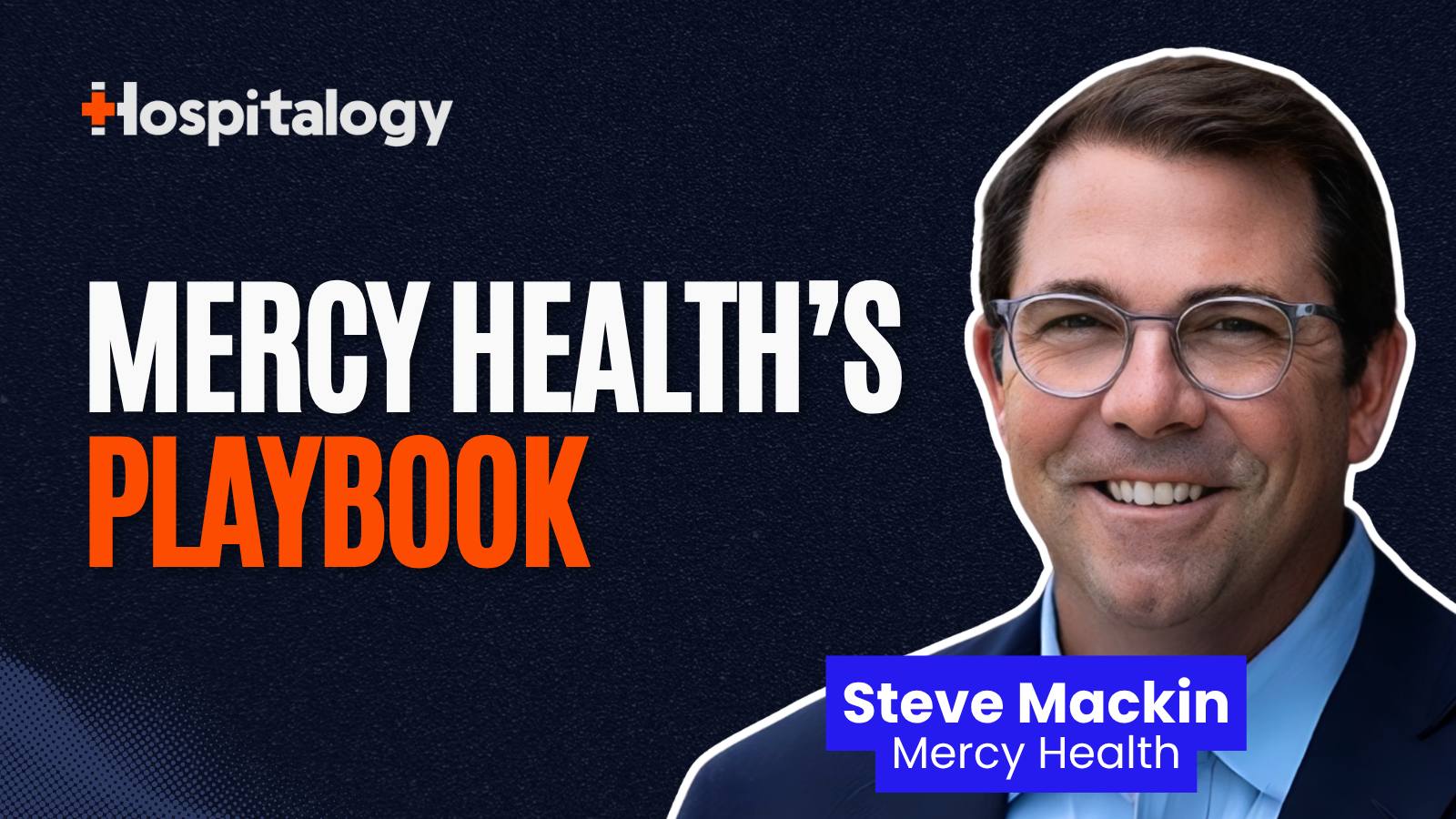 Want to listen to the podcast episode instead? Click here. Mercy’s scarcity mindsetSteve came to Mercy after nearly 20 years at Cancer Treatment Centers of America, where he started as a management trainee and worked his way up to interim president. So when he jumped to a 200-year-old faith-based nonprofit, I asked him directly what spurred the move. The through line, he said, isn't profit motive versus mission but rather…scarcity. In a startup environment, you're forced to innovate with limited resources. In a nonprofit health system that serves every patient regardless of ability to pay — not just commercial and MA lives, but everyone — that same scarcity dynamic is baked into the operating model. "Scarcity's your friend," he told me. "It forces you to think differently around the care model." It’s an interesting framing, reorienting the nonprofit constraint (you can't turn anyone away, you operate in tough markets, your margins are thin) as a strategic advantage — it forces you to build a better mousetrap. And it attracts people who think that way. Steve talked at length about selecting for "Mercy fit" — people who are change-oriented, other-centric, and comfortable having a point of view in the meeting room. He wants people who will challenge his thinking, not echo it. Mercy’s somewhat contrarian strategic bet: concede on price, win on care model and efficiencyMercy has deliberately operated at a lower price point than many of its competitors. Steve was pretty transparent about this:
Most systems are fighting tooth and nail for rate increases, especially in the current inflationary environment. Mercy's position is, essentially, ‘we'll accept the constraint on price, but we'll win by building a care model that's so much more efficient and consumer-friendly that volume growth and cost avoidance more than compensate.’ And the financials numbers indicate the strategy is working, with a 11.9% revenue CAGR over the last 3 years, and EBITDA climbing from 4.5% to roughly 5.7%. I pushed Steve on what sparked this approach versus the traditional fee-for-service volume play, and his answer was blunt: "He who gets the healthcare model right and does it sustainably wins. Community by community, state by state." He also didn't mince words about what happens to systems that can't get there: "There's going to be winners and losers. I hate to say that, but I really do think there will be winners and losers when it comes to the long-term viability of systems." Mercy and the chronic care playbookSteve's most compelling proof point was Mercy's CHF program. Nationally, CHF patients are one of the biggest cost sinks in the system — they get uncomfortable, they have no good same-day option, and they land in the ED. Because Mercy holds risk on so many of these lives, it redesigned the entire pathway: frequent proactive outreach, 24/7 access to Mercy Virtual, and a network of same-day outpatient clinics built specifically for fluid management. The investment into CHF led to ED admissions for CHF patients cut in half over the last year. So based on these results, Mercy has deployed 12 clinics so far and plans to double the facility count in 6 months. Similar programs are running for diabetic patients, CKD patients, and cancer patients. There’s a second order effect here which results in higher acuity, higher needs patients in the actual inpatient / ED setting. When you keep chronic patients out of the ED, you create capacity for the patients who actually need to be there. Investing in preventive is as much about keeping patients out of the hospital as it is making sure beds and ED units are ready for the growth in the patients who need it most. You're simultaneously improving outcomes for the sickest patients and freeing up capacity to serve more volume on the acute side. This flywheel — better chronic management funding more capacity funding more growth — is the whole ballgame for a system at risk, and it's a big reason Steve views the recent EBITDA improvement as a floor rather than a ceiling. Killing 1,300 point solutionsCan you believe one enterprise had 1,300 point solutions? This number is almost unfathomable to me. I've written before about the point solution problem in health IT, and Steve gave one of the most incredulous points I've heard: Mercy turned off over 1,300 point solutions as part of its move to a platform model of care. They migrated all data to the cloud, standardized on a single instance of Epic (one of the largest single instances in the country), and built an infrastructure that allows them to deploy new solutions enterprise-wide at a pace most systems can't touch. When Mercy decided to deploy Aidoc’s AI imaging platform — which does AI over-reads on all imaging and reprioritizes cases from the traditional first-in-first-out model to real-time clinical urgency — they rolled it across all hospitals and clinics, covering nearly 4 million lives and 4,400 providers, in about 90 days. Steve said most health systems would take a year or more for the same deployment. Steve was clear that this wasn't just a technology initiative — it was a behavioral and cultural shift that started under his predecessor with physician integration, EHR consolidation, and the build-out of a virtual care platform that now includes 15-20 solutions fully integrated into the care model. The key insight here is that Mercy now thinks of itself as a care platform — one that can ingest, validate, and scale new technologies and care models across its entire footprint, which creates a new paradigm and operating model for health system-startup partnerships, for AI deployment, and for the speed at which a system can evolve its care model, and this is the path most health systems need to head down. Worth flagging his answer on the labor displacement question, too, since I asked him point blank about AI and jobs given Mercy is the largest employer in some of its communities. He doesn't buy the displacement narrative for healthcare: the industry is structurally short on bedside labor, and in his view AI pulls bureaucracy out of the workflow and pushes more people toward the bedside working at top of license. Certain back-office pockets get more efficient, sure. But he framed AI as the thing that "brings back the joy of practice" rather than the thing that empties the building. Mayo partnership and data assetsMercy's expanded partnership with Mayo Clinic is an interesting one as data becomes so strategically valuable in this LLM-dense arena. The combined data asset spans 15 million patients, 12 billion images, 3 billion lab results, 10 million pathology reports, and 1.6 billion clinical notes. Steve framed the value on three dimensions.
If you're building an AI-enabled clinical tool and you need to validate against a dataset that's both massive and representative, this partnership creates one of the most compelling proving grounds in the country. And Mercy and Mayo sit at the point of validation — meaning they're essentially gatekeepers for which AI solutions get the stamp of clinical credibility and scale. Consumerism, standardization, and the “third rail”Steve also talked about Mercy's consumer-facing strategy, and I thought his framing of the problem was spot-on. Health systems have "trained consumers to circumnavigate what we've put before them," he said. "There's such low reliability in what they're looking for in terms of outpatient care that patients have to circumnavigate and find the solution that they're looking for." reliability in outpatient access is so low that patients route around the front door entirely and frequently land at the wrong site of care. We taught them the bad behavior. Now we have to unteach it. Mercy's response is to build high-reliability access across channels — asynchronous care for the Gen Z crowd, traditional physical visits for boomers, and everything in between — all navigable in the patient's terms. Steve's position is that an informed patient making better daily consumption decisions is good for healthcare and good for Mercy, since Mercy wins on that math. To that end, they're partnering with Garner on quality and cost transparency for employers and consumers. And they're investing heavily in standardizing schedules, templates, and workflows across the system so that a digital layer can surface real-time availability. Steve called that standardization effort "the third rail of politics in healthcare.” Getting 4,500 employed clinicians to standardize their templates and schedules is the kind of unsexy, politically fraught work that most systems avoid. But it's table stakes for building the kind of consumer-facing digital experience that patients are increasingly demanding. Mercy's willingness to push through that resistance is, in my view, a huge competitive advantage that doesn't show up on any balance sheet. Mercy’s road aheadSteve is bullish on Mercy's trajectory. He expects the 5.7% EBIDA to mark a low watermark rather than a peak, driven by continued chronic care cost avoidance, the capacity that avoidance creates, and a slate of new product launches landing this year. Legislative headwinds from potential Medicaid cuts are real — Mercy has modeled the exposure and identified efficiency offsets — but his posture is that care model gains generate enough value to absorb the shock. He also dropped a few partnership names that caught my ear. Mercy is working with Alice Walton to build a 3 million square foot destination medical campus in Northwest Arkansas (someone who is quietly putting in the WORK in our industry behind the scenes) — cardiovascular center of excellence, other specialty centers, all in a value-based model. They're working with Wellvana to extend their clinically integrated network to new communities. They're partnering with the PillPack founders at General Medicine on access solutions. And the Aidoc imaging AI partnership is already at full scale. Step back and the picture is a health system building the infrastructure, partnerships, and care models for where healthcare has to go, while most of its peers are still litigating rate escalators. You can quibble with individual choices. You can't quibble with the coherence or the execution speed. I'll be watching Mercy closely over the next 12-18 months as these bets mature. If Steve's right that care model is the ultimate competitive differentiator — and I think he is — Mercy is as well-positioned as any large system in the country to prove it. HOSPITALOGY AI RETREAT UPDATE Real Talk About AI and Health System TransformationSpeaking of health system transformation, those who are working at the heart of it and artificial intelligence should join me in Phoenix this November. Real talk on the current state of AI and health systems, networking with 100 of your peers, and travel accommodations for hospital and health system leaders. Healthcare leaders will walk away with peer relationships, governance frameworks, and a clearer read on where to place their AI bets. Apply for the Hospitalogy AI Retreat at hospitalogyretreat.com or reply to this email directly to learn more about attending and speaking opportunities. .png?sig=8029bb462e5f1f753e5d400465d443a462d1b349c2ba3a22bdeee00e80026a32&size=email-body&dpr=2) ON YOUR RADAR
*This resource is brought to you by one of my brand partners who help make this newsletter possible! Thanks for the read! Let me know what you thought by replying back to this email. — Blake | |||||||||
|