{if ftt_dorm_120 == true}
Quick favor: Our records indicate that you aren’t opening this email. But records can be wrong. Please click here if you’d like to remain subscribed to Fintech Takes. |
|
|
|
{/if}Happy Monday, Fintech Takers! And Happy June! I hope the flowers are blooming and the birds are singing, wherever you are.
It’s a bit rainy here, but that’s OK because today’s newsletter comes to you from the Fintech Frontier Summit — a small gathering of bank and fintech folks at a ranch in the mountains of Montana.
Beautiful setting. Lovely people. Fascinating conversations. Overall, a wonderful way to cap off my spring travel season. - Alex
P.S. — Stablecoins as a settlement layer and a bridge to other on-chain efficiencies within the world of card payments is a topic that I am fascinated by. I’ll be talking with Western Union and Rain about it on June 30th. Join us! |
Was this email forwarded to you? |
|
|
|
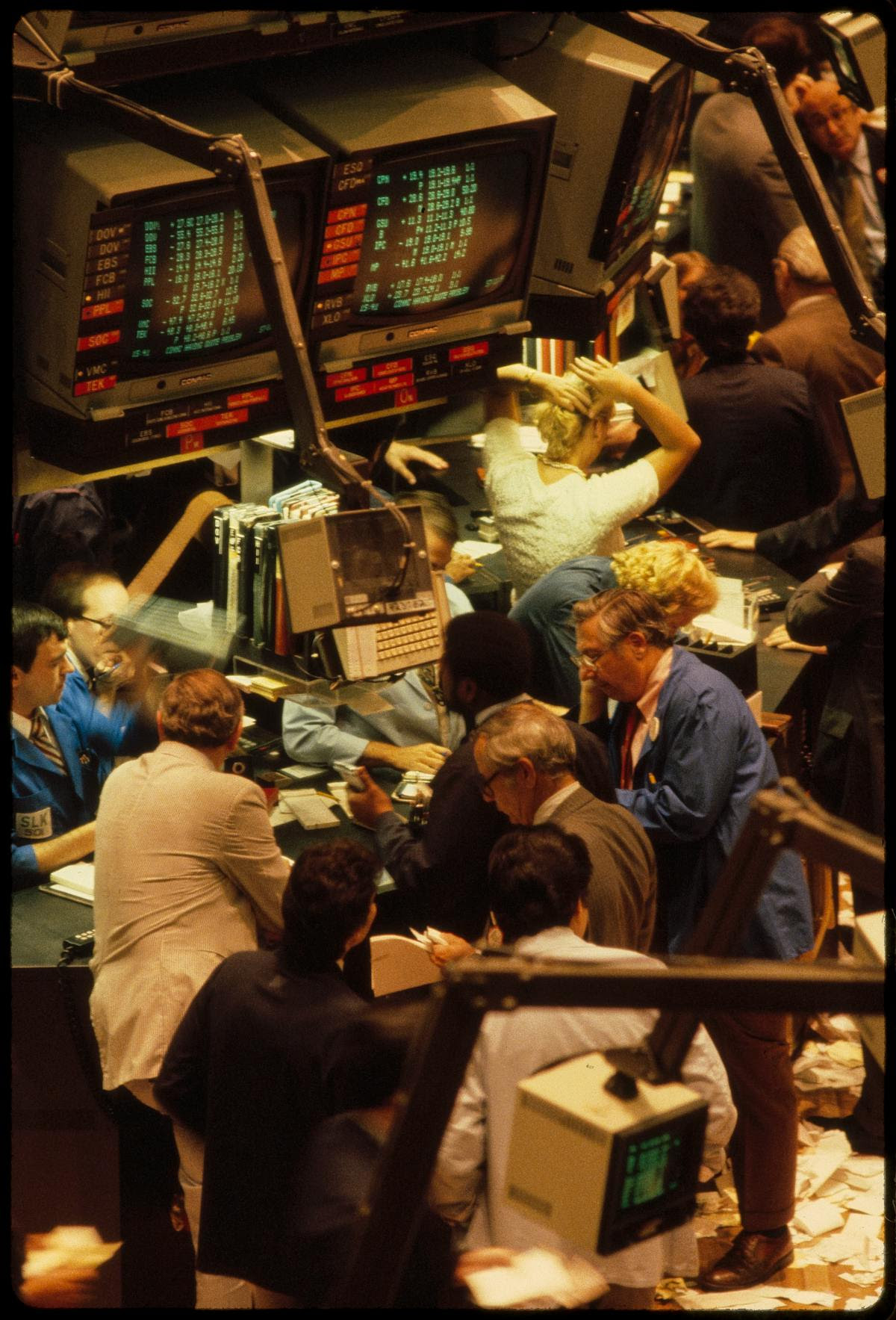
N.Y. Stock Exchange by Bernard Gotfryd (1924-2016). |
|
|
|
#1: What is the purpose of SoFiUSD? |
SoFi became the first national bank to offer a stablecoin on a public blockchain:
SoFi … announced today that SoFiUSD, a bank-issued U.S. dollar stablecoin, is available for SoFi members to buy, sell, hold, and convert directly within the SoFi app.
This marks the first time that a U.S. national bank-issued stablecoin is available directly on a banking app. By expanding SoFiUSD to its nearly 15 million members, SoFi is building the bridge between traditional banking and digital assets. By integrating blockchain technology within its banking ecosystem, SoFi is helping to make digital financial tools more accessible, practical, and trustworthy. |
I try to be as rigorously neutral on the topic of stablecoins as I can be. As I have written many times before, stablecoins are (by design) crypto stripped of speculation, which means that they are an excellent test of the non-speculative value that crypto can provide to companies and individuals.
Press releases like this really make me feel like stablecoins are failing that test.
SoFi’s press release spends quite a few words bragging about how safe and well-designed SoFiUSD is; backed 1:1 by liquid assets, regular attestations from an independent CPA, support for Ethereum and Solana, blah blah blah.
However, it fails to clearly convey why SoFi members would want to buy, sell, or hold SoFiUSD. SoFi claims that it will be integrating the stablecoin into other products and services “in the coming weeks,” and these integrations will allow members to: -
Convert SoFiUSD into tokenized deposits, unlocking the ability to earn interest and access FDIC insurance on the deposits.
- Move value across borders 24/7/365, with fewer delays and lower costs.
- Trade crypto on Bullish, a centralized crypto exchange.
That sounds mildly interesting, until you remember that: -
SoFi already offers deposit products that pay interest and are protected by FDIC insurance. SoFi members don’t have to buy SoFiUSD and then convert it into a tokenized deposit to access those benefits! Also, as a side note, it feels weird to promote FDIC insurance on tokenized deposits when you offer a stablecoin. Doesn’t that undercut the message that your stablecoin is safe and 100% backed by liquid assets?
-
SoFi already offers the ability for members to send money to recipients in over 30 countries via a partnership with Lightspark, a Bitcoin-based global payments platform. That partnership was announced last year and SoFi didn’t have any native international money movement capabilities before that, which suggests that it’s not a feature that its members were beating down the door to get their hands on.
- Institutional clients don’t need SoFiUSD to trade crypto on Bullish or any other crypto exchange. Instead, they can pick one of the many US dollar-backed stablecoins already in existence, all of which function exactly the same SoFIUSD (but with much greater liquidity).
Put bluntly, there is no new, tangible benefit that SoFi members are going to get from SoFiUSD, based on what the company shared in its press release.
This makes me think that the real purpose of this press release is to appeal to SoFi investors, particularly the rabid contingent of retail traders that have made $SOFI a part of their identity.
And the fact that a savvy CEO like Anthony Noto apparently believes that this press release will positively impact those investors’ sentiment towards SoFi makes me depressed about the stock market, stablecoins, and the state of fintech overall.
Whatever happened to customer value, man? |
#2: Robinhood’s Agentic Whimper |
Robinhood announced some agentic AI capabilities:
Robinhood said users on its platform can now create a separate account for their AI agents and connect them to a dedicated wallet. While these agents would be able to read and analyze users’ portfolios to come up with trading strategies and suggest investments, they’ll only be able to access the pre-loaded balance in the dedicated wallet to place orders.
Robinhood says users can connect their AI agents to its Model Context Protocol (MCP) service to do things like analyze concentration risk and sector exposure, execute trades, or look through analyst notes to identify new investment opportunities across various sectors. Robinhood is also debuting a new virtual credit card meant to be used by AI agents. With this card, users can connect their AI agents to the company’s banking MCP server to enable them to make payments. |
Compared to what its competitor Public launched back in March, this strikes me as unusually conservative for Robinhood. The company didn’t embed AI agents within its platform. It just built the integration layer allowing its customers to connect their own AI agents to their Robinhood accounts, so that they can do research and make trades on their behalf. At the moment, it’s just stock trading. No options, crypto, or prediction markets.
According to a VP of Product at Robinhood, the company took this ‘bring your own agent’ approach because it saw demand from the tech-savvy segment of its customer base, and it wanted to test it with them and learn from how they use it. I’m sure there’s some truth to that, but I also think Robinhood has very little interest in enabling full-scale agentic trading across all of the asset classes it supports.
The reason for this is simple: It’s not compatible with the company’s business model or customer base. As CEO Vlad Tenev explained last year, “Most of the time you're not doing it just because you want to make money. You also love trading and you're extremely passionate about it."
Translation: We make money on dumb retail traders who make bets for fun and we don’t want them using AI agents to make those bets better or less frequently. |
#3: The Feeling of Debanking |
Jackie Reses, Co-founder and CEO of Lead Bank, gave an interview in which she pushed back, hard, on the notion of debanking:
I don't believe there was debanking. I think it's a crock of shit. An absolute crock of shit.
There's 5,000 banks in the United States. We have a lot of red states. Are you telling me that in lots of red states, including where my company is headquartered, Kansas City, Missouri—those banks were not willing to bank, for example, conservative companies?
What debanking actually means is that banks transitioned out of offering crypto products or risky products like adult entertainment or something like that.
This take engendered a lot of angry rebuttals from the crypto community. This tweet from Austin Campbell, which I will quote in part below, is a representative example:
As someone who testified in front of Congress on this topic, there was 100% debanking. This is an outrageously irresponsible take at this point, and ignorant on the facts. Put simply: if this is the view of the CEO of Lead Bank, you shouldn't be doing business with Lead Bank. |
Reconciling the viewpoints of bankers, regulators, and crypto founders and operators on debanking is an enormously difficult task. It’s more akin to therapy than it is a fact-based investigation. An analogy might be helpful.
Let’s say you and I have been dating. And I lose my job. And it’s not really clear to you whether I deserved to lose my job or if it was just bad luck. And I say “I’ll get another job soon,” but in the meantime you’re annoyed with me because I’ve continued to gamble, despite no longer having a steady income. And your parents, who used to be neutral in their feelings about me are now acting overtly cold and hostile toward me (and probably talking bad about me behind my back).
And then you break up with me. And you don’t really give me a clear reason why.
I’m going to feel like your parents actively sabotaged our relationship. I may even convince myself that your parents threatened to cut you off financially if you didn’t break up with me.
But, of course, it’s possible none of that is true. Maybe you had been planning to break up with me for a while. Or maybe you made the decision after I lost my job. Your parents’ obvious dislike of me definitely didn’t help matters, but it’s possible (likely, even) that the decision wasn’t primarily driven or engineered by them. It’s probably not a conspiracy. But you can understand why it might feel like a conspiracy to me. That’s a much easier story to tell myself and my friends than it is to say, “I wasn’t as responsible and financially attractive as I needed to be to keep you, and while I think your parents’ dislike of me was excessive and unfair, I understand and respect your decision.” This is, roughly, how I’ve come to think about the alleged debanking of crypto under the Biden Administration, which the conspiratorially-minded among us refer to as “Operation Chokepoint 2.0.” It feels like a conspiracy to those inside the crypto industry because the banking industry pulled back from crypto between 2022 and 2025 and banking regulators during that time clearly did not like the crypto industry and were warning banks about the risks of operating in the crypto industry.
However, it is also true that the crypto ecosystem experienced a brutal winter in 2022 and 2023, brought on, in part, by the failures and malfeasance of many large crypto companies (FTX, most notably). This made the industry both financially unattractive and reputationally risky, and it is perfectly understandable that banks during those years might have had a legitimate business interest in pulling back from or staying away from crypto.
It felt like a conspiracy, but there’s no real evidence that it was. The OCC’s own report on the subject, authored with the intent to appeal to the Operation Chokepoint 2.0 true believers, found nothing substantive. |
|
|
|
2 READING RECOMMENDATIONS |
A good rundown of interesting topics in Jason’s newsletter from yesterday. Be sure to watch out for a new Fintech Recap episode from Jason and I, coming on Wednesday. |
I haven’t gotten a chance to dig into all of these announcements yet, but it seems like there was some interesting stuff that came out of Plaid’s annual Effects conference. I’m glad Mary Ann wrote about them. |
Most engineering orgs can't prove their AI coding spend pays off. Fundbox CTO Ofer Karp makes that argument, and has a framework for what disciplined adoption should look like. Read it here. *This rec is brought to you by one of our fantastic brand partners. |
There are a TON of interesting questions being asked in the Fintech Takes Network. I’ll share one question, sourced from the Network, each week. However, if you’d like to join the conversation, please apply to join the Fintech Takes Network. AI is making it easier to start and grow companies. And while I doubt we see a one-person unicorn in 2026 (as our AI overlords predict that we shall), I do think this trend of leaner and faster entrepreneurship is real and will accelerate. How will this trend affect competition in financial services?
If you have any thoughts on this question, reply to this email or DM me in the Fintech Takes Network! |
|
|
|
Thanks for the read! Let me know what you thought by replying back to this email. — Alex |
|
|
|
{if !profile.vars.fintech_takes_user_fitness && profile.vars.fintech_takes_user_fitness != false}Join 2,444 other finance and fintech leaders in the Fintech Takes Network
|
|
|
|
{/if}{if profile.vars.fintech_takes_user_fitness == true}The conversation doesn't have to stop here
Keep learning and connecting in the Fintech Takes Network
EVENTS | FEED | LIBRARY | DIRECTORY
|
|
|
|
{/if}Get your brand in front of 66,000+ fintech and banking executives. |
Workweek Media Inc.
1023 Springdale Road, STE 9E
Austin, TX 78721 Want to ruin my day? Unsubscribe. |
|
|
|
|