Hey there,
Quick note: it looks like you signed up for Fintech Takes through an old subscribe page, and somehow you never started receiving it. That's on us, and I'm sorry for the delay.
Going forward, you'll get honest, curious analysis of the ideas and companies changing how money works three times a week. I hope it's worth the wait.
If you're no longer interested, no worries. You can unsubscribe below.
— Alex |
|
|
Happy Wednesday, Fintech Listeners!
LendingClub announced yesterday that it’s changing its name to Happen Bank, and this news has completely discombobulated me.
On the one hand, LendingClub wasn’t a great fit anymore. It described a business model (P2P lending) that the company outgrew a long time ago. And I can see how it might have been confusing to potential customers who weren’t sure, just looking at the name, if LendingClub was a bank (it is!) that offered bank accounts (it does!)
Plus, I always screwed up the spelling because they stupidly removed the space between lending and club. But, on the other hand, Happen Bank is … not great? I don’t know. Maybe I just need to give myself time to get used to it. Naming is ridiculously hard and I can see what the team was trying to do (a bank for people trying to make things happen!)
But still. Blink test, I don’t love it. And the logo color and font feel a bit too playful.
I promise that today’s newsletter and podcast are not about this news, nor about the subtle art of branding in financial services. I just needed to get my LendingClub thoughts down on paper. OK, now I feel better! Let’s do this … - Alex |
Was this email forwarded to you? |
|
|
3 BIG IDEAS FROM THE PODCAST |
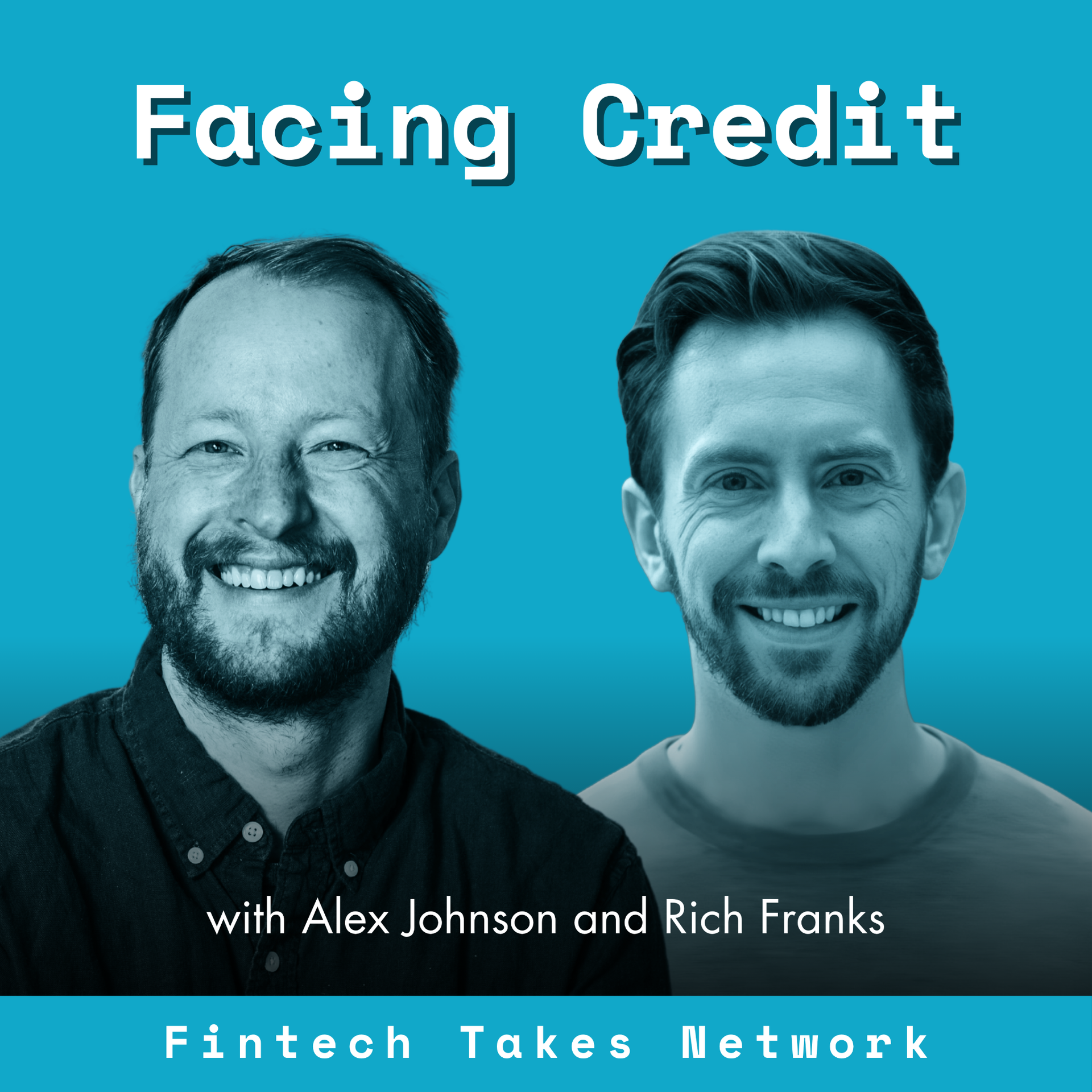
This week on the Fintech Takes podcast, I got to sit down with Rich Franks for a new episode of Facing Credit, where we unpack what's happening with lending right now.
Rich is a fintech advisor and consultant with more than 20 years in credit risk, across both the fintech side and the bank side (including, of course, time at Capital One). He’s seen everything this market has thrown at practitioners, and I've been wanting to record this episode for a while. The U.S. credit scoring market has changed more in the last year than the previous 30 years combined. That sounds hyperbolic, but I promise you it’s not.
If you're a lender, what credit score should you use? Should you build your own? If you do build your own, how can you be sure that you’re capturing all of the value created by new sources of data, like consumer-permissioned bank transaction data?
If you're a consumer, do you actually know how your creditworthiness is being determined when you apply for a loan? Do you know what actions to take to improve all the various credit scores that lenders are using?
These are a taste of the kinds of questions Rich and I dig into. We also talked about what the credit scoring market will eventually look like when it consolidates down, and what FICO and the credit bureaus are going to do next. And of course we talked about Block's Cash App Score (which I am personally obsessed with) and even got into AI at the very end. |
And read below for my three big ideas... |
After extensive testing, the results are in: adding cash flow data to a bureau-based credit decision produces approximately a 30% predictive lift.
30% is a staggering number! Credit risk careers are built on basis point-level improvements. Achieving a 30% predictive lift is the credit risk-equivalent of batting .600 for a season in professional baseball. It simply does not happen.
And yet, for years, most lenders haven’t seized the opportunity presented by cash flow underwriting. Why?
The answer is friction. The best conversion rates quoted by bank account aggregators for the consumer linking step are 70-80%. That sounds good until you consider what it means in practice: putting a step with 80% conversion at the top of a lending funnel means giving away a fifth of your business before a single underwriting decision is made. As Rich put it, the threshold can’t be asymptotically close to a hundred percent. It needs to be a hundred percent. You have to eliminate the concept of dropout entirely.
Verification steps also don't filter applicants randomly. You lose your best customers (the ones who won't sit through any friction), and your worst customers (the ones who know they'll fail). What's left in the middle is not necessarily the population you'd have chosen.
Rich's observation here stuck with me: the person who controls the consumer experience in a lending funnel does more for credit risk outcomes than the data scientist does. |
|
|
#2: The Distance Between Can and Should |
Rich told me about a time when he tested merchant-level transaction data as an input into a credit risk model. The result, which didn’t surprise him, is that it was highly predictive.
It was also problematic.
He used the example of a town with a high-end grocery store and low-end grocery store. Unsurprisingly, the shoppers at the high-end store were dramatically better credit risks. However, the data also had a clear compliance challenge, as he explained: I can tell you if I walked into those two stores at any time of day; I can tell you have a fair lending problem just by looking around.
That anecdote isn’t an argument against bank transaction data. It's an argument for the industry thinking deeply about the morality of how we use bank transaction data (and other novel sources of data), before the regulators catch up.
The example I raised was Verizon versus Cricket Wireless. Both offer the same core service, but they are packaged, priced, and marketed for two very different customer bases. And just like the grocery stores, I’m guessing that the analytics would tell us that which mobile carrier you use is a very predictive attribute for guessing whether or not you will pay back a loan.
These merchant-level insights are in bank transaction data. And thanks to the growing adoption of cash flow underwriting (enabled by the open banking data aggregators) they are increasingly available to credit risk professionals for use in their features and models. The question is whether they should be used. And, if so, how?
The current CFPB likely doesn’t care. It seems to think that anything relating to fair lending or Reg B is a woke DEI conspiracy. However, that’s not how regulators and the attorneys general in many of the states feel. And it may not be how the CFPB feels in a few years either.
Lenders should start thinking about the difference between what they can do with bank transaction data and what they should do with it now, before the regulatory pendulum swings violently back in the other direction.
|
#3: What if the Big Banks Followed Block’s Example? |
Large sophisticated lenders build proprietary machine learning models all the time. What Block is doing is different. It built a model drawing on Cash App P2P transactions, direct deposit patterns, loan repayment behavior (including Afterpay loans), and other internal signals, and they're making it visible to consumers as an explanatory score with actionable factors. And, as I’ve written about before, they've announced plans to sell it to third-party lenders for use in underwriting Cash App customers for products Block doesn't offer, with auto lending as the example that's been floated.
Rich likes the logic for consumers. Credit Karma did something similar with Lightbox a while back. The company found that saying, "you're likely approved" is more useful to a consumer than a score that may or may not match what any given lender actually uses. Block is taking this logic further: Here is everything we know about your financial behavior in our ecosystem, translated into a score you can see and act on.
Rich's question is about what happens when you extrapolate this trend out.
Block's rationale is defensible in isolation. Cash App and Afterpay loans don't get reported to the credit bureaus today, so Block isn't withholding data that was ever part of the traditional credit reporting ecosystem. The company is monetizing something that was never in the system to begin with. But where does that logic lead?
What if JPMorgan Chase — the largest bank in the U.S. — decided to do this? JPMC loan repayment data flows through the traditional credit bureau system today. If JPMC decided its data was too valuable to furnish for free and built its own score instead, every other lender in the U.S. would have to buy a JPMC score to underwrite a JPMC customer. And that’s assuming that JPMC would agree to make its data and score available to other lenders, which is not a safe assumption!
I don’t think this will happen, but it’s a fun hypothetical to think through. |
|
|
Jay Budzik, SVP at Fifth Third, is one of the smartest people working at the intersection of banking and AI, so I figured this episode of Bank Nerd Corner would be excellent. And I was right! It is! |
This introduction to the episode was enough to get me hooked: Have you noticed a lot of young people getting into antenna-maxxing as alpha? Or, maybe searching for any bit of copium after they fat-fingered and got rinsed? Or maybe they farmed during a yes-fest on Mention Markets resulting in some serious printing? If none of that made sense to you, then we have the perfect episode for you. |
|
|
Thanks for the read! Let me know what you thought by replying back to this email.
— Alex |
|
|
{if !profile.vars.fintech_takes_user_fitness && profile.vars.fintech_takes_user_fitness != false}Join 2,444 other finance and fintech leaders in the Fintech Takes Network
|
|
|
{/if}{if profile.vars.fintech_takes_user_fitness == true}The conversation doesn't have to stop here
Keep learning and connecting in the Fintech Takes Network
EVENTS | FEED | LIBRARY | DIRECTORY
|
|
|
{/if}Get your brand in front of 63,000+ fintech and banking executives. |
Workweek Media Inc.
1023 Springdale Road, STE 9E
Austin, TX 78721
Want to ruin my day? Unsubscribe. |
|
|
|