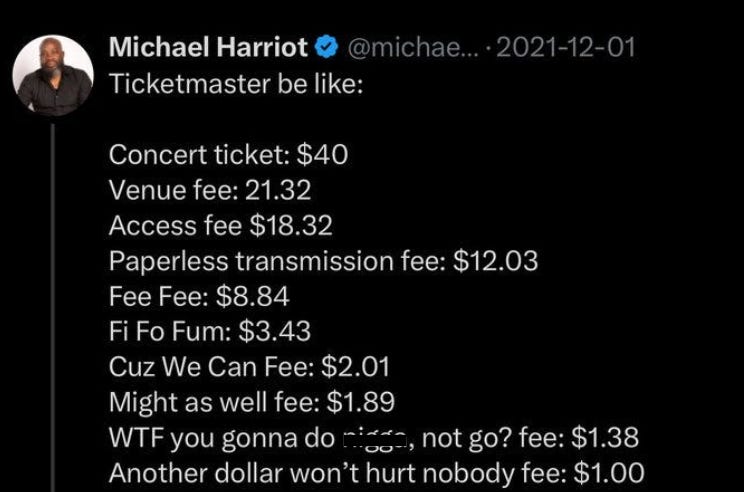
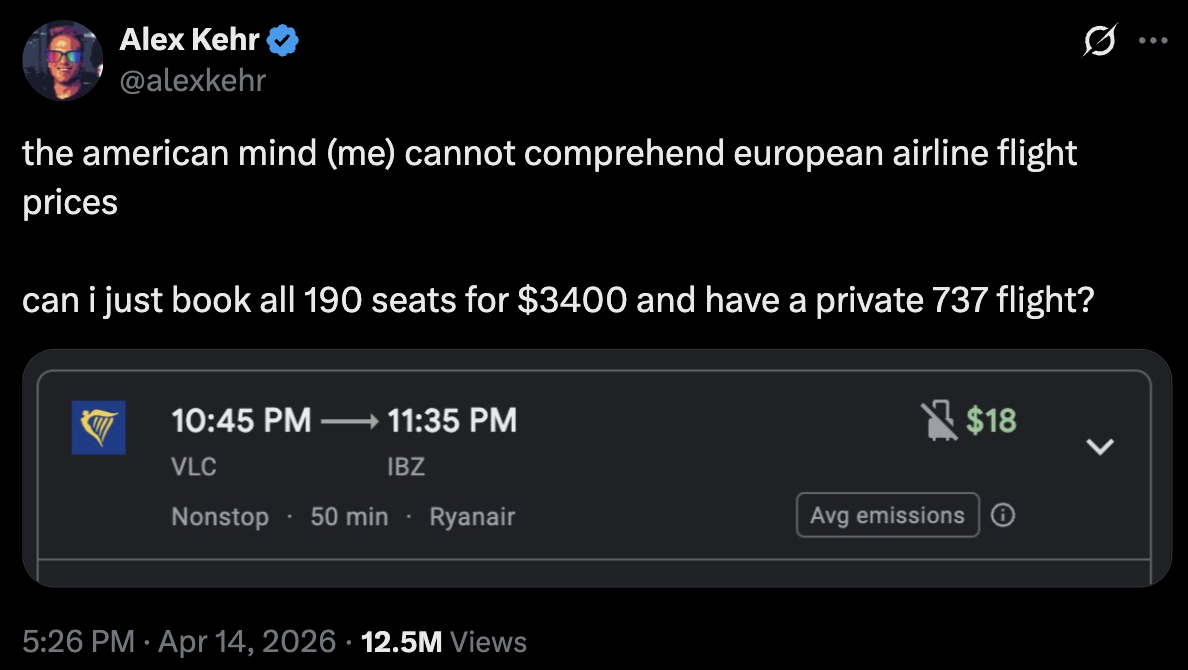
Ok, it is a bit more complicated than “Might as well fee”.
But Ticketmaster’s fee situation is definitely the most salient and consumer-facing part of the key antitrust charges.
Here is more from Music Business Worldwide:
Across three core claims [against Live Nation], the jury found that:
-
Ticketmaster willfully acquired or maintained monopoly power in the market for primary ticketing services to major concert venues through exclusionary conduct.
- Ticketmaster did the same in the market for primary concert ticketing services to major concert venues.
-
Live Nation willfully acquired or maintained monopoly power in the market for large amphitheaters through exclusionary conduct.
In each case, the jury also found that the anticompetitive conduct caused harm, and that Live Nation controlled, dictated or encouraged Ticketmaster’s behavior.
The jury additionally found that Live Nation unlawfully tied artist promotion services to the use of its large amphitheaters (meaning artists were required to use Live Nation’s promotion services in order to play its amphitheaters).
On damages, the jury found that consumers were overcharged by $1.72 per ticket for primary concert tickets at major concert venues across 22 states and the District of Columbia [this $1.72 overcharge applied to ~20% of all Live Nation tickets sold].
According to the states’ case, Live Nation is using its monopoly position to basically Tony Soprano everyone in the ecosystem:
- To the artists: “Oh, nice tour you have there, would be a shame if we didn’t promote it because you used a 3rd-party venue.”
-
To 3rd-party venues: “Oh, nice stadium you have there, would be a shame if it stays empty because we won’t let our artists play there unless you use our ticketing platform.”
-
To fans: “Oh, nice college fund you have there for your kid, enjoy this Another Dollar Won’t Hurt Fee because what other ticketing platform will you use to book your favourite artist who we happen to rep?"
To be sure, these concerns have existed for decades.
As Matt Stoller highlights, Ticketmaster’s webpage basically brags about absorbing a competing platform in 1991 right on the timeline page of its website: “Ticketmaster acquires its major competitor Ticketron”.
They were rolling up other ticketing platforms to gain market power.
In 1994, Pearl Jam went to war against Ticketmaster. Stone Gossard and Jeff Ament — along with the managers for Aerosmith and REM — testified in congress against the ticketing giant. The artists said that Ticketmaster was using its influence over venues, promotion and tickets to charge fans “exorbitant fees”.
Pearl Jam ended up cancelling its tour that year due to this beef.
While Ticketmaster was cleared of being a monopolist in various class-action lawsuits, its reputation hasn’t exactly…well, please see the above tweet.
When Live Nation acquired Ticketmaster in 2010, the Department of Justice (DOJ) forced the newly formed company to pinky swear sign a 10-year consent decree agreeing not to force concert venues to use Ticketmaster. In 2019, that consent decree was given more meat because venues were complaining that Live Nation was retaliating against them for using other ticketing platforms.
Then, came the “website crash heard around the world”. On November 15, 2022, a super-duper-superstar artist who rhymes with Baylor Sift launched the Eras tour. A record 2.4 million people bought tickets on Ticketmaster that day but millions of other fans were left in the lurch and the website went down.
A bunch of Swifties then got rugged on secondary markets by scalpers and the outcry led to lawsuits and another congressional hearing. Within two years, the DOJ and dozens of states had filed antitrust lawsuits against Live Nation.
Live Nation settled its lawsuit with the DOJ just last month. However, the states case kept going and that is how we got this week’s legal outcome.
That earlier settlement provides a roadmap for how a judge may seek antitrust remedies against Live Nation.
But, first, I want to play some devil’s advocate.
I’m personally biased against all ticketing platforms (Ticketmaster, StubHub, SeatGeek) for two reasons. First, we’re obviously getting donged on the fees. Second, anytime I have to buy a ticket on the secondary market, it is a reminder that I don’t have the hustle to actually snag a ticket right when it goes on sale (I’m learning this lesson the VERY VERY hard way with FIFA 2026 tickets right now).
So, I had to force myself to understand Live Nation and Ticketmaster’s rationale for their tie-up (a "steelman" if you will):
-
Organizing and promoting live concert events is very expensive and has paper-thin margins. Dude, I can barely organize a coffee meeting. I can’t imagine the lift that goes into throwing a concert for The Weeknd. A fully-integrated business — with control of ticketing that ties promotion and ticket inventory — creates a better fan experience and is the most viable way to make the whole model work for everyone long term.
-
A scaled player can invest more in infrastructure, fraud prevention, resale controls and digital ticketing (I will admit that the Ticketmaster App is pretty slick and it feels like magic when a concert ticket shows up in Apple Wallet).
- Live Nation doesn’t actually set most of the ticket price. Artists dictate the face value and venues tack on most of the Fee-Fees (80% of Live Nation events are in 3rd-party venues).
The last point probably has the most credence.
Yes, ticket prices have definitely gone up. According to Bloomberg, the average face value price for a top-100 artist has risen from $53 in 1996 to $142 today (all adjusted for inflation).
There are a few key factors to consider about this price increase.
In the 1990s, concerts were marketing for the physical albums. CD sales — aka the bundling of 2 or 3 great songs with a bunch of filler no one wants — was an incredible business model for artists. Physical albums were the cash cow.
Now, live touring makes up the majority of income (70%+) for the top-tier artists and streaming services are the marketing tool to get people to come to the shows. Artists are very incentivized to pump them ticket prices and the demand for live events has been wild post-COVID.
Those pesky secondary markets also (shocker) inflate ticket prices….especially from fees. For primary tickets, fees are ~27% of the face value. On secondary markets, one study found fees hitting 56% of a ticket’s face value.
The clear appetite of buyers on the secondary market has led to platforms implementing dynamic pricing, which further boosts primary ticket prices (but at least this money is going to artists and promoters, opposed to scalpers).
This is a long way of saying that Live Nation isn’t the only one milking fans. The company is a pain sponge for the rest of the industry (similar to how Roger Goodell gets paid $70m a year to eat shit for the NFL owners).
But but but but, let’s be honest. They is milking us with them fees. Of course they are. Look at the business model. Just like Disney with Disneyland. Live Nation has to turn the fee dial if it wants to profit-maxxxx.
There were some pretty damning evidence from the state’s antitrust trial, per NYT:
Live Nation employees joked about trying to “gouge” people for parking and V.I.P. upgrades at concerts, calling fans “so stupid” for paying the inflated charges and boasting that they were “robbing them blind baby.”
To quote one of the greatest fictional characters in the history of the TV medium: “Is you taking notes on a criminal f-cking conspiracy?"
The company’s explainer via Bloomberg:
Live Nation’s ticketing director Ben Baker testified that Ticketmaster’s fees depend on the face value of the ticket. As of September 2023, the company’s standard rate card called for charging $3.25 on tickets with a face value of as much as $5.99. From there, the fees increase based on face value with the highest price range — above $116 — garnering a 20% fee that caps at $70.
Will Live Nation be broken up?
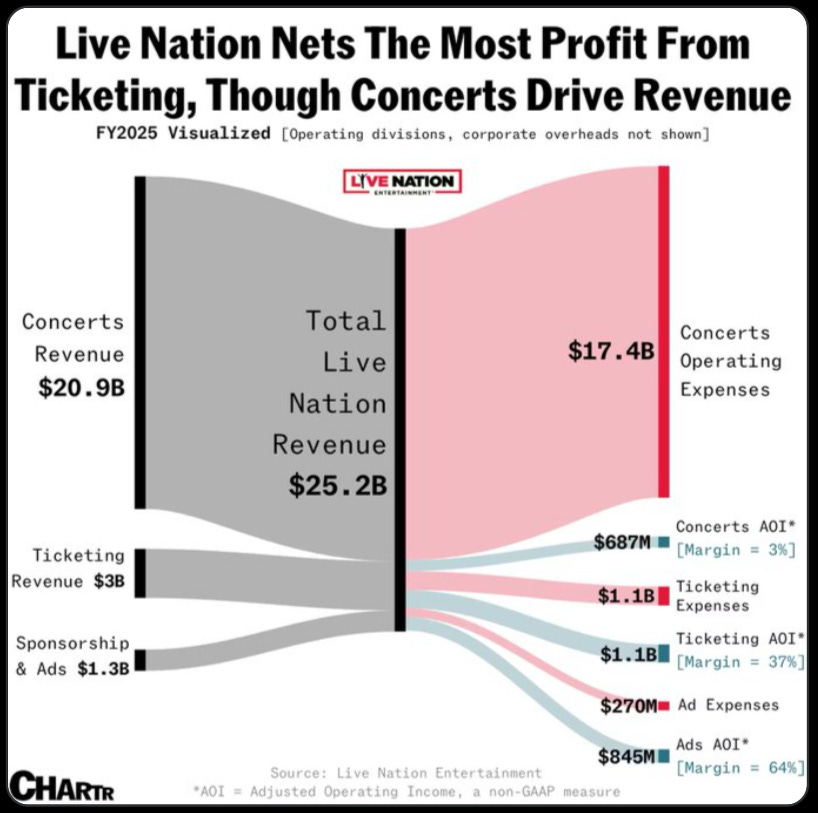
The stock was up +3% in the day after the verdict. Markets don’t seem to think the judge will force Live Nation to divest Ticketmaster. It would be gnarly. Recall, the concert division made $687m on a $20.9B revenue for a paltry margin of 3%.
WHAT IS THIS? AN OPERATING MARGIN FOR ANTS?
The current vibe feels similar to Google losing antitrust cases in the past two years, with courts deeming that it illegally operates search and ad network monopolies. However, Google avoided a break-up (which would have included a spin-off of Chrome). The search giant was forced to make changes to distribution deals and data sharing but most considered it a “slap on the wrist”. The judge said he didn’t want to disrupt a rapidly changing market (aka AI and the rise of OpenAI/Anthropic is threatening Google).
Breaking up Live Nation wouldn’t be nearly as disruptive, though. And the company has clearly abused its position…so who knows?
Live Nations has already signalled that it will appeal the decision.
Either way, the settlement with the DOJ last month is probably the template: it paid a $280m fine, will divest from 13 venues, offered ticketing platform interoperability and agreed to a 15% cap on service fees at Live Nation-owned venues.
If there isn’t a break up, we’ll probably see more divestitures and get a lower cap on service fees (and an application of that cap across every venue on the Ticketmaster platform, not just Live Nation-owned ones).
The ticketing division would remain Live Nation’s profit engine...but with fewer Cuz We Can Fees.