{if ftt_dorm_120 == true}
Quick favor: Our records indicate that you aren’t opening this email. But records can be wrong. Please click here if you’d like to remain subscribed to Fintech Takes. |
|
|
{/if}Happy Friday, Fintech Takers!
It's snowing in Montana. In the middle of April. And this is not at all unusual. My wife just told me, "I'm glad you didn't take the snow tires off the car yet."
As I like to say around here, this state is literally hell on earth. No one in their right mind should want to live here. DO NOT MOVE TO MONTANA! And with that very important PSA out of the way, let's talk about fintech! - Alex |
Was this email forwarded to you? |
|
|
Over the past several months, there has been a flurry of news announcements combining two different topics.
One of the topics — AI — is one that all investors are over-the-moon excited about. The other topic — Personal Financial Management (PFM) — is one that most investors actively despise.
I’m sure I’m missing some, but here are the ones I’ve seen. Perplexity partnered with Plaid: |
Before we get into what each of these announcements means, let’s level set on the current state of the PFM market and how we got here. |
PFM, as we understand the term today, got its start in the wake of the Great Financial Crisis. As the New York Times reported:
When the financial sector took a dive this fall, the entrepreneurs behind a new batch of personal finance sites worried that they were in the wrong place at the wrong time.
After all, if people no longer trusted their banks, why would they trust some start-up with their most private financial information?
As it turns out, interest in these sites is up, not down. Burned by their banks and the stock market, people seeking help with budgeting, saving and investing are turning to sites with names like Mint, SmartyPig, Cake Financial, Wesabe and Credit Karma.
Visits to online personal finance sites are up threefold over last year, said Jim Bruene, founder of the trade publisher Online Financial Innovations, and many of the sites say they have grown quickly since the crisis worsened in September.
Mint, which tracks users’ financial accounts and creates budgets, has 630,000 registered users, a quarter of whom have joined since the fall.
While the details of these PFM 1.0 products differed, they mostly shared the same basic form (dashboards, charts, budgets, categorized transactions) and business model (free for users, monetized through ads/lead gen).
They also have another thing in common — none of them exist today as independent companies.
Mint and Credit Karma were acquired by Intuit (with Intuit shuttering Mint a few years ago). SmartyPig was acquired by Sallie Mae Bank. Cake Financial was acquired by E*TRADE. And Wesabe shut down in 2010 after failing to gain enough traction.
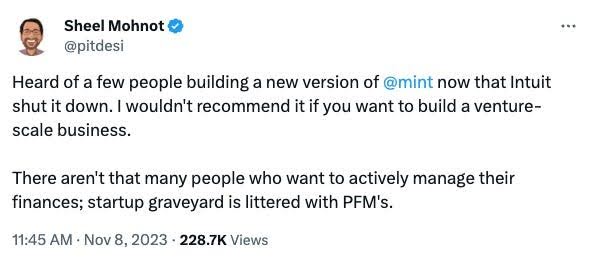
The lesson that venture capital investors took from this PFM 1.0 era was that you should, under no circumstances, invest in a startup building a PFM tool. It has all the expense and competition of B2C fintech, but with the added bonus that the product you are trying to sell is the financial services equivalent of a gym membership; a service that all consumers know they need, but one that only a small percentage will actually pay for and consistently use.
Here’s how Sheel Mohnot at Better Tomorrow Ventures put it: |
However, despite investors’ pessimism about the product category, founders have kept trying to build the perfect PFM tool. They see the graveyard, and they are undeterred!
(As a side note, I will say that PFM founders are some of my favorite people in fintech. They are the definition of persistent. They could give a fuck if VCs are excited about the space or not. They see the problem clearly, and they will not quit until they make a meaningful dent in it.)
Three of the most successful companies of this PFM 2.0 era are Monarch Money, Copilot Money, and YNAB.
Again, the details differ. Monarch was founded in 2018 and has raised a staggering (for PFM) $95 million in funding. Copilot Money was founded in 2019 and has, so far, only raised a $6 million. YNAB is, in some ways, more of a religion than a software product. It was founded way back in 2004 and has not, from what I can tell, raised a dime of venture capital.
However, all three are similar in form. YNAB has an old-school budget app look (befitting its age). Monarch is similar, though with a more modern sheen and compelling data visualizations. Copilot has, by my estimation, the most beautiful and intuitive UI. But all of them are, functionally, Mint; you connect your bank account(s), set goals, build a budget, and track your spending. The difference between PFM 1.0 and PFM 2.0 isn’t the product. It’s the business model.
All three PFM 2.0 products have a subscription fee. YNAB is $14.99 per month or $109 if you commit for a year. Monarch is $14.99 per month or $99.99 for the year. Copilot is $13 per month or $95 for the year.
Monthly subscriptions are not a popular business model in financial services. Banks and fintech companies have, for decades, worked to convince consumers that financial products and services should be “free”. Even premium credit cards, the most successful subscription product in consumer finance, go out of their way to frame their upfront costs not as monthly subscription fees, but as annual membership fees that unlock thousands of dollars in valuable perks.
The notion of just saying, “We built this product. We think it’s very good and you will like it. We offer a limited-time free trial, and this is how much it will cost per month after that. No tricks. No fine print.” is so unusual in consumer financial services that it feels downright radical. And yet, that’s exactly what PFM 2.0 companies do! Here’s how Copilot explains its pricing: We’re in this for the long haul. We want to continue building and improving Copilot for years to come, and subscription pricing makes that possible. We believe charging a fair price for a well-made product is among the most honest ways to run a sustainable business. We get to do the work we love, and you get the comfort of knowing that we’ll never sell your data or promote other companies’ products just to make a buck.
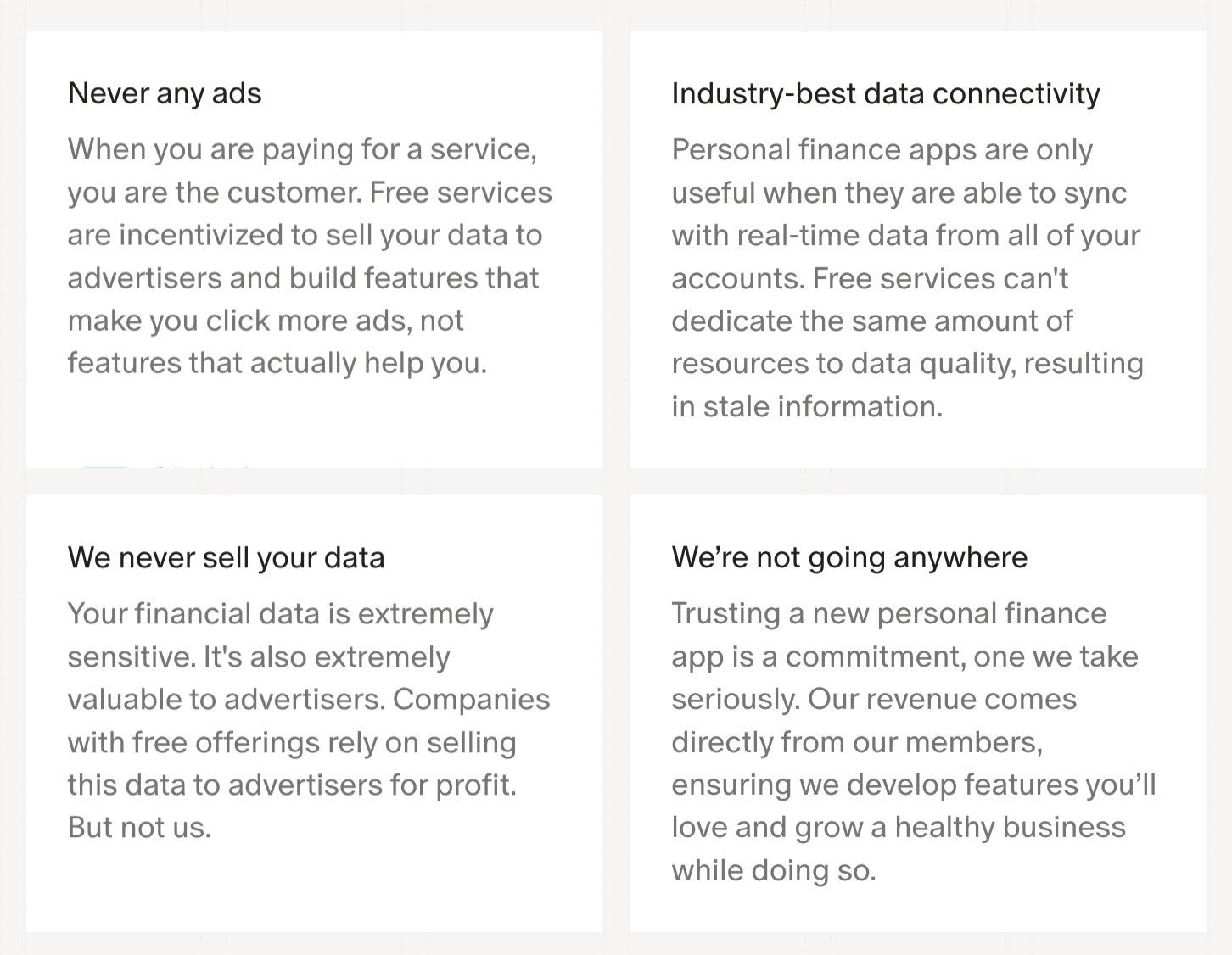
And here are the benefits that Monarch says its pricing model provides to customers: |
Notice the framing. Both companies emphasize the importance of incentive alignment (we are paid to build the best possible product for you, not to hawk other companies’ products). They highlight the value of consumers’ financial data and the dangers in working with providers that may try to monetize it. And they stress that their business model is sustainable over the long run (we’re not going anywhere). The overall message is crystal clear: The only way that you can know that we have your best interests at heart and are always giving you the best financial insights and advice is if you pay directly for our product. The reason this history is important is that the next era of PFM, which we seem to be heading into — PFM 3.0 — will be defined by the lessons that we, as an industry, have learned (or not learned) from PFM 1.0 and PFM 2.0. |
The first lesson that we have hopefully learned about PFM is a simple one: Most people don’t want to actively manage their finances.
The most dangerous and difficult-to-avoid trap for PFM founders is assuming that the market wants what they and their close friends and family want. In an essay from a few years ago, I called this the 15% problem:
I challenge you to find a credible survey that finds usage of digital budgeting tools significantly greater than 15-20% for the general consumer population. You know what? Don’t bother. You won’t be able to do it. Why not? Because there is a small percentage of the general consumer population (about 15%) that enjoys building budgets and categorizing and tracking expenses and seeing detailed charts of cashflow patterns and that consumer segment never gets meaningfully bigger. These are the folks that like building spreadsheets in excel and (I strongly suspect) taking every new digital productivity tool for a test drive. These consumers are very passionate and are often early adopters of new budgeting and expense tracking apps, which can often fool the fintech founders building those apps into thinking they’ve found a more attractive product-market fit than they actually have.
I stand by this and, if anything, 15% is way too high. Max Levchin and I talked about this problem (founders building products for the way their brains work) on a podcast last year, and he estimates that it’s closer to 3% of the population.
Regardless, the overarching point is that while consumers want help improving their financial habits and financial outcomes, they don’t want to do the work, no matter how intuitive or streamlined the UI. Returning to my earlier analogy, this Ronnie Coleman quote seems appropriate: “Everybody wants to be a bodybuilder, but nobody wants to lift no heavy-ass weights.”
This appears to be the primary motivation driving what Perplexity, OpenAI, Public, Revolut, and Cash App are building. They believe that some combination of large language models, chatbots, and well-tuned agentic harnesses can fundamentally alter the experience of personal financial management in a way that dramatically increases the level of consumer adoption and usage, compared to PFM 1.0 and 2.0 products. What will this new modality for PFM look and feel like? Well, it will be personalized. No more one-size-fits-most budgeting frameworks or generic advice. As Cash App’s head of product design explains:
No two financial journeys are the same, so we’ve built Moneybot to learn each customer’s habits and tailor its suggestions in real-time.
It will also be built, dynamically, around the customer’s needs and questions, expressed in the same way that they think: in natural language. Here’s Plaid describing its Perplexity partnership:
Personal finance doesn’t have to be intimidating. Instead of piecing together information across institutions, users can ask questions about their finances and get clear answers that help them feel more confident. … You can use natural language to get a visual picture of your spending activity over time, creating helpful tools like a net worth calculator, customized budget tracker, and debt payoff planner–among other ideas. Most importantly, it will be able to solve the intention-action gap that has plagued financial advising and PFM forever. Here’s Public:
For decades, investing meant manually entering orders—whether by calling a broker, placing a trade on the web, or tapping a mobile app. Agents on Public change that. Instead of monitoring the markets and executing trades, investors can simply describe what they want to do, shifting the experience from manual clicks to expressing intent. Agents on Public monitor conditions in real time and execute investors’ strategies exactly as defined.
Ronnie Coleman wouldn’t approve, but this is a critical difference between financial services and healthcare. If you want to improve your physical health, you have to do the work yourself. However, if you want to improve your financial health, you can (in theory) have an AI agent lift those heavy-ass weights on your behalf. That’s a MASSIVE difference between PFM, as we have historically understood it, and how PFM 3.0 might work. The question is, will consumers be willing to pay for it? And will PFM 3.0 providers even attempt to get them to? |
I’ll be honest with you: I have no idea which business model will become dominant in the PFM 3.0 era.
We could just carry over the lessons from PFM 2.0 and go with a monthly subscription fee. That would be the most straightforward option, and it would keep the incentives between the end customer and the PFM provider aligned.
However, there are two problems with a subscription model.
First, not all consumers can afford a subscription. I’m not sure how many households a $20/month fee (let’s just say) would be prohibitively expensive for, but it’s not zero. And that matters because the potential of a Personal Financial Agent (PFA?) is particularly enticing for low-income households, where there is less low-hanging fruit for a simpler, machine learning-powered PFM tool to pluck. We want this capability to be broadly accessible.
Additionally, certain providers in this space will, I think, balk at a subscription-based business model. OpenAI has 900 million weekly active ChatGPT users, 95% of whom are using the free version of the product. It has no chance of converting a large percentage of them into paid users, no matter how compelling the PFM functionality it offers.
Which, of course, brings us back to the PFM 1.0 business model: ads and affiliate commissions.
OpenAI launched a pilot for its new ads business back in January of this year. Within two months, it had already surpassed $100 million in annual recurring revenue. There is clearly a market for influencing ChatGPT users, and I would imagine that financial services companies would pay a premium to influence the financial decisions that OpenAI (and now Hiro) will be helping people make.
To be blunt, this potential future scares the hell out of me.
The Anthropic ad about an aspiring entrepreneur being awkwardly pitched a predatory lending product by ChatGPT in the middle of a brainstorming session is funny. And effective. But it’s not the most accurate portrayal of what that experience will eventually look and feel like.
It won’t be awkward. It will be smooth and utterly compelling. AI chatbots are already quite skilled at emotional manipulation. Today, they put those skills to use to engage and retain users, but there’s no reason to believe that they can’t be applied to help AI chatbots better sell sponsored products. And if you think, “OpenAI would never do that. It would damage the trust users have in them!” Let me just remind you that enshittification is the universal law of late-stage capitalism, and it will come for consumer-focused AI labs like OpenAI. Perhaps faster than we think.
So, what does that leave us?
I think the third option, which Revolut, Public, and Cash App all personify, is the ecosystem model.
The idea with this model is that a sufficiently large and diversified B2C financial services provider can offer a Personal Financial Agent, embedded within their ecosystem, that is both free for users and unburdened by the warped incentives created by advertising. Such a company would offer a PFA not to generate revenue, but to increase the value of its entire ecosystem, driving increased retention, cross-sell, and engagement. Put simply, a PFA embedded in Cash App/Public/Revolut could (in theory) supercharge the mechanisms that Cash App/Public/Revolut already use to make money.
This is appealing because it solves the access problem while avoiding the enshittification problem that will inevitably come from misaligned incentives.
The challenge is that the PFA, under this model, would only be helpful within the ecosystem in which it’s offered. Cash App’s MoneyBot isn’t going to recommend that you open up a SoFi high-yield savings account, even if the rate is better than what Cash App offers. Public’s agent isn’t going to help you execute crypto trades on Coinbase, even if they have crypto tokens you want to invest in that Public doesn’t have. Revolut’s AIR AI assistant may help you plan out and book your upcoming travel, but it will never suggest that you pay for it with your Chase Sapphire Preferred card, even if using that card would earn you more rewards.
Every potential business model for PFM 3.0 has benefits and drawbacks. If I had to predict, at this moment, what we will see, I’d guess that there will be a bifurcation in the market between two primary options: -
Rebundled with AI at the center. A set of large, multi-product B2C financial services providers (Cash App, Chime, JPMorgan Chase, SoFi, etc.) will embed robust Personal Financial Agents at the center of their ecosystems (or within sub-ecosystems for the biggest providers like JPMC … imagine a PFA at the center of the bank’s private banking business). They will be free for customers, but the range of their assistance will be limited by the providers’ own commercial interests.
-
Unbundled, orchestrated by AI. A few startups and more narrowly-focused B2C financial services providers will gain traction with a standalone Personal Financial Agent that will orchestrate customers’ financial lives across a wide range of different products and providers. This agent will remove the friction that makes assembling, optimizing, and maintaining a fully unbundled personal finance stack unworkable today. It will be fully aligned with customers’ interests through a (not inexpensive) subscription fee, and, as such, it will not hesitate to move customers’ money from one provider to another, even at the smallest opportunity (like a small movement in interest rates).
Neither one of these models seems inherently weaker than the other (unlike an ad-driven model, like what OpenAI may pursue, which seems like it would be a disaster). However, both models pose a few interesting questions. Let’s end today’s essay with them: -
Who is liable? The AI industry’s use of the term “agent” is clever in that it conveys the idea of a capable and trustworthy entity that can do things on a user’s behalf. And that’s how it feels when you are interacting with one. Having a conversation with AI about your physical or emotional health feels like talking to a doctor or a therapist. Ditto for tax investing questions. It feels like talking to a CPA or CFA. That’s by design. The AI labs want you to trust them for high-value inquiries the way you trust the human equivalents in these roles. However, the difference is that human doctors, therapists, accountants, and financial advisors owe a legal duty of care to you, and they can be held liable if they are found to have been negligent in that duty. Legally speaking, software cannot be held liable under this same duty of care. Even if we use the word “agent” to describe that software, it does not mean that it is, legally, an agent. I suspect that the winners in PFM 3.0 will be the ones that embrace some form of legal liability and proactively shoulder this duty of care for their principals (this is one of the reasons why I’m not bullish on the AI labs winning in this space … they will not want to sign up for the liability).
-
Do we need built-for-purpose harnesses for PFM? In AI, a harness is the production layer around a model or agent that gives it tools, controls what context it gets, manages state and memory, routes it through workflows, checks outputs, enforces permissions, logs actions, and decides when a human must approve something. Claude Code is a harness wrapped around Anthropic’s Opus 4.7 model, designed for agentic coding. The question I have been wrestling with this week is, do we need to build a specialized harness for PFM 3.0? At the moment, I’d lean towards yes. As PFM moves from summarization into recommendation and action, the harness becomes a financial decisioning layer — not just orchestration — and that requires domain-specific judgment about risk, advice, and user outcomes. That judgment won’t come out of a generic agent framework; it has to be built by teams who deeply understand personal finance.
-
What will regulators think? They’ll likely have some questions for providers like Cash App that pursue the “rebundled with AI at the center” model, but overall, I doubt that approach will raise any massive red flags. The “unbundled, orchestrated by AI” model will, on the other hand, provoke some serious concerns. AI agents, working directly and exclusively for consumers to optimize their financial outcomes, will, if properly enabled, introduce a lot of instability into the financial system. If consumers’ savings account balances can be moved, programmatically and in real-time, to chase yield, banks that depend on stable deposit funding to make longer-term loans and investments will have a problem. And, therefore, their prudential regulators will have a problem as well. I could see PFM 3.0 Personal Financial Agents leading to the creation of automated bank liquidity guardrails, similar to the stock market circuit breakers that were implemented after the 1987 "Black Monday" crash.
-
How will data access change? There’s a reason that Plaid partnered with Perplexity. Perplexity has become the Baba Yaga of consumer-permissioned data sharing: stand up a reliable (and free) API for consumer-permissioned data sharing, or Perplexity will scrape you! Whoo-oo-oo-oo! Perplexity is already in the middle of this fight with Amazon (and seems to be doing reasonably well), and it would not surprise me if Perplexity started using consumer-provided credentials to access and scrape financial data outside the scope of what Plaid offers today (which would have the lovely side benefit of encouraging data providers to integrate with Plaid). At the end of the day, AI agents (including our Personal Finance Agent) need data to operate, and we should expect PFM 3.0 providers to exert new competitive pressure in the world of open banking.
|
|
|
MORE QUESTIONS TO PONDER TOGETHER |
Big news for the endlessly curious (yes, you): I’m collecting your fintech questions on a rolling basis.
What’s keeping you up at night? What great mysteries in financial services beg to be unraveled? Think of it this way, if a stranger is a friend you just haven't met yet, your question is a Fintech Takes conversation waiting to happen.
One that could headline a Friday newsletter or be answered in an upcoming Fintech Office Hours event.
Drop your question here, whenever inspiration strikes! |
| |
There are many fun events — virtual and in-person — coming up in the next few months. Here’s where I’ll be! |
I'm hosting a virtual event with TruStage where we'll look at how lenders are rethinking risk, and how borrowers are responding on the other side of the table. And most importantly: what frameworks actually help when you have to act without certainty. Save your spot! |
Kiah Haslett and I are going to be hosting an event with the marvelous folks at Team8 during New York Fintech Week. It’s about AI and how it is changing banks’ build, buy, and partner decisions. Great topic. Great venue. Space is limited, but let me know if you’re interested! |
There’s also going to be basketball at New York Fintech Week! Come hoop with us! |
Talk about a great topic and a great venue. We’ll be talking about bank - fintech partnerships at a ranch in the mountains in northern Montana. In June. Fuck yes. Space is very limited, but let me know if you apply, and I’ll put in a good word! |
|
|
Thanks for the read! Let me know what you thought by replying back to this email.
— Alex |
|
|
{if !profile.vars.fintech_takes_user_fitness && profile.vars.fintech_takes_user_fitness != false}Join 2,444 other finance and fintech leaders in the Fintech Takes Network
|
|
|
{/if}{if profile.vars.fintech_takes_user_fitness == true}The conversation doesn't have to stop here
Keep learning and connecting in the Fintech Takes Network
EVENTS | FEED | LIBRARY | DIRECTORY
|
|
|
{/if}Get your brand in front of 62,000+ fintech and banking executives. |
Workweek Media Inc.
1023 Springdale Road, STE 9E
Austin, TX 78721
Want to ruin my day? Unsubscribe. |
|
|
|