{if hosp_dorm_120 == true}
Quick favor: Our records indicate that you aren’t opening this email. But records can be wrong. Please click here if you’d like to remain subscribed to Hospitalogy. |
|
|
{/if}{if profile.vars.hew_transition}
A reminder: You’re receiving this because you were previously subscribed to HealthExecWire. Hope you enjoy. | |
|
{/if}
Happy Tuesday, Hospitalogists,
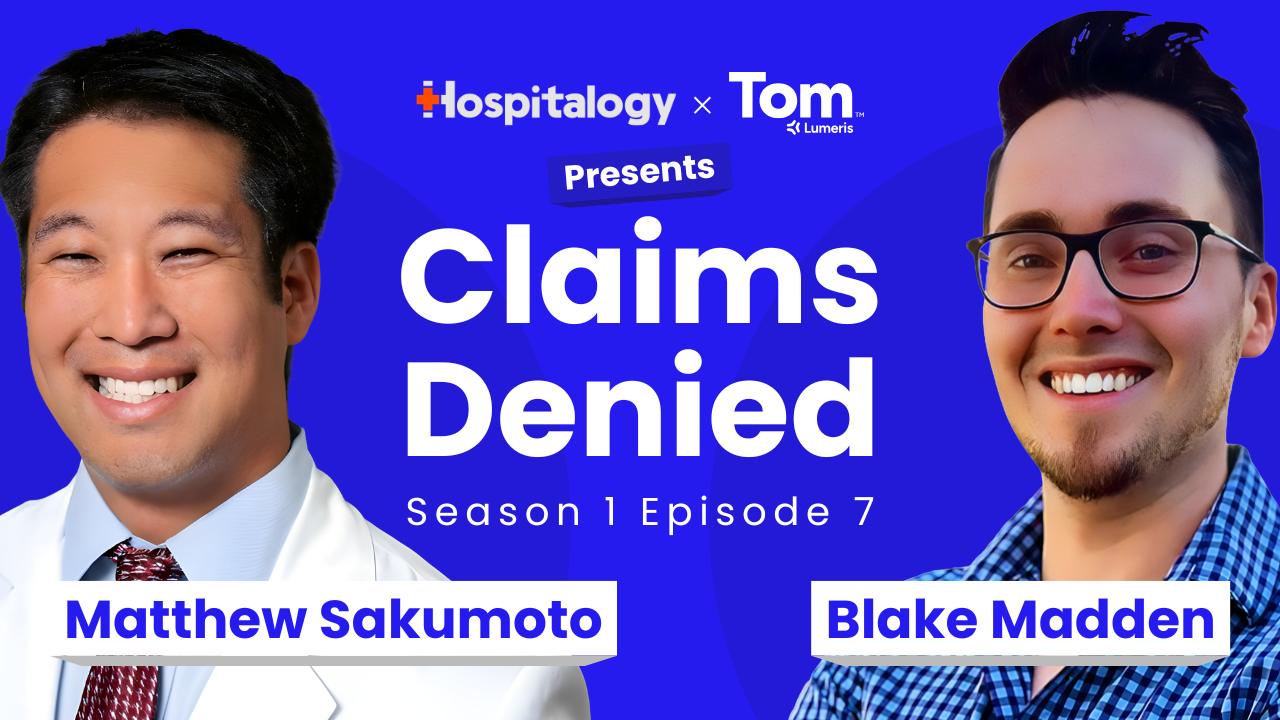
Today, I’m sharing key takeaways from my podcast episode with Matt Sakumoto, the new Chief Clinical Product Officer at Nabla. The REASON I’m sharing this with you is because we stood up a new hub on the Hospitalogy site for podcasts! You can find them all there. For instance, today’s podcast with Otto Sipe on the Medvi scandal was incredible. It’s not on the site (yet…ironic) but you can find it here on Apple and here on Spotify.
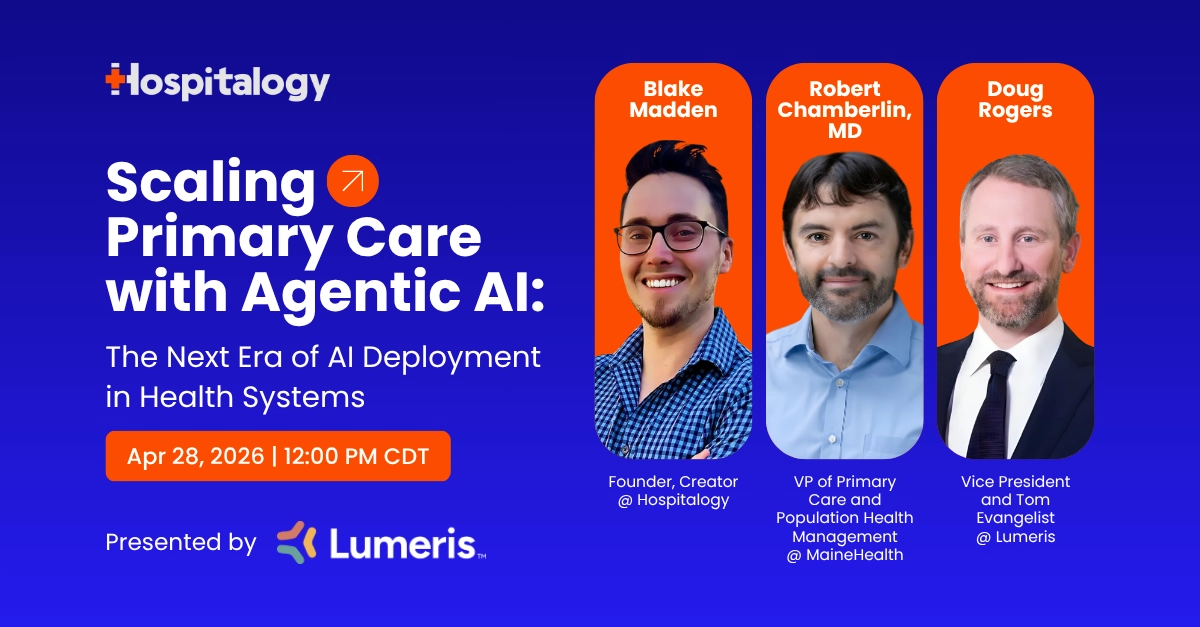
Also, cancel your mid-day meetings and join me and Lumeris on 4/28 for a conversation about what it really looks like to build an AI-enabled primary care strategy… one that positions primary care as the intelligence layer of your entire enterprise.
We'll get into: - Why platform architecture beats point solutions for long-term AI transformation
- How to prep your organization for longitudinal AI
- Which clinical workflows in primary care are ripe for this right now
You'll leave with a clearer picture of where to start and how to build toward it. Save your spot here. |
Was this email forwarded to you? |
|
|
From Words to Actions: Nabla's New CCPO on the Post-Ambient AI Frontier |
Listen to our discussion here.
I caught Matt Sakumoto on Day 4 of his new gig. Four days into being Chief Clinical Product Officer at Nabla, sitting at the company's Executive Healthcare AI Summit, still practicing as a virtual primary care physician. The man hadn't even finished onboarding and he was already dropping takes on the future of agentic AI, physician independence, and why your health system's AI readiness problem is actually a people problem.
This was a live recording of Claims Denied (yes, I named my podcast that, and yes, Sakumoto told me it was "mildly triggering," which honestly is the best possible review). We were fresh off Yann LeCun's presentation on world models, and the energy in the building was palpable. |
Matt Sakumoto is Nabla's new Chief Clinical Product Officer. If you're not familiar with him, here's the quick hit: practicing virtual primary care physician, former leader at Sutter Health, deep background in implementation science, and someone who made his first startup leap during the 2020 telehealth wave.
The "Chief Clinical Product Officer" title is worth unpacking because it's distinct from a traditional CPO. Nabla already has Laurent running product. Sakumoto's role is specifically the clinical interface layer, bridging frontline clinician pain points with product development while also serving as the connective tissue between Nabla and its health system customers. Sakumoto described himself as the person who takes signals from the front lines, translates them into product priorities, and then loops back to help customers troubleshoot.
I thought this framing was great, honestly. Too many health tech companies build product in a vacuum, disconnected from the people actually clicking through the workflows. Having a practicing physician whose fingers are still on the keyboard (and who still gets claims denied, for that matter) sitting in the product org is a smart structural decision.
When I asked him "why now, why Nabla?" Sakumoto framed the move as catching a generational wave. Telehealth in 2020 was the first one. AI is the second. And rather than just consuming whatever tools the market produces, he wanted to be the one shaping them. Fair enough. |
Ambient Is Table Stakes. So…what’s next? |
The biggest thematic throughline of our conversation, and really the entire Nabla Summit, is that the ambient scribe chapter is closing. Not because it failed. Because it won. Ambient documentation is saturated. It's approaching commodity status across enterprise health systems. Physicians expect it. It's table stakes. So the question becomes: what's the second act?
Sakumoto's answer was clean and memorable: "Right now, ambient scribes are writing notes. My vision is taking words and turning them into actions."
And therein lies the agentic AI thesis in one sentence. Moving beyond putting words on a page to actually executing the next clinical or administrative step. Fewer clicks, fewer manual tasks, more automation of the workflows that eat physician time after the note is written. Think order entry, referral routing, prior auth initiation, care gap closure, in-basket triage. The unsexy stuff that consumes hours. The future of ambient lies with infrastructure and plumbing.
This tracks with what I've been hearing from health systems and other AI players across the board. The ambient wave proved the technology works and that physicians will adopt it. Now the race is to go deeper into clinical workflows and RCM functions, and to do it in a way that actually sticks operationally. Then, hopefully, from there, we can expand into clinical use cases and things that don’t just maximize for sole business/economic output.
Yann LeCun's keynote at the Summit reinforced this trajectory. He predicted world models would be in the wild within 1 to 2 years and that meaningful healthcare implementations could follow within 5. Sakumoto's personal vision aligned perfectly: "I want that next step to be there before I think about it." Predictive, embedded, invisible AI…next best actions embedded. |
Implementation Science in Healthcare |
Here's where the conversation got particularly interesting for anyone managing AI adoption inside a health system. I asked Sakumoto how he evaluates organizational AI readiness, expecting maybe a scorecard or maturity model. Instead, he pulled from his implementation science background and framed it through the two most recent major technology waves in healthcare: EHRs and video visits.
EHRs, he noted, were "shoved down everybody's throat." Telehealth got a pandemic-driven push. AI is different because adoption is more voluntary and varied. So readiness, in his view, comes down to change capacity: leadership buy-in, training infrastructure, governance structures, communication cadence, and appetite for speed of change.
I loved this take because it cuts against the grain of the typical vendor pitch, which is usually "our technology is so good it sells itself." Sakumoto is essentially saying: I don't care how good the product is if your organization can't absorb it. Culture eats software for breakfast.
He also made a sharp distinction between large health systems and smaller organizations. Large systems have money, yes, but it's distributed across dozens of departmental budgets. Selling into a large system means rounding up 5+ champions across different departments and building coalition. Smaller systems have the opposite problem: one CMIO wearing all the hats, making decisions faster but with fewer resources.
His advice for both was the same: define the problem first, then find the solution. Don't overpay for enterprise software that does everything when you only need it to do three things. And the best vendors, he said, come in with that same mindset, willing to walk away if they're not the right fit. Humble? Sure. But also strategically sound. That kind of trust-building is what turns a vendor into a long-term partner.
|
Can AI Bring Back the Small Town Doctor? |
At one point in the conversation, Sakumoto floated a thesis I hadn't fully considered: as the cost of AI-powered back-office tools drops, independent and small-group primary care practices could become economically viable again.
The reason solo and small-group PCPs got swallowed - and are getting absorbed - by large systems wasn't clinical, but operational. Declining reimbursement, overhead headaches, meaningful use…Billing, care coordination, patient outreach, scheduling, intake, all of the back-office machinery that's expensive to build and maintain independently. Large systems provided that infrastructure, but the trade-off has been autonomy and corporatization of medicine.
Now imagine a world where AI handles revenue cycle automation, care coordination workflows, self-scheduling, automated patient intake, and outreach. The cost of that stack is dropping fast. A 5-person primary care group could conceivably run a back office that used to require a mid-sized health system's administrative apparatus. Sakumoto was genuinely enthusiastic about this:
"Can we bring back that small town doctor feel? I think that is actually possible with a lot of these tools."
I pushed back a bit here, because the AMA's physician consolidation reports tell a more sobering story. Primary care groups are still lining up to be acquired. The employed physician subsidy model is increasingly untenable (just ask Kaufman Hall). And PE continues to roll up practices. So how do you reconcile the "technology enables independence" thesis with the "everyone's still getting bought" reality?
Sakumoto acknowledged the tension but argued the pendulum will swing. Consolidation will continue in the near term, but eventually, the economics will shift enough that independence becomes viable again, especially if the technology cost curve keeps declining. Maybe it's not pure independence but something like a large primary care group with an MSO or capital partner providing economies of scale without full vertical integration.
I think he's probably right directionally, even if the timeline is uncertain. The question is whether the AI cost curve drops fast enough to outpace the consolidation wave. And whether physicians, after years of being employed, still have the appetite (and business acumen) to go independent. |
VBC…the Elephant in the Room |
We talked a bit about VBC and Sakumoto said he’s still holding out hope for true value-based care. Not the buzzword version. The real thing.
His argument is straightforward: if VBC actually works as intended, it changes the incentive structure in ways that favor primary care. More time for care coordination, relationship building, and prevention. AI tools give that time back by automating the administrative burden. The flywheel spins. I think in general the definition and scope of VBC has broadened beyond what is useful. Now we’re seeing a shift back to a more basic ‘High Value’ version rather than a financing mechanism.
But here's the structural problem he identified, and it's one I think the industry still hasn't solved: measuring prevention requires 3-to-10-year timelines, and insurance operates on annual cycles. You can't demonstrate that your diabetes prevention program saved $X million when the patient switches employers (and insurers) 18 months in. The employer-based insurance model fundamentally breaks longitudinal care incentives.
When I asked if there were any recent models or financing mechanisms that cracked this, Sakumoto was candid: "I haven't seen anything that's really pushed that forward." Since this conversation, LEAD has been announced, and it has the rumblings of a model that could break into the game with Medicare and Medicaid. I also know some states are thinking about innovating in Medicaid given rural health transformation dollars. There’s momentum.
He also touched on quality measurement and the gaming problem. Every metric with a numerator and denominator gets gamed. Star ratings get financially engineered. Process metrics incentivize box-checking over outcomes. His preference is outcome-based measurement, but he readily admitted he hasn't figured out the utopia either. (If you have, his inbox is open.) |
H&R Block for Insurance Thesis |
Here's a freebie idea Sakumoto tossed out that I thought was surprisingly compelling: within 5 years, there will be an H&R Block equivalent for picking health insurance.
The complexity of insurance selection is approaching tax-code levels. What premium level do I need? What deductible? Which network has my doctors? As consumer choice expands (especially if we move further toward marketplace-based or ICHRA-based models), the average person is going to need a guide.
Maybe it's an AI bot. Maybe it's a human advisory service. But the thesis is that insurance selection becomes its own cottage industry, separate from the employer-broker-carrier chain. And the second-order effect is interesting: if the consumer is picking insurance directly, the insurer suddenly has a vested interest in the individual rather than the employer's captive membership pool. |
Dissecting the M&A Landscape (and the Board Game Question) |
We went a little off-script here and Sakumoto asked me which board game best encapsulates healthcare M&A. (Look, it's a live recording. You take creative swings.)
We landed on Catan. The economics, the stakeholder dynamics, the zero-sum competition for longest road. Right now, specialty drugs and GLPs hold that longest road. Managed care is getting destroyed. Hospital-side M&A has been muted since the FTC started blocking large-scale provider deals (except for that weird Sutter-Allina thing). Most of the action has been bankruptcy-driven divestitures (hello, Ascension and Tenet portfolio optimization).
The more interesting M&A conversation is happening in health tech. Sword's ~$300M acquisition of Kaia, plus other recent digital health deals, suggests that consolidation is accelerating on the technology side even as it stalls on the provider side. Sakumoto noted that the emerging pattern isn't just vendor-health system relationships but genuine co-development partnerships. Large systems aren't just buying practices anymore; they're buying (or deeply partnering with) tools.
|
On AI regulation, Sakumoto doesn't see strong centralized federal guidelines coming anytime soon. His bet is state-by-state movement, with the industry eventually coalescing around the most stringent state's standards (the California car emissions analogy). In the meantime, it's situational awareness and staying plugged into frameworks from groups like CHAI and ORCA.
For his CCPO role specifically, regulation directly shapes what Nabla can and can't automate. When do you keep humans in the loop? What can you semi-automate and tee up for clinicians? It's not just triangulation, as he put it. It's "an eight-pointed star" of balancing clinical need, regulatory allowance, and individual health system policies. |
When I asked Sakumoto where he sees himself and Nabla in 5 years, he reiterated that he wants the next step for the physician to be there before they even have to think about it, with AI that doesn’t just document the clinical encounter, but anticipates the next move and executes it. That’s the vision. A clear one for a guy 4 days into building a clinical product org at one of the most interesting AI companies in healthcare. |
|
|
-
Resource: Health systems spend millions on temporary labor to manage specialist shortages without fixing the underlying coverage problem. AmplifyMD’s latest white paper lays out the workforce optimization and staffing economics of a scalable, more cost-effective solution.*
-
Breakdown: Becker’s Health IT details an interesting use case of AI-driven outreach helping to close care gaps at scale. Advocate Health used Hippocratic AI's conversational AI to call over 15K hypertension patients who hadn't had their blood pressure rechecked in the past year. Taking only 12 days to complete the outreach, the AI prompted patients to take readings at home and escalated elevated results to a human nurse. As a result, ~1,200 patients were cleared with normal BP, 274 were flagged and routed to care, and another ~400 were flagged for unrelated health issues, all at engagement rates that beat Advocate's standard cold-call outreach.
-
Roundtable: Don’t miss the April Hospitalogy Roundtable for Plus Members, Friday, April 24, at 1pm EDT. Save your spot here.
*This resource is brought to you by one of my brand partners who help make this newsletter possible! | |
|
That’s all for this Tuesday. I would love to know your thoughts! Just hit reply to this email.
– Blake |
|
|
{if profile.vars.board_room_user_fitness == true}The conversation doesn't have to stop here
Keep learning and connecting in the Hospitalogy Network
EVENTS | FEED | LIBRARY | DIRECTORY
|
|
|
{/if}{if !profile.vars.board_room_user_fitness && profile.vars.board_room_user_fitness != false}I'm building a community of leaders in strategy, finance, and ops
at hospitals and health systems to help us connect, learn, and grow together. |
|
|
{/if}
Get your brand in front of 68,200+ executives and healthcare decision-makers. |
Workweek Media Inc.
1023 Springdale Road, STE 9E
Austin, TX 78721
Want to ruin my day? Unsubscribe. |
|
|
|