Hello! Kiah here. Welcome to Fintech Takes Banking, my weekly newsletter where I highlight things I think are interesting or important for bankers and the surrounding environs.
I’ll share the same disclaimer I shared back in September 2025: This piece assumes both a working knowledge of bank M&A and a baseline knowledge of financial accounting and reporting, but also that you, dear reader, are not an accountant. I tried my best to make this both accurate and digestible, but in some ways, the complexity is the point.
|
Was this email forwarded to you? |
|
|
A commercial client calls. They need to send $4 million instantly, confirm receipt in real time, route it to the right subaccount automatically, and settle in stablecoin next time they transact. Can you handle that request? Can your competitors?
If you're not sure of the answer, you should come to this.
It’s a conversation exploring the structural gap that’s keeping banks from meeting modern treasury management expectations, and what forward-looking institutions are doing about it. |
End of an Era for Messy M&A Accounting |
Buying a bank is a lot of work.
There’s the target identification, the courtship, the due diligence and the negotiation. There’s the announcement, the public and private meetings, the integration. And then, finally, there should be a payoff. The reason why the acquirer bought the seller should become evident: the deepening of a footprint, the new territory, the expanded product offerings and higher credit limits. The deal’s justifications eventually show up in the income statement and balance sheet. But that’s a lot of work, and the accounting to accurately capture all of these costs and benefits is its own separate behemoth that we’ll discuss today.
At least, it was.
One consequence of the double count going away under the current expected credit loss model, or CECL, is that the financial results of bank buyers should be easier to understand. I wrote about the CECL double count’s slow fade in September 2025, and you might want to revisit it in conjunction with this piece (two accounting newsletters — lucky you!). Today, I want to focus and reflect on the recent history of purchase accounting and the last year we will see it in its current form.
One reason this matters is because of the increase in merger and acquisition activity the banking industry experienced in 2025. There were 185 deals announced last year, up from 126 in 2024, according to a recent report from Hovde Group. There have been 34 deals in 2026 so far. So there are roughly 275 banks — based on those three years of deal activity, give or take a few banks that did several deals and a few acquirers that became sellers — that will spend the next several years reporting a blended set of earnings that include their legacy operations and the bank they acquired. And in 2027, they will need to report their results using the updated “purchased financial asset” approach under CECL.
|
A Blast Back to the 2010s |
To better understand and appreciate the simplicity of the “purchased financial asset” approach, let’s go back to just after the 2007-09 financial crisis. Coming out of the crisis were strong banks, weak banks and failing banks. Many of the strong banks were able to acquire weak and failing institutions. “There were large deals and distressed deals, which generally means there were large discounts on those portfolios,” said Ashley Ensley, partner in the financial services practices at Forvis Mazars.
While these could be clutch, sweetheart deals for buyers, they were also a lot of work, given the buyer's weakness and deterioration. The acquiring bank had to look at an asset with credit quality issues and figure out what it was actually worth at the time of acquisition, relative to what the original value was. Once acquired, the asset would begin its payoff, or wind down.
It was difficult in the wake of the financial crisis to predict how these assets would perform relative to the discounts they were assigned at acquisition. Every quarter, the accounting team would estimate the future cash flows they thought the loans would generate. Ashley said if the loan performed worse than expected, the bank could immediately recognize an impairment and write it off. But if the loan performed better than expected, the bank spread that accretable yield forward over the rest of the life of the loan. Accretable yield is the expected cash flows in excess of the asset’s purchase price. This type of income was classified as purchase accretion income.
Purchase accretion income, especially tied to distressed banks and large credit marks, could introduce an element of volatility into acquisitive bank earnings. The volatility, coupled with the amount of estimating involved over the life of these troubled assets, contributed to skepticism from industry observers about the earnings results of acquirers. And of course, many of these strong banks were acquisitive. They didn’t just have purchase accretion income from one bank. They would have income streams from banks acquired in 2009, 2010, 2012, 2013.
Accounting should have provided answers to these questions, but at the time, those answers weren’t helpful. The results were noisy, the math was messy. Purchase accretion accounting made the pro forma bank’s earnings unpredictable and made projections unreliable. Ashley remembered how, during the 2010-19 recovery, these acquisitions would fuel banks’ record earnings, but analysts and investors would focus on breaking the earnings into “core” earnings and accretion income.
You can understand why: The paydown of acquired assets isn’t exactly a promising future revenue stream. And there was a perverse incentive of this kind of repetitive, accretive income flowing from these acquired, discounted portfolios. Buying a discounted asset and reaping the benefits of record income as these assets perform better than you expected for the next several years? A bank could get addicted to such easy income.
Mandi Simpson, accounting advisory managing partner at Crowe, remembered hearing executives at serial acquirers discussing how banks could get “hooked” on accretion from a deal. But the danger in such easy income was that it could mask the difficult post-deal work: the cost savings, the rationalization, the growth.
“Of course, interest income from a deal isn't going to increase forever. I think part of the challenge was that some banks didn't have the discipline to do the things they need to do on the cost side, to make the hard decisions,” she said. “When that music stops, and you have a terrible efficiency ratio because you didn't find all these cost saves, that's pretty painful.”
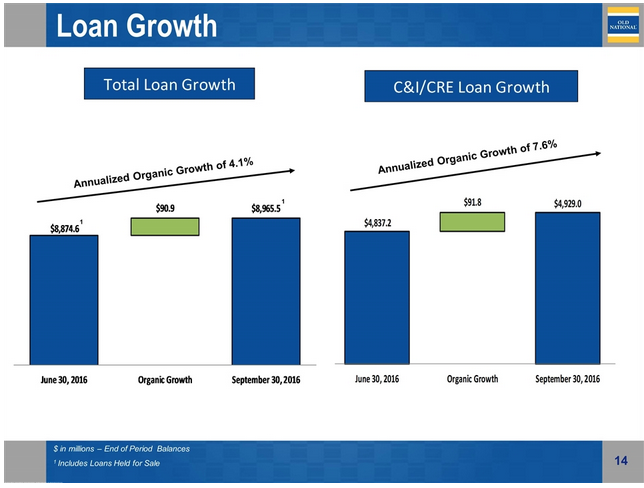
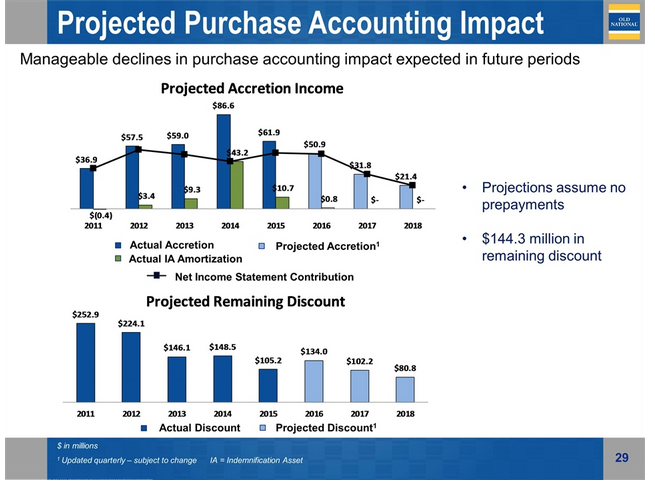
To address those concerns, acquisitive banks sometimes broke out their income streams to show how they were organically growing even as they benefited from a windfall of purchase accretion. They also spent time guiding revenue expectations as to when the acquired portfolios would wind down and the accretion income would peter out. As an example, Evansville, Indiana-based Old National Bancorp had announced nine live or assisted bank deals between 2007-16. The bank, which had $14.7 billion in assets at the time, included these slides in its November 2016 investor presentation.
|
Source: Company SEC filings |
Contrast that to today. Starting in 2020, after CECL went into effect, bank buyers now essentially assigned the acquired portfolio’s expected credit loss to their allowance. Additionally, most transactions since 2020 have involved sellers with decent asset quality, so the deals haven’t carried large credit discounts.
This reporting has become much more straightforward since the accounting board eliminated the Day One double count. Purchase accretion today is the liquidity or interest rate marks, which are fixed and tend to be seen as predictable, straight-line math for observers. The liquidity mark for acquired assets is calculated in the Day One CECL estimate and remains stable for the life of the loan until it pays off. A deal with meaningful purchase accretion indicates that the assets that repriced when they came over initially carried low, fixed rates.
The standard has been updated. Has the impression that directors, analysts and industry observers also updated? Mandi said she remembered reading analyst reports that discounted the purchase accretion income after CECL was in effect and thinking, “No, that’s the interest rate mark. Don’t discount that, it’s good money.” Going forward, deal details and post-deal financials should “more clearly mirror the economics of the transaction,” she said. “I would almost say what you had before was a distorted view of the economics.”
To that end, Keefe Bruyette and Woods Managing Director Catherine Mealor published a report in July 2025 arguing that acquisitive banks had been unfairly sold off after their deal announcements, in part because “the dynamics around fair value accretion differ from previous cycles, with less risk of an earnings cliff compared to pre-Current Expected Credit Loss (CECL) deals.”
When the standard was expected to be finalized earlier in 2025, Mandi assumed that “of course, everybody was going to early adopt this” to eliminate the punitive impact the double count had on capital. But given the update’s finalization in November, only a handful of institutions elected to early adopt. While Mandi does expect many to early adopt in 2026, financial statements covering deals that have closed in 2026 are not yet available. Ashley theorized one reason for the slow uptake in early adoption was that it may have been difficult for interested banks to get their control functions updated in time for the new approach.
The standard goes into effect for all filers in 2027 — winding down this decade-plus-long chapter of noisy, volatile and addictive acquisition income. |
In 2020, CECL was supposed to be the biggest challenge facing banks. It wasn’t. But CECL made accounting for the pandemic and its responses and mitigants weird. The very first year these models went into effect for large banks, the pandemic immediately stressed them as a likely untested, black swan event. The pandemic also led to a brief cessation of M&A, which eventually restarted and rebounded to last year’s five-year high. Only this time, buyers are accounting for their acquired institutions under the new CECL standard, including the double count. Now it’s 2026. The double count is going away. Interest rates seem stable. We’ve had CECL for six years. Has the banking space reached an accounting stasis?
“It feels like we've settled,” said Ashley. “We even have clients who are now redoing their CECL model. The one they had worked for for five years, but now they're like, ‘We've learned a lot. It's probably time for a refresh.’ That signals to me that things in accounting are stable. They're picking up this project that they would never have picked up two, three years ago. But now they have some time to think about it … they have some capacity to shift people to new projects.”
The world is so far from normal; I wouldn’t insult you by implying anything close to that. But is accounting included in the typical chaos and complications that come with bank M&A, or have we finally fully addressed this particular issue? Are we in stasis? “Everything else in the world is crazy,” Ashley said. “Maybe it's time for accounting to make things easy.” |
|
|
What I’ve been reading, watching and listening to this week: |
🧳 Vacation packing list: I am headed to Portland this week for a girls’ trip, and we’re running the Bridge to Brews 8K. We used the free version of Wanderlog to plan out our itineraries and points of interest; it’s a great app for group travel. Also, I haven’t read or watched Twilight, and my friends swear I won’t know any reference made this weekend. Sorry, I have taste! 😝
📫 Send your friends cards!: The New York Times recently published a piece about the benefits of writing letters, as well as some tips on how to start. I definitely recommend it: I started writing cards to my friends when I traveled as a way to use up the pens and cards I had accumulated. It’s easy, fun, thoughtful and you get to buy new cards, pens and stamps!
🎙️ On Bank Nerd Corner: I’m bringing you a conversation I recorded at CBA Live 2026 with Jay Budzik, senior vice president at Fifth Third Bank, about how the regional bank uses artificial intelligence in its credit function. We talk about which loan types and stages of the credit lifecycle are best suited for AI deployment, the governance framework and advice for bankers who worry they’re behind on AI adoption.
🛫 Catch me at: New York Fintech Week with my friend and coworker Alex Johnson. First up is Innov8 Village Happy Hour on April 29, in partnership with Team8. I’ll also be talking smack courtside during the Fintech Takes 3v3 Classic on April 30.
|
Thanks for reading! Let me know your thoughts on this piece.
– Kiah |
|
|
Get your brand in front of 60,000+ financial services execs. |
Workweek Media Inc.
1023 Springdale Road, STE 9E
Austin, TX 78721
Want to ruin my day? Unsubscribe. |
|
|
|