{if hosp_dorm_120 == true}
Quick favor: Our records indicate that you aren’t opening this email. But records can be wrong. Please click here if you’d like to remain subscribed to Hospitalogy. |
|
|
{/if}{if profile.vars.hew_transition}
A reminder: You’re receiving this because you were previously subscribed to HealthExecWire. Hope you enjoy. | |
|
{/if}
Hospitalogists,
Happy Tuesday to all but particularly the BUCA executives who are breathing a huge sigh of relief after CMS decided to bump up MA payments in 2027 to 2.5% and keep risk adjustment the same. An article came out last week in the New York Times profiling a company called Medvi as proof that Sam Altman's prediction had come true - that AI could enable a single founder to build a billion-dollar company. "$1.8 billion with just two employees," they rhapsodized.
The tech world collectively lost its mind. Forbes, Inc., PYMNTS, and dozens of other outlets piled on with fawning coverage. Sam Altman himself said he'd "like to meet the guy."
The longer I sat with it, the more something felt off. And then I started pulling threads. And then I couldn't stop pulling threads. And now I'm sitting here staring at what might be the most brazen example of healthcare grift I've covered since Done (the ADHD pill mill)…except this time, the grifter got a front-page profile six weeks after the FDA sent him a warning letter.
So feel free to tell me I'm taking crazy pills (which isn't too far off from what Medvi is selling, tbh), but indulge me for this one. Because if the Done story was Cerebral and Theranos having a baby, the Medvi story is what happens when Silicon Valley's AI fever dream crashes headfirst into the DTC telehealth underworld. And everybody claps.
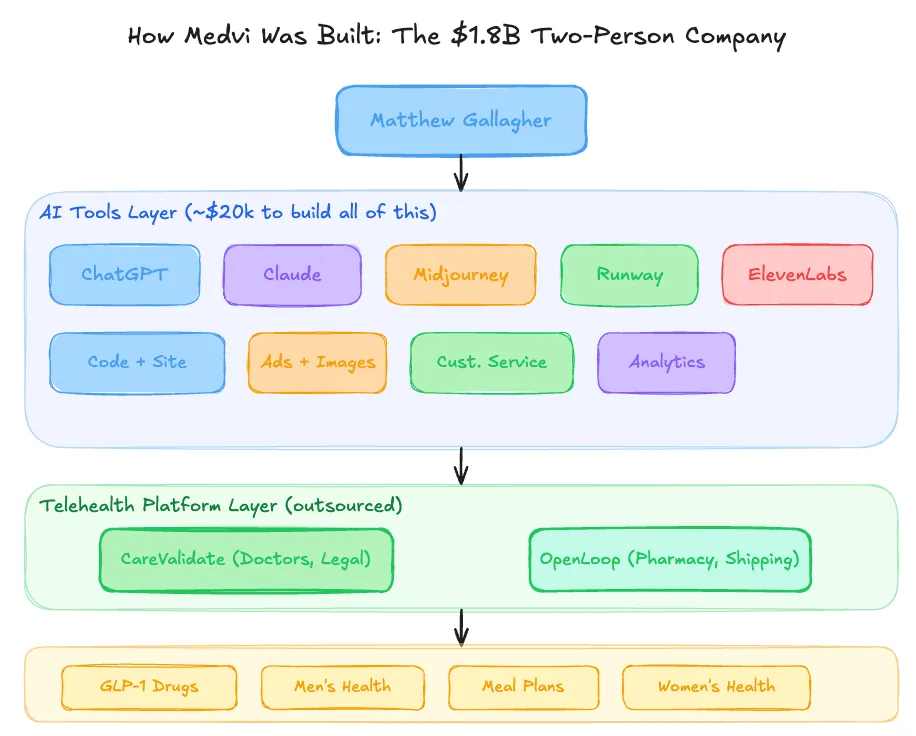
What we actually have here is a founder who launched a telehealth company in September 2024, outsourced the entire clinical operation to third-party platforms (OpenLoop and CareValidate), used AI to build a marketing website and ad funnel, deployed 800+ fabricated doctor personas on Facebook to sell compounded GLP-1s, listed fake before-and-after patient transformations created by deep-faking photos stolen from places like Reddit, sold a product - oral tirzepatide - that literally doesn’t work…i.e., a class action lawsuit has called "modern-day snake oil" with "no demonstrated mechanism of absorption or efficacy," received an FDA warning letter for misbranding violations in February 2026, and had his aforementioned clinical partner suffer a 1.6M-patient data breach in January 2026.
This isn’t the American Dream. It’s a healthcare nightmare. |
Was this email forwarded to you? |
|
|
Going deeper on an interesting topic, theme, or trend |
How to Build a Healthcare Grift - Easily |
How exactly did Medvi come to be?
The first thing you need to know is this company isn’t unique. There are dozens of GLP-1 telehealth clones and an entire underworld operation solving for distribution within the current supply and demand imbalance facing consumers who want GLPs at lower prices. So these companies filled that gap. It’s surprisingly easy to do, and really only in healthcare could you have a setup like this. It doesn’t take a rocket scientist, as evidenced by this X thread and the copycat market here.
All of these grifters went down the same build path. Medvi just took the build a step further with AI and fraudulent marketing to consumers: -
Step 1: Pick a market with rampant demand. GLP-1s are the hottest drug class in the world. Ozempic, Wegovy, Mounjaro, Zepbound…branded versions have been in chronic shortage throughout 2023-2025 or priced out most consumers, creating a massive gap between supply and demand. That gap opened a window for compounded versions of these drugs, which are legal under Section 503A of the FDCA when a commercially available product is unavailable. So obviously the gray compounding market exploded. All of these companies continue to exploit this to the max.
-
Step 2: Don't build anything. Outsource everything. Gallagher didn't build clinical infrastructure. He didn't hire doctors. He didn't set up a pharmacy. He plugged into OpenLoop Health and CareValidate - telehealth-in-a-box platforms that handle the physicians, prescriptions, pharmacy fulfillment, shipping, and (in theory) compliance. Medvi is, at its core, a marketing wrapper. A front door. The entire clinical supply chain belongs to someone else. (Which objectively is cool to think about how many powerful turnkey solutions there are in healthcare now…when used appropriately).
-
Step 3: Use AI to build the marketing funnel. Gallagher used ChatGPT and Claude to write website copy. MidJourney and Runway to create advertising materials. ElevenLabs to clone voices for AI customer service. The website was vibe-coded into existence. This is the ‘AI’ part the tech press fell in love with. What’s also funny about the tech community falling in love with this story…is the utter lack of original thinking. Everything contrived by AI and added to Medvi was a rip-off of something else - another telehealth site, another funnel, someone else’s picture…we’re praising a founder who lacked original thought and ripped everything off from someone else. AI’s bread and butter.
-
Step 4: Optimize the funnel for maximum prescription volume. When your entire business model is "acquire patients, route them to prescribers, collect subscription fees," every incentive points toward one thing: get as many people through the funnel and onto prescriptions as fast as humanly possible. Clinical rigor is a speed bump. Follow-up care is an opportunity cost. The prescription is the product. So optimize for prescriptions and get to as close to a 100% prescribe success rate as possible. At least GLP-1s are relatively safe…sheesh.
|
Unfortunately this is where the fun stops and the abuse and fraud begins. |
800 Fake Doctors Walk Into a Facebook Ad |
When you outsource everything or run it through AI, you get shitty results. Or, you just don’t care. Both in this instance are probably true. Take, for example, the fact that Medvi generated over 800 fake, synthetic doctors and attached those doctors to real, trusted, highly reputable institutions.
"Dr. Sarah Martin." "Dr. Monica Ashford." "Dr. Amelia Rhodes" -- who, by the way, had an image of Johns Hopkins Hospital at the top of her page despite no one by that name existing in the Maryland Board of Physicians database or on any Johns Hopkins website. "Dr. Tuckr Carlzyn MD," promoting Medvi's erectile dysfunction drugs. "Dr. Matthew Anderson MD," whose page listed an Angolan phone number. "Dr. Spencer Langford MD," whose older posts corresponded to a clothing store in the Republic of Congo.
Drug Discovery & Development confirmed more than 5,000 active Medvi ads on Meta as of early April 2026. Buried at the bottom, a disclaimer on Medvi’s site reads: "Individuals appearing in advertisements may be actors or AI portraying doctors and are not licensed medical professionals.”
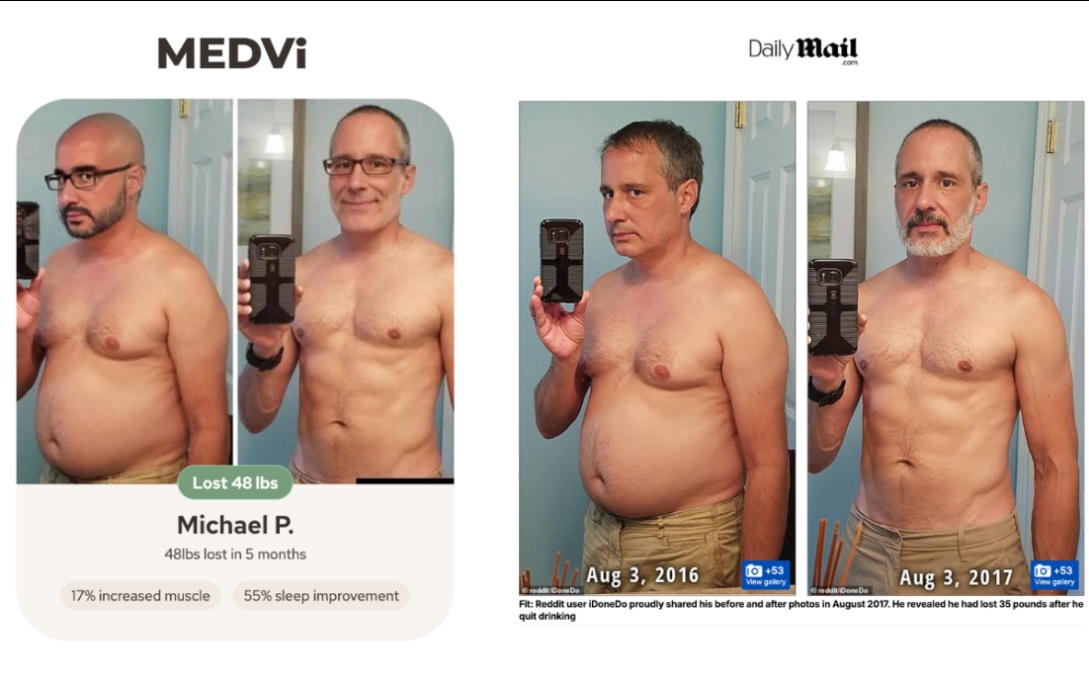
Until very recently (sorry other DTC telehealth folks, the CAC alpha isn’t there anymore) those ads ran on Meta at industrial scale, targeting demographics least likely to detect AI-generated content, plastered next to fabricated before-and-after weight loss transformations pulled from the internet and run through face-swap tools.
One of Medvi's supposed patient success stories, "Michael P.," was traced back to a Reddit user whose 2017 transformation photos documented a sobriety journey. Semaglutide for weight loss didn't even exist when those photos were taken. Someone (AI) deep-faked his face and slapped it on Medvi's website as a customer testimonial. "Sometimes you have to see it to believe it," Medvi's site stated next to the falsified images.
You're right, Medvi. I do have to see it to believe it.
We’ve got ads from Medvi saying you can basically become the next version of Brad Pitt or Pedro Pascal within 5 months. |
Take this multiple layers deep at a personal level:
- Your mom wants to lose weight and has always wanted to try GLPs but couldn’t afford it
- She sees an ad from some female with gray hair who looks amazing, air brushed, and somehow jacked after 5 months of being on Medvi’s platform
-
She also sees an ad from a real doctor with a Johns Hopkins logo attached to it
- Then she sees that she can take an oral GLP-1, get the same results, and for half of the cost of what she’s seen advertised by Eli Lilly or Novo, or even Hims
|
^Screenshot of Medvi’s website, as of yesterday. |
As a consumer, you’re tripped up and deceived in multiple ways on this journey. You’re lied to about the potential efficacy of the program (all of these people are fake), the brand is attaching itself to some of the most trusted institutions in America (doctors and nationally regarded academic medical centers), AND you’re about to be prescribed snake oil. |
One of the most damning parts of this whole thing is Medvi pushing a product to its customer base that quite literally does not work.
The drug, as sold, has no viable absorption pathway.
Tirzepatide is a large peptide molecule. Digestive enzymes destroy peptides of this size before they can cross the intestinal wall and reach the bloodstream. The only FDA-approved oral GLP-1s on the market - both semaglutide-based - required a specialized absorption enhancer to achieve roughly 1% bioavailability., and even then it has to be taken under tightly controlled conditions (empty stomach, limited water, no food for 30 minutes). There are no human studies nor clinical trials involving any oral tirzepatide product. Eli Lilly has stated explicitly that no oral form of tirzepatide has been approved or evaluated by any regulator, and the FDA has only approved the injectable form.
A class action complaint filed in November 2025 against OpenLoop and compounding pharmacy Triad Rx -- the infrastructure behind Medvi -- brings RICO claims and calls these tablets "modern-day snake oil." The plaintiff purchased the pills through Medvi for $279.99 and alleges he never consulted a licensed medical professional -- he was only asked to provide his medical history, height, and weight.
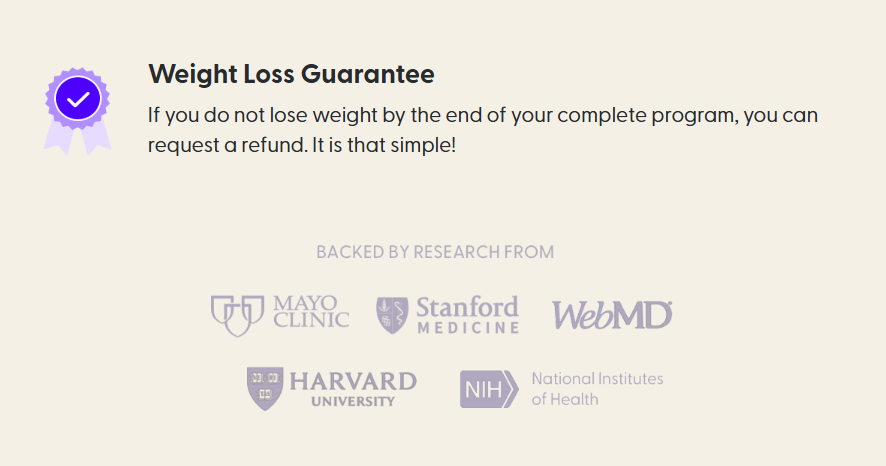
To put this more bluntly than the legal filings: Medvi was selling consumers a pill that cannot physically do what it's supposed to do, at $249/month, on auto-renewing subscriptions with a cancellation policy requiring 72 hours' notice, and a refund guarantee that (per consumer complaints) shifted from 3 months to 5 months after enrollment. By month 5, you've figured out the oral tablets don't work, and Medvi conveniently offers to "upgrade" you to injectable compounded tirzepatide.
Neat little flywheel, isn't it?
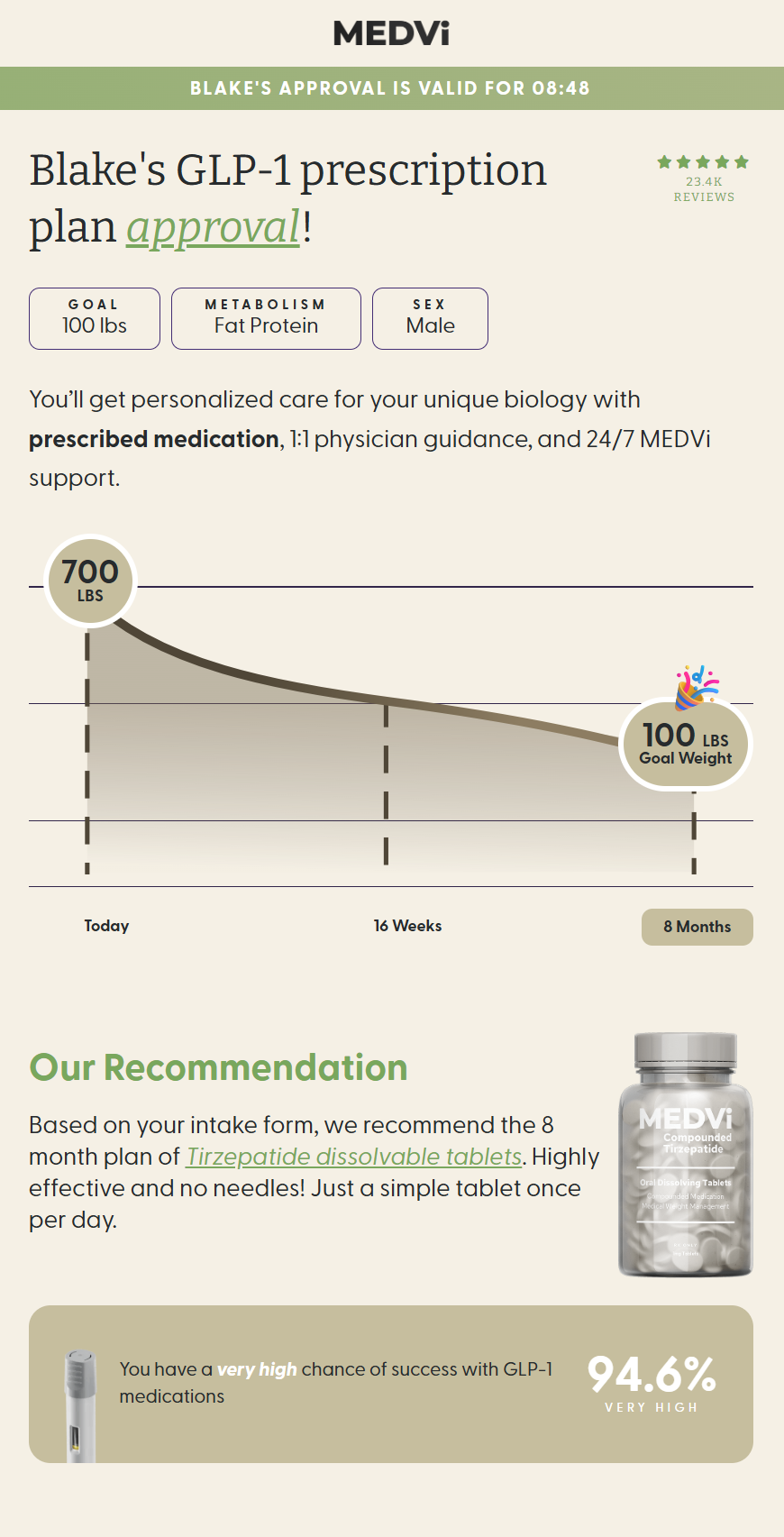
I had to see this for myself. So yesterday I went on the Medvi site, entered my height as 7 feet and my weight as 700 pounds, set my weight loss goal to 100 lbs, and was immediately recommended oral tirzepatide. The site told me I could achieve my weight loss goals in 8 months. I was "approved" within minutes -- but only for 8 more minutes! A countdown timer urged me to act fast. (Don't worry. I refreshed the page and got another 11 minutes.) Over 23,400 five-star reviews, the site assured me.
|
At no point did anyone - human or AI - flag that a 7-foot, 700-pound individual requesting a 100-pound weight loss has clinical needs that wildly exceed what a compounded oral GLP-1 (or any medication alone) can address. At no point was there a meaningful clinical interaction. At no point did anyone say "hey, oral tirzepatide doesn't actually absorb through the GI tract." And once I get to the actual clinician one could only hope it gets caught. But for now, Medvi is telling me this is possible - on its face, a 7 foot, 700 pound person can get to their goal weight in 8 months. And for folks putting in real heights and weights, they’re being told similarly. This seems like highly deceptive behavior toward consumers, despite my outlandish example, and goes to show that corners were obviously cut and guardrails are nil.
Still, this example doesn’t change the fact that Medvi’s outsourced telehealth vendor(s) - OpenLoop, CareValidate, and the lot - are still prescribing oral tirzepatide - despite the clear and obvious public denial of its effectiveness. Where is the clinical check? Where is it? OpenLoop? CareValidate? Anyone? Feel free to hit me up with a response. Is this medicine, or is it approval at scale?
Here's the part that keeps nagging at me: if Medvi's revenue figures are anywhere close to accurate - $401M in 2025 at $249-299/month - hundreds of thousands of consumers passed through this funnel. Where are they? How many are sitting on auto-renewing subscriptions for oral tirzepatide that can't physically do what it's supposed to do? How many hit month 3, realized the pills weren't working, and got "upgraded" to injectable compounded tirzepatide? How many just churned and chalked it up to another weight loss product that didn't deliver? We don't know. Nobody has asked. And regulators should be asking, loudly, because the scale of potential consumer harm is alarming.
Speaking of which… |
Breaking Down the Infrastructure of a Pill Mill, and the DTC Underworld Web |
Let's now talk about those partners - the plumbing beneath this operation, because it matters for understanding how the DTC telehealth underworld actually functions.
Medvi is just a shitty marketing wrapper (err…well, or highly effective depending on your perspective) and doesn't prescribe anything. Medvi doesn't compound anything. Medvi doesn't ship anything. Medvi is a marketing platform. The clinical decisions, the prescriptions, the drug fulfillment…all of it flows through OpenLoop Health and CareValidate. Gallagher told the Times as much and he thinks he’s off the hook because of it, despite all of the deceptive marketing consumer obfuscating behaviors we’ve scratched the surface on above.
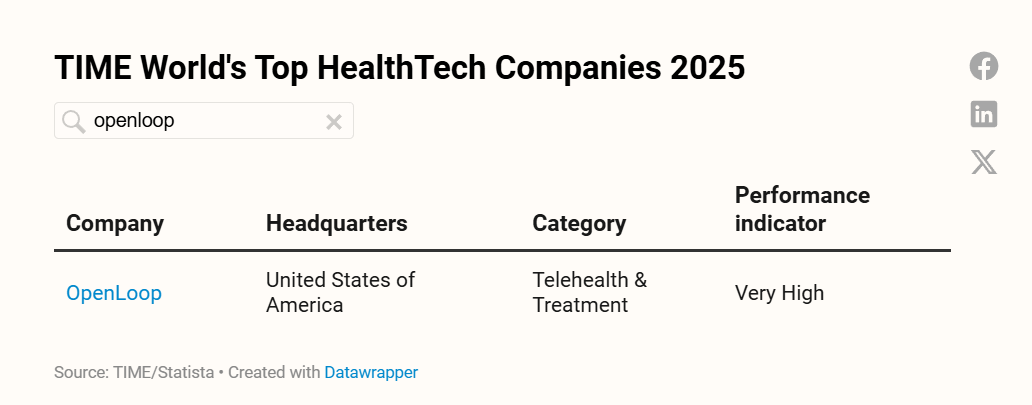
OpenLoop is a white-label telehealth infrastructure company. It provides the backend while other companies supply the brand. But public records and pending litigation suggest the relationships inside that ecosystem may run deeper than a neutral platform.
Jon Lensing is OpenLoop’s co-founder and CEO. Public filings also list his father, Dale Lensing, as an officer of OpenLoop Healthcare Partners, P.C., the affiliated medical group whose clinicians write prescriptions on the platform. A pending RICO complaint further alleges that Triad Rx, AKA, the pharmacy compounding and shipping oral tirzepatide, is connected to OpenLoop through a network of related entities and shared operational ties. Yikes. Those claims are still being litigated, but they point to a model that looks less like independent actors and more like a vertically coordinated system. Fact pattern doesn’t look great though.
As Brendan Keeler (his article is a must read for this whole thing) put it: OpenLoop didn’t just build the library; it helped write the story, print the books, and stock the shelves, while someone else puts their name on the door. And MEDVi is featured prominently as one of the main offending storefronts for oral tirzepatide. The complaint also names a cluster of brands including Friday’s Health, Remedy Meds, Prime Health, FuturHealth, Diddly Health, HeyRemmy, MyStart Health, 24HrDoc, and others and alleges they relied on the same underlying clinical and operational backbone. OpenLoop’s own materials describe a white-label model where partners bring the front-end brand while OpenLoop provides the clinical and technical stack.
And it's not just Medvi's orbit. A STAT News analysis found that among the 70+ telehealth companies the FDA has warned over the past six months, a sizable proportion of these share clinical affiliations with just four nationwide medical groups: Beluga Health, OpenLoop, MD Integrations, and Telegra. Four groups. Dozens of storefronts. The clinical plumbing beneath the DTC telehealth underworld is far more concentrated than most people realize, and it means the regulatory problem isn't whack-a-mole with individual brands, but structural. Same behaviors. Shut down Medvi tomorrow and the same prescribing infrastructure spins up a new front door by next week. This is exactly what happened with Done and the ADHD pill mills.
Then came the January 2026 security incident. OpenLoop disclosed that an unauthorized actor accessed its systems and removed data over a short window in early January. A threat actor claimed to have taken roughly 1.6 million patient records, though OpenLoop has not publicly confirmed that total. At least 68,160 Texans were affected, and notifications began going out in March. Multiple lawsuits followed. |
Put it all together, and the picture that emerges is this: patients were funneled through aggressive, misleading, marketing; treated through a shared telehealth infrastructure; prescribed a product now being challenged in litigation as unapproved and ineffective; and had their data pass through a system that was later breached. What’s hilarious (and sad) to me is how every part of the funnel can point blame at the other actors. - OpenLoop can call Medvi a third party marketing layer
-
Medvi can say OpenLoop and CareValidate are responsible for clinical and compliance layers
- OpenLoop can call themselves an aggregating platform and absolve themselves of any clinical decisions that ‘independent’ providers are making on behalf of marketing funnels like Medvi
Oh and don’t forget OpenLoop, which just really CANNOT stay out of the news lately, just acquired Season Health, a food as medicine telehealth platform with a 2 minute assessment for eligibility. So you can see the writing on the wall where this whole thing goes next. Another adjacent downstream service to sell as a part of the GLP-1 underworld craze.
I already asked the question. By now the answer should be obvious. There is no clinical check. There is no balance. There's a marketing funnel on top, a prescribing engine in the middle, and a compounding pharmacy at the bottom. Every layer has a financial incentive to keep the volume flowing and a contractual argument for why oversight is someone else's job. |
The Hims Comparison Is Insulting |
Some of the coverage made comparisons between Medvi's margins and those of Hims & Hers. Medvi at 16.2% net margin vs. Hims at ~5%. Two employees vs. 2,400+. Look how much more efficient the AI-native company is!
This comparison is intellectually dishonest on every level. For one, we’re believing that the initial reporter did a good job reviewing the financials from a known grifter. Nah, that’s sketchy fam.
For two, Hims & Hers, despite having its fair share of controversy (and I've written about the compounding situation before), is building a legitimate, if controversial, business. -
Hims owns the telehealth relationship and the customer experience.
- It’s vertically integrated into its own compounding operations.
-
Sustainable competitive advantages, quality control, and a defensible business model that doesn't evaporate the moment a regulatory window closes.
There are two reasons Medvi's economics look more compelling, and neither of them is efficiency. -
First, Medvi's customer acquisition costs are lower because Medvi quite literally lies. Fake results. Fake doctors. Fake affiliations with Johns Hopkins and other trusted institutions. Fabricated before-and-after photos where average consumers somehow transform into the second coming of Brad Pitt. A near-100% approval rate for a product that doesn't need to work because it physically can't. Of course the funnel converts. When you remove every friction point including the friction of …telling patients the truth, your CAC craters. That's not a business model innovation. That's fraud with a subscription layer.
-
Medvi's margins are higher because Medvi outsources everything. The clinical infrastructure, the prescribing, the pharmacy, the compounding, the shipping. The number of employees means absolutely nothing if you've contracted out every core function. You have no moat. No quality control. No sustainable competitive advantage. Your alpha is gone tomorrow. And your "efficiency" is really just a measure of how few people stand between the marketing spend and the prescription.
Gallagher wanted to make a quick buck before the alpha disappeared. It cannot be stated plainly enough. He was/is not trying to build a sustainable business. He is trying to maximize his short term gain and then pivot into personal brand and gray market peptides. |
What "Disruption" Apologists Get Wrong
|
I've seen the counterarguments floating around, and I’ve seen the dystopian responses from the general tech crowd - even some healthcare folks - who are still impressed by these results despite the obvious grifts. "All category-defining companies operated in regulatory gray areas. Airbnb, Uber, Robinhood." -
Sure. But those companies built defensible technology, created genuine operational moats, and delivered a product that actually worked for the consumer. Uber solved a real transportation problem. Airbnb solved a real lodging problem. Even Robinhood, for all its controversies, gave consumers functional access to equity markets. Medvi is a commoditized clone of an already existing business and is largely getting by by taking advantage of short-term supply and demand economics while ALSO selling a pill that cannot physically absorb through the GI tract. This is drop shipping with a prescription pad. Gallagher didn't invent a category or identify a novel wedge. These DTC GLP-1 companies already existed. He ripped off existing funnels, outsourced the clinical backend to a turnkey platform, fabricated the marketing with AI, and exploited a temporary gap between drug demand and supply. There is nothing net new here except the scale of the deception. The alpha is gone, and this is not a unicorn business.
"Consumers have the power to choose. More access to GLP-1s outweighs the journey to get there." -
Except this company is fundamentally anti-consumer. All subscription programs auto-renew. Consumers are being recommended a product - oral tirzepatide - that the scientific evidence suggests does not absorb through the GI tract. Refund policies are opaque, expire before you can tell if oral T works, and (per complaints) shift after enrollment. As mentioned, the doctors recommending the products don't exist. The before-and-after photos are fabricated. At what point does "consumer choice" require that the consumer actually has accurate information to choose with?
"We shouldn't regulate innovation out of existence." -
Nobody is saying that. I am profoundly pro-innovation and pro-consumer. The GLP-1 revolution is real and transformative. Expanded access to these medications through telehealth and compounding has genuinely helped hundreds of thousands of patients who couldn't get branded drugs. But there's a world of difference between expanding access responsibly and selling snake oil through an army of deep-faked doctors. And the fact that the entirety of the tech industry is celebrating this man for doing something many smart and capable founders could have done -- but decided not to because they actually have a moral compass -- pisses me off.
|
Broader Healthcare Implications…We Made this Mess Ourselves |
Beyond the Medvi-specific outrage, there's a structural dynamic at play here that deserves more attention than it gets: the crying need for transparency in healthcare has never been louder, and Medvi is what happens when we keep ignoring it.
Grifters who enter healthcare, exploit loopholes, and leave us to pick up the scraps are the worst of us, but we have made our own bed.
We've seen this pattern before. Adeptus and surprise billing. Nutex and HaloMD exploiting No Surprises Act arbitration. Cerebral. Done with ADHD. And now the GLP-1 pill mills. Every cycle, a bad actor identifies an information asymmetry, exploits it at scale, extracts maximum value, and leaves the rest of us to pick up the scraps. But we shouldn't pretend this is limited to fly-by-night grifters. The longstanding incumbents - PBMs with opaque spread pricing, certain private equity structures built on financial engineering, 340B arbitrage that benefits everyone except the patient - are sapping value from the system in their own quieter, more durable way. Both categories thrive on the same underlying condition: the consumer doesn't know what's happening, and the system is designed to keep it that way.
Medvi exploited this perfectly. The currency of healthcare is trust, and Medvi tapped directly into that by fabricating the two things consumers trust most: real doctors and real patient results. When someone shows up to weaponize that trust asymmetry with better technology, we call them a visionary. That should tell you everything you need to know about where we are.
What's needed across the board, from DTC telehealth to PBM contracting to hospital pricing, is greater transparency and more information made accessible to the consumer. I do think we're headed in that direction. But we need to move faster, because the bad actors are moving faster too. Everyone bemoans the regulatory burden on telehealth. Everyone asks why the DEA still requires in-person visits for controlled substances. Everyone wonders why the pandemic-era flexibilities haven't been made permanent. This. This is why.
Because the moment you loosen the rules, people like Matthew Gallagher show up. And Ruthia He before him. And the Cerebral founders before her. The pattern is painfully obvious. Exploit a deregulatory window, maximize volume over clinical rigor, scale the marketing machine faster than regulators can inspect it, and extract as much value as possible before the walls close in. The answer isn't to keep the rules frozen. Rather, it's to build enforcement capacity that can match the pace of market entry. | An Abject Failure of Tech Journalism |
Every single piece of information I've laid out in this article was publicly available before the New York Times published its April 2 profile of Medvi. Every. Single. Thing.
The FDA warning letter? Public record, dated February 20, 2026 -- six weeks before the profile ran. The Futurism investigation documenting deepfake photos and fake doctor personas? Published in May 2025 -- eleven months before the profile. The RICO class action lawsuit? Filed in November 2025. The OpenLoop data breach? Disclosed in January 2026.
And those revenue figures...would love to see legit documentation rather than trusting the grifter-agenda setting relationship. The New York Times says it "reviewed financial documents," which is a far cry from an independent audit. So we have a founder who fabricates doctor personas, deepfakes patient testimonials, and sells a product that doesn't absorb through the GI tract — and the global press is taking his self-reported revenue figures at face value. Maybe the numbers are real. Maybe they're not. But if this story has taught us anything, it's that verification matters.
I’d say do better, but they know exactly what they’re doing.
After the Times piece dropped, Forbes, Inc., PYMNTS, and the broader tech press dogpiled with their own breathless coverage, all repeating the same narrative: AI-powered solo founder builds billion-dollar company. None of them checked, either. They saw the Times byline and ran with it. This is how misinformation launders itself through the media ecosystem and makes us all worse off by attracting vibe-coding grifters to the underworld of healthcare.
This whole story and how it was portrayed is an abject failure of tech journalism. These outlets are pushing their own agendas, craving to find the first AI solo founder unicorn and optimizing for virality and subscriber engagement - are, in a way, running their own grift. You should understand this fact every time you read something from them. The tech world is so obsessed with the narrative of the billion-dollar solo AI founder that they glazed over every red flag to get the story across the finish line.
It's like watching the next iteration of Cerebral or Done being celebrated in real time. And here I sit seeing the story and reactions, asking myself…”Am I taking crazy pills?” Well, turns out the answer is no…but Medvi’s customers might be.
This notoriety will only serve to boost Medvi’s financial profile. All attention is good attention at this point. He is using this press as a launching point for upcoming move into peptides, which will avoid scrutiny, and in being cash pay, provide a great little nest egg to ride off into the sun. This should not be celebrated as an entrepreneurial success story. This is an example of an extremely smart person with no ethical code taking advantage of a window of opportunity to maximize short-term profits at the expense of everyone else in the healthcare system. And if history is any guide - from Done to Cerebral to whatever comes next -- the window will close. The lawsuits will compound (pun intended). And the rest of us in healthcare will be left to clean up the mess. |
To the Voices of Reasonability |
Here's the thing about the Medvi story: the real version of it, the one the Times should have written, isn't about a grifter. It's about the people who saw through it. So let me end by giving credit where it's actually due.
To Maggie Harrison Dupre at Futurism, who actually did real research and identified Medvi for the sleazy, fraudulent operation it is - eleven months before the Times profile ran.
To Brendan Keeler at Health API Guy, who meticulously traced (and is actively tracing) the legal and corporate connections between Medvi, OpenLoop, and the affiliate marketing engine.
To Rik Renard, Jonathan Slotkin, Gary Marcus, and the dozens of others who called out the Times profile for what it was. Real perspective and reasonability still exists. It just doesn't always live where you'd expect.
To the countless founders who are working on real problems in healthcare and doing things the right way - picking up the pieces every time someone else exploits the system. You are the ones who actually deserve the profiles.
And to the transformative capabilities of AI and those using it to advance our industry rather than extract from it, technology is not the villain here. This technology is extraordinary. No - the villain is the person who pointed it at the most vulnerable consumers in the most opaque industry in America and called it innovation.
Let’s pick up the pieces. |
|
|
My favorite reads & resources from the week |
*This read is brought to you by one of my brand partners who help make this newsletter possible! |
|
|
Thanks for the read! Let me know what you thought by replying back to this email. — Blake |
|
|
{if profile.vars.board_room_user_fitness == true}The conversation doesn't have to stop here
Keep learning and connecting in the Hospitalogy Network
EVENTS | FEED | LIBRARY | DIRECTORY
|
|
|
{/if}{if !profile.vars.board_room_user_fitness && profile.vars.board_room_user_fitness != false}I'm building a community of leaders in strategy, finance, and ops
at hospitals and health systems to help us connect, learn, and grow together. |
|
|
{/if}
Get your brand in front of 67,900+ executives and healthcare decision-makers. |
Workweek Media Inc.
1023 Springdale Road, STE 9E
Austin, TX 78721
Want to ruin my day? Unsubscribe. |
|
|
|