{if ftt_dorm_120 == true}
Quick favor: Our records indicate that you aren’t opening this email. But records can be wrong. Please click here if you’d like to remain subscribed to Fintech Takes. |
|
|
{/if}Happy Monday, Fintech Takers!
Quick housekeeping note before we dive in: this newsletter is a bit of a greatest hits situation.
Over the last few months, I've been writing about the credit card market in pieces, one story (and Monday newsletter) at a time, and I've been meaning to pull the thread together into something more coherent.
This newsletter is that attempt.
The credit card market has changed in ways that most consumers haven't fully registered yet. Credit cards serve fewer and fewer people extremely well (affluent customers benefit the most), and the industry keeps treating that as a reason to double down rather than look up and ask what, exactly, we’re optimizing for. That shift raises questions I find very hard to answer. Like, are there other products positioned to fill the gap? Are we leaving certain segments of the market behind permanently? Does the industry even know that it’s doing this?! I hope you enjoy it! - Alex
P.S, Conventional wisdom says to wait for clarity before making big decisions. Financial services doesn't have that luxury. That's what I'm digging into in my next virtual event: how uncertainty is reshaping credit, and what it looks like to act with confidence when the fog won't lift. Save your spot.
|
Was this email forwarded to you? |
|
|
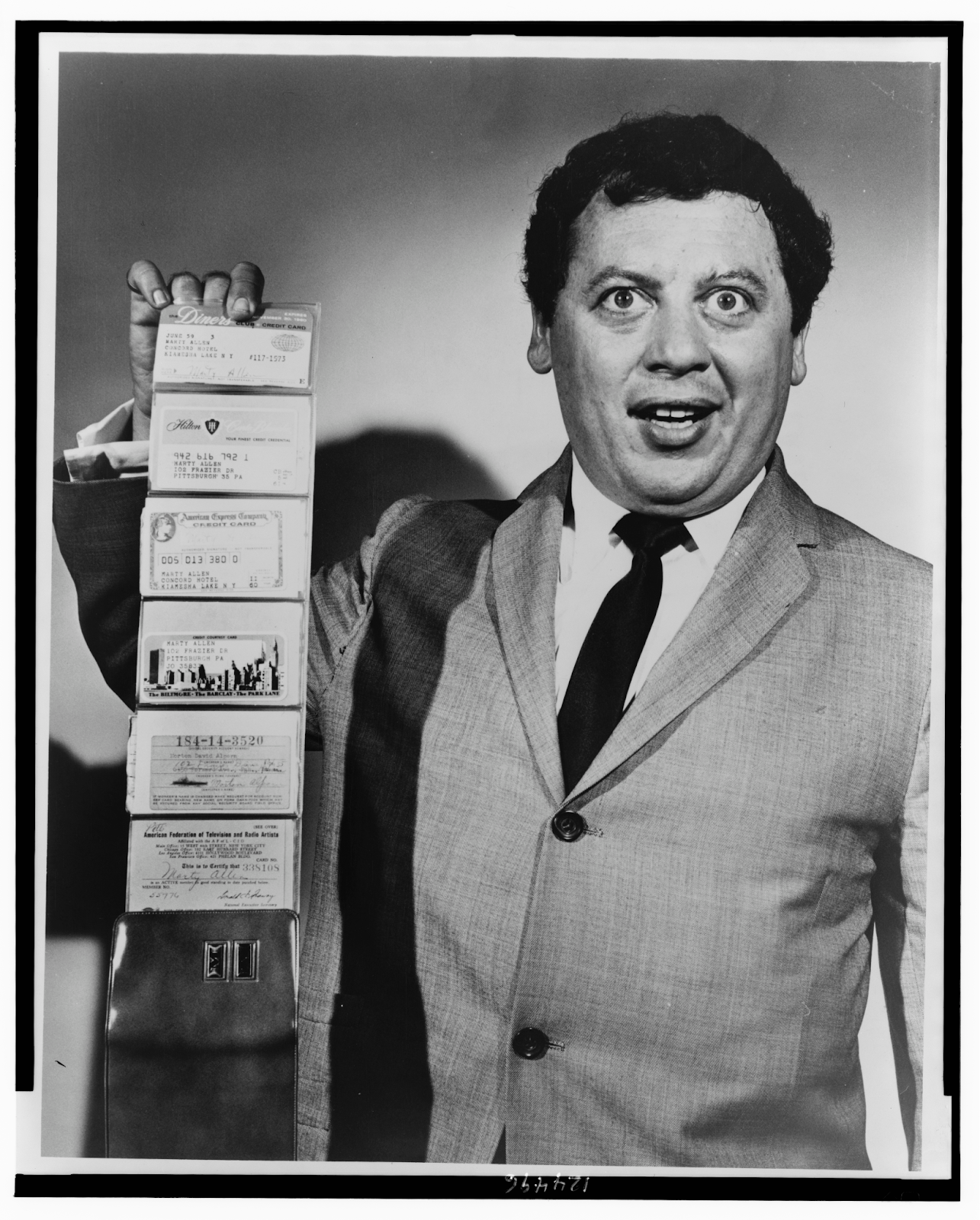
Marty Allen, The Darling of Daytime TV. |
|
|
#1: Credit Cards Have Become a Luxury Good |
At the end of last year, the CFPB released its seventh biennial review of the consumer credit card market, which remains the most data-rich portrait we have of the credit card market today:
In this report, we review how consumers use credit cards, practices of credit card issuers, and how the credit card market is changing. We revisit topics covered in earlier reports, such as deferred interest and innovations in the marketplace, while introducing new areas of focus this year. We analyze how cardholders spend by merchant category, review promotional interest rates, and take a deeper look into card transaction disputes. Consistent with the report’s mandate, we consider consumers with below-prime credit scores and cover topics related to the cost and availability of credit.
|
If you're getting déjà vu and thinking I yippee-ed at the release of 190+ pages of nerdy, data-driven goodness about the state of the U.S. credit card market, congrats on being a power Fintech Takes reader. You'd be right.
Here is what the data shows: -
Annual growth in credit card spending was around 5% in 2024, and virtually all of that growth is attributable to cardholders with prime and superprime credit scores.
- Growth among near-prime and subprime cardholders has been flat since 2023, despite an increase in the number of those cardholders.
- About 56% of below-prime balances are now held by issuers with less than $100 billion in assets, while larger issuers hold 95% of superprime balances.
- The share of cardholders making only the minimum payment hit its highest level since at least 2015.
- And the share of no-reward credit cards, most common among subprime and near-prime segments, has plummeted as reward credit cards (particularly cash back cards) have surged in popularity.
What these five data points collectively tell me is this: the credit card market has split in two. The top of the market is growing, getting richer rewards, and borrowing more. The bottom of the market is treading water, losing access to rewards, and increasingly stuck making minimum payments on expensive balances. But wait, there’s more!
Matthew Goldman, in his newsletter CardsFTW, shared reporting from The Wall Street Journal that revealed the number of new cards opened at top issuers declined 5% year-over-year in Q2 2025, even as total credit card spending kept growing above inflation. Matthew’s read: top earners are spending transactionally for rewards, and lower-income segments are using cards to stretch budgets. (And as Matthew writes about, branding lets banks charge higher interest rates than the risk level would justify, and those multi-decade high rates have made carrying a balance genuinely punishing.)
The people most likely to carry a balance are, of course, the people the big issuers just deprioritized. In other words, the folks paying the most to use their credit cards are the ones the big issuers are least interested in serving.
After the big issuers helped consumers burn through their pandemic-era savings and get spending back to usual, those issuers made a conscious choice to tighten underwriting, reduce exposure, and concentrate everything on the superprime segment. Near-prime and subprime consumers got handed off to smaller, more risk-tolerant issuers and fintech lenders (BNPL, EWA, and the like).
The consequences of that decision are already showing up in the data above: 56% of below-prime balances have already migrated to smaller institutions. Minimum payment rates are at their highest since 2015. The rewards that made credit cards worth having for ordinary consumers are disappearing from the products designed for them. Yes, these cycles turn. The big issuers will eventually ease underwriting standards again when the economic fog clears.
But the more interesting question is whether there are long-term consequences from walking away from the majority of the market, and what opportunities that hands to the players willing to serve those consumers.
Are other products positioned to fill the gap? Are we leaving certain segments of the market behind permanently?
Someone is going to build for the consumers currently left behind. It probably won't be Chase or AmEx, though.
(Related to this discussion, Matthew Goldman and I chatted with Scott Johnson, President of Cards at LoanPro, and Nick Noufer, Director of Marketing at Synctera, about how new entrants in the credit card market can compete with the big issuers. You can watch the reply here.) |
#2: The Foundation of a Product |
Earlier in the year, Bilt introduced its new lineup of “Bilt 2.0” credit cards. Then, a few days later, it relaunched its relaunch. To quote Ankur Jain, Bilt's CEO, on why: Over the past few days, I’ve spent a lot of time reading our members' emails, DMs, and notes. Many were thoughtful and passionate. Some were frustrated. All were fair. I feel incredibly lucky to lead a company with members who care this deeply.
On one hand, there have been record applications for the cards, and I’m excited for members to get them. However, I’ve also seen real and reasonable confusion about the new value proposition—especially around rent and mortgage points. That’s on me, and we’re fixing it. |
Bilt was supposed to be the card for everyone else.
The old Bilt Card, issued by Wells Fargo, had a distinct value proposition for users. It allowed cardholders to pay their rent with the card (fee-free) and collect 1x points on rent (up to 100,000 points/year), no annual fee, just five transactions per billing cycle to unlock the full reward. Bilt 1.0 wasn’t a card for status-obsessed frequent fliers, but a card for renters — people who are, by definition, not the superprime homeowning demographic that Chase and AmEx are fighting over.
The problem is that Wells Fargo was reportedly losing tens of millions of dollars a month due to wrong assumptions about cardholder spending, revolver rates, and mortgage conversion. Those economics forced the rewards restructure that became Bilt 2.0: three tiers, annual fees up to $495, and Bilt Cash (a second rewards currency engineered to make earning points on rent payments contingent on putting significantly more everyday spend on the card).
In other words, the market pulled Bilt toward the premium model even though that's not what Bilt set out to build. Thin economics eventually force a product pivot.
But the rewards restructuring is only half the story. As I wrote about recently, when the Bilt-Wells Fargo breakup was covered in the press, everyone (including me) focused on the economics. The story underneath the story is that Wells Fargo wasn't just Bilt's bank partner. Wells Fargo was, in many underappreciated ways, the product itself.
When Wells Fargo exited, Bilt replaced its operational infrastructure with a combination of different service providers, like Column (the bank), Cardless (the issuer processor), and Fidem Financial (the capital provider). The launch of Bilt 2.0 hasn’t gone well for cardholders (as Jason Mikula has reported), and that’s in part because Bilt underestimated how much value Wells Fargo's vertically integrated infrastructure had been providing all along.
Building for the consumers whom the big issuers have ignored is an obvious opportunity, but Bilt 2.0 shows you the challenge of executing on that. |
#3: The Accidental Blueprint |
In January 2026, JPMorgan Chase reached a deal to acquire the Apple Card portfolio from Goldman Sachs, one of the last remnants of Goldman's ill-fated consumer banking initiative.
From The Wall Street Journal:
JPMorgan Chase has reached a deal to take over the Apple credit-card program from Goldman Sachs, further cementing JPMorgan’s status as a behemoth in the credit-card sector and marking the final chapter of Goldman’s failed experiment in consumer lending. The biggest bank in the country will become the new issuer of the tech-giant’s credit card, one of the largest co-branded programs with some $20 billion in balances. |
Goldman's consumer banking foray was a disaster, but the Apple Card is where things truly came apart. Goldman signed an agreement that gave Apple enormous latitude to run the product, and that resulted in a poorly-performing portfolio. Instead of selling its $20 billion Apple Card portfolio for a premium (up to $2 billion wouldn't have been unreasonable given the cachet of Apple's customers), Goldman had to give JPMC a $1 billion discount to take it off its hands.
The Wall Street Journal reported that the discount reflected high exposure to subprime borrowers and above-industry-average delinquency rates, creating the potential for significant losses on outstanding balances.
In other words: Goldman let Apple run wild, inherited a portfolio full of borrowers it hadn't properly underwritten, and paid $3 billion in foregone value to escape a bad contract. That’s quite a run. And the most interesting part is what JPMorgan Chase saw when it looked at that same portfolio.
Unlike their counterparts at Goldman in 2019, the people running JPMC's co-brand credit card business today likely negotiated a much better deal with Apple, with more latitude on managing portfolio risk and a more favorable risk-sharing arrangement. I’m sure that JPMC also thinks it will be better than Goldman at both underwriting new customers and rehabilitating delinquent ones. They're already planning to launch a new Apple savings account, which tells you where they think the real value sits: not in the card itself, but in the broader financial relationship with Apple's customer base.
Apple's customer base is not uniformly superprime. Goldman's portfolio had meaningful subprime exposure, which is part of why it underperformed what Goldman's management expected. JPMC looked at the same exposure and, with better underwriting discipline and a vertically integrated infrastructure, appears to believe it can profitably serve that broader credit spectrum. But the largest bank in the country recently acquired a portfolio with significant below-prime exposure, negotiated hard to make the economics work, and may already be thinking about cross-selling a savings account rather than just optimizing rewards.
The consumers sitting in the Apple Card portfolio aren't an abstraction. They may be the ~56% of below-prime balances that have already migrated away from the big issuers, the renters Bilt couldn't hold onto through the transition from 1.0 to 2.0, and/or the subprime borrowers Goldman had inadequate control over because it signed away too much latitude to Apple. Each of those groups represents a version of the same unresolved problem: a large, real market that the credit card industry keeps failing to serve sustainably. |
|
|
In this Data Takes spotlight, MX digs into financial health data so you can understand what your customers are carrying.
51% of U.S. adults say money is their main source of stress.
49% say thinking about their finances makes them anxious.
62% live paycheck to paycheck.
That's not a segment of your customer base; that's most of it.
MX maps financial health as a pyramid: stability at the bottom, progress in the middle, security at the top.
The providers who help customers climb up are the ones they trust. |
|
|
2 READING RECOMMENDATIONS |
I’m fascinated by the failure of OpenAI’s partnership with Walmart and what it means for the future of everyone’s favorite buzzword: agentic commerce. Tom provides some helpful context in this one. |
Speaking of OpenAI, Thompson absolutely crushes them here, using the acquisition of TBPN as a jumping off point:
I’ve previously wondered if OpenAI might be like Twitter, another text-centric company that fell backwards into a huge market and never developed into a functional business because of it; if Twitter is a clown car that fell into a gold mine, OpenAI might be the short bus at the end of the rainbow. There’s supposed to be a pot of gold there, but it never quite seems to materialize, the colors are fading, and worst of all there just isn’t much evidence that anyone knows what they are doing or that there is any sort of overarching plan. Ads are bad, until they’re the plan; Meta execs are hired en masse, and the ads that launch are low-effort keyword-driven offerings; Apple is a partner until Jony Ive is hired, but he’s still doing projects for Ferrari; meanwhile, Anthropic is focused on the enterprise and shipping, Google is encroaching, and the answer to that is to buy a podcast? What is going on here?
Whoa! |
There are a TON of interesting questions being asked in the Fintech Takes Network. I’ll share one question, sourced from the Network, each week. However, if you’d like to join the conversation, please apply to join the Fintech Takes Network. What is your favorite example of a bank, credit union, fintech company, or non-finance brand doing something novel and interesting in the credit card space? Please do not pitch me a new premium credit card with a high annual fee! We already have a bunch of those!
If you have any thoughts on this question, reply to this email or DM me in the Fintech Takes Network! |
|
|
Thanks for the read! Let me know what you thought by replying back to this email. — Alex |
|
|
{if !profile.vars.fintech_takes_user_fitness && profile.vars.fintech_takes_user_fitness != false}Join 2,444 other finance and fintech leaders in the Fintech Takes Network |
|
|
{/if}{if profile.vars.fintech_takes_user_fitness == true}The conversation doesn't have to stop here
Keep learning and connecting in the Fintech Takes Network
EVENTS | FEED | LIBRARY | DIRECTORY
|
|
|
{/if}Get your brand in front of 62,000+ fintech and banking executives. |
Workweek Media Inc.
1023 Springdale Road, STE 9E
Austin, TX 78721
Want to ruin my day? Unsubscribe. |
|
|
|