{if ftt_dorm_120 == true}
Quick favor: Our records indicate that you aren’t opening this email. But records can be wrong. Please click here if you’d like to remain subscribed to Fintech Takes. |
|
|
{/if}Happy Friday, Fintech Takers!
I hope you’ve had a great week, and if you were attending a conference like Fintech Meetup or CBA Live, I hope you made it home safe and have recovered from your travels.
I am recovering nicely after Fintech Meetup, and I thought it would be fun to share some thoughts and observations from the show and the various conversations I had while I was there. - Alex |
Was this email forwarded to you? |
|
|
Fintech Meetup started in 2021 as a virtual-only event, entirely focused on meetings. I attended that first event, and it was weird. Intriguing, but weird.
In 2022, after another virtual-only event, the conference was acquired by Hyve Group (terrible name for a company BTW), and in 2023, it jumped from virtual to in-person. That 2023 event was held at The Aria in Las Vegas and was, for a Vegas conference, glorious; just the right size, slightly above-average venue, a nice mix of meetings and content. A+. Over the last couple of years, the event has been held at The Venetian, which is also where Money20/20 has traditionally been held, making Fintech Meetup something akin to Money20/20’s younger brother.
This year, Fintech Meetup was held at Mandalay Bay, which was slightly uncomfortable for everyone involved. It was a bit like being a fish and being put in a slightly larger and older tank while your normal tank is being cleaned. It’s not wrong, per se, but it felt weird. You could kinda tell that no one really knew where to go. Luckily for me, I made some wonderful new bank friends at this year’s event, and they took me under their collective wing — my thanks to them and to everyone who let me crash their parties and ask dumb questions. Here’s a rundown of some of the things I learned. |
AI is Overpowering Everything |
I’ll be honest, I don’t remember a technology that thoroughly permeated every part of the financial industry the way that AI has.
Online and mobile were huge, obviously. But they didn’t touch every part of the industry. We mostly talked about those technologies as new distribution channels and, to a lesser extent, as efficiency boosts for specific back-office tasks. And for all the true believers digital channels had in banking and fintech in the 2000s and 2010s, there were plenty of detractors saying things like, “actually, this won’t be as disruptive as you think.”
It’s difficult to find that same skepticism with AI.
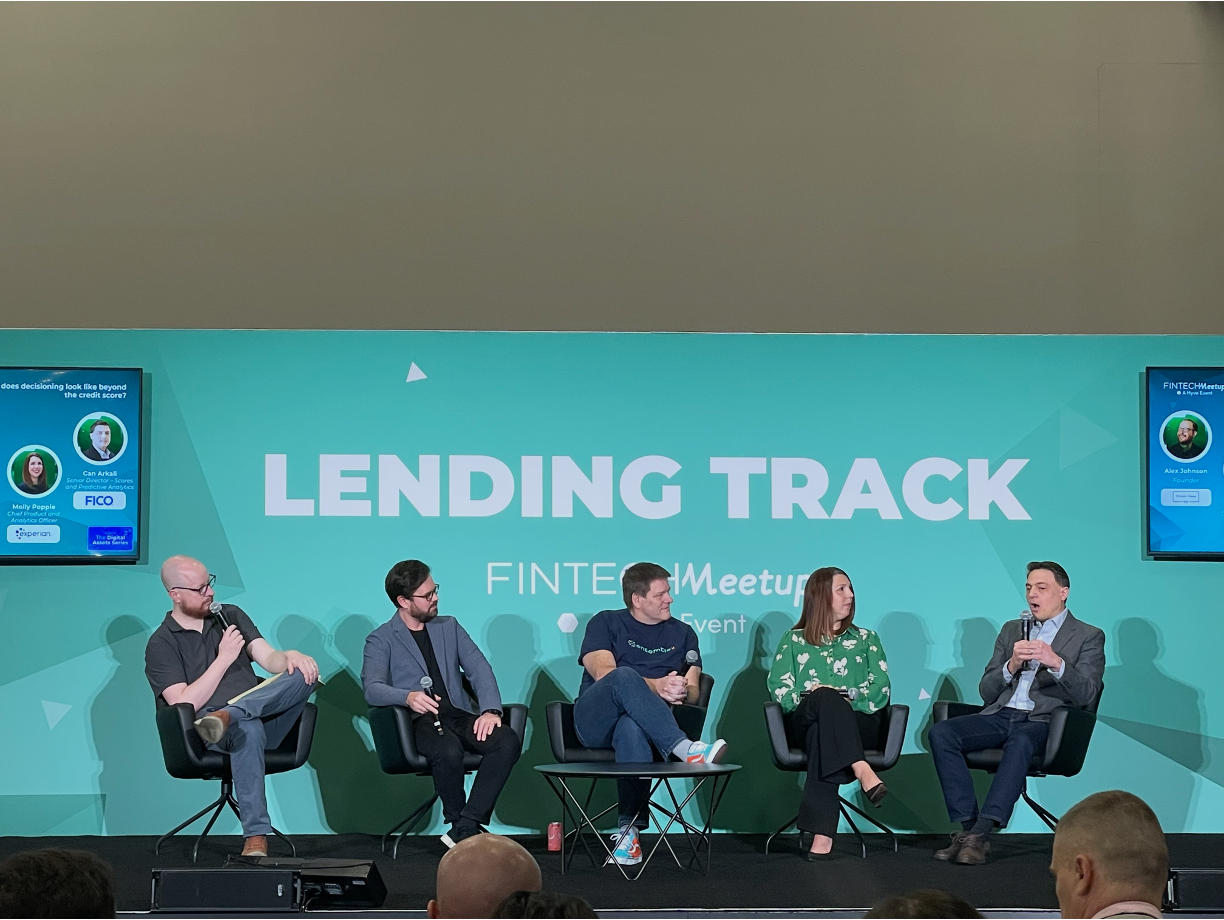
Everyone at Fintech Meetup was talking about AI. It was in every session (including the one pictured below on the future of decisioning and credit scoring). Every hallway conversation. Every networking event and dinner. You could not get away from it.
|
Now, I know this isn’t exactly revelatory. Like, “Wow, Alex. AI is important in 2026? Tell me more!”
However, I think it’s important to appreciate the degree to which AI has, almost overnight, become the North Star that most banks and fintech companies are using to chart their courses. It speaks to both the breadth of AI’s potential across every domain in financial services — distribution, product development, back-office operations, strategic planning, human resources — as well as the uncertainty that everyone in the industry seems to feel about how, exactly, AI will reshape the market, their companies, and, ultimately, their jobs.
At times, it felt like we were all participating in a massive job fair, describing the various ways we are using AI to optimize our personal and professional workflows, with the hope of impressing some invisible and omniscient hiring manager. |
[Whispers] Agentic Commerce Isn’t Really a Thing … Yet |
Given the dominance of AI as a topic this week, it felt uncomfortable to ask this question:
Am I stupid, or is agentic commerce not as big a deal, at least right now, as Stripe and Visa and Mastercard are making it seem?
And yet, I asked quite a few people this question, and most of them (quietly) told me that the hype is well out of proportion to the current level of agentic commerce activity that they are seeing in the market. Furthermore, there isn’t yet a consensus on where AI agents will provide a significant lift, in terms of customer value, on top of the ways that e-commerce transactions are conducted today. Now, to be sure, there are very promising use cases for agentic commerce. Travel gets mentioned a lot. As does procurement for small businesses, especially businesses that routinely source goods and services from suppliers across multiple countries. But even for those use cases, there is a lot of important work that needs to be done before we can enable them at any meaningful scale.
Liability is the big one that kept coming up in my conversations this week. Adding an intelligent, autonomous agent into the middle of customer-merchant transactions is going to create a lot of new points of friction and confusion. Who is on the hook when a customer claims that an agent incorrectly made a purchase on their behalf? What if the customer’s instructions to the agent are vague or contradictory? What if the customer mistakenly empowers an agent created by a fraudster or an agent with poor security that is compromised by a fraudster? What if the customer lies about their agent making a mistake because they are trying to commit chargeback fraud?
The network rules that will define the answers to these questions are still being written. And I can tell you that banks and fintech companies are frustrated that Visa, Mastercard, Stripe, and the rest of them are spending so much time publicly pumping up agentic commerce without first establishing clear rules for the road. |
Agentic Search is a Thing
|
While agentic commerce remains more theoretical than real, for the moment, agentic search is here.
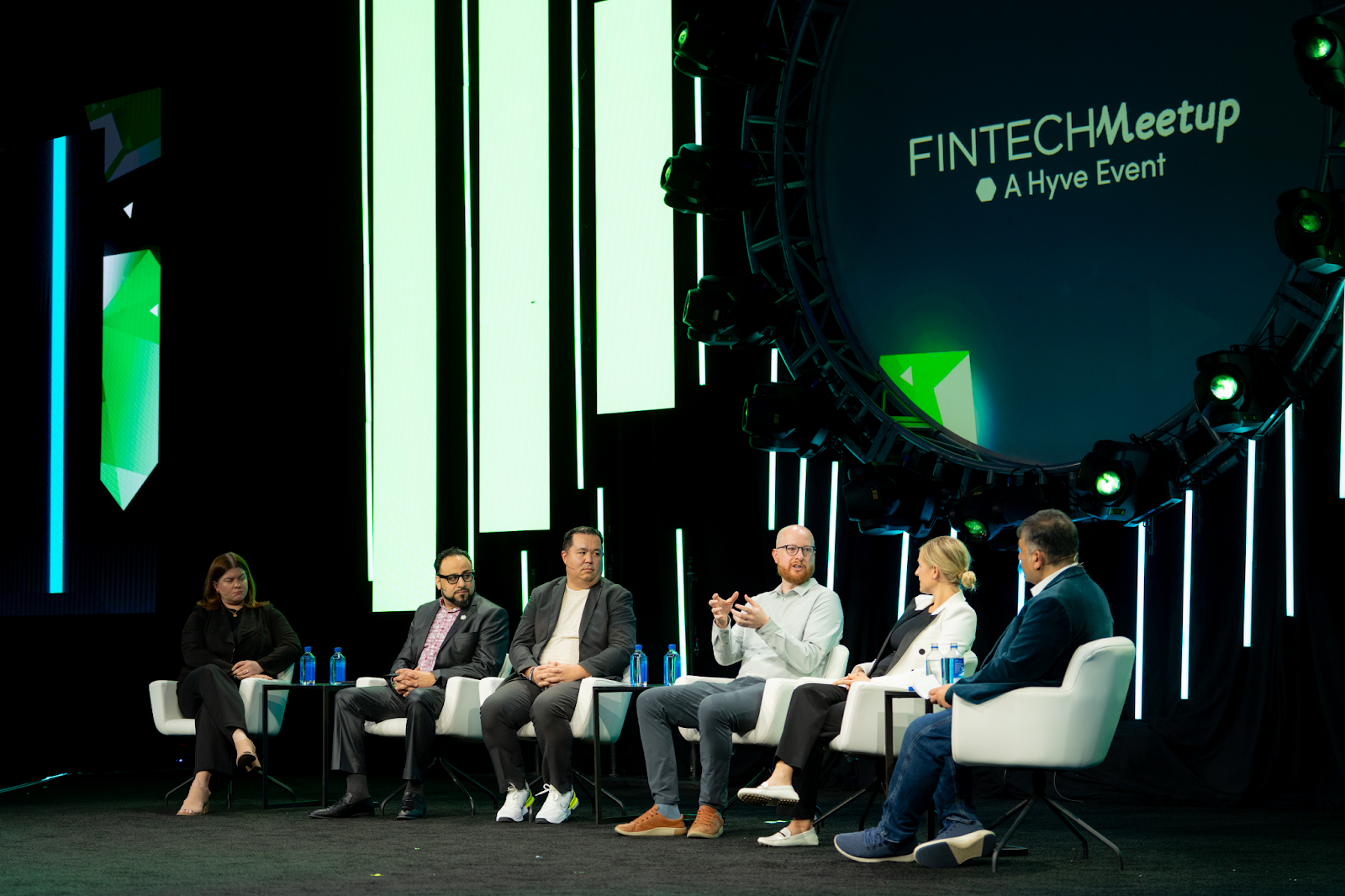
I spent some time this week talking to marketers (including on a fun panel on customer acquisition in the age of AI … pictured below), and I heard the same thing consistently: AI chatbots have already meaningfully disrupted search engines as a research and information retrieval tool for consumers and business owners, and they will continue to do so.
|
This isn’t shocking. If you think about it, it’s actually quite unnatural for people to look for information using keyword searches. That’s just a thing we’ve all learned to do because that’s the way that Google’s algorithm works.
Asking questions is a much more natural process. And it’s one that is well-suited to AI chatbots, which is why AI chatbots are disrupting Google (and why Google proactively disrupted itself, as Carlos Caro and I discussed on this podcast episode!) This has a bunch of interesting implications for financial services companies, including: -
If people can search for information in whatever way that makes the most sense in their own brains (and trusting the LLM to understand what they’re asking for), rather than having to dumb down their searches to common keywords that are likely to get the best results in Google, we should expect the rate of long-tail keyword searches to go up over time. Which companies will win when customers can search for exactly what they are looking for?
-
Generative engine optimization (GEO) is already starting to replace search engine optimization (SEO) as the primary tactic that marketers are relying on when writing their content. Compared to SEO, GEO requires a simpler and more structured approach to organizing content. When you’re writing for an LLM, you want to make it as easy and inexpensive for the LLM to parse your content as possible.
- Trust matters a ton in GEO. AI chatbots want to return highly authoritative and trustworthy results, but they don’t have the same direct approach to indexing domain authority that Google does. Instead, they rely on sources that humans (and Google) have already deemed trustworthy, such as Reddit and product review websites like Nerdwallet.
|
Open Banking: Do Whatever the Fuck You Want |
There is very little faith among the open banking folks I speak with that we will have settled regulatory rules governing consumer-permissioned sharing of financial data in the U.S. anytime soon.
Or possibly ever.
Whatever rule the current CFPB comes out with will immediately be challenged in court by whichever side is most upset. Hell, both sides of the market may sue simultaneously. And because we’ve so thoroughly dismantled the administrative state, those lawsuits will continue forever. Congress would need to pass an incredibly detailed and prescriptive open banking law for us to even have a chance of establishing regulatory clarity. Obviously, the chance of that happening is basically zero. And even then, I’m not sure it would work.
Instead, the market is just going to figure it out.
In one sense, this is depressing. Big players with significant leverage will, within certain limits, be able to do whatever the fuck they want. We’ve seen how that’s worked out so far, and I have no real reason to expect anything different from those players moving forward.
However, in another sense, this represents a bit of a return to form for the U.S. market. We’ve always been a market-driven open banking ecosystem, not a rules-driven one. That’s how we built the open banking infrastructure that we have today. And my sense, talking to folks in and around FDX, is that there is a renewed recognition on the part of many banks, fintech companies, and data aggregators that the industry will need to come together and solve things itself, rather than waiting for regulators to do it for them.
| As I mentioned in my intro, Fintech Meetup started with a focus on facilitating short, curated 1:1 meetings.
The way it historically worked was that you would be strongly encouraged to complete an exhaustive personal profile, describing who you are, what you do, and what areas of fintech you are interested in talking to other people about. Based on that profile, you would have the ability to pick other attendees whom you would like to meet with. If those individuals also expressed an interest in meeting with you, a 15-minute “speed date” meeting would be scheduled.
This double opt-in system worked extremely well in the early days. I participated in it several times and always found the quality of the resulting meetings to be significantly above-average. I didn’t participate in the meetings this year, but in talking to many of the folks who did, it sounds like the experience has been significantly degraded. Fintech Meetup has always incentivized bankers to attend the event and to participate in the meetings. These incentives — free event passes, a moderate T&E stipend, etc. — made sense, especially in the early years, because bankers are high-value targets at an event that is focused on helping fintech companies get business done.
However, from what I heard this year, Fintech Meetup may have been too aggressive in trying to monetize the event by selling sponsors a guaranteed number of “hosted meetings” with bank decision-makers (regardless of the fit) and throttling access to vendors that chose not to pay extra. This was the source of significant frustration.
Bankers didn’t like it because the meetings that they were forced to attend were irrelevant and low-quality. And even the sponsors who paid to participate didn’t like it because they could tell the bankers didn’t want to be there.
I hope Fintech Meetup dials the monetization lever back down and restores the meeting program to its former efficacy. |
Checking Account Bundles Are Coming |
Ron Shevlin will be pleased with this one: subscription bundles built around checking accounts seem to be becoming a more popular product idea.
Ron was one of the first people I remember pitching the idea that consumers would be willing to pay a subscription fee for access to a checking account, if that account was bundled with enough perks and value-added services.
We’ve seen quite a few fintech companies make this bet. The European neobanks (Revolut, Monzo, N26, and bunq) all offer premium subscriptions. In the U.S., Current, Robinhood, and Coinbase offer paid subscriptions as well, though obviously, the details of each bundle vary. And just yesterday, Chime launched Chime Prime, which is a fee-free premium membership that unlocks access to higher rewards, interest rates, and travel perks in exchange for direct depositing at least $3,000 per month.
From my perspective, this is a positive development for the industry. We need to wean consumers off the notion that checking accounts should be free. Many banks already charge monthly maintenance fees on checking accounts if they fall below certain balance or deposit thresholds. Subscription bundles are just a positive spin on that same economic reality.
My educated guess is that we will see several national and super-regional banks introduce their own premium consumer checking account bundles within the next 12-18 months. I also expect to see more fintech companies get into this game. One to watch is Step/MrBeast Financial, which will have the opportunity to bundle banking services with MrBeast’s upcoming MVNO mobile phone service. |
Returning to AI for a second, another trend I noticed at the event was a significant disparity in AI interest, experimentation, and adoption among community banks.
Some are all in. They are actively experimenting with various LLMs and agentic AI systems, including, most notably, Claude Code. They are working to augment and expand the productivity of their employees (especially in the back office) and to build the internal tools and systems that they can’t afford to buy off the shelf from third-party vendors.
Others are functionally ignoring AI. Their executives have a few soundbites that they can repeat at board meetings so that they don’t sound out of touch, but when you ask them how they are using AI agents inside the bank, they give you a blank look or start talking about Microsoft Copilot. This division is striking because of the naturally disadvantaged position that all community banks are in, compared to their larger peers. Banking is a scale game, and community banks have, for years, been playing a losing hand.
AI has the potential to shake up that dynamic. It can give a community bank the technology development and maintenance muscle of a much larger institution, allowing the bank to outkick its coverage when it comes to traditionally resource-intensive activities like new product development or core system conversions. Or, to paraphrase Lin-Manuel Miranda:
Running on empty, with nothing left in me but doubt I picked up a harness
And I prompted my way out |
Banks’ Build/Buy Decisions |
Another AI subplot in banking is the disruption that it is causing in banks’ build/buy decisions.
For smaller banks, build is becoming a significantly more attractive option thanks to the availability of AI coding tools. Banks understand that these tools can’t produce enterprise-ready software on their own, but the argument is that it’s becoming faster and cheaper for banks to build the software they need using AI tools and then to invest in the appropriate internal resources to harden that software and get it ready for production.
At the same time, there is an expectation that bank procurement processes are going to have to become even more rigorous. Increasingly, every third-party software product has an impressive-looking demo (thanks vibe coding!), which puts increased pressure on bank procurement folks to effectively sort reality from hype.
AI will even show up post-procurement, reshaping how banks manage their third-party vendors. Imagine having forward-deployed AI agents that fully understand your bank’s policies and business goals, operating within your vendors’ environments, monitoring the effectiveness of your software deployments, and recommending changes to further optimize performance.
(BTW, the impact of AI on banks’ build/buy decisions will be a central topic of the event that we are putting on with Team8 during New York Fintech Week. If you’d like to attend, let me know. I can put in a good word for you!)
|
Banks Know Their Customers the Best |
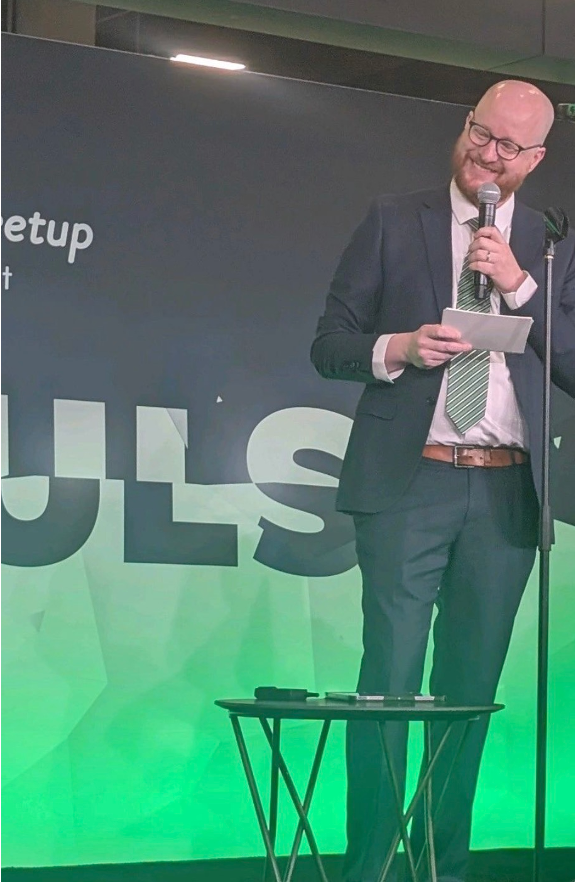
I had the honor of hosting a very special session at Fintech Meetup this year: Fintech Feud - the gameshow. Hence the suit: |
For our game, we pitted two teams — Team Bank and Team Fintech — against each other, forcing them to guess the most popular answers to a series of survey questions about consumers’ financial habits and goals.
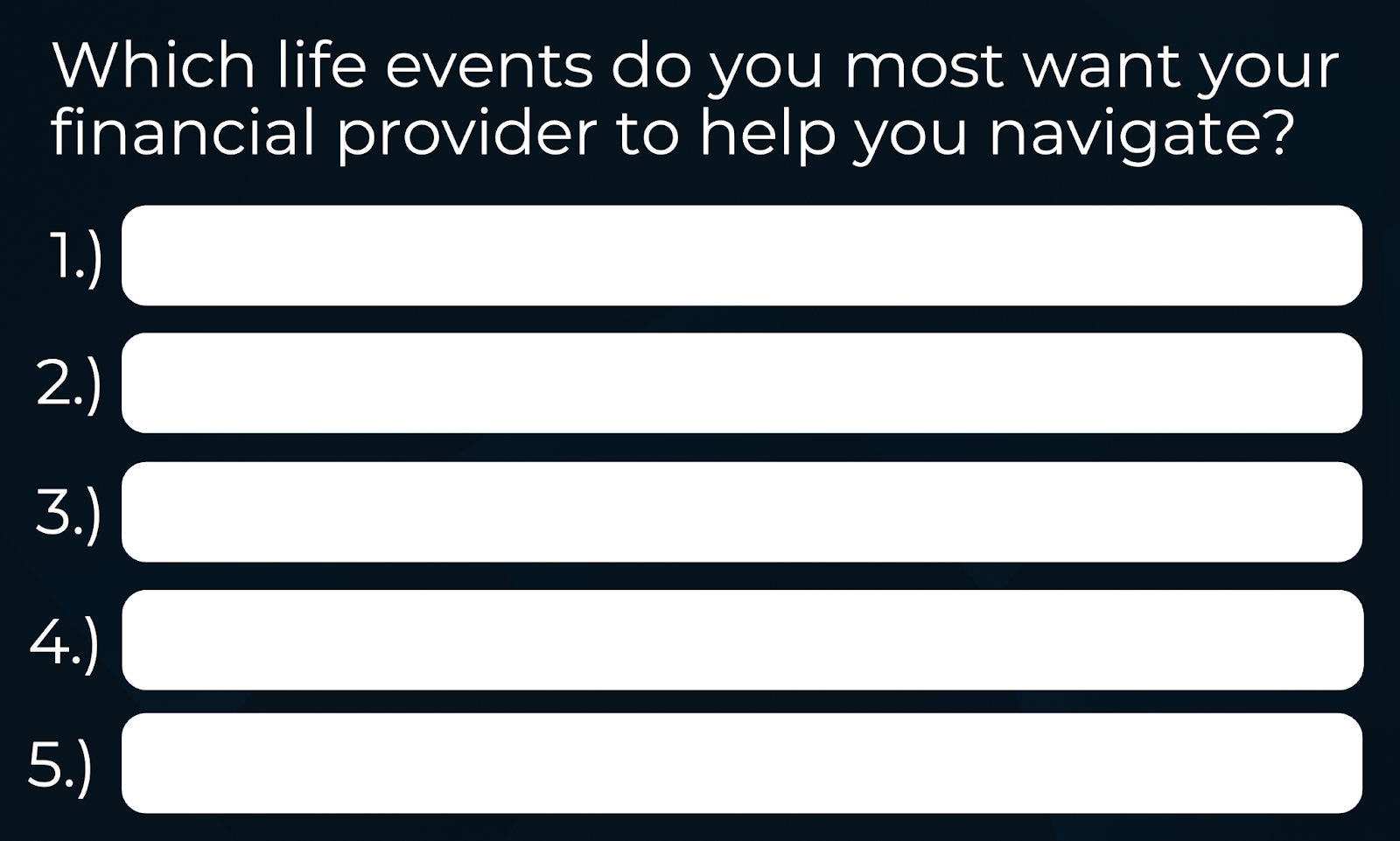
Our goals were A.) to have fun and B.) to discover whether bankers or fintech folks were better able to guess the most popular responses to consumer survey questions like this one: |
(If you missed the session, but you’d like to play along, hit reply to this email and give me your guesses for the five most popular answers to this question. Winner gets a sweet piece of Fintech Takes merch!)
In a surprising twist, Team Bank won the contest in a landslide. Congratulations to Tyler Seydel and Missy Stewart! |
I am probably just trying to wish this into existence, but whatever. Here’s a prediction: 2027 will mark the death of Las Vegas as the capital of U.S. fintech events.
Money20/20 will be held at The Venetian this fall. Fintech Meetup in 2027 will, from what I hear, be located at The Venetian as well. But after that? It’ll be chaos!
Money20/20 is planning to move to the Las Vegas convention center in 2027, which is an absolutely insane plan that will, I predict, lead to the show losing its grip on its status as THE event that everyone feels the need to attend.
And once that spell is broken, I think we will see a diaspora of fintech events in 2028 and 2029, across a range of U.S. cities that are far more deserving than Las Vegas to play host to this wonderful industry.
Here’s hoping! |
|
|
MORE QUESTIONS TO PONDER TOGETHER |
Big news for the endlessly curious (yes, you): I’m collecting your fintech questions on a rolling basis.
What’s keeping you up at night? What great mysteries in financial services beg to be unraveled? Think of it this way, if a stranger is a friend you just haven't met yet, your question is a Fintech Takes conversation waiting to happen.
One that could headline a Friday newsletter or be answered in an upcoming Fintech Office Hours event.
Drop your question here, whenever inspiration strikes! |
|
|
There are many fun events — virtual and in-person — coming up in the next few months. Here’s where I’ll be! |
This will be my first B3! It’s hosted by the Bank of North Dakota, and I could not be more excited to visit Fargo! |
There's an exhaustion that comes from trying to make good decisions in a market that won't sit still. Rates moving in ways that are hard to predict. Credit tightening. AI quietly (and not so quietly) displacing income across nearly every industry. And all of it landing on the desk of anyone who has to say yes or no to a loan.
The temptation is to wait it out. But I keep coming back to the same uncomfortable truth: the fog might just be the forecast now.
So instead of waiting, I want to dig in. I'm hosting a virtual event with TruStage™ where we'll look at how lenders are rethinking risk, and how borrowers are responding on the other side of the table. And most importantly: what frameworks actually help when you have to act without certainty. Save your spot. |
Kiah Haslett and I are going to be hosting an event with the marvelous folks at Team8 during New York Fintech Week. It’s about AI and how it is changing banks’ build, buy, and partner decisions. Great topic. Great venue. Space is limited, but let me know if you’re interested! |
There’s also going to be basketball at New York Fintech Week! Come hoop with us! |
Talk about a great topic and a great venue. We’ll be talking about bank - fintech partnerships at a ranch in the mountains in northern Montana. In June. Fuck yes. Space is very limited, but let me know if you apply, and I’ll put in a good word!
|
🎥 Bonus: Cash Flow Lending* (by me, with Collin Galster at Nova Credit and Michael Krzysko at Imprint) |
"It's on the roadmap" isn't the same as being on the adoption curve. Collin Galster (Nova Credit) and Michael Krzysko (Imprint) joined me to explore what separates lenders who are compounding capabilities from those still waiting to begin. Replay is live.
*this rec is brought to you by one of our fantastic brand partners |
|
|
Thanks for the read! Let me know what you thought by replying back to this email.
— Alex |
|
|
{if !profile.vars.fintech_takes_user_fitness && profile.vars.fintech_takes_user_fitness != false}Join 2,444 other finance and fintech leaders in the Fintech Takes Network
|
|
|
{/if}{if profile.vars.fintech_takes_user_fitness == true}The conversation doesn't have to stop here
Keep learning and connecting in the Fintech Takes Network
EVENTS | FEED | LIBRARY | DIRECTORY
|
|
|
{/if}Get your brand in front of 61,900+ fintech and banking executives. |
Workweek Media Inc.
1023 Springdale Road, STE 9E
Austin, TX 78721
Want to ruin my day? Unsubscribe. |
|
|
|