Another Jensen-ism is that “AI won't take your job. But someone who understands how to use AI will".
He often talks about his own career to make the case.
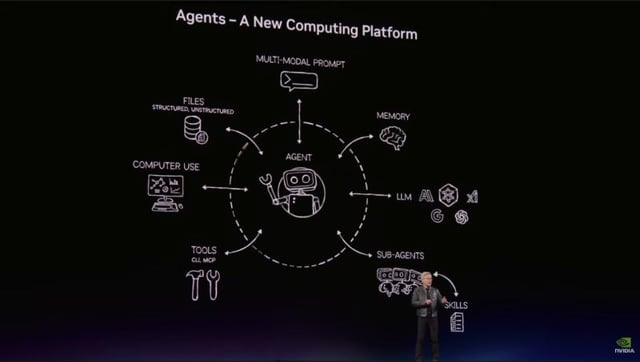
Jensen has 60 direct reports. He says all of them are smarter than him. But he’s the orchestrator. Intelligence isn’t the only (nor, the deciding) variable for the success of Nvidia. In his eyes, everyone can be the “CEO” of AI agents.
That’s a more positive vision of the future.
Anthropic co-founder and Head of Policy Jack Clark was recently on the Plain English podcast and Derek Thompson asked him why Dario frequently gives the alarmist takes.
It’s been a clear turn off for the public and an 80,000-person survey by the startup found that developed Western markets were more concerned about AI than the rest of the world:
Globally, 67% of interviewees expressed net positive sentiment toward AI. Clear trends emerged in which people in South America, Africa, and much of Asia view AI with more optimism than those in Europe or the United States.
When asked about concerns, respondents from Sub-Saharan Africa (18%), Central Asia (17%), and South Asia (17%) were the most likely to say they had none—roughly double the rate in North America (8%), Oceania (8%), and Western Europe (9%).
One theory is that more developed Western markets have slower growth, which puts the population in a zero-sum mindset. Instead of growing the pie, people are trying to split it.
With that context, telling everyone that your tech will replace their jobs and drink their milkshake is an INTERESTING SALES PITCH!
Clark’s defense is that Anthropic doesn’t want to be overly-panglossian about AI. It can do tremendous good but also very very bad stuff.
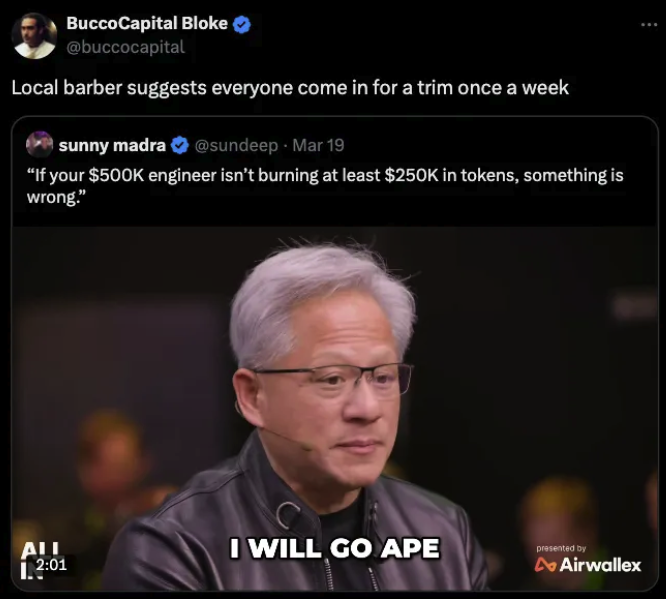
Is Jensen’s approach too positive? Honestly, it seems measured (even with the occasional “local barber says you need a trim once a week” pitch).
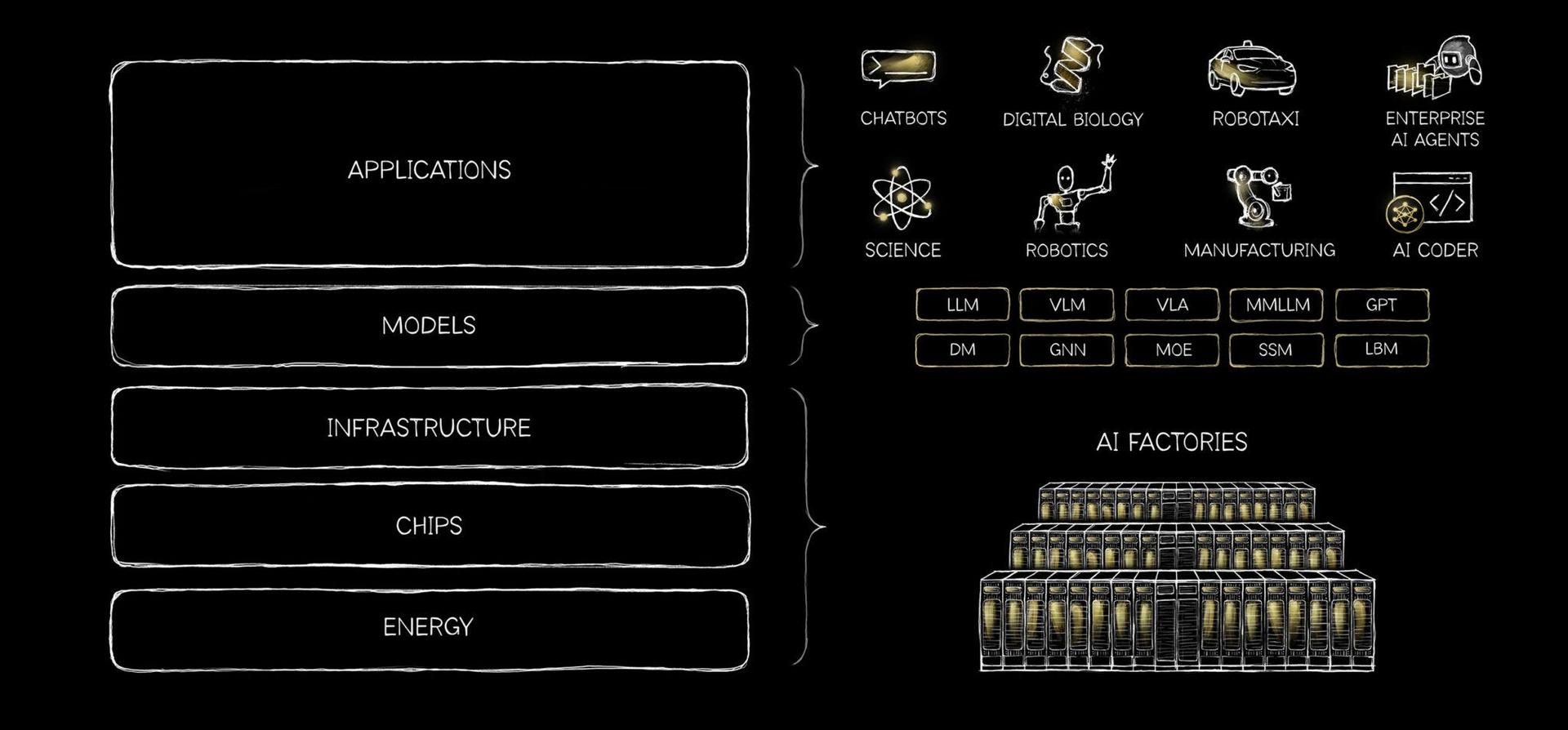
Aside from the public messaging, Jensen is also having a bunch of C-suite negotiations that we don’t see. He’s trying to convince the brass up and down the ecosystem (ASML, TSMC, Caterpillar, Big Tech, GE Verona etc.) to put up multi-multi-billion dollar in CAPEX for the world he sees coming.
How much manifesting is going on there?
Jensen gives Lex one salient example. A few years ago, he told the world’s leading memory chip manufacturers to expand one type of product (HBM, high-bandwidth memory).
He doesn’t name check them but it’s obviously Micron, Samsung and SK Hynix…which were three of the top-performing stocks last year (which, surprise, I completely whiffed on by not investing).
Jensen explains:
If you look at the CEOs of the DRAM industry — about three years ago — I was able to convince several of them that even though HBM memory was still used pretty scarcely at the time (mostly in supercomputers), it was going to become a mainstream memory for data centers in the future.
At first, that sounded ridiculous. But several of the CEOs believed me and decided to invest in building HBM memory.
Another type of memory that seemed odd to put into a data center was the low-power memory we use for cell phones. We wanted them to adapt that for supercomputers and the data center. Their reaction was basically: “Cell phone memory for supercomputers?”
I explained why. Look at these memories — LPDDR5, HBM4. The volumes are so incredible. All of them had record years and these are 45-year-old companies.
So that’s part of my job: to inform, to shape, to inspire.
There’s a Steve Jobs story with the first iPhone that has similar energy about manifesting the future with a supply chain vendor.
In Apple’s case, Jobs had to convince Corning to commercialize Gorilla Glass for the first iPhone (an earlier prototype of the iPhone had a plastic screen that kept getting scratched).
Brian Merchant relays the story in his book “The One Device” (my write-up on the book here):
[In 2005, Jobs met Corning CEO Wendel Weeks and told him] he doubted Gorilla Glass was good enough, and began explaining to the CEO of the nation’s top glass company how glass was made.
“Can you shut up,” Weeks interrupted him, “and let me teach you some science?”
Jobs was sold, and, recovering his Jobsian flair, ordered as much as Corning could make — in a matter of months. “We don’t have the capacity,” Weeks replied. “None of our plants make the glass now.” He protested that it would be impossible to get the order scaled up in time.
“Don’t be afraid,” Jobs replied. “Get your mind around it. You can do it.”
According to [Walter Isaacson’s biography on Jobs], Weeks shook his head in astonishment as he recounted the story. “We did it in under six months,” he said. “We produced a glass that had never been made.”
Man, this story just hits all the notes of the Jobs mythology:
- Total self-assurance (mixed with douchebaggery): “he…began explaining to the CEO of the nation’s top glass company how glass was made” (LOL)
- Visionary: Jobs was willing to change his mind if convinced and — after being taught some science — he saw the potential of Gorilla Glass.
- Reality distortion field: “Don’t be afraid…get your mind around it, you can do it.”
On the last point, Jobs’ reality distortion field clearly has parallels to Jensen manifesting reality.
So, what’s Jensen trying to manifest next?
Nvidia did $200B+ in sales last year and Jensen says there is $1T in backorder for Nvidia chips and racks over the next two years.
Jensen tells Lex that he believes Nvidia could still see material revenue increase on the continued rise of AI agents and integration across every industry...hopefully with major breakthroughs in healthcare, energy, science (NOT INVESTMENT ADVICE):
There’s nothing that I see that says $3 trillion is not possible. The burden is shared by 200 companies [in the supply chain]. The fact is that we scale out on the backs of the ecosystem.
The question is: do we have the energy to do so? Surely, we will have the energy to do so…that number is just a number.
Almost everything that I [am forecasting for the future token demand] doesn’t exist. That’s the part that is hard. If Nvidia was a $10 billion company trying to take market share, then it is easy to see for shareholders: “Oh, Nvidia could just take 10% share, they could be this much larger.”
But it’s hard for people to imagine how large we could be because there’s nobody I could take share from [note: Jensen often calls these yet to exist opportunities “$0 Billion Dollar” markets].
So I think that that is one of the challenges: the world’s imagination of the future.
That’s why his process of reasoning then manifesting a vision for different types of sick leather designer jackets AI token usage is as important as the new products at GTC.