Hi Marketing Bestie, I took Ari to the Miami Open for her bday. JK I would never. It's for me. LOL. | Was this email forwarded to you? |
|
|
5 WAYS TO BOOST CONVERSIONS WITHOUT INCREASING AD SPEND |
Bas Wouters founded Online Influence Institute. Wrote the book "Online Influence."
Got trained by the legends: Daniel Kahneman (Nobel Prize winner), Robert Cialdini, BJ Fogg.Companies like Disney, Booking.com, and Airbnb pay him massive money to apply behavioral psychology to their marketing.
He increases conversions without increasing ad spend.How? He optimizes something a lot marketers completely ignore: How the brain actually makes decisions.
And right now, he's giving away free optimization plans. You submit your site, he analyzes it, shows you where conversions are leaking, gives you the top 5 fixes with copy rewrites and UX improvements. Completely free. (Normally companies pay him thousands for this.) Here's what happens when conversions drop: You increase ad spend. Or optimize the campaign. Or tweak the creative. Or adjust the targeting.What you DON'T do: Optimize the actual decision-making process in people's brains.And that's where all the money is hiding.
Listen to the full episode here where Bas breaks down why "100+ customers" kills your conversion, how B2B buyers are just as irrational as B2C, and why specificity is the secret weapon you're not using. |
1️⃣. Start Optimizing How The Brain Makes Decisions. |
Bas's Take: "Most marketers, if they need more results... The instinctual action is increase your ad spend. Or we're going to optimize something, but then they optimize the campaign or they optimize the creative or maybe even the ICP... What they never optimize is how the brain actually makes decisions." When conversions are down, the playbook goes: Increase ad spend. Optimize the campaign. Tweak the creative or targeting. What gets skipped: The DECISION-MAKING process itself.
That's the opportunity.You can spend $100K more on ads. Or you can understand how people's brains actually work and rewrite your messaging to match that. Same traffic. Better conversions.
Bas works with massive companies. Disney. Booking.com. Airbnb. They don't always need MORE traffic. They need better messaging that aligns with how humans actually decide.
Because here's the reality: Your rational feature list doesn't move people. Your logical arguments don't convert. Your specs don't matter if you're not triggering the right psychological shortcuts.
Decisions happen FAST. Based on shortcuts. "This looks expensive, must be good." "Everyone's using it, I should too." "This person is an authority, I trust them."Your job: Design messages that trigger those shortcuts.
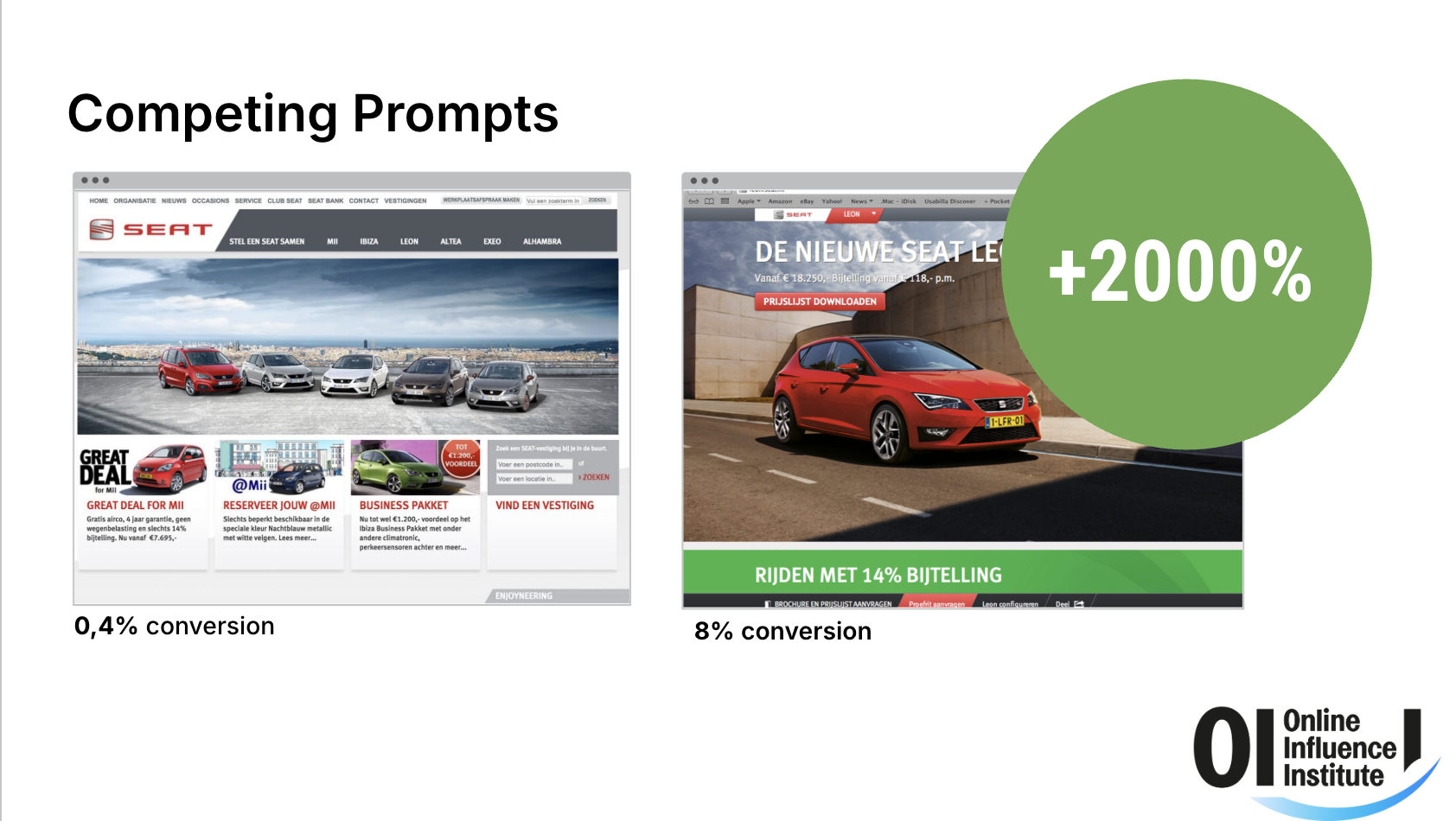
PROOF: SEAT increased conversions from 0.4% to 8% (+2000%) by changing their homepage from generic car lineup to a single compelling offer with clear behavioral triggers. |
Takeaway: Before increasing your ad budget, audit your conversion funnel for psychological triggers. Are you using social proof (specific numbers, not "100+")? Authority markers (credentials, media mentions)? Scarcity (actual limited spots, not fake urgency)? Specificity (exact details, not round numbers)? Rewrite 1 key page using behavioral psychology principles. Test it against your current version. If it wins, you just found free money without touching ad spend. |
2️⃣. "100+ Customers" Kills Your Conversion. Use Specificity Instead. |
Bas's Take: "If I say we have 100 plus customers... your system one says, hmm, this smells fishy. You're putting a hundred, you could have rounded up. You could have been telling a lie here... They already made the decision that that's danger and I'm going to leave."
This 1 blew my mind. And it should blow yours too.
When you say "100+ customers," your logical brain thinks that's fine. It's not lying. It's accurate.
But the emotional brain (the 1 ACTUALLY making the decision) goes: "Wait. Why didn't they say the exact number? Are they hiding something? Did they round up from 3?"
The brain fills in gaps. Usually negatively.
"100+" becomes "probably like 3 people bought this and they're lying to me."
Boom. They bounce. Before your logical arguments even get a chance.
Specificity signals honesty. "127 customers" feels REAL. "100+" feels like marketing BS.
Same principle everywhere: "$1,497" beats "$1,500." "Join 3,847 subscribers" beats "Join thousands." "Published 23 case studies" beats "Published 20+ case studies."
The more specific, the more believable. The more believable, the higher the conversion.
This isn't about being pedantic. It's about understanding that ROUND numbers trigger suspicion. Specific numbers trigger trust
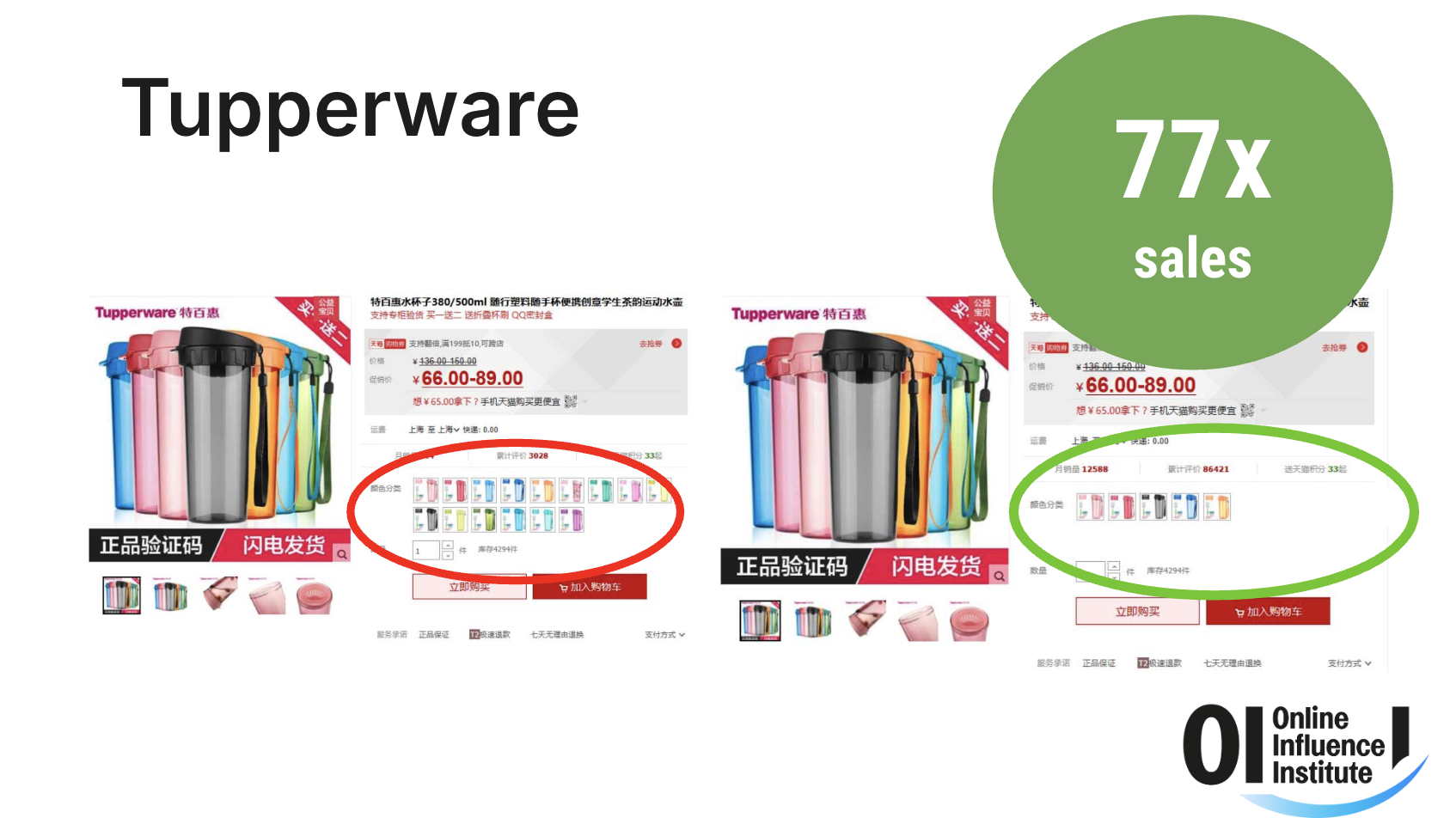
PROOF: Tupperware tested color options on their product page. BEFORE showed all color variations at once. AFTER showed only 5 specific popular colors. Result: 77x sales increase. |
Takeaway: Search your website for any round numbers or "+" symbols. "100+ customers" ➡️ "127 customers." "$5,000 saved" ➡️ "$4,847 saved." "20+ features" ➡️ "23 features." "Founded 10 years ago" ➡️ "Founded in 2015." Make every number as specific as possible. This signals authenticity and honesty to the emotional brain, which makes the actual buying decision. Test this on your most important pages first. |
3️⃣. B2B Buyers Make Emotional Decisions Too. Then Justify With Logic. |
Bas's Take: "In B2B, the world works completely different because we really make big decisions and therefore we use system two. I would argue against that... You need to lease 1000 new cars... you collect all the facts, they're almost always almost similar. Then the decision trigger... is, well, I like that guy at the BMW dealer or my CEO tells me he likes BMW." The B2B myth: Big purchases. Long cycles. Committees. Surely THAT'S logical decision-making.
Wrong. Bas's example: Leasing 1,000 cars for executives. BMW vs Audi vs Mercedes. You spend MONTHS collecting specs, pricing, features. Everything's similar. What tips the decision? "I like the BMW dealer guy." Or "My CEO prefers BMW." Emotional. Then you backfill with logic. My example: You KNOW a Honda is financially smarter. But your neighbors drive BMWs and Audis. You don't want to be the odd 1 out. So you buy the BMW. THEN justify it with "better resale value" or whatever. Same with baby products. I saw an influencer using certain utensils. Emotional brain: "I want those." Then rational brain checks: "Okay are they BPA-free? Safe?" If yes, I buy. But the influencer triggered the decision. The mistake: B2B marketers create purely rational messaging. Feature lists. Spec sheets. ROI calculators.
But the decision still happens emotionally. Then gets justified logically.
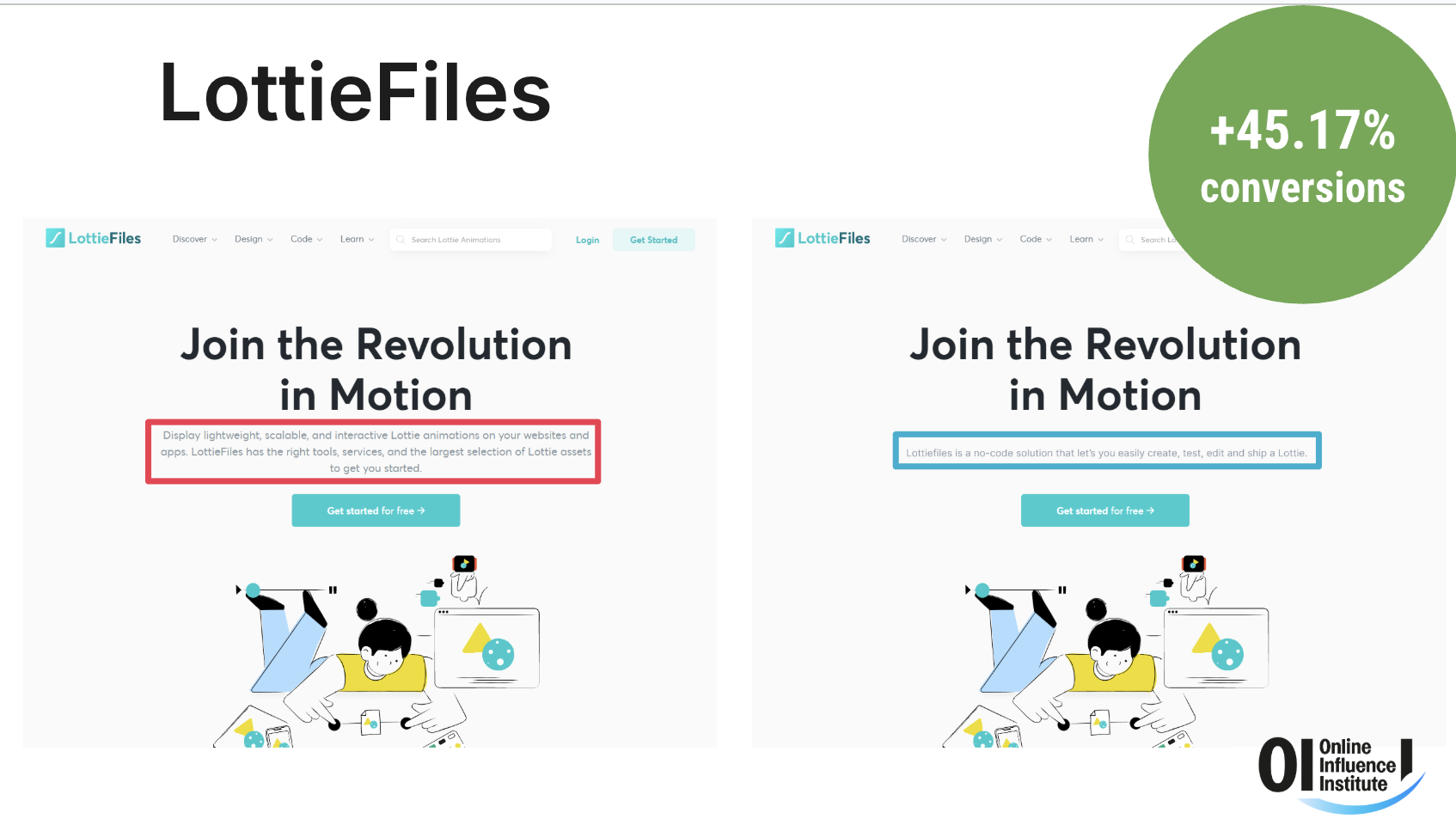
PROOF: LottieFiles changed their homepage copy from feature-focused ("Display lightweight, scalable, and interactive Lottie animations...") to benefit-focused ("Lottiefiles is a no-code solution that let's you easily create, test, edit and ship a Lottie"). Result: +45.17% conversions. |
Takeaway: Even in B2B, lead with emotional triggers FIRST. Authority (who else uses this). Social proof (what results they got). Status (be like these successful companies). THEN provide the rational backup (ROI, features, specs) so they can justify the decision they already made emotionally. Test emotional headlines vs rational ones on your B2B landing pages. "Join 847 companies growing 40% faster" beats "Our platform has 23 features for optimization."
|
4️⃣. Don't Let The Emotional Brain Reject You Before Logic Gets A Chance. |
Bas's Take: "Don't let system one screw you before you even get to the logic to help them sell... People are just saying, wait, they're lying to me. I'm bouncing. I'm going to find someone who has more examples than them."
Here's what happens: You put "100+ customers" on your page. Emotional brain gets suspicious. Visitor bounces. They never even SEE your amazing features. Your compelling case studies. Your perfect solution.
Because the emotional brain rejected you FIRST. Before logic got a chance.
This happens everywhere: Vague claims ("industry-leading"). Stock photos that look fake. Testimonials without names. Round numbers. Generic copy.
All of these trigger suspicion in the emotional brain. And once that happens, game over. They're not reading your carefully crafted value prop. They're already gone. The fix: Remove EVERYTHING that triggers suspicion. Add EVERYTHING that builds trust.
Specificity builds trust. Real photos build trust. Named testimonials build trust. Exact numbers build trust. Authentic language builds trust.
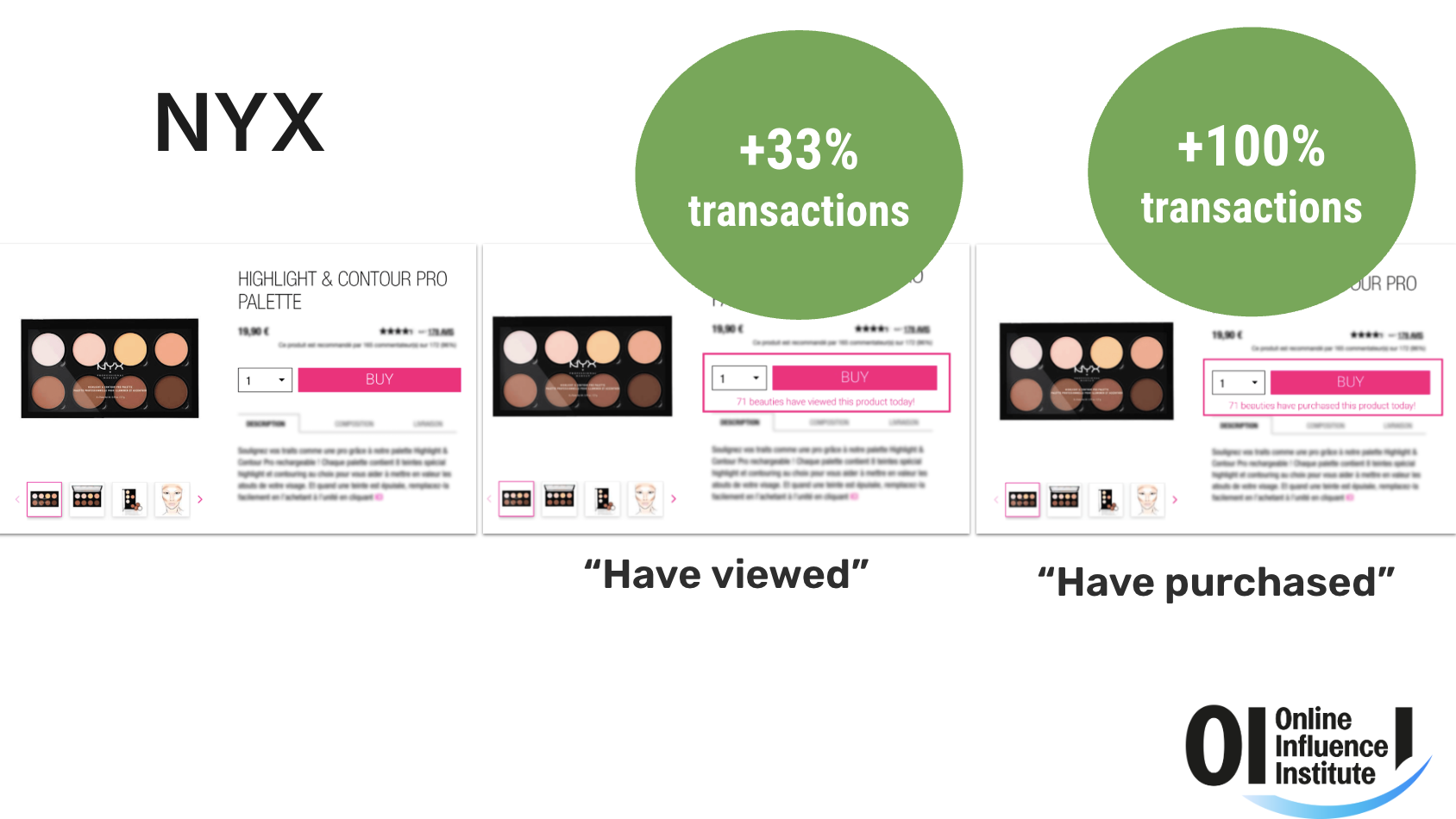
You need the emotional brain to ACCEPT you. THEN the rational brain can process your logical arguments. But you can't skip step 1. PROOF: NYX Cosmetics tested social proof language. "71 beauties have VIEWED this product today" = +33% transactions. "71 beauties have PURCHASED this product today" = +100% transactions. Past tense action beats passive observation. |
Takeaway: Do a "trust audit" of your landing page. Screenshot it. Show it to someone who doesn't know your company. Ask: "What makes you suspicious?" They'll point out round numbers, vague claims, stock photos, no social proof. Fix those FIRST before optimizing anything else. Add: Specific numbers, real photos, named testimonials, exact metrics, authentic language. These build trust with the emotional brain, which lets logic actually work.
|
5️⃣. Behavioral Science Is Your Foundation. Not Your Add-On. |
Bas's Take: "I would say that's like the fundamental layer of a house, like building a house with a foundation is behavioral science... You don't have to increase ad spend before you do the... start with improving the optimizing the mind. And then you could, once you learn that, you could do that in all parts of your funnel." Behavioral psychology gets treated like a "nice to have." A sprinkle of social proof here. A scarcity timer there.
Bas treats it like the FOUNDATION. The thing you build everything else on. Because once you understand how decisions actually get made, you can apply it EVERYWHERE. Your ads. Your landing pages. Your emails. Your product pages. Your checkout flow. Your onboarding. Your pricing page.
Every single touchpoint is an opportunity to align with how the brain works instead of fighting against it. And the ROI is insane. Because you're not spending MORE. You're converting BETTER. Bas works with companies paying him massive fees. But he's giving away free optimization plans because he knows once people SEE the results, they're hooked. Small changes. Big outcomes. That's the power of understanding the brain. Takeaway: Don't treat behavioral psychology as a tactic to "test sometime." Make it your foundation. Start with 1 page (probably your highest-traffic landing page). Apply every principle: Specificity, social proof with exact numbers, authority markers, scarcity (real, not fake), reciprocity, consistency. Test it against your current page. When it wins (it will), roll those principles out across your entire funnel. Ads, emails, checkout, onboarding, everything. This compounds. 1 change leads to 10 more opportunities.
|
|
|
Hear that? It’s the sound of an open bar on a beach in Miami. And it’s calling your name. Join me at Soho Beach House — the coolest, chillest bar you’ve ever seen — for happy hour on Tues, April 28. Senior Marketers looking for a place to escape the conference chaos at POSSIBLE, rsvp here. |
|
|
I hope Ari isn't reading this far because I am so glad bday month is almost over. 😉 Don't share this newsletter with Ari please. Your friend, Daniel |
|
|
{if !profile.vars.marketingland_user_fitness && profile.vars.marketingland_user_fitness != false}Join 7,390 other marketing leaders in Marketingland |
|
|
{/if}{if profile.vars.marketingland_user_fitness == true}{/if}Get your brand in front of 127,222 marketing leaders. |
Workweek Media Inc.
1023 Springdale Road, STE 9E
Austin, TX 78721
Want to ruin my day? Unsubscribe. |
|
|
|