Hello! Kiah here. Welcome to Fintech Takes Banking, my weekly newsletter where I highlight things I think are interesting or important for bankers and the surrounding environs.
Cash flow data in lending — everyone believes in it, not everyone has figured out how to actually sequence the adoption. Alex is hosting a virtual event tomorrow (3/25) that maps out a realistic path forward, from on-us data to full off-us underwriting. Save your spot.
| Was this email forwarded to you? |
|
|
How are consumers feeling about their financial health and outlook?
The latest MX Data Takes spotlight shows that it’s a mixed bag. Consumers are neither thriving nor failing. They feel some stress around economic uncertainty and how to balance short-term needs with long-term dreams, but they’re also optimistic about the outlook and feel like they’ve got agency to achieve it.
The research underlines that consumer financial health is not a fixed state — it’s a hierarchy of needs that build on each other. Understanding how their customers think about their financial health creates opportunities for financial institutions to better support them as they balance stability, progress and long-term aspirations.
|
|
|
How the DIDMCA Debate Dims Dual Banking |
What is the future of the United States’ dual banking system if states take steps to undermine charter parity?
Dual banking is like an invisible force shaping the financial services landscape, like gravity or magnetic attraction. It is extremely important in the scheme of things, but most of the time, I can take its existence as a given. National and state-chartered banks follow the same safety and soundness regulations, so I never thought too much about the difference. Charter parity has flattened the lived, daily realities of dual banking.
That is changing. And so I have spent two newsletters detailing the history, conflicting court cases and unanswered questions stemming from recent legislative efforts to opt out of interest rate exportation for state-chartered banks. These issues are important, but they are also ancillary to the core issue: what does this mean for dual banking?
You see, these efforts strike directly at the principle of dual banking, which is the foundational principle of the United States financial services system. It’s not clear how much this fight will weaken dual banking and what it means for the long-term outlook. But one thing is certain: The interest rate opt-out movement has made dual banking visible — and it has made it vulnerable. |
A Brief History of Dual Banking |
Dual banking is a historic and central concept within the U.S. financial services system that allows both states and the federal government to charter, regulate and supervise financial institutions. “In banking circles, the ‘dual system’ of both national and state banks and national and state agencies regulating banking is an object of almost universal veneration,” wrote Kenneth E. Scott in his 1977 Stanford Law Review article entitled “The Dual Banking System: A Model of Competition in Regulation.”
In the modern era, the state banking charter and the national banking charter had charter parity, thanks to deliberate actions by regulators and lawmakers. When it came to the specific question of interest rates exportation, the Depository Institutions Deregulation and Monetary Control Act of 1980 gave state-chartered banks the ability to use their home state’s interest rate in interstate lending — same as the national banks.
DIDMCA meant that state-chartered institutions and their lending partners unthinkingly operate under the same interest rate exportation regime as their national peers. State-chartered banks could develop a national lending strategy with certainty. They could then present themselves to fintechs, who would only need to figure out which banks could export their interest rate and what that rate was. |
Unless a state opted out. DIDMCA allowed states to opt out of interest rate parity for state-chartered banks, but not for national banks. The rationale some states used in their right to opt out of DIDMCA referred to dual banking: State banks had to abide by their state’s interest rate cap, even when lending to customers outside the state. “The final decision maker for any state bank is the state that chartered the bank,” said John Pitts, vice president for government relations, public policy and social impact at Affirm Holdings. “The functional business understanding of DIDMCA has been that the opt out means a state is opting out its state banks from exporting the state’s interest rates.” Of course, differences in interest rates meant that states that had opted out of DIDMCA often put their banks at a competitive advantage nationally — but that was the state’s prerogative! The cost of control was competition.
This understanding has carried a lot of water for the bank-fintech space as it developed in the last 20 years, and it’s being challenged today by a different way to interpret the DIDMCA opt-out. Iowa has consistently viewed its opt-out as applying to out-of-state banks that need to comply with its interest rate cap, based on two pieces of evidence from 1981 and 2022. Iowa’s interpretation was adopted by Colorado and Oregon, and it was upheld by the 10th Circuit.
“This [debate] isn’t a preemption war between the Office of the Comptroller of the Currency and the state banking agencies,” said Michele Alt, a partner at the consulting firm Klaros who worked at the OCC when there were these types of disputes between the federal government and the states. “It's particular states breaking ranks with other states.”
The implications of this interpretation could be massive. If the 10th Circuit's interpretation holds, legislators in one state could restrict the operations of banks in another state, in the interest of their consumers. And there appears to be interest and momentum across the U.S. to opt out of DIDMCA. Today it’s Iowa, Colorado and Oregon. Rhode Island could be next, depending on current legislation.
“I think the 10th Circuit decision is momentous because it brings to the forefront that states have this right under DIDMCA,” said Todd Phillips, an assistant professor at the J. Mack Robinson College of Business at Georgia State University. “States forget that they have these powers, that these laws are on the books.” |
(State) Bank Versus (National) Banks |
The 10th Circuit interpretation, coupled with opt-out interest from states, could mean state-chartered banks may need to revisit whether this is the right charter for them going forward. Michele pointed out that state-chartered banks in states bordering an opt-out state will need to make sure their lending activities are in compliance if the states don’t share the same interest rate cap.
“I understand the interest in states in preserving the integrity of their interest rate laws, but it puts state banks at a disadvantage, and it makes it undeniably more appealing to have a national bank charter if you're lending,” she said. “It's a lot more operationally complex and expensive to have different compliance schemes for different states.”
If you work at a state-chartered bank — even if you’re not located in a state with no interest rate caps and you’re not currently partnering with a firm that offers loans above caps of 21% and 36% — does thinking about this tire you? Wasn’t it nice following one set of rules and never thinking about interest rate exportation? Is having a national bank charter so different from having a state charter? You can see where this might go.
“Are state chartered banks allowed to compete nationally with federally chartered banks?” John asked. “If the answer is ‘No,’ the harm that is going to show up is going to show up in the business strategies of state-chartered banks. … In a world where you need to comply with 50 states on your credit products, the number of state-chartered banks that are going to be open to doing that collapses.” |
One way to gauge how state banks think about it is through potential future charter flips. Charter flipping is permitted but unusual. My experience is that when it happens, it is usually an institution going from a national charter to a state one, since assessment fees were cheaper, the OCC’s rigorous approach to supervision wasn’t a good fit for some institutions, and the belief that the charter privileges and powers were similar.
“If I was a state-chartered bank with a [banking as a service] partnership, I would be thinking about getting a national bank charter,” Todd said bluntly. “The way it is now, I wouldn't take the risk.”
But he added that changing to a national charter isn’t without risks. In the past, the OCC has been “pretty restrictive” of national banks engaging in high-interest loans. While he doubted the OCC under the current leadership would be restrictive, that isn’t guaranteed if leadership changes. That speaks to one benefit of state supervision: It can be “more insulated” from political shifts that occur in Washington if the party in power changes, said Robert Savoie, a partner at Womble Bond Dickinson. This allows state regulators to “focus on bread-and-butter financial services regulations without being quite so politicized,”
At the same time, Robert added that the states have been “laboratories of democracy,” and can be faster to create different licensing regimes for innovative business models. Todd agreed, pointing out that financial technology companies will continue to be interested in these types of state charters, which include examples such as Georgia’s MALPB charter, Wyoming’s SPDI charter and Connecticut’s Innovation Bank Charter.
|
Did we just witness the end of dual banking? |
There is a slim chance that Congress could settle this debate with legislation. Senators Bernie Moreno (R-Ohio) and Rep. Warren Davidson (R-Ohio) introduced a bill that would clarify that states have the “authority to regulate in-state chartered institutions,” but that “protects interest rate exportation, and promotes competitive parity with national banks.”
But outside of Congress and further court decisions, executives at individual institutions will need to decide for themselves what the right charter is for their strategy and future growth plans. It’s not clear if that approach to supervision is worth the potential disadvantage and uncertainty associated with DIDMCA opt-outs to the 3,000 or so state-chartered banks in the country. Maybe some banks will decide their strategies are unaffected by these caps and keep their state-bank charter. Maybe they flip. (Author aside: Are state-chartered banks even thinking about this, or have their trade groups all focused their attentions on the stablecoin yield fight?)
John argued that one bank charter becoming “demonstrably less valuable” than the other means the end of dual banking. This doesn’t necessarily mean that the U.S. would have only one type of bank charter, or that the number of state bank charters would rapidly collapse. But changing the value proposition of one charter type threatens the very core of dual banking. “The fundamental premise of dual banking is that it does not matter which charter type you have,” he said. “You are an equal entity to the entity that has the other charter.”
Many customers today don’t care where their bank is headquartered when they borrow money. They don’t know what their state’s interest rate cap is because that’s not the interest rate cap that impacts them. That’s by design. And so it’s hard to predict the future of dual banking and the state banking charter in the wake of these three states opting out of DIDMCA, and how worried state banks and state banking agencies should be as a result.
DIDMCA helped make dual banking invisible. By making dual banking invisible, did DIDMA also make it irrelevant? |
|
|
What I’ve been reading, watching and listening to this week: |
🐠 What are The Rich up to now?: Installing giant personal fish tanks that cost a month’s rent to maintain and make their mansions hard to sell, according to this article in The Wall Street Journal. “Rich people real estate” remains one of my favorite subgenres of journalism, and the photos and anecdotes in this article do not disappoint.
🤖 Ruminating on: this newsletter explaining why ATMs didn’t kill bank teller positions, but the iPhone did, and what it tells us about how artificial intelligence. I have heard about this bank teller/ATM relationship before as a parable about transformative technology and automation; it hadn’t occurred to me that the analysis was incomplete because it was frozen in time.
🎙️ On Bank Nerd Corner: Alex and I discuss a few nonbank topics like Kraken’s surprise Fed account and private credit, before discussing why Chase Bank <3 branches.
🛫 Catch me at: CBA Live 2026, March 30-April 1, in San Diego. I’ll be at two events at New York Fintech Week with my friend and coworker Alex Johnson. First up is After Hours: AI in Banking on April 29, in partnership with Team8. I’ll also be talking smack courtside during the Fintech Takes 3v3 Classic on April 30.
|
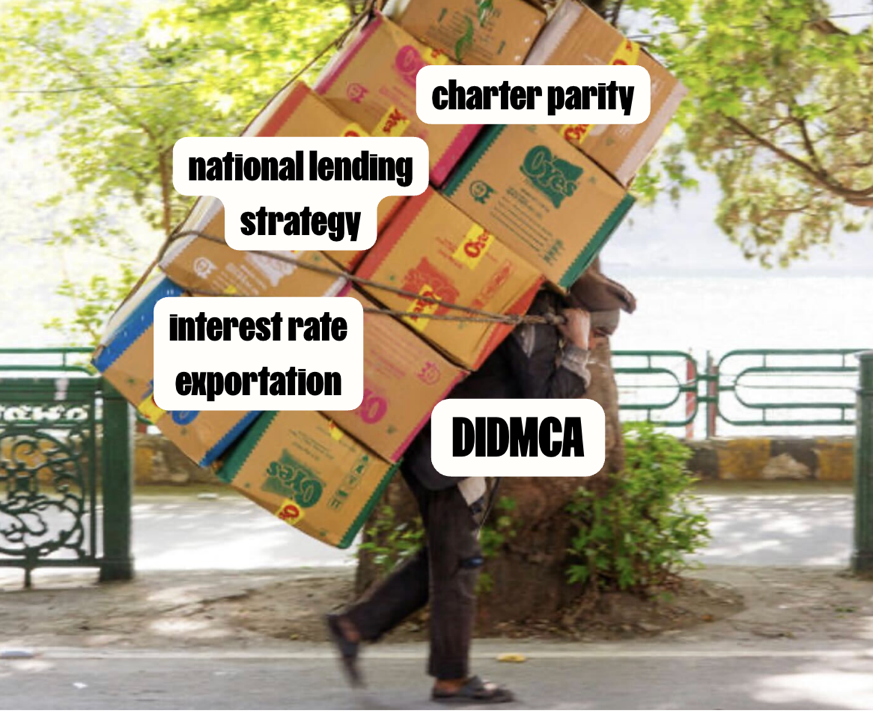
Thanks for reading, and thanks once again to my colleague Claire Monterroyo for the meme. Let me know your thoughts on this piece, which is the final piece from me on DIDMCA for the time being. Thanks for journeying with me through this rabbit hole. 🕳️
– Kiah |
|
|
Get your brand in front of 60,000+ financial services execs. |
Workweek Media Inc.
1023 Springdale Road, STE 9E
Austin, TX 78721
Want to ruin my day? Unsubscribe. |
|
|
|