{if ftt_dorm_120 == true}
Quick favor: Our records indicate that you aren’t opening this email. But records can be wrong. Please click here if you’d like to remain subscribed to Fintech Takes. |
|
|
{/if}Happy Friday, Fintech Takers!
And happy Spring Break (at least to those of you in Montana). I am enjoying some time with my family today, so I’ll be keeping today’s newsletter brief.
While I spent most of my week learning about open banking, my obsession over the last couple of weeks has been prediction markets. So, if you’ll indulge me … - Alex |
Was this email forwarded to you? |
|
|
To be clear, I don’t want to write about prediction markets. They’re not fintech, in the traditional sense.
At their best, they are a useful mechanism for helping researchers and academics forecast future events. At their worst (which is where we are, right now, in March 2026), they are an uncontrolled vector for gambling addiction, insider trading, and corruption.
I don’t want to write about prediction markets, but I have to because prediction markets have embedded themselves into wealth management and banking apps, thanks to reliably amoral companies like Robinhood, Coinbase, and DriveWealth.
This article by Isaac Rose-Berman describes the problem well:
This is best epitomized by Robinhood, the gamified brokerage most popular among young Americans. After initially partnering with Kalshi to offer event contracts, Robinhood acquired its own prediction market exchange last year. Contracts are listed on the home screen, one swipe away from retirement accounts and crypto, promoted more aggressively than any asset that might actually make users money.
To place a bet on DraftKings you have to download a gambling app, create an account, and deposit money: a series of steps that requires you to decide you want to gamble. Millions of Americans haven’t made that decision, and never would. But they already have Robinhood. They already have Schwab. The money is there, the account is open, and the bets are increasingly one tap away from their savings.
As long as this is happening, and as long as fintech founders who should know better continue flirting with prediction markets (Kalshi’s Tarek Mansour and Luana Lopes Lara were recent guests on Stripe’s Cheeky Pint podcast), I will reluctantly continue to learn and write about prediction markets.
A lot has happened in prediction market land over the last couple of weeks, so today felt like a good day to fire off some quick takes. |
If Cash App embeds prediction markets, we riot.
|
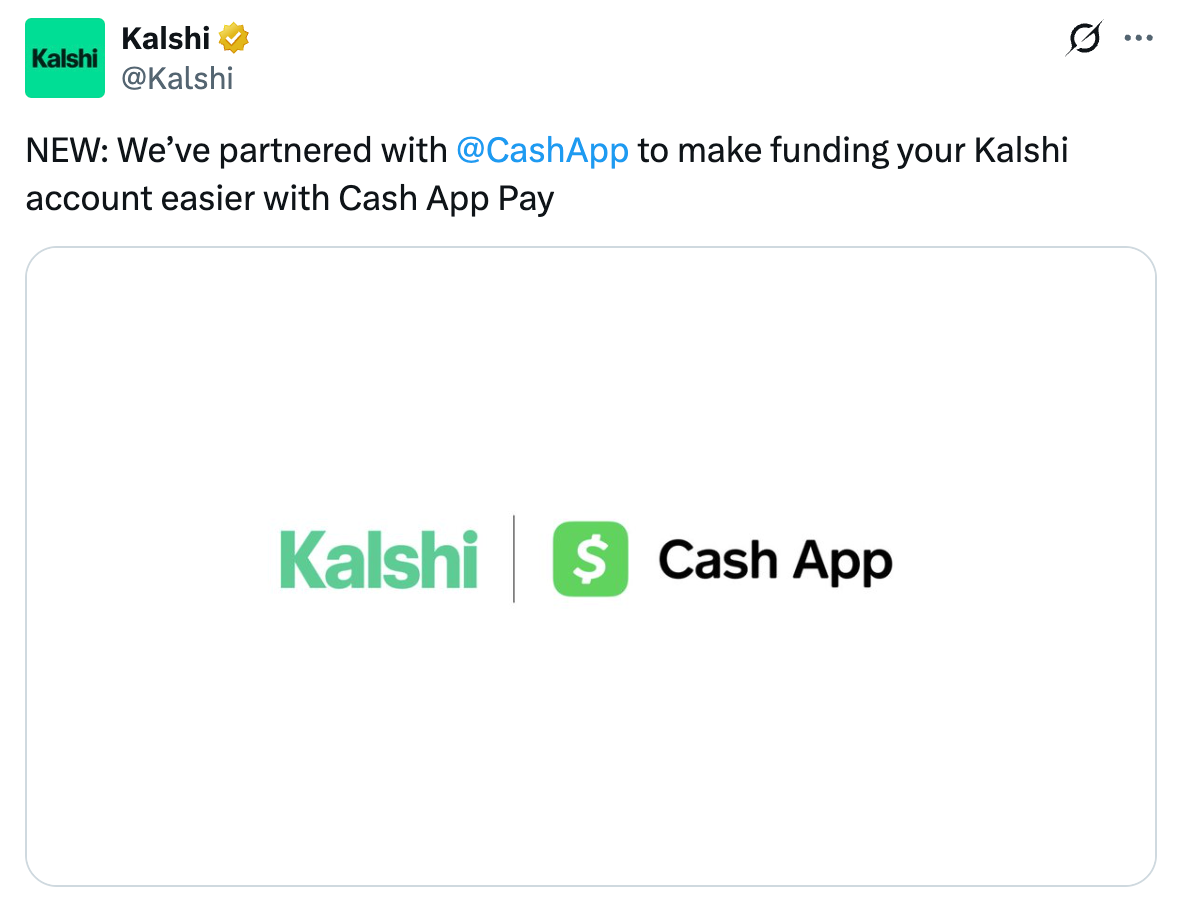
Cash App has partnered with Kalshi so that Cash App users can easily fund their Kalshi accounts with their Cash App balances: |
I’m not a huge fan of this, but, by itself, it’s not a big deal. What is a big deal is what this partnership suggests about what might be coming down the road — Cash App embedding Kalshi-powered prediction market wagers within its app. I cannot stress how bad an idea that would be.
Cash App has always managed to stay on the right side of the line when it comes to embracing financial innovations that present new risks and opportunities for its users. It offers fractional stock investing, but it has never leaned into the memestock mania. It has offered Bitcoin investing for a long time, but it has eschewed memecoins and shitcoins (probably because of Jack Dorsey’s fanatical love of Bitcoin specifically, but whatever, I’ll take it).
With prediction markets, there is no safe place to land.
The event contracts that have actual utility as a way to hedge risk are utterly uninteresting to the average retail user (Can you imagine a 19-year-old investing in a Fed rate decision contract in order to hedge his risk of being unemployed?) They are, therefore, not worth the work and expense to integrate and manage.
And the event contracts that are interesting to the average retail user — sports, pop culture, etc. — are gambling, pure and simple. They have a negative expected value for the vast majority of users (especially when combined together into parlays, or “combinations” as the prediction markets call them). While I hope this goes without saying, Cash App should not be in the business of enabling its customers to gamble. If Cash App embeds prediction markets in its app, we riot. |
How Do Americans Feel About Prediction Markets? |
The American Institute for Boys and Men released the results of a poll that it commissioned to understand how Americans think about prediction markets and the landscape of different gambling options more broadly. The results are fascinating. I’ll be digging into them more in future newsletters and podcasts, but here are a couple of specific findings that jumped out to me: -
Only 21% of Americans say they are very or somewhat familiar with prediction markets, compared with 35% who say the same about online sports betting. While familiarity is higher among men ages 18–24 (29%), it’s still not a huge number. This isn’t surprising. Though the concept of prediction markets isn’t new, the large-scale commercialization of them is. They have a long way to go in building awareness, which is why Klashi just raised $1 billion in funding and is currently offering a $1 billion prize for picking a perfect March Madness bracket (the odds of this hitting are effectively zero, so it’s purely a marketing promotion).
- There’s a very good reason why the American Institute for Boys and Men has made a big investment in sports betting — the use of sports betting services is highly concentrated among young men. In the past six months, 26% of young men reported using at least one sports betting, daily fantasy sports, prediction market, or other gambling platform, compared to 14% of the general public.
-
50% of prediction market users said their top reason for using one of the platforms was entertainment, while 41% said they primarily used prediction markets to make money. For what it’s worth, my observation is that the prediction markets themselves NEVER promote their products as entertainment, but consistently promote them as a way to make money (Tarek Mansour, Co-founder and CEO of Kalshi, recently encouraged users to sign up for the company’s March Madness promotion by saying, “90 minutes left to attempt generational wealth. The odds are not zero. And it's free. You owe it to your grandchildren.”)
-
Event contracts on prediction markets are accurately viewed as closer to gambling than investing by the general public (61% vs. 8%). However, in a disturbing twist, young men were slightly less likely to view event contracts on prediction markets as closer to gambling than investing (47% vs. 10%). This will be an area to watch, especially as prediction markets continue to seep into wealth management and banking apps.
-
A mere 4% of Americans — and 7% of young men — believe prediction markets are good for society. That is only a tick higher than the 3% who believe that online sports betting is good for society. However, interestingly, the percentage of respondents who said that prediction markets were bad for society (38%) was much lower than the percentage of those who think online sports betting was bad for society (52%). There is a large chunk of Americans who think that prediction markets are neither good nor bad (34%) or don’t know (22%). This suggests to me that Americans are open to the prediction markets’ argument that they can provide socially useful signals about future events, but correctly view sports betting as a dangerous diversion from that mission.
|
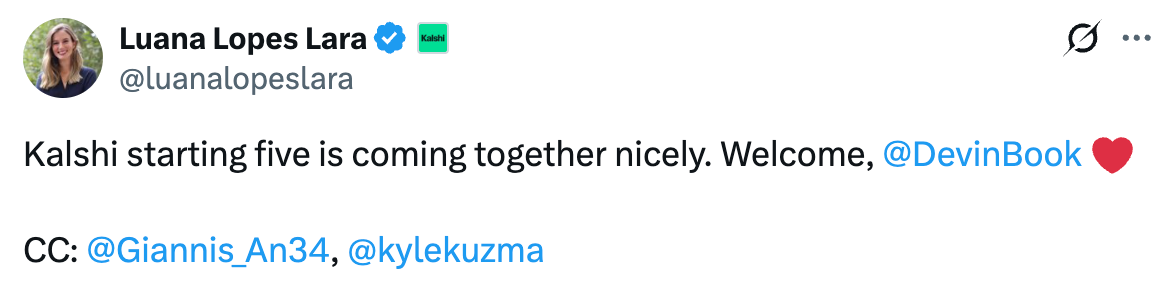
Kalshi is leaning into athlete endorsements as a way to grow brand awareness. Specifically, it has recruited Giannis Antetokounmpo and Kyle Kuzma as investors. The company says that it is trying to compile a “starting five” of NBA spokesmen: |
The company claims Devin Booker as a part of its starting five as well, but that doesn’t work for me because A.) I like Devin Booker, and B.) He’s only a paid endorser of the company, not an investor, so he doesn’t count according to my rules.
Now, you might ask: Who am I to decide what the rules are in this circumstance?
And I would answer by reminding you that I am the world’s leading authority on all fintech/NBA crossover topics, including who gets to be a part of Kalshi’s starting five. The obvious next question: Who should be in Kalshi’s starting five?
Here is your answer: -
Giannis Antetokounmpo. A great player, but it’s not clear how skilled he actually is, given that he mostly just uses his size / funding to push people out of the way. Cultivates an air of uncertainty, even though it drives his fans crazy.
-
Kyle Kuzma. Believes in his heart that he’s the best player in the league, but needs to play with much better players to come anywhere close to winning.
-
Jordan Poole. Has never met a shot / event contract he didn’t like. Annoyingly overconfident and destined to be punched in the face by a teammate.
- Rudy Gobert. Beloved by analytics folks, but almost universally despised by his peers. One of the worst contracts / valuations in the league.
- Malik Beasley. Investigated for illegal gambling and embroiled in a bunch of different lawsuits.
|
Prediction Markets vs. Legacy Media |
Here’s a story that I thought was funny.
Kalshi and Polymarket both offer event contracts on the winners of the Academy Awards, because, you know, we need to be able to hedge the risk that Kylie Cosmetics becomes less valuable because Kylie Jenner will spend all her time consoling Timothee Chalamet if he loses the Oscar to Michael B. Jordan (did I do that right?) Kalshi and Polymarket both accurately predicted the winners of 19 of 24 Academy Awards categories correctly, representing an accuracy rate of 79.17%.
Pretty good!
However, the Hollywood Reporter, a legacy trade publication that chooses to rely on well-sourced reporters and analysts rather than the wisdom of the crowds, predicted 21 of 24 categories right, an 87.5% hit rate.
What? I thought prediction markets always outperformed legacy media companies?!? |
Prediction Markets vs. Journalism |
Here’s a story that is not at all funny. In fact, it’s one of the most disturbing things I’ve ever read.
Emanuel Fabian, The Times of Israel’s military correspondent, recently reported on an Iranian ballistic missile landing just outside the city of Beit Shemesh. After filing his report, he started receiving messages from a number of different people asking him to confirm if it was, indeed, a missile or just a fragment of a missile that had been intercepted.
Fabian confirmed that, according to his sources, it was indeed a missile. But the messages kept coming. At first, they asked him to update the story. Then they started circulating fake messages, supposedly authored by Fabian, saying that he was going to update the story. Then they pressured a journalist colleague of Fabian’s to convince him to change the story. Then they started threatening him and his family. One message read, “You have two choices: either believe that we have the capabilities, and after you make us lose $900,000 we will invest no less than that to finish you. Or end this with money in your pocket, and also earn back the life you had until now.”
Why were the people threatening Fabian going to lose $900,000?
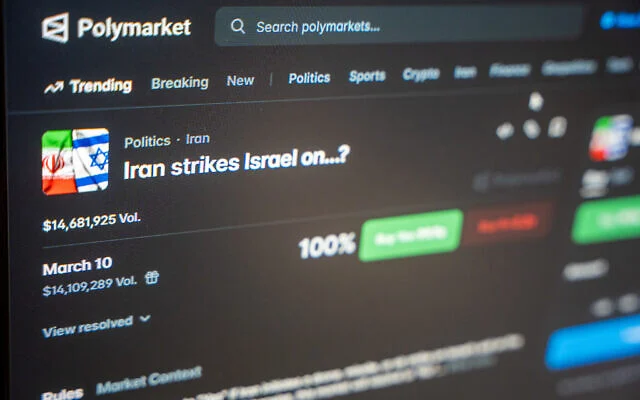
Well, because they had bet “No” on Polymarket for this wager: |
They had bet “no” on whether a missile would hit Israel on March 10, and if Fabian’s story was updated to say a missile fragment had hit, rather than an entire missile, the bet would have been resolved in their favor.
Polymarket currently operates primarily outside of the U.S. (though it seems likely that it is turning a blind eye to U.S. users accessing the service). However, the platform is in the process of returning to the U.S. officially. It is rolling out a regulated, U.S.-based app (currently in beta), and it has entered into partnerships with Intercontinental Exchange, Circle, Dow Jones, Major League Baseball, the National Hockey League, and the Golden Globes, among others. It has raised money from Ribbit, Valor, Point72 Ventures, Dragonfly, General Catalyst, Founders Fund, and Intercontinental Exchange, among others.
If we lived in a civilized time, Polymarket would be permanently banned from ever returning to the U.S., the partners mentioned above would back out immediately, and the investors mentioned above would publicly disown the company and mark their equity down to zero.
But, of course, we don’t live in a civilized time, so we should expect more stories like this in the future. |
One small glimmer of hope — Senator Chris Murphy and Representative Greg Casar just proposed the Banning Event Trading on Sensitive Operations and Federal Functions Act, or the BETS OFF Act.
The Act focuses on restricting large parts of the prediction market industry, particularly markets tied to sensitive, influenceable, or insider-driven events. At its core, the bill would ban “event contracts” on outcomes like military actions, government decisions, terrorism, and other events where participants could plausibly have advance knowledge or direct influence. It also targets markets considered easily “rigged,” including certain political developments and insider-dependent cultural events like awards shows. The broader goal is to prevent insider trading–like dynamics and eliminate financial incentives tied to high-stakes real-world events.
The legislation would go beyond simply banning categories of markets. It would require the CFTC to prohibit these contracts on licensed exchanges, extend enforcement pressure to offshore platforms, and potentially cut off payment processing to noncompliant operators. It also introduces legal risk for U.S.-based individuals involved in operating or promoting restricted markets. Importantly, the bill does not eliminate all prediction markets — it largely preserves those tied to financial, economic, or widely observable outcomes — but it draws a hard line around markets involving government actions or privileged information.
If enacted, the impact would differ across platforms. Polymarket would likely see a more meaningful hit because of its heavy exposure to geopolitics and political-event trading. Kalshi, by contrast, would likely be less affected overall due to its stronger concentration in sports and financial-style contracts, though its politics, culture, and “mentions” markets would face clear risk.
It’s worth noting that many of the contracts that the BETS OFF Act would explicitly make illegal are already effectively illegal due to the way the CFTC has historically interpreted the Commodity Exchange Act (CEA). Specifically, the CEA empowers the CFTC to prohibit contracts that are contrary to the public interest, involve gaming or wagering, or relate to unlawful activity. It has repeatedly interpreted this to exclude markets on things like assassinations, terrorism, or other violent acts.
It’s also worth noting that the chances of the BETS OFF Act becoming a law in the next three years are basically zero because of the Trump Administration’s enthusiastic support of prediction markets and Donald Trump Jr.’s role as an advisor to both Kalshi and Polymarket. |
The CFTC is Starting to Weigh In |
Speaking of the CFTC, the agency recently issued an advisory and an Advanced Notice of Proposed Rulemaking (ANPR) regarding prediction markets. Taken together, they give the impression of an agency that is keen to sand off some of the rough edges that are currently giving the prediction market industry a black eye, while fundamentally preserving the basic structure and profitability of the industry overall.
Sports betting is the wedge issue.
Despite sports betting having little to no social utility, the CFTC does not appear to be entertaining the idea of banning sports event contracts entirely. Instead, the ANPR asks how to distinguish sports from other forms of “gaming,” whether sports competitions should be treated differently from award competitions, and what consumer-protection and integrity measures would make gaming-related event contracts acceptable from a public-interest standpoint. The ANPR asks specifically about manipulation, abusive sales practices, the characteristics of participants in gaming-related markets, and whether “responsible gaming” tools like self-exclusion, monetary or time limits, ad limits, warnings, and disclaimers should matter in the analysis. That framing suggests the agency is seriously considering a framework where at least some sports contracts remain permissible if the right guardrails are in place, rather than assuming they are categorically off-limits.
That impression gets stronger when you read the ANPR alongside the staff advisory, where the CFTC said it wants to “encourage growth and innovation” in prediction markets while reminding exchanges of their legal obligations, and noted that some of the guidance has particular applicability to sports-related event contracts. The ANPR also spends a lot of time on the mechanics of making these markets safer — listing standards, manipulation risk, market surveillance, position limits, resolution disputes, and inside-information controls — which is usually what an agency does when it is trying to regulate a market into a compliant structure, not eliminate it.
Disappointing, but not unexpected. |
If you’re looking for even more content on prediction markets (and the broader rise of gambling and speculation in our culture), might I recommend the following resources: |
|
|
MORE QUESTIONS TO PONDER TOGETHER |
Big news for the endlessly curious (yes, you): I’m collecting your fintech questions on a rolling basis.
What’s keeping you up at night? What great mysteries in financial services beg to be unraveled? Think of it this way, if a stranger is a friend you just haven't met yet, your question is a Fintech Takes conversation waiting to happen.
One that could headline a Friday newsletter or be answered in an upcoming Fintech Office Hours event.
Drop your question here, whenever inspiration strikes! |
|
|
There are many fun events — virtual and in-person — coming up in the next few months. Here’s where I’ll be! |
Every month, I get together with Plus Members of the Fintech Takes Network, and we chat about what’s been happening in fintech. It’s one of my favorite things that we do at Fintech Takes, and guess what? Our March Fintech Office Hours is open to everybody! Come and hang out with us! |
I’ll be speaking with folks from Nova Credit and Imprint about where we are with the integration of cash flow data into lending and where we’re going next. Should be a fun and fascinating discussion. |
This will be a busy one! In addition to meetings, I’ll be speaking at 3-4 sessions? Including as the host of the first-ever Fintech Family Feud gameshow? Are you intrigued? |
This will be my first B3! It’s hosted by the Bank of North Dakota, and I could not be more excited to visit Fargo! |
Kiah Haslett and I are going to be hosting an event with the marvelous folks at Team8 during New York Fintech Week. It’s about AI and how it is changing banks’ build, buy, and partner decisions. Great topic. Great venue. Space is limited, but let me know if you’re interested! |
There’s also going to be basketball at New York Fintech Week! Come hoop with us! |
Talk about a great topic and a great venue. We’ll be talking about bank - fintech partnerships at a ranch in the mountains in northern Montana. In June. Fuck yes. Space is very limited, but let me know if you apply, and I’ll put in a good word! |
|
|
Thanks for the read! Let me know what you thought by replying back to this email.
— Alex |
|
|
{if !profile.vars.fintech_takes_user_fitness && profile.vars.fintech_takes_user_fitness != false}Join 2,444 other finance and fintech leaders in the Fintech Takes Network
|
|
|
{/if}{if profile.vars.fintech_takes_user_fitness == true}The conversation doesn't have to stop here
Keep learning and connecting in the Fintech Takes Network
EVENTS | FEED | LIBRARY | DIRECTORY
|
|
|
{/if}Get your brand in front of 60,000+ fintech and banking executives. |
Workweek Media Inc.
1023 Springdale Road, STE 9E
Austin, TX 78721
Want to ruin my day? Unsubscribe. |
|
|
|