{if profile.vars.event_registration_completed != 'new_member_meetup' && profile.vars.safe_space_subscription_status == 'active' && (time("now") > profile.vars.onboarding_complete_time) && (time("now") < profile.vars.onboarding_complete_time + 604800)}
It looks like you're new to Safe Space. If you haven't yet, make sure to sign up for our New Member Meetup. It’s the best way to find your people, say hello, and get the support you need right from the start.
|
|
|
{/if}
Hi ya party people, Happy Friday, HR girlies and gents!
You survived another week of being everyone's therapist, legal counsel, and office parent simultaneously. Truly, the range. 👏 I’m excited for a little R&B this weekend…reading and bed! I'm currently surrounded by about 50,000 stacks of books, and at this point they're basically load-bearing walls in my home. I REGRET NOTHING. Anyway, we have bigger problems to solve than my lack of book space!
We've got someone trying to figure out if they're actually ready for a director role they'd essentially be inventing from scratch, and we've got someone dealing with employees who interview like absolute rockstars, then spend their remote workdays running two full-time jobs while a mouse wiggler heroically clocks their hours for them. Fun stuff, right???
Let's discuss, and if you have questions of your own to submit, submit them here!
🕌 Eid Mubarak to those celebrating! 🕌 | |
|
{if profile.vars.safe_space_user_fitness == true}
✨ Don't forget: You can always vent, celebrate a win, or find support in Safe Space |
|
|
{/if}{if !profile.vars.safe_space_user_fitness && profile.vars.safe_space_user_fitness != false}
✨ Don't forget: You can always vent, celebrate a win, or find support in Safe Space |
|
|
{/if}{if profile.vars.safe_space_user_fitness == false}
Was this email forwarded to you? |
|
|
{/if}
🤔 promotions & regulations |
|
|
✍🏾 How do you know you're ready for a director role? It would be a new role in our organization, being placed between myself (a manager) and my supervisor (an AVP).
Context: Central HR Department at a public university. I have been the manager of the HR shared services unit for 2+ years, managing a team of 7 HR Generalists. We are rapidly growing in terms of numbers of employees and units we support on campus and believe we need more staff/leadership to continue growth and improve efficiency/processes etc.
|
|
|
📣 Tammi Burnett, Director of People and Culture @ Rainforest Action Network:
I really value direct feedback on my performance, so you might start there. Ask some trusted colleagues for informal (or formal) feedback. Moving into a Director role, you likely already have the HR skills you need. It's the "other stuff" you want to make sure you're versed in now, too. If you haven't done budgeting or finance work, I would advise taking some classes or workshops on those, as well as HR strategy and how to move into thinking more holistically across the organization.
Finally, how good are you at things like boundaries/saying no or not now, advocating for your team while toeing the line, delegating, leading with empathy and candor, staying calm under pressure? I use my HR skills daily, but as a Director, I use my emotional and relational skills 1000x a day more than my HR skills. 📣 Sondra Norris, Founder @ Strategic Culture Partners:
Agree 100% with Tammi Burnett. It’s a new role, which is a great opportunity … and a potential trap of assumptions and unvoiced expectations. So, first of all think about how YOU think this role would help the organization … what’s been missing without this role? Be specific and business outcome oriented … even if the steps in between are more managerial or relationally oriented. From there think about what skills are required to deliver that to the organization (Tammi’s list is a good one) - what do they look like? What do they accomplish? Who are they used with?
Start talking with people who receive HR’s “services and products” - what do THEY imagine/assume would be different? While doing that, find out about what’s going on in their world - become known and credible and interested in their spaces - you may need their vote later. You’ve BEEN a manager, have you MANAGED managers? The problems you solve are different. Your vantage point is different. Director level means broader organizational business perspective and knowledge - seeing how parts fit together (or don’t). It means communicating about different things in different ways, especially upwards. Most moves upward we’re never really “ready” for - it’s all new. The best way to be ready is to embrace your “new-to-this” status - be ready to learn, be ready to prove your competence at this new level all over again.
And - you get to design what the role looks like, the impact it will have … because you’ve been the manager and you’ve experienced the problems that having someone between you and the AVP could have solved: typically slow, bottlenecked decisions; budget battles (make sure the new role has the budget authority that matches the accountability); the bridge between high-level strategic and ground level tactics and operations is that Director role.
Safe Space members can join this discussion here. Not a member yet? Apply to join here.
|
|
|
✍🏾 Are other HR departments dealing with people who use a mouse wiggler and/or are working 2 jobs at the same time. We hire some of these people and they come across as very polished wonderful people and then we discover this other side of them. When we learn about what they are doing and confront them they suddenly know all the laws and rights they have and throw them back at us and become combatant. What can HR do to prevent this and discover this before we actually hire them.
Context: Size of company is 175 employees, manufacturing industry for a DTC CPG product so we have a large marketing department. Most of our employees work remotely except for those in production.
|
|
|
📣 Erin Bennett, Manager of Talent @ Woods Hole Oceanographic Institute:
Hi there - this is a very real challenge for a lot of folks in the post-covid virtual world... I think it's difficult to prevent completely, but there are ways you can approach your interview and selection processes to try and identify some of the risk flags: -
Look for timeline overlaps on resumes: A subtle red flag is unclear employment timelines, for example:
- Multiple “consulting” roles overlapping full-time jobs
- Vague contract work
- Start/end dates missing/overlapping months
* Also dig into any roles that use the title "Consultant," as this can often indicate someone juggling 2+ part or full-time roles
- Use structured availability questions in interviews:
- What does a typical workday look like for you as a fully remote employee?
- How do you structure your day when working cross-functionally with teams?
* People juggling two jobs often reveal: rigid calendar blocking; strict meeting limitations; async-only preferences (this is not proof, but patterns may emerge)
A couple of things you can do upon/after hiring: - Clear employment policy: Include explicit language like:
- Full-time employment requires primary professional commitment
- Outside employment must be disclosed and approved
- Work during scheduled hours must be dedicated to company work. Many companies don’t explicitly state this, which creates gray area.
-
Manager-based accountability (not surveillance): Mouse wigglers exist because companies measure activity instead of outcomes. Better signals are: missed meetings; delayed responses; consistently unavailable during core hours; shallow engagement in collaboration.
For what it's worth - as long as there isn't a COI issue (eg. Recruiting for 2 companies or a fiscal component), if the person is performing well in their role and can successfully "juggle" without it impacting their output, it may not be an issue? I have had folks on many of my teams with "side gigs" and as long as they don't interfere with them getting their job done (or have any sort of COI), I've mostly let it be... 📣 Safe Space Member:
I have only had a few instances come up where a manager believes a direct report is over employed, but whenever it does come up, I encourage managers to focus on performance issues, including availability and work schedule. Whether or not they have another jobs isn't the issue - it's if they are delivering quality work as expected and able to participate fully in their as needed. If they aren't, talk to them about that as a performance issue that needs to be solved, setting clear expectations of what is needed. If the manager thinks they have another job that is impacting performance, I help coach them with trying to figure out if that's true and causing performance issues, but ultimately we're still actually addressing the performance problems.
If you are consistently finding the over employment is causing performance issues in new hires, I would probably look at the reference check process, really digging into feedback from recent roles, and also make sure to set up clear expectations with candidates about things like schedules & availability and performance expectations. I might be in minority here, but in my personal opinion, if someone can manage two jobs at once and still fully deliver for us (as long as there is no conflict of interests), great for them!
📣 Angela Harder, Owner- Fractional HR @ The People Part:
Agree with these takes. Is the issue optics or performance? Being clear about working hours, work assignments, and availability is the focus, what people do in the in-between isn't where our energy should be spent. Also what's the difference between having a side gig and changing laundry, letting the dogs out, having daycare closed during the work day? I think being willing to ask why do we care, over and over again will help you get to the root of the issue, if there is a real one.
Safe Space members can join this discussion here. Not a member yet? Apply to join here.
|
|
|
🎧 You've handed an engagement score to a CEO, watched them completely misread it, then smiled through the pain, right? I chatted with Anne Maltese from Quantum Workplace, who broke down why the questions behind your engagement surveys might be the real problem. Check it out on Spotify or Apple Podcasts!
🏀 Hiring in 2026 is giving March Madness energy: unpredictable, chaotic, and one bad decision away from a first-round exit! This month's HR Therapy is for every People and Talent leader who is done running full-court press with no strategy and wondering why the best candidates keep picking someone else.
💰 Pay Transparency matters (but it's also difficult). That's why I created this course. Join the Safe Space community to access it, plus everything else you need to stay ahead of the curve.
🔍 Is your 2027 benefits strategy built to survive executive scrutiny? Progyny's free planning guide gives HR and benefits leaders 10 executive-level questions to pressure-test whether their strategy is actually delivering...or just looks good until someone starts asking hard questions. Go grab it!*
*This one is brought to you by one of my amazing brand partners
|
|
|
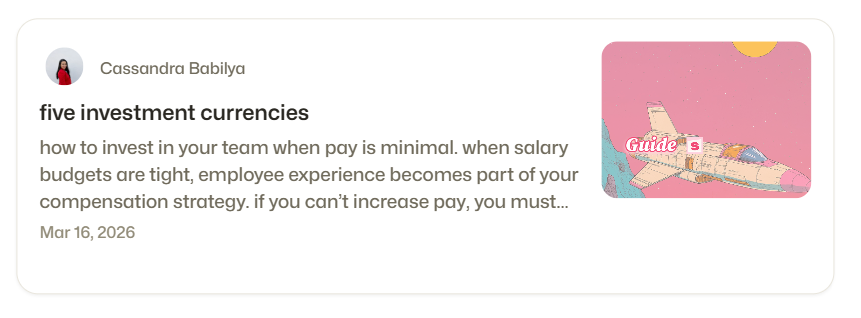
Each week I feature a resource I love from the Safe Space library that I believe would be relatable to this week's newsletter topic.
This week, we’re talking investment alternatives when budgets are tight. Check it out HERE ⬇️
|
|
|
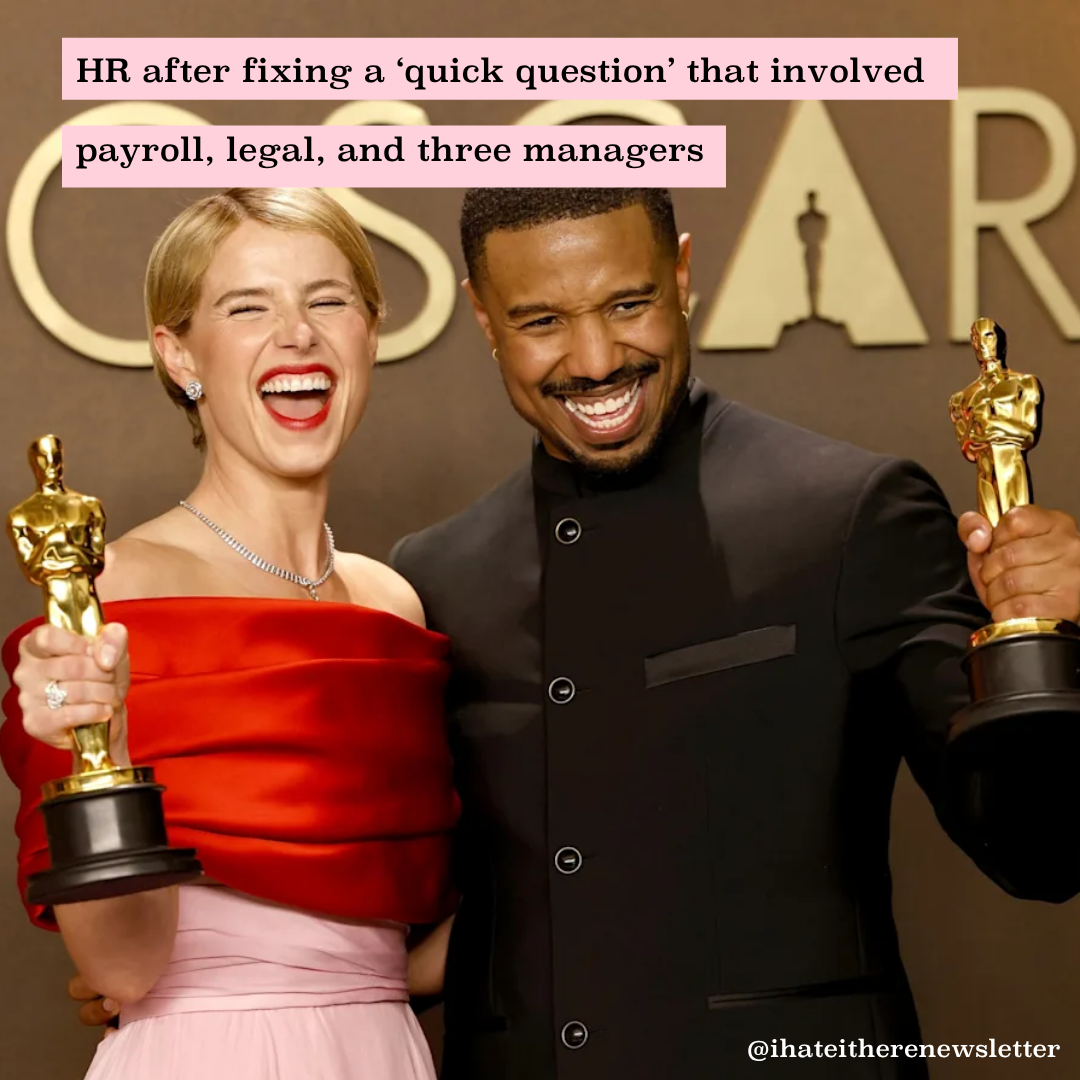
😂 things are rarely ever that simple |
You know how it goes... a quick question turns into tracking down things in 3 systems and then completely rewriting a policy. Been there, dread that. But when it's fixed, it feels like you're flying on CLOUD 9. |
|
|
That's all for this week! I hope you enjoyed! If you have any thoughts, please let me know. I'm allll ears. Reminder: Today is FRIDAY. 🙏 |
|
|
{if !profile.vars.safe_space_user_fitness && profile.vars.safe_space_user_fitness != false}Join 9,787 other HR and People leaders in Safe Space |
|
|
{/if}{if profile.vars.safe_space_user_fitness == true}
The conversation doesn't have to stop here
Keep learning and connecting in Safe Space |
|
|
{/if}Get your brand in front of 167,000+ HR and people operations leaders. |
Workweek Media Inc.
1023 Springdale Road, STE 9E
Austin, TX 78721
Want to ruin my day? Unsubscribe. |
|
|
|