Hey good folks and happy Thursday!
Sorry this one is coming in a day late––but I haven’t missed a weekly newsletter in almost 4 years now. Wild! All right, let’s dive in. |
Was this email forwarded to you? |
|
|
Thought leadership isn’t a content type. It’s a content goal. |
It must happen at every organization. Someone, somewhere, says the words, “thought leadership,” and looks in your direction. As the content lead, the implication is that you –– or if you’re lucky, your team –– will create a “thought leadership” piece of content on whatever the topic is at hand. A knot immediately begins to grow in your stomach.
“Thought leadership” could mean anything. It’s one of those professional phrases people use to sound smart or offer direction, but that has no real definition.
Depending on your company, your boss, your CEO, or simply the day of the week, “thought leadership” could mean: - A ghostwritten piece of content (by you!) under your CEO’s name in Forbes or Entrepreneur.
-
A white paper that needs to be produced by next week, though there is no clear distribution plan in place, so it will likely just sit there for months until another team wants to make use of it.
-
A piece of research conducted on an audience whose data will magically confirm the suspicions of the top executives at your organization.
-
A long-form blog post that ensures your company ranks #1 on whatever the key term is at hand (though, let’s not kid ourselves, it’s probably a new word the company wants to “own” and so there is no real SEO value in it at this point in time).
-
A short-form blog post you also ghostwrite for an executive, likely because the company doesn’t yet have access to Forbes or Entrepreneur, or your company wants to send traffic back to your site and not a media company’s, so, here you are.
- All of above!
I’ve been here. Gosh, I have been here so many times.
I have been that person sitting in the room staring back at the eyes staring at me, expecting me to come up with a genius piece of content right now that can support the untested theory the company wants to solidify in the minds of its audience.
In my experience, what folks usually mean when they request a “thought leadership” piece of content is that there is only one point-of-view presented. And, that it is presented in such a way that the audience immediately grasps it, understands it, and believes it.
This piece of content, they say, will be: - Shared by the sales team with all their leads.
-
Distributed across social media on the company’s owned channels.
- Sent in an email to the company’s customers.
-
Used to drive to a downloadable asset somewhere, and then again included in that asset’s nurture stream.
This “thought leadership” piece of content is the crux of the integrated campaign. And all eyes are on you to make it successful. But here’s the problem:
Never has one single piece of content made anyone think of any organization as a thought leader in their space. That’s because content marketing, at its core, is about trust. |
Done well, content marketing results in thought leadership. |
You cannot create thought leadership in a single piece in the same way you cannot earn someone’s trust in a single conversation.
What earns someone your trust is a pattern of deserving it, which means that over time, you come to learn –– subconsciously or otherwise –– who that person is, what they believe in, and why they care about the things they do. You learn this through their behavior, and come to trust them based on their consistency to the perceived behavior pattern.
This can be easily manipulated, of course. And, each of us can be easily misled. As a result, trust can be easily lost. It’s the human condition. So, too, is it with content. It is why each piece you publish is so important. Not because an individual article will make a huge difference at the start, but because each of them add up to your content’s reputation and expected behavior over time. Subconsciously or otherwise, your audience notices a pattern. That pattern tells them who your company is, what the people who work there believe in, and why the company hired a team to publish content at all.
While each of us is easily misled, while it is rather easy to manipulate intentions and fool someone –– no one person or organization can maintain such behavior for too long before the audience calls you out, disregards you, and no hope of thought leadership can be attained. |
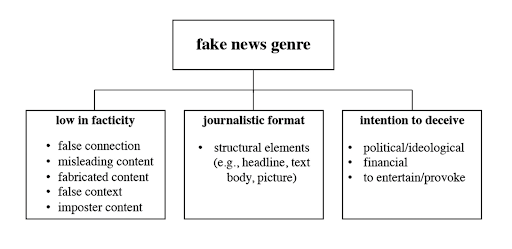
…with news organizations and other types of media. It was never one piece of content that made folks question the intentions of various reporters or specific news organizations (or all of them).
The fake news or renewed yellow journalism perception on the part of readers happened overtime, as our old expectations on who those organizations were, why they published, and what they believed in changed.
“What fake news stands for, however, is something larger than the term itself: a fundamental shift in political and public attitudes to what journalism and news represent and how facts and information may be obtained in a digitalized world.” –– Jana Laura Egelhofer & Sophie Lecheler (2019) Fake news as a two-dimensional phenomenon: a framework and research agenda, Annals of the International Communication Association.
|
It will take media organizations decades to earn back that trust, even as they remove clickbait headlines and discard revenue practices like “branded content” that made so many question their motives. |
Digital literacy and pattern perception |
Content marketing teams and the organizations that hire them have a lot to learn from what has happened to media –– and they better learn fast. Online readers are savvier than ever, and fluent in digital literacy, including digital pattern perception. In fact, consumer trust is at an all-time low:
- 71% of consumers aren't convinced brands will deliver on their promises
- Only 34% think they’re transparent about their commitments and promises.
-
75% of brands could disappear overnight and most people wouldn't care.
- Less than half of brands, 47% to be exact, are seen as trustworthy.
Content can light a brand’s path to customer trust and loyalty, but only if that content consistently explains, educates and adds to the larger conversation. |
Next time: Creating your compass |
How do you create content that is additive on a regular basis? How do you combat the internal forces that want more content production akin to Hubspot’s model as a forcing function to success?
I believe content teams need a compass that outlines their publishing philosophy. - Without such a compass, it is easy for teams to bend to the whims of company demands, ignoring strategy for the sake of getting something live.
- Without such a compass, teams too quickly exchange their audiences’ best interests for ill-conceived campaigns or “thought leadership” one-offs.
In the next issue, I’ll break down what a content compass is, and how to create one for your organization.
This is about setting the foundation for a strong and effective content strategy, one that gives you and your team the power to say no, the ability to properly prioritize, and the results to prove it all made a difference after all. |
|
|
You do you!
One content marketer’s best practices aren’t always right for another one, though I do try to distill out the main concepts and core practices I believe everyone can benefit from. That said, you must use good judgment when deciding whether to take advice given from folks on the internet. I am an expert, and this advice comes from my direct experience, but I am not smarter than you, and I have nothing to gain or lose because of what you do.
|
|
|
THINGS KEEPING ME CONTENT |
| |
Thank you so much for the read! Let me know what you think by replying to this email. Excited to be here with y’all. Tracey |
|
|
Get your brand in front of 8,800+ content marketers and executives. |
Workweek Media Inc.
1023 Springdale Road, STE 9E
Austin, TX 78721
Want to ruin my day? Unsubscribe. |
|
|
|