Surprised to see me in your inbox on a Thursday?! Well, here I am! This is a ✨special edition deep dive✨ of I Hate it Here. Every now and then, you may get one of these from me! 👏
This special edition deep dive is sponsored by The Predictive Index.
What's a deep dive?
Deep dives are opportunities for me to collab with specific companies in the HR/People space on topics of joint interest to them, me, and even you! The sponsoring company provides invaluable input on the topic but this edition itself is written, edited, and published by your fave gal, me! Today, I'm discussing why work has started to feel so hollow for so many people, and what the data is finally confirming about it.
Let's get into it! |
Work Feels Empty, And It’s Not Just You Experiencing It |
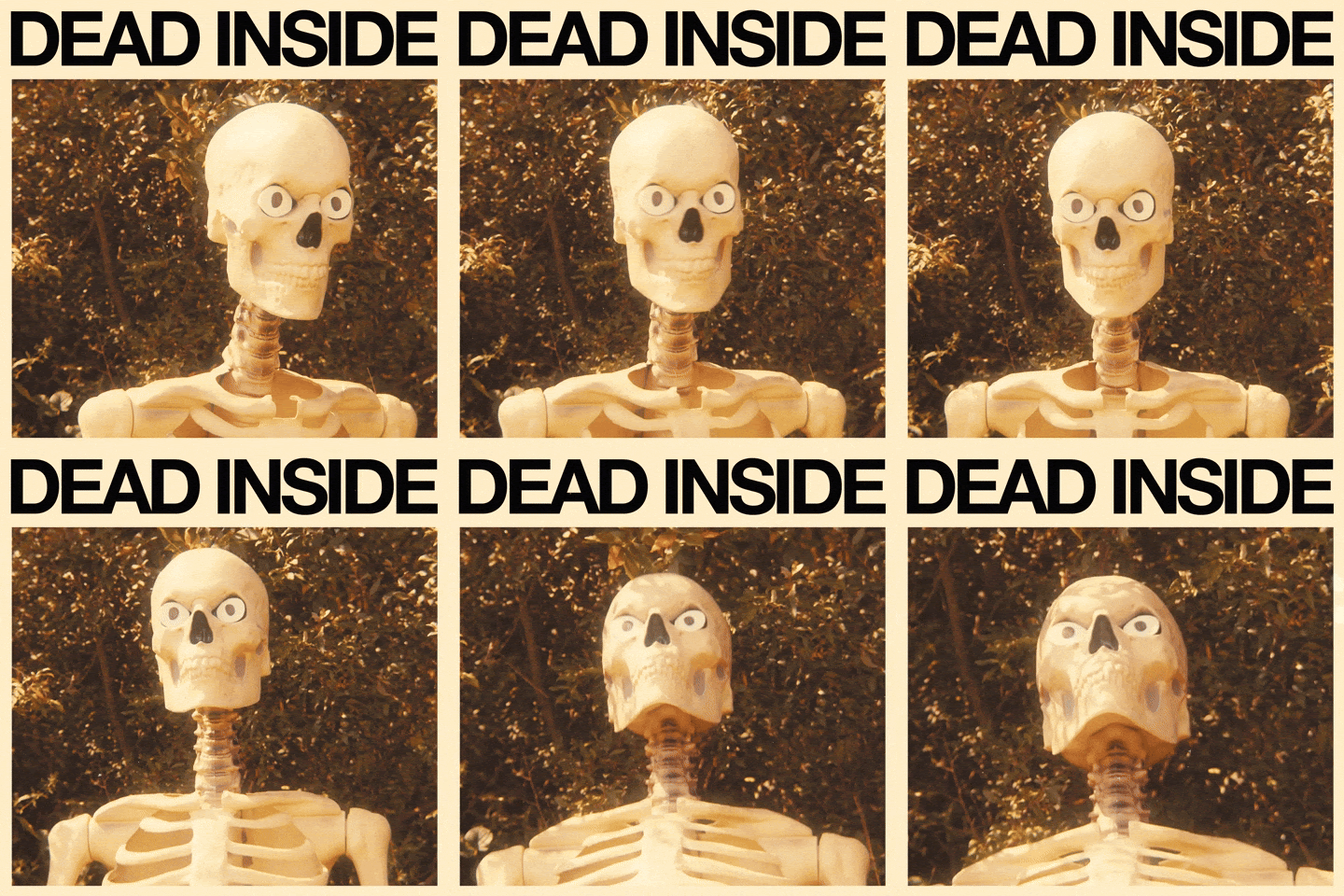
How many of us are feeling that unexplainable cloud over our heads right now? Some days, work feels empty…like genuinely, soul-level hollow. You open your laptop and go through the motions of the day, then by the time you’re finished, you’re sitting there in deep thought thinking, “what was any of that actually for?”
Trust me, I’ve felt this plenty of times. And you know the weird part about it? I love what I do.
I care about HR. I care about people. I care about building workplaces that don't make people want to walk into traffic. So when even I have days where work feels like I’m on a hamster wheel, I pay attention because if I'm feeling it, your employees are absolutely feeling it. Probably more. There's this particular flavor of work emptiness that I think we don't talk about enough.
It's the subtle kind, doing the same thing on repeat and slowly losing the thread of why it matters.
It's your contributions going unacknowledged because your manager assumes you're self-motivated and doesn't think to say anything.
It's a job that looked meaningful on the job description and somehow got reduced to a series of tasks that feel completely disconnected from anything real.
In a nutshell, it's invisible, thankless work that exists in the gap between what gets celebrated and what actually keeps the organization functioning.
The Predictive Index wanted to understand just how widespread this feeling actually is, so they went straight to the source, surveying 1,000 U.S. employees across industries, generations, and job levels in their 2026 Motivation at Work study. I've been sitting with this data, and today I'm breaking down what it means for the people doing the work and the leaders responsible for them. |
🥱 Finding 1: They Came Ready, Then The Workplace Wore Them Down |
📣 Nearly 78% of employees say they started their current role motivated!
People are walking through the door with something to prove…and then a shift happens.
Because 72% of those same employees now observe disengagement among coworkers at least some of the time. 🤯And only a whopping 16% say their work consistently feels meaningful.🤯 Does that blow anyone else's mind, or what?!
The vast majority of your workforce is showing up every day to work that doesn't feel like it means anything.
They're doing it anyway and being professional about it, but inside, their light is dimmer than it was on day one.
‼️ PI's findings mirror what Gallup's been tracking too, which is that active engagement has dropped from 36% in 2020 to 31% today.
That's 8 million fewer engaged workers over five years, and we've been watching this happen in slow motion! Yet, people still act surprised when retention gets hard or performance plateaus.
My take is that motivation disappears because the conditions that allow caring silently erode, and most leaders don't notice it's happening until someone puts in their two weeks. 👀 So what does this actually look like in the day to day? A few things to watch for: - An employee has gone quiet. They’re sharing fewer ideas, giving less pushback, and asking no questions.
- An employee has pulled back socially. Like, they’re still showing up, but the energy seems gone.
- 1:1s with the employee feel surface-level. Shorter answers, less honesty, a lot of "everything's fine."
- A language shift where things are being said like "just getting through it" and "it is what it is" from someone who used to be fired up about the work. That's a big red flag for me!
|
🤔 Finding 2: The Fragmented Attention Economy Is Eating Teams Alive |
77% of employees say distraction interferes with meaningful work at least sometimes, and 41% are navigating three or more communication channels every single day.
😵💫 This is something I think about (and experience) quite a bit!
That’s Slack, email, Teams, whatever project management tool your org is currently evangelical about, and the random text from a coworker who knows you'll respond faster there.
Anyone else have nightmares featuring notification sounds??? TBH: Your employees are not doing deep, meaningful work because they’re doing context-switching cosplay. And I haven’t even mentioned the meetings yet! 🤯
Only 10% of employees describe their 1:1s with managers as always productive. GASP!!!!! (Pretending) The rest are showing up to calendar blocks that feel more like status updates than actual convos, because they’re completely devoid of the kind of dialogue that helps someone understand how their work connects to…well, anything. Candidly, this is where I get a little fired up, because the fix is as simple as providing clarity.
🔍 When people know exactly what matters most, and why, they can filter out the noise themselves.
When priorities shift without explanation (which, let's be honest, happens constantly) employees lose focus, but they also lose faith.
The survey found that 35% of employees said clearer priorities would most improve their motivation. That ranked first BTW!!!
Yes, that’s above recognition, fewer meetings, and even autonomy. ⚡ People want to know where to point their energy. That's literally it! |
📣 Finding 3: What Gen Z and Millennials Are Asking For That Nobody Is Giving Them
|
The generational patterns in this survey are worth paying real attention to because they're not what a lot of leaders expect.
‼️ Millennials and Gen Z are significantly more likely than baby boomers to say clearer priorities and stronger manager support would improve their motivation.
They're also more likely to point to weak team connection as an energy drain. Some may mistakenly dismiss this as some form of entitlement, when all it is is a different relationship with work. After all, they're the ones who have watched loyalty get rewarded with layoffs and a "we're a family here" style of BS get followed by a 30% workforce reduction via Zoom call!
The trust deficit is palpable, and it means that for younger employees, motivation is about whether they feel seen by the people leading them and whether someone in management cares enough to give them a direction to run in rather than just a pile of tasks to complete.
‼️ The thing about team sizes going forward that I keep coming back to is this idea that they're going to get leaner.
That’s because AI is handling more, budgets are tighter, and leaders are going to be managing 10 different personalities with fewer resources than before.
This means the margin for misunderstanding your people is shrinking fast.
This is exactly where tools like what The Predictive Index offers start to matter in a way that goes beyond the assessment itself.
They’ve spent over 60 years studying human behavior at work, like behavioral drivers and cognitive patterns that determine how someone processes information, communicates, and finds meaning.
When you're working with a team of ten and you have maybe thirty minutes a week of real face time with each of them, you can't afford to figure this out by trial and error. The speed to insight matters. |
You Can't Pour Meaning Into People, But You Can Build the Conditions for It |
If you've read this far, I'm willing to bet you've felt some version of this emptiness yourself! Maybe it was a season, or maybe it's right now. I understand the feeling of putting effort into tasks that get absorbed into the machine without a single moment of recognition. Or the priorities that shift on a Tuesday with zero explanation and somehow you're expected to just realign without missing a beat.
You might not feel seen on most days, but I see you.
People Leaders who are genuinely trying to hold the humanity of their organizations together while also being asked to do more with less…this survey is basically a portrait of your daily reality reflected back through the people you're trying to support.
The data tells us that meaning at work is disrupted, and the conditions that restore it are within reach.
They're just not coming up naturally in conversation, and they're not going to appear on their own.
👀 So here's the challenge I want to leave you with: get curious about your people before they get quiet.
The disengagement that's already visible on your team (the 72% who are watching coworkers check out) didn't start as disengagement. It started as unmet needs that nobody got around to addressing. You have more tools available to you than any previous generation of HR leaders.
Use them and build the conditions where meaning can exist. And for the love of everything, tell someone their work matters today!!!!! Because the alternative is a cost nobody can actually afford anymore.
The Predictive Index published the full findings from this study, and honestly, it's worth reading in its own right for what it reveals about where your team might be right now.
Read the Data Yourself |
|
|
Thanks for reading this deep dive! Reply with any thoughts you have. XOXO, Hebba Youssef |
|
|
{if !profile.vars.safe_space_user_fitness && profile.vars.safe_space_user_fitness != false}Join 9,787 other HR and People leaders in Safe Space |
|
|
{/if}{if profile.vars.safe_space_user_fitness == true}
The conversation doesn't have to stop here
Keep learning and connecting in Safe Space |
|
|
{/if}Get your brand in front of 166,500+ HR and people operations leaders. |
Workweek Media Inc.
1023 Springdale Road, STE 9E
Austin, TX 78721
Want to ruin my day? Unsubscribe. |
|
|
|