{if ftt_dorm_120 == true}
Quick favor: Our records indicate that you aren’t opening this email. But records can be wrong. Please click here if you’d like to remain subscribed to Fintech Takes. |
|
|
{/if}Happy Wednesday, Fintech Listeners!
Around the same time that I published Monday’s newsletter (which included a section on agentic commerce), tech people on Twitter were in the depths of yet another AI-fueled freakout, this time sparked by a highly speculative research report.
Yes, I read the Citrini report. No, I don’t understand why shares of Visa, Mastercard, and American Express dived between 5% and 7% after it was published (the stock market is weird!) Personally, I did not find the portions on agentic commerce and stablecoins remotely convincing (and people who understand marketplace businesses like DoorDash were similarly mystified about that section).
Indeed, the entire conversation around AI is becoming severely disconnected from reality. It’s worth reminding ourselves that we really only know three things for sure: -
No one knows exactly how AI will reshape society and the economy. No one.
- It will take longer than most expect (the world is big and complex and busy).
-
We have agency in how this plays out. To paraphrase one of my favorite quotes, “we’re not locked in here with AI, AI is locked in here with us.”
Today’s newsletter and podcast isn’t entirely free from AI (these agents are everywhere!), but I can promise you that they are reasonable, rational, and, most importantly, interesting! — Alex |
Was this email forwarded to you? |
|
|
3 BIG IDEAS FROM THE PODCAST |
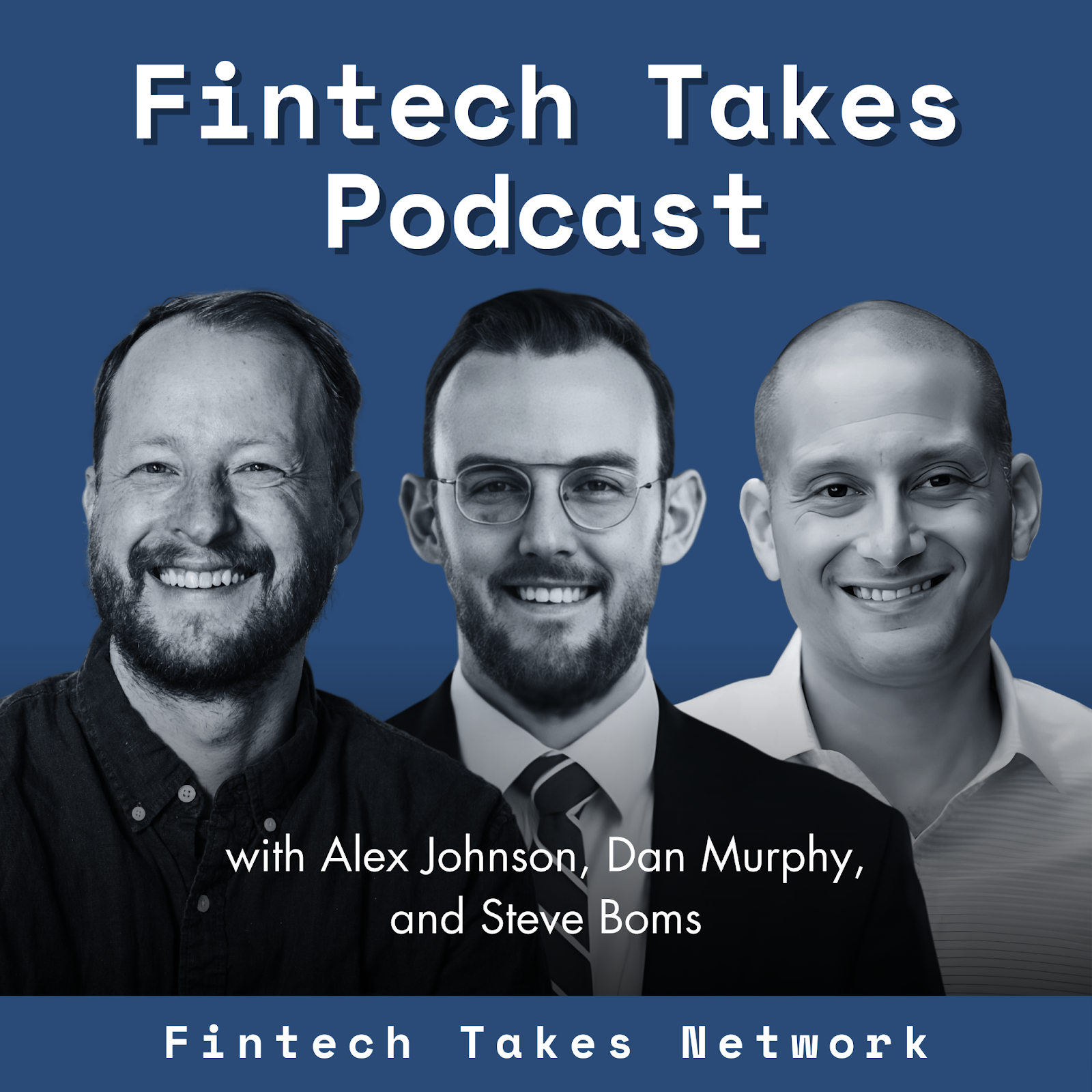
In this week’s episode, I sat down with Steve Boms and Dan Murphy. We shifted focus from the U.S. open banking landscape long enough to look north and ask, wait, did Canada just pass us?
Specifically, we talked about the Consumer-Driven Banking Act — what it is, why it exists, and how a country I've occasionally and affectionately mocked in this newsletter for its tortoise-like pace is now inarguably ahead of the U.S. on open banking regulation. We covered a lot of maple-leafed ground, from how different countries learn from each other on financial technology policy to the small-c conservatism baked into Canadian financial services, from the big five oligopoly to our current U.S. trade situation with Canada. |
And read below for my three big ideas... |
#1: The Tortoise and the Hare |
Turns out, Aesop knew what he was talking about! Canada was supposed to go live with open banking in … 2024, which didn’t happen. I noted this in the newsletter at the time, and my wonderful Canadian subscribers noted that I noted it! However, on the podcast, we talked about how this slower pace may have been a blessing in disguise. Canada has explicitly taken lessons from the countries that moved first on open banking regulation. For example, as Dan points out, Canada got to watch the U.S. rulemaking process and see the BPI lawsuit play out. This gave Canadian regulators a clearer view of banks’ revealed preferences versus their stated preferences (as things moved from theory to implementation). The Canadian legislation is voluminous and incredibly specific precisely because they saw what happens when you leave room for interpretation.
The UK built prescriptive technical standards that were a major accomplishment (and are now a major burden). The U.S. issued a broad rule based on a short and nonspecific statute. All of this became a curriculum for Canada (and for whichever country moves on open banking regulation next); a chance to study what went wrong without paying the same tuition. |
|
|
I've been gently ribbing Canada over its open banking regulations and other fintech topics for years in this newsletter. My Canadian subscribers have, unsurprisingly, taken my jokes with grace and good humor. And now the bill comes due for me.
To my Canadian friends: I sincerely apologize! You were right and I was wrong. I genuinely have a great deal of fondness for Canada and you should know that (despite the actions and rhetoric of our current government officials) pretty much everyone else in the U.S. does too! We look forward to learning from the innovations that are soon to come from your open banking ecosystem. |
|
|
#2: Lowercase “c” conservatism, Uppercase “C” Change |
The Canadian financial services landscape is highly concentrated. Five banks hold roughly 90% of consumer deposits, which is what we would traditionally call an oligopoly (i.e., a market dominated by a small number of large firms).
That goes hand-in-hand with an attribute that shapes everything downstream, what Steve calls “a conservatism with the lowercase c” that policymakers, consumers, and bankers bring to financial services innovation. Most bank customer agreements explicitly prohibit sharing usernames and passwords with third parties, which cuts off a whole class of fintech relationships before they can begin.
And no conversation about innovation in Canadian financial services gets very far before someone invokes 2008 (and how Canada's cautious regulatory culture and the tight alignment between its big banks and government kept the country comparatively insulated from the damage).
But this same conservatism may have also created the conditions for more dramatic disruption. Steve cites survey data showing that more than half of Canadian consumers and small businesses feel stressed when interacting with the financial services sector (stress that’s even more pronounced for women, new Canadians, minorities, and very small businesses).
The oligopoly that stifled market-driven disruption may have also prevented the kind of gradual, piecemeal improvements that might have relieved some of this pressure. When external pressure finally arrived, in the form of geopolitical tensions, trade friction, and the broader fracturing of the U.S.-Canada relationship, there was no half-measure available. A system so effective at resisting incremental change couldn't respond incrementally.
Canada looked at its most important geopolitical relationship and concluded it could no longer count on the U.S. as its default partner, in trade and in innovation, and decided to take more drastic steps to ensure its ability to compete in a global market.
The same regulatory culture that moved slowly on open banking is now building a framework that (Steve says) could leapfrog virtually every other country in the world if it’s delivered as envisioned. |
#3: Audit Trails for Agents |
Open banking has spent years solving a specific set of problems: how to handle permissioned access, assign liability, and maintain traceability when autonomous systems make decisions. Those same problems are now appearing in every industry, thanks to agentic AI.
Dan mentions a lawsuit that I also have been tracking. Perplexity's Comet browser taking actions on Amazon’s website on behalf of its users (and Amazon’s customers). Amazon sued. Dan says if you read the legal arguments, they echo every open banking access fight of the last decade. It’s the same fight as open banking, but in a different arena.
Steve points out that the core issue is liability. And the reason liability is so challenging today is that traceability is broken. Our personal data has been breached so many different times, in so many different ways, that when that data is misused, we have no idea who to blame! Steve’s argument is that consumer-permissioned data access has the potential to help here because it can create a traceable ledger of who changed what and when. That kind of specificity lets you assign responsibility more cleanly than in today's mess of opaque databases and stolen credentials. Agentic AI will operate across retail, healthcare, and anywhere else users decide to use it. The policy fights that follow will rhyme with open banking fights, except the people writing legislation may never have heard of Section 1033. Financial services has a decade of hard-won knowledge about how to structure permissioned access when software acts on behalf of humans. The question Dan raises is a simple one: will anyone think to use it? |
|
|
You have to approach this topic with a great deal of humility and curiosity to make any headway whatsoever. Fortunately, that’s what Derek Thompson does.
| Mike Cagney is about as sharp as they come on this topic. Interesting conversation. |
What happens to debt collections when generative AI changes how the work gets done? I have a new miniseries for that! In the finale (Episode 4) of Collections Conversations, Dave Wasik (Partner at 2nd Order Solutions) explores why AI is hitting collections differently than every other lending workflow, and why the borrower's shame might actually make a bot the more humane option. |
|
|
Thanks for the read! Let me know what you thought by replying back to this email. — Alex |
|
|
{if !profile.vars.fintech_takes_user_fitness && profile.vars.fintech_takes_user_fitness != false}
Join 2,444 other finance and fintech leaders in the Fintech Takes Network |
|
|
{/if}{if profile.vars.fintech_takes_user_fitness == true}The conversation doesn't have to stop here
Keep learning and connecting in the Fintech Takes Network
EVENTS | FEED | LIBRARY | DIRECTORY
|
|
|
{/if}Get your brand in front of 58,000+ fintech and banking executives. |
Workweek Media Inc.
1023 Springdale Road, STE 9E
Austin, TX 78721
Want to ruin my day? Unsubscribe. |
|
|
|