{if hosp_dorm_120 == true}
Quick favor: Our records indicate that you aren’t opening this email. But records can be wrong. Please click here if you’d like to remain subscribed to Hospitalogy. |
| |
{/if}{if profile.vars.hew_transition}
A reminder: You’re receiving this because you were previously subscribed to HealthExecWire. Hope you enjoy. | |
|
{/if}
Happy Tuesday Hospitalogists!
This week I’m sharing a highlight from my recent podcast with James Hereford, CEO of Fairview Health Services, and I also wanted to surface some great insights from the Hospitalogy community about how we can increase competition in the hospital space (inspired by Nikhil Krishnan’s posts here and here) and more.
Enjoy! |
Was this email forwarded to you? |
|
|
From Basketball Coach to Health System Turnaround CEO |
|
|
If you missed the news, I’ve started a weekly podcast called Claims Denied, one man’s quest to learn everything there is to know about the business of healthcare. |
Each week, I’ll be talking with influential healthcare leaders across innovation, strategy, finance, policy, and more. It’s a great way to learn about disruptive health tech startups, hear war stories, stay up to date on emerging health system transformation strategies, and listen in to scalding hot takes on pressing topics and the future of the industry. We’re already on episode 6 and I’m having a blast.
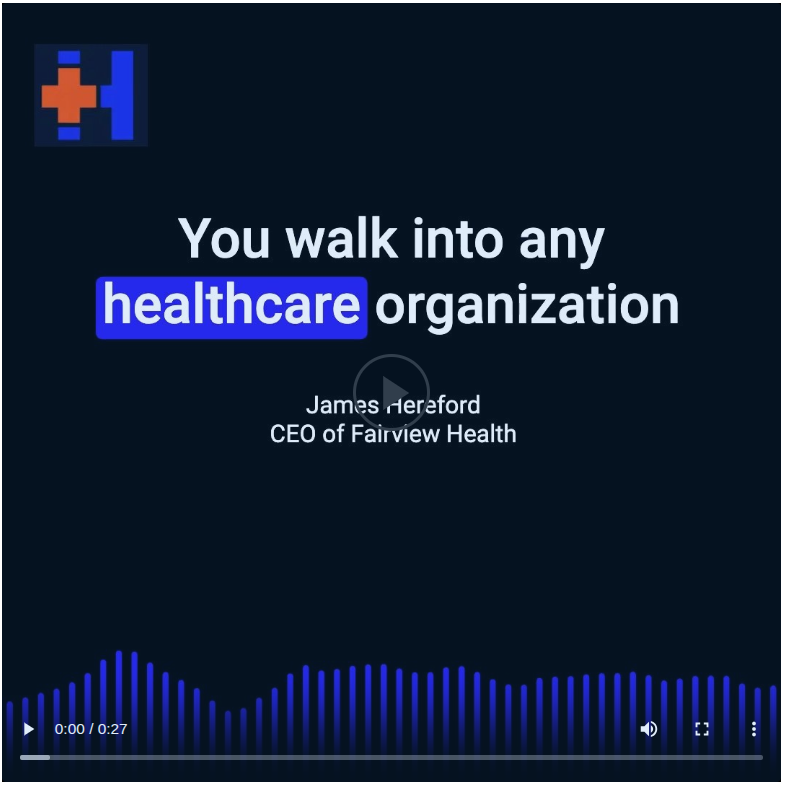
In episode 2, Fairview Health Services CEO James Hereford and I had a heart to heart around what a real health system turnaround looks like when you inherit “zero trust” and 6 years of organizational drift. James talked about his unconventional path into healthcare, why lean management systems (not “lean tools”) became Fairview’s operating backbone, and how labor control, throughput, and supply discipline powered a $350M recovery without sacrificing quality, service, or engagement.
James and I also dig into the economics of specialty pharmacy/340B, and where Fairview Health has been able to win with AI. James even shares his biggest AI implementation failures, the need to give employees agency, and the mistake most orgs make when they fall in love with technology. Here’s a clip, but be sure to catch the full episode. New episodes each week - Subscribe here! |
Increasing Competition In the Hospital Space |
|
|
This was my initial post in the community since I figured some folks there would have some interesting takes. I’d love the broader newsletter’s reactions to Nikhil’s original post and these comments below!
I came across this post from Nikhil Krishnan on how to introduce competition for hospitals. He mentions some common reform thoughts like: -
removing CON laws,
- pushing site neutral payment reform,
- making non-competes unenforceable,
-
allowing physician hospital ownership,
- enforcing price transparency,
and other interesting reforms (which I find spicier and more interesting, in my personal opinion).
My question for you guys is...how do you think we can increase competition in the hospital space? What reforms would you advocate for? Here is Nikhil’s original post: https://www.outofpocket.health/p/how-do-we-increase-competition-for-hospitals |
|
|
Ann Somers Hogg - Director, Health Care Research
“Interesting analysis. I find the more interesting question at the very bottom of his newsletter: ‘How would you make the hospital landscape more competitive or bring prices down?’ And it's the ‘or bring prices down’ part that I gravitate towards.
Increasing hospital competition by creating more hospitals isn't the right strategy if the goal is reduced costs. Hospitals and health systems have business models that need to be changed in order to be sustainable, not replicated as they are. So, instead of suggesting ways to create more hospitals (which just further scales unsustainable business models), I think the better question is how do we bring new business models into the ecosystem to compete with the existing hospital business model?
He gives a small amount of space to hospital-at-home and micro-hospitals, but not enough. The default shouldn't be to add more of the same in an effort to lower costs. Instead, let's back up and start with the patient value proposition, and design a business model around that to compete with existing hospitals (on certain services) and lower costs.” |
|
|
THE ‘SUPPLY CREATES DEMAND’ TAKE |
Jeanne Duke - Fractional CAIO
“I agree with Ann. It's long been shown that prices for medical services go UP when more competition enters the market, a unique characteristic common to elite goods and services. With more service providers, the market for $$$ buyers becomes more price-exclusive, pulling the $ of all boats up with them. Only a new business model can crack this deviant market behavior.” |
|
|
Anonymous
“Isn't talking about hospital pricing as the culprit a bit like complaining about grocery stores as the reason why food prices have inflated? Shouldn't we be talking about the margins that exist all along the value chain and comparing them? Starting at the health plan level and factoring in all the margins that are extracted from the health care spend.
Look at the margins of Pharma, device manufacturers, supply manufacturers, construction companies, IT vendors, consultants, hospital base physician provider entities, etc. Adding competition at the hospital level doesn't address any of these other ‘margin extracting’ entities and in fact would probably give them even more unfettered access to the healthcare dollar.
A better solution might be to place a tariff on all of these entities, take that money and underwrite per capita payment for hospitals (yes, this would require folks to pick their preferred health system). If you moved 50% of a health system’s revenue to a flat PMPM (not tied to utilization), you could exchange that payment modification for reduced commercial FFS rates. This would make the current invisible cost shifting that occurs for the commercial payers transparent. This approach would also change the relationship with the patient from episodic/transactional to one of a continued revenue stream.” |
Ann Kempski - Consultant
“Nikhil's list is a good one. I would add: -
Removal of procedures from the Medicare inpatient only list, which this Administration is doing scaling back 340b eligibility for tax-exempt hospitals and requiring specific behaviors like passing down discounts to uninsured patients.
- Medicare should make the hospital at home demo permanent and expand it.
- More CMS mandatory risk models for hospitals and physicians.
-
Relaxing network adequacy requirements in MA, Medicaid, and ACA plans (ERISA plans don't have NA rules), with guardrails and requirements like demonstration of telehealth capacity and quality measures that include patient surveys, could be effective in certain geographies.
-
Even reciprocal professional state licensure laws (there is a physician compact and not all states have joined it) across states can promote greater competition.
More market-based competition actions would include: - Commercial plans - employer-sponsored and ACA plans - could establish more centers of excellence for hospital level care and pay for patient travel costs.
-
They could also offer a narrow network (using a direct contract with one local system) alongside the broader PPO so lower wage workers can select a more affordable plan.
-
Some proponents of direct primary care believe that these independent practices can increase competition by giving primary care more referral power (when there is still more than one choice in the market).”
|
THE RETHINK INTEGRATIONS TAKE |
Anonymous “I'm aligned with what you listed from Nikhil, especially eliminating (or at least heavily reforming) CON laws and making non-competes unenforceable. In addition, I would advocate for: -
Reforming overly complex licensing and accreditation requirements
- Rethinking vertical integration incentives (tying reimbursement advantages to demonstrated integration value not ownership alone)
-
Monitoring post-merger access and quality metrics more aggressively (particularly to see if we need reforms in antitrust laws or enforcement)”
|
THE RETHINK INCENTIVES TAKE |
Karina Lupercio - Founder “I like what Ann said, and I’m less convinced that adding more hospitals is the answer, and more interested in how we redesign the incentives inside existing ones. AI has real potential to compress administrative waste, i.e., revenue cycle complexity, denial management, prior auth friction, which are non-trivial cost drivers. But efficiency alone doesn’t lower prices. Without a distribution mechanism, savings get captured as margin by default.
If we’re serious about affordability, AI-driven admin compression should be paired with accountability. One model could allow hospitals to retain efficiency gains for 1–2 years to fund adoption and reinvestment, while implementing standardized, audited administrative cost reporting from day one. After that validation period, a rolling multi-year measurement could trigger structured pass-through (either moderating commercial rate growth or reducing patient cost-sharing).
The broader point isn’t just about hospitals; it’s about AI and incentives. Efficiency gains only change affordability if governance determines where those gains flow. Otherwise, we risk making the system leaner without making it more affordable. At least this is where my head goes.” Hospitalogy members can join this discussion here. Not a member yet? Apply to join here. |
|
|
Hospitalogy IRL Meetup: Nashville Recap |
On January 20, the Hospitalogy community gathered in Nashville for an IRL member meetup, hosted by longtime member Eric Thrailkill and was built around a simple idea we care a lot about: getting thoughtful healthcare people in the same room.
The meetup was co-hosted alongside the Nashville Area Chamber of Commerce, Global Health Innovators, and Global Health Connector - all communities Eric is actively involved with and deeply connected to. With so much overlap across these groups, the night was about bringing together like-minded folks who are already working toward similar goals, and giving them space to actually connect.
The group met at Nashville Glasshaüs, a space that made it clear this wasn’t going to be a typical healthcare meetup. Eric also brought in a podcast truck, capturing insights from folks throughout the night and turning the meetup into something people could take with them beyond the room. Operators, innovators, and ecosystem builders from across the Nashville healthcare scene showed up ready to share what they’re working on, trade notes, and meet others navigating the same challenges. No formal programming, no sales pitches, just real conversations and a lot of new connections forming. Huge thank you to Eric for pulling this together and for continuing to help grow the Hospitalogy community in Nashville, and to everyone who came out and made the night what it was. More Hospitalogy IRLs coming soon. If you’re interested in hosting or helping bring one to your city, DM Kat Lewis. |
|
|
-
Read: Hospitals reported 111 CEO exits in 2025, a 7% increase from 104 recorded in 2024. Read more in Becker’s Hospital Review.
-
Resource: Healthcare needs more sustainable, scalable delivery systems to bridge the gap between rising hospitalizations and retiring physicians. AmplifyMD’s white paper explores 6 AI-enabled virtual coverage models that expand clinical capacity and access.*
- Roundtable: Don’t miss the February Roundtable for Plus Members, February 27 at 1pm ET. Register here.
*This read is brought to you by one of my brand partners who help make this newsletter possible! |
|
|
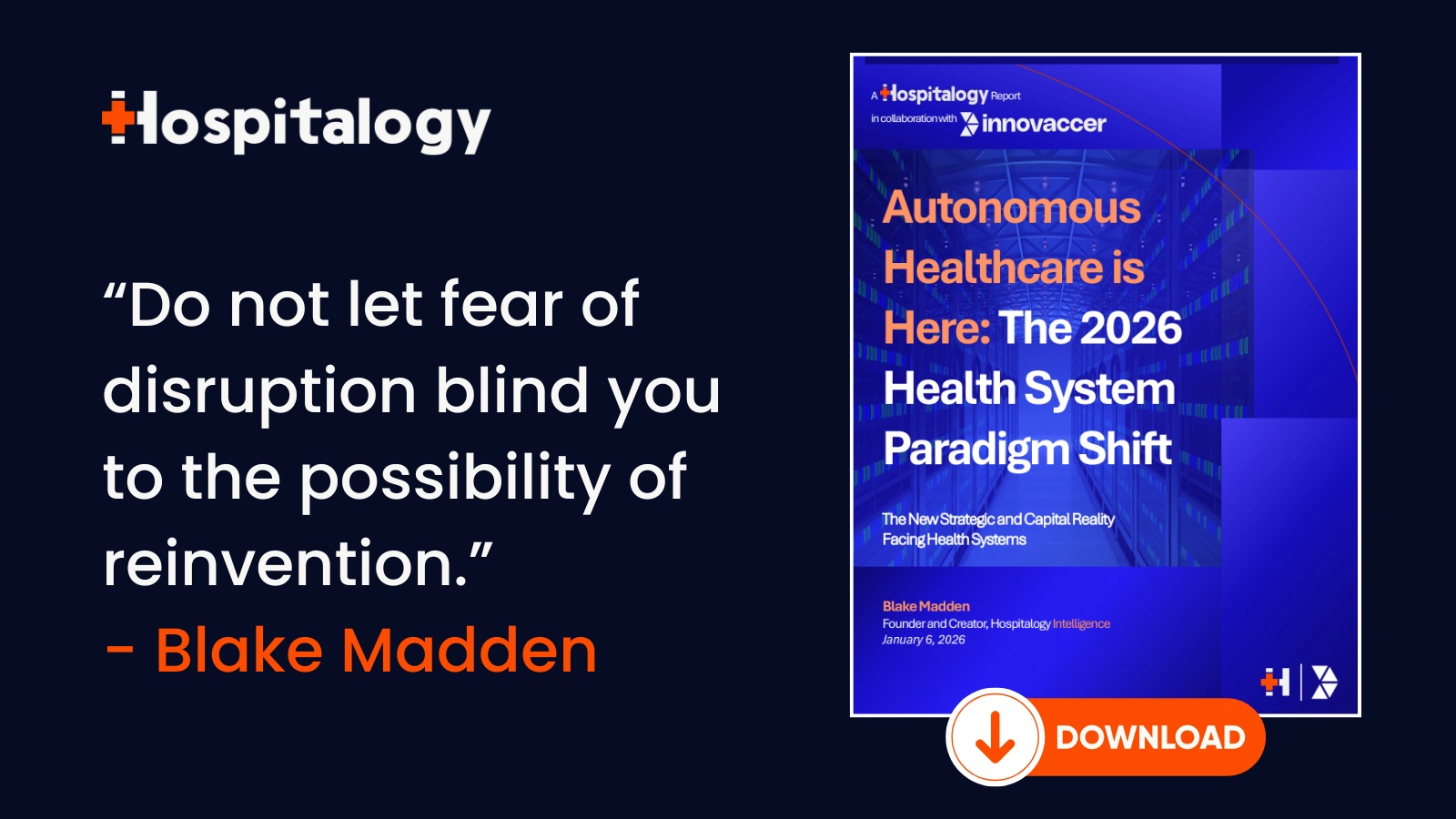
My quote above sounds like I was channeling Confucius. Maybe I should have gone with the Yoda version, Blind you to the possibility of reinvention fear does.
That’s it for today. I would love to know your thoughts!
– Blake |
|
|
{if profile.vars.board_room_user_fitness == true}The conversation doesn't have to stop here
Keep learning and connecting in the Hospitalogy Network
EVENTS | FEED | LIBRARY | DIRECTORY
|
|
|
{/if}{if !profile.vars.board_room_user_fitness && profile.vars.board_room_user_fitness != false}I'm building a community of leaders in strategy, finance, and ops
at hospitals and health systems to help us connect, learn, and grow together. |
|
|
{/if}
Get your brand in front of 66,500+ executives and healthcare decision-makers. |
Workweek Media Inc.
1023 Springdale Road, STE 9E
Austin, TX 78721
Want to ruin my day? Unsubscribe. |
|
|
|