Hello! Kiah here. Welcome to Fintech Takes Banking, my weekly newsletter where I highlight things I think are interesting or important for bankers and the surrounding environs.
This newsletter comes to you after a whirlwind weekend in New York with friends, where we saw a couple of shows, ate a lot of food and stayed up late. Take trips with your friends! And it also comes to you from Nashville, since I left LaGuardia on likely one of the last planes to take off Sunday evening as a blizzard moved through the area. My gratitude and eternal thanks to everyone who worked to get that flight in the air, including and especially after a medical emergency and mechanical issue. I will take being three hours late getting home rather than two days!
| Was this email forwarded to you? |
|
|
Fintech Takes Banking Takes a Banking Field Trip |
Last week, I took the newsletter on a short field trip to the Federal Reserve Bank of New York for a tour.
This newsletter doesn’t often go on field trips. To be clear, the newsletter goes places, to the extent I go places: Washington, Vegas, Montana and Utah a surprising number of times, to name a few. But these are places where events are held, and not often a place of direct relevance or importance itself. That is to say: I went to these cities, but I could’ve gone to any city. I went to a specific conference hotel, but I could’ve gone to any conference hotel.
The Federal Reserve Bank of New York is not like that; its location is central to its historical function and purpose. The Panic of 1907 had convinced policymakers that after 80 years, the nation might be ready for a permanent central bank. Only this time, instead of a singular institution, the Federal Reserve Act of 1913 established a supervisory board in DC and a regional reserve system that would oversee a nation subdivided into regional districts. Those reserve banks would manage and execute the operational duties and tasks of the board, oversee supervision and monitor conditions in their districts, including through a research lens — missions they still follow today.
|
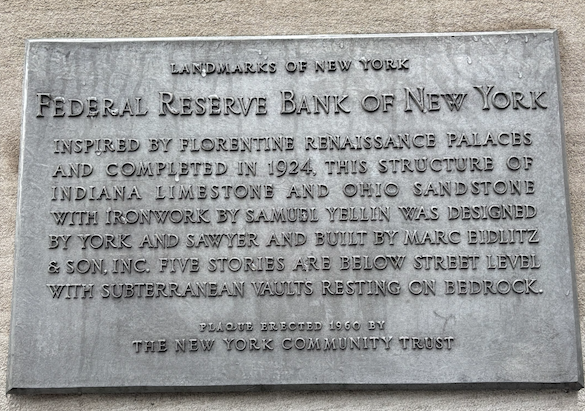
Photos are not allowed inside the Fed, so you’ll have to make do with the historic landmark outside the building |
When the New York Fed opened in November 1914, it had seven officers and 85 clerks, “many on loan from local banks,” according to a history of the reserve bank. Gov. Benjamin Strong recalled later in a speech that in those early days, the equipment at the bank “consisted of little more than a copy of the Federal Reserve Act.” On its first day of business, the bank took in $100 million from 211 member banks, made two rediscounts and received its first shipment of Federal Reserve Notes.
But within four years, the Fed’s responsibilities, constituency and functions were already expanding. There were more member banks and more transactions, thanks to the introduction of the nationwide collection system in 1916. The Great War, or World War I as it's now known, was a catalyst for the Fed to gain another important role: A repository for other countries’ banks, through reciprocal accounts.
Leaders of the Federal Reserve System thought it would be useful to reach out to other foreign central banks to facilitate wartime transactions, “including payments for war-related U.S. exports, financing of wartime government debt, and gold transfers,” according to a 2017 speech. The U.S.’s entrance into World War I in 1917 allowed the bank to enter into its first reciprocal account agreement with a foreign central bank, the Bank of England. They established nostro, or a cash account that a bank holds with another bank in a foreign currency, and custody accounts on each other’s books. The New York Fed soon executed agreements with the Banque de France, Bank of Italy and Bank of Japan. The New York Fed today is still the institution that houses these reciprocal accounts.
The New York Fed also served as the federal government’s fiscal agent during the war and sold and distributed the government bonds that financed the military’s expenditures. It is still the exclusive fiscal agent of the U.S. Department of the Treasury. “It conducts all primary auctions of marketable Treasury securities … [and] carries out exchange rate policy,” according to the New York Fed's website. Additionally, the “Treasury receives all direct federal revenue and borrowed funds, and pays nearly all federal expenses, through its [g]eneral [a]ccount at the Reserve Bank of New York.”
The service extends to dozens of employees who served in the war, the names of whom are carved onto one wall inside the building’s lobby. Across from those names is the wing of the Fed that is dedicated to educating the public — namely, middle and high schoolers from all over the country visiting New York, but specifically those in District 2. Today, some of the Fed’s educational displays are in a hall where the public used to buy treasuries. This is a different part of the building from where member banks would conduct their business; the discount window was located on a different floor entirely, so competitors wouldn’t hear or see banks applying for loans.
New York is the beating heart of the U.S. financial services system — true today and true in 1914. The Federal Reserve Bank of New York occupies a place in the reserve system that is colloquially known as “the first among equals.” Among the 12 Reserve Bank branches, it is the busiest by volume. The New York Fed also houses the Open Market Trading Desk, which receives and implements directives from the Federal Open Market Committee in Washington about the stance of monetary policy. It has a permanent seat on the FOMC, and its president is traditionally selected to serve as the committee’s vice chairman.
The question of what a bank’s building should convey about the institution itself was in effect when the Fed Gov. Strong decided the office needed a bigger physical space, only four years into its existence. Construction of what is now the Federal Reserve Bank of New York’s main office began in 1921, with most completed by 1924. The New York Fed’s main office building takes up an entire city block in lower Manhattan. |
Did I Get to See the Gold Vault? |
No, unfortunately, I did not get to see the world's largest gold storage reserve. But vaults are one of my weirdo niche bank interests, and I do intend to write about them, so I am going to pass on mentioning more about the vault in this newsletter. |
Interesting Thing I Learned about the New York Fed: |
-
There was a “minor diplomatic faux pas” (the best kind) when the reciprocal account agreement with the Bank of England was announced in 1917, called the British Treasury bills episode. It goes as such: The announcement coincided with the 1916 reelection of President Woodrow Wilson, who won on a pledge of neutrality. He directed the Federal Reserve Board in Washington “to issue a clear-cut warning to U.S. banks not to invest in a pending large placement of British Treasury bills in the U.S. market.” This had the “immediate and worldwide effect” that the U.S. had “broken with Britain” —exactly the kind of effect you want to have. To counteract this, officials at the Board decided to unilaterally announce the agreement with the Bank of England, “contrary to the terms of the account negotiations and to the consternation of the New York Fed.” Where were the British in all of this? “The Bank of England magnanimously let the matter slide—noting that mistakes ‘may arise even in the best regulated families.’”
- The same speech with the above anecdote noted that Strong went on to call Bank of England’s Montagu Norman “my dear Monty.”
-
In November 1985, a computer bug in newly installed software at the Bank of New York almost brought down the entire securities industry, an outcome that was only prevented by the New York Fed. This incredible story was recounted in the Bank Treasury Newsletter. At the time of its computer update (failure), the Bank of New York served as one of two clearing banks for government securities on Fedwire, where it processed and delivered all the transactions and government securities. But the bug meant the bank could only receive securities, not send them, causing the bank to overdraft its account at the Fed. Fed staff called the CEO of Bank of New York to put a supplementary discount loan agreement in place “where, if we had to, we can take as collateral for a discount window loan everything down to the flowerpots,” Gerry Corrigan, the president of the New York Fed at the time, recalled later (Corrigan also wrote the insightful 1983 essay that asked why banks are special). Bank of New York thought the situation would get fixed by the end of the day, but signed the agreement anyway.
The computer bug wasn’t fixed by the end of the day. Bank of New York’s overdraft hits $23 billion by 2:30 a.m. on Friday — the company was valued at $24 billion — when Corrigan approves a discount window loan to the bank and directs the Fed to backdate it to Thursday just before midnight. Corrigan also had to call Fed Chair Paul Volcker, who was in Argentina, and wait for Volcker to stop screaming so he could explain why the Fed had no choice but to make the loan or deal with the fallout from the Bank of New York’s failure.
-
The main office of the New York Fed is located two blocks from the World Trade Towers, but was not damaged during the Sept. 11, 2001, terrorist attacks. The bank was able to support financial activities such as Fedwire and the discount window, despite telecommunication breakdowns in Manhattan. Discount window lending spiked to $46 billion on Sept. 12, up from less than $1 billion before the attacks. The Fed also decided to pay banks as usual when they submitted checks for clearing, even though the temporary suspension of air transport caused a significant delay in collecting checks from the issuing banks. Float spiked to $28 billion in the days after the attacks, up sharply from an average of $766 million a day.
Outside of keeping funds flowing throughout the economy without disruption, the Fed used its downtown office to support first responders, including free meals at its cafeteria and office space for a trauma counseling service for New York police.
-
In 2016, the Bank of Bangladesh suffered a theft of funds held at the New York Fed. The Fed received 35 requests to transfer $1 billion to private accounts at several institutions in Asia through the Swift interbank messaging system; these messages appeared to come from the central bank’s servers in the capital city and were accompanied by the correct codes authorizing the transfers. The New York Fed executed five transfers for a total of $81 million before its systems raised a money-laundering alert and blocked the remaining transfers. Both the New York Fed and Swift said their systems were not breached or affected. In early 2016, Bangladesh's foreign-currency reserves hit a record of $28 billion; a third of those reserves were held in liquid form in bank accounts at the Fed and the Bank of England, according to Bangladesh Bank officials at the time.
-
In 2018, David Andrew Finer at the Chicago Booth School of Business analyzed New York City yellow taxi records to infer the interactions between insiders at the New York Fed and major commercial banks around the Federal Open Market Committee meetings. He found “evidence suggestive of an increase in meetings between them both at the New York Fed’s offices and in areas associated with dining and shopping. The occurrence of the changes very late at night and during typical lunch hours suggests informal or discreet communication.”
|
This Concludes the Newsletter Tour of the Tour |
The tour of the New York Fed is somewhat limited. It is not intended for bank reporters but for students, especially those in the Fed’s second district, which includes some of the Northeast, Puerto Rico and the U.S. Virgin Islands. It’s focused on explaining the major nodes of the U.S. economy, to understand where the New York Fed fits into the broader transmission of financial policy, how money moves in the U.S. and the work that goes into keeping the financial system stable.
Increasingly, much of this activity happens digitally. “Bank” is as much a verb as it is a noun these days. But that collapse of physical boundaries around place and space has created a mental collapse of the companies that look like banks but aren’t, or of activities that look like banking but aren’t. As that happens more and more, I think it’s
useful to occasionally stop and consider the physical space that has traditionally been the space of activities that, when added together, equals a bank. |
|
|
What I’ve been reading, watching and listening to this week: |
🍗 I had Jollibee for the first time: (in Times Square, of all places), and the fried chicken was excellent. My friends ate a shocking and somewhat gross amount of the spaghetti. I had heard of the Filipino fast food chain from my Asian Pacific Islander friends, but was delighted to read about the American expansion in this recent article in The Atlantic.
🎭 Keeping with the New York theme: One of the shows I saw was “Stranger Things: The First Shadow.” I have not watched a single minute of the Netflix show, but thought the stage show was very fun, if surprisingly dark, given the number of children at the show. TV and movies make it easy to take special effects for granted, but the effects and sets were so good.
🎙️ Have you been hearing: me and Alex talk about bank charters, fair value accounting and master accounts for years now? The déjà vu continues on the most recent episode of Bank Nerd Corner Squared as we discuss developments regarding the nation’s newest bank, Lending Club and the skinny master account proposal.
|
Thanks for reading! Let me know your thoughts on this piece.
In all fairness, I visited the St. Louis Fed’s museum/educational exhibit in 2023 ahead of a conference, but unfortunately, I wasn’t writing a newsletter at the time, so no essay. I do have a bag of shredded currency and a pretty nice mug. Let me know if you think there’s a fun banking field trip I should add to my future trip itineraries!
– Kiah |
|
|
Get your brand in front of 60,000+ financial services execs. |
Workweek Media Inc.
1023 Springdale Road, STE 9E
Austin, TX 78721
Want to ruin my day? Unsubscribe. |
|
|
|