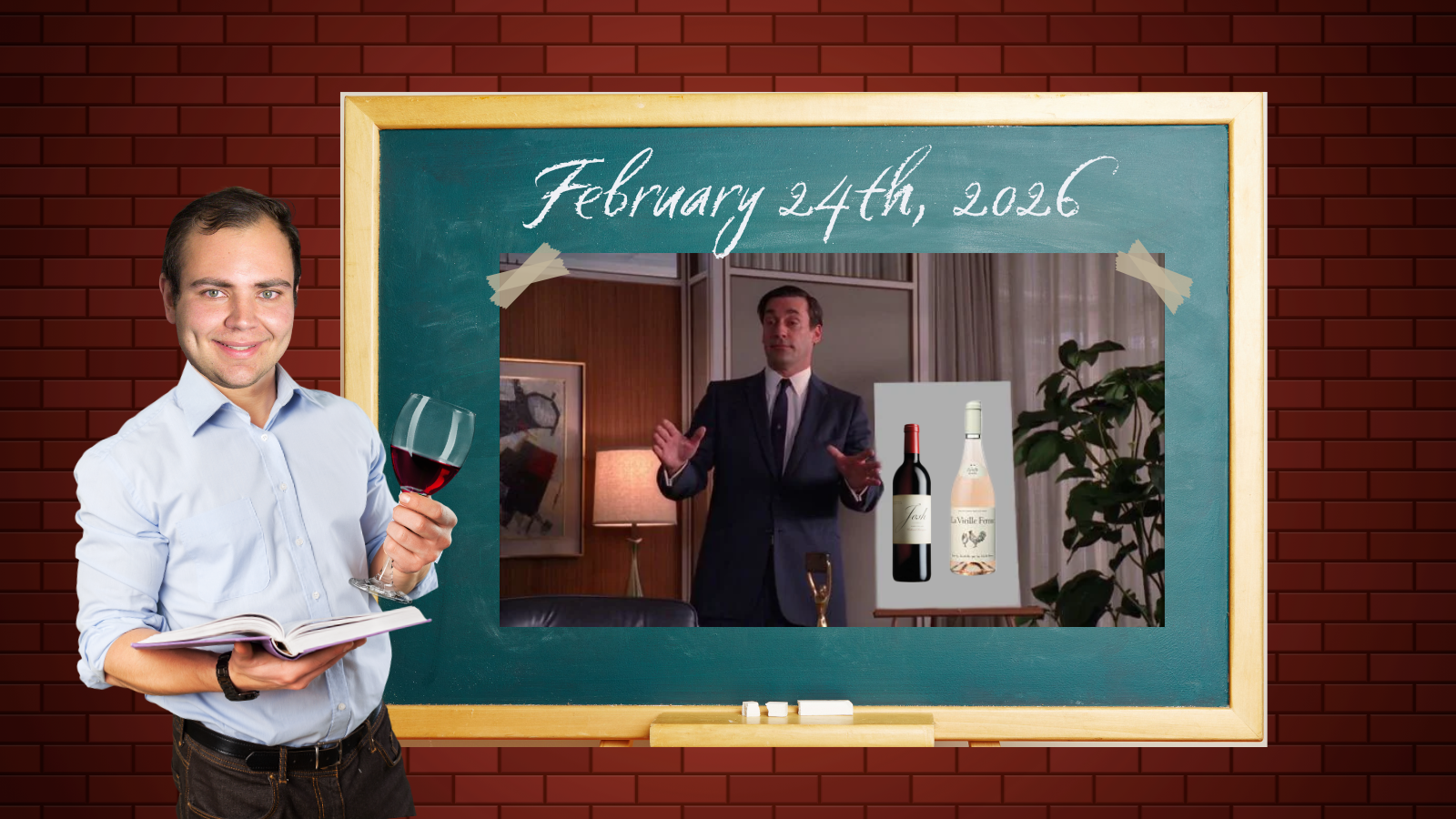
Hey Marketing Bestie, Us marketers sure can learn a lot from our Marketing fore-fathers and fore-mothers.
Consider this a parade for the greatest marketing campaigns in memory. Welcome to Marketing Classics 411, a new kind of ancient history. In place of hieroglyphs, expect to decipher the campaigns of yesteryear.
Professor Millennial teaches every Tuesday (remotely), via electronic mail. Class is now in session. |
Was this email forwarded to you? |
|
|
How Josh Cellars & “The Chicken Wine” Kept Viral Momentum Flowing |
If you’ve been in a wine store in the last EVER, you’ve seen Josh wine. It costs $15-20.
90M bottles are sold annually. In the U.S., it’s the most popular wine priced over $10.
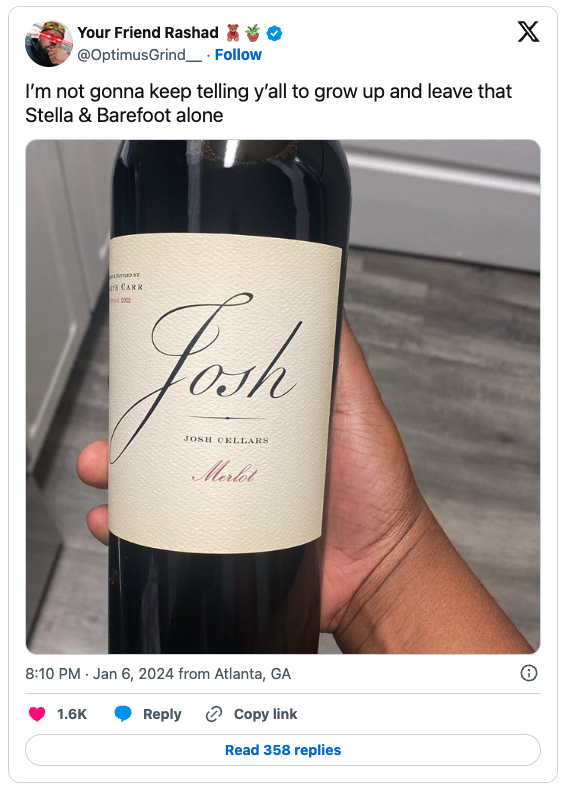
But Josh was just an easy-to-pronounce bottle on the shelf until it became a meme wine in 2024. During Dry January, LOL.
Now, brands go viral all the time. But memes don’t always translate into $$$. Like any earned media, meme fame needs a capture plan. Without infrastructure, quick thinking, and flexibility, viral moments fizzle fast.
When lightning strikes, you need to know how to get in on the joke, AND get the last laugh…by turning internet attention into relevance & sales that LAST.
Josh Cellars managed to do it. And they weren’t alone in having some meme marketing moves.
In the process, they engaged a new generation of consumers at a time when alcohol consumption is on the decline.
This is the story of how 2 boozy brands made their memes age like fine wine. |
A quick flight of facts about Josh Cellars:
👨🚒: Launched in 2007 by Joseph Carr as a tribute to his dad Josh, who was a military veteran, lumberjack, and firefighter.
🖋: Joseph’s mom designed the elegant cursive “Josh” on the label. Aw!! 🍇: There are 11 varietals, mostly produced in California, plus a Reserve collection. ⭐: They’re award-winners - multiple 90+ scores from Wine Enthusiast, & named American Winery of the Year in 2021. 🛒: Josh has that distro locked DOWN: they’re sold at Target, Walmart, Costco, Kroger, Trader Joe’s, and even Walgreens in some states. When Josh went viral, they were already true to this, not new to this.
Their problems were industry-wide: younger generations hadn’t connected with wine. They were more sober-curious, and they had more options at the store than just “wine, beer, or liquor.”
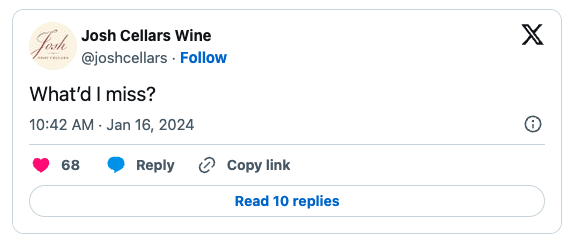
Then, 1 dry January, 1 tweet hit the internet…and sent Josh into the pop culture stratosphere. |
1 thing Josh DIDN’T have? An active presence on X. They hadn’t posted since 2019! |
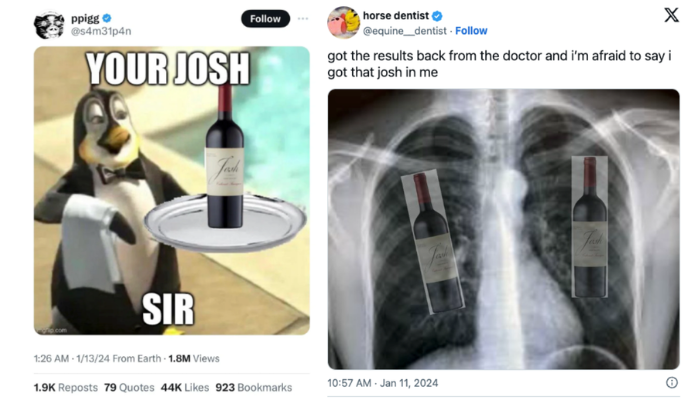
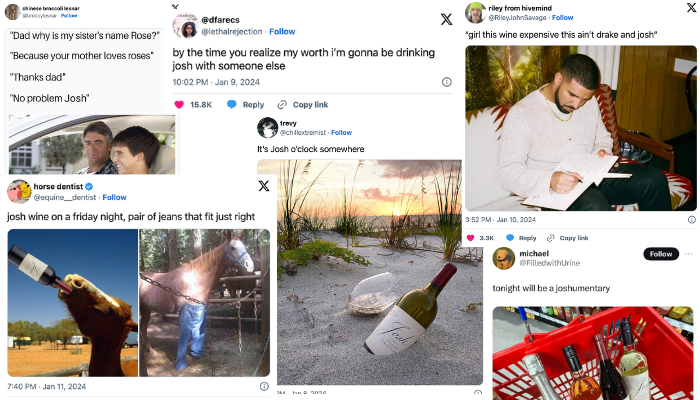
IT’S JOSH O’CLOCK SOMEWHERE |
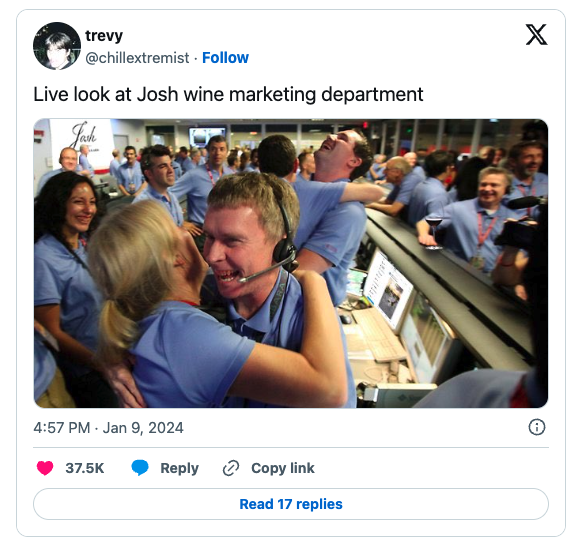
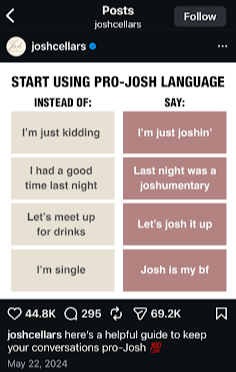
Soon, the meme cup runneth over. Recurring theme 1: The weirdness of a wine brand being named...Josh.
Recurring theme 2: Talking like super-affordable Josh is a super-fancy wine. It was a perfect storm for jokes. |
The memes spilled over to TikTok. People who knew the brand, immediately got the joke. People who didn’t, were curious. And people who’d seen it, but had never tried it, felt behind the curve. All while Josh’s Marketing team was literally locked out of its X account! #marketingnightmares |
This, but sobbing, because no one has the 2FA code (via Marketing Brew) |
It was time to get back in the feed. |
The wave of Josh memes didn’t “create” the brand. It refreshed it. Going viral is like a temporary distribution glitch. It opens new channels, and makes you reconsider where your audience is - AND how they discover new products.
The real win is if you can translate your 15 minutes (or 150+ memes) of fame into durable brand relevance.
Josh knew that being a punchline was a purchase trigger. But it had always taken itself seriously, despite their approachable name and price point.
To paraphrase Chief Brand Officer Dan Kleinman, Josh “spoke sommelier, not social.” The brand had done the hard work of mastering the fundamentals. It had distribution, name recognition, and quality products. Now it also had the attention of younger, terminally online consumers. |
Josh understood the assignment and started thinking about attribution. To measure their viral success, it tracked 2nd-order signals, like search lift, retailer velocity, and repeat behavior.
Within weeks, the brand saw a 79% increase in social followers and a 6% increase in sales.
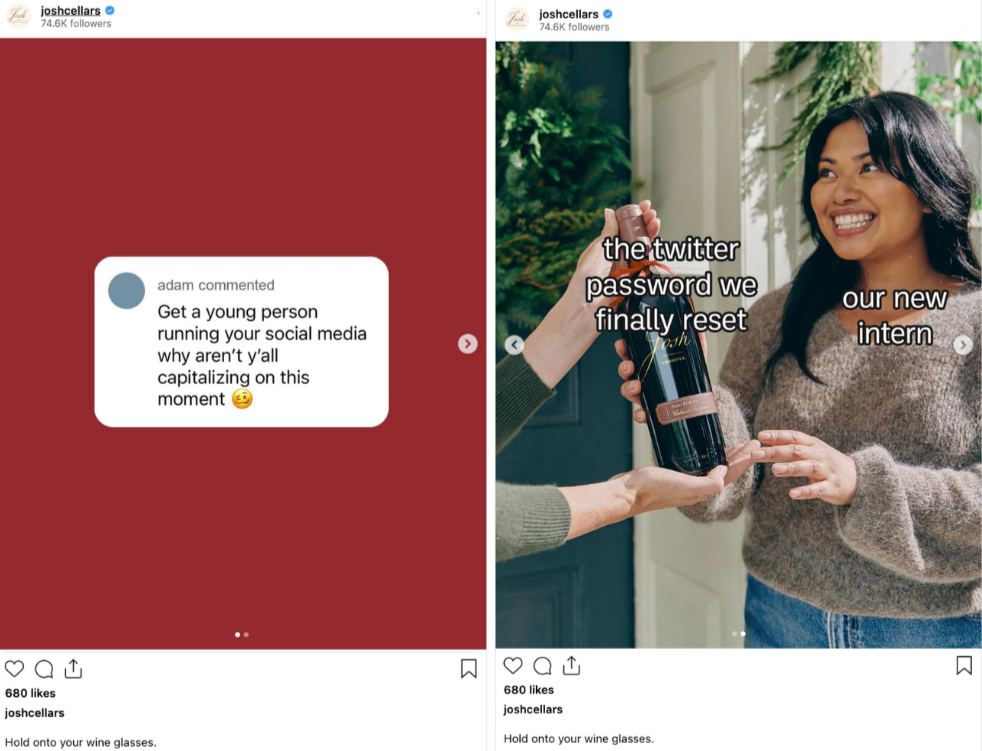
They allegedly even hired a Gen Z intern to take over socials. |
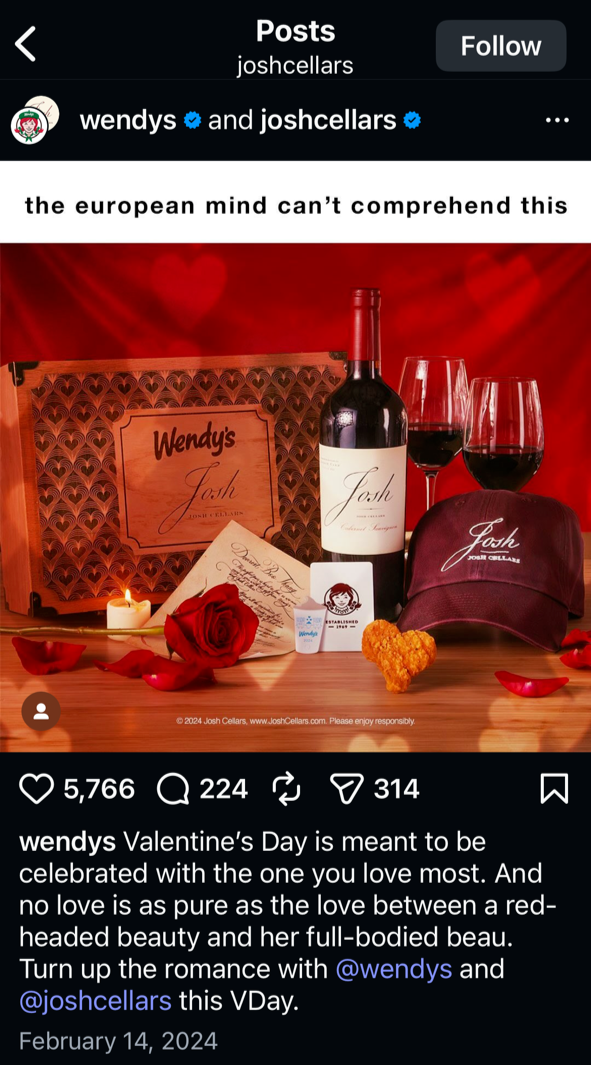
Josh dove into the social trends. After some online flirtation, they even launched a Valentine’s Day partnership with Wendy’s, to really lean into the “feel fancy without paying fancy prices” vibes.
It wasn’t an actual product collab. But the posts were what mattered - because they were adding something fresh to the gag. |
Then Wendy’s released a romance novella called “Wendy and Josh Are Friends.” On Wattpad.
Josh even made it on The Today Show, hundreds of headlines, and on SNL, inside a big dumb cup. It was all very weird, fun, and experimental. And very much NOT your typical old-school wine Marketing.
By the end of 2024, 38% of Josh’s total sales growth was from consumers under the age of 40.
|
|
|
You can wait for your brand to go viral, or… you can think about how your customers already talk about it and lean in NOW. Here’s your homework:
Select 1 hero product from your brand and run this meme conversion exercise.
1️⃣. What do customers call the product? Or is there a funny internal nickname? Jot it down, along with the top jokes insiders repeat.
2️⃣. Identify what the joke’s really about. Is it the price, brand identity, use case, packaging, something else?
3️⃣. Brainstorm demand capture experiments to run, so you bring the meme into Marketing. Maybe you rename the PDP, get creative with retail copy, or update metadata.
4️⃣. Think of a few ways to scale the meme, like a limited drop that increases searchability and drives to purchase in the same click. |
|
|
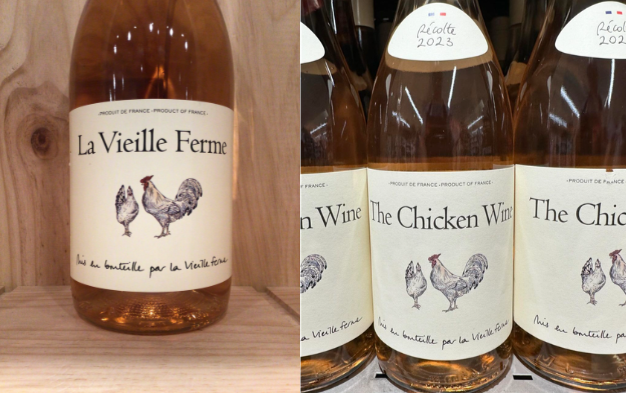
La Vieille Ferme isn’t as easy to say (or type, tbh) as Josh.
So people started calling it the Chicken Wine.
|
This French table wine’s been around since the ‘70s, and costs about $10. It’s more popular in the UK. But if you’ve seen Josh in-store, you’ve probably seen this brand, too.
There’s no original source for the nickname. It may actually predate social media. (Is that allowed??)
But in 2024, it took off. Food publications started reporting widespread use of “Chicken Wine” on TikTok.
La Vieille Ferme could’ve responded in a lot of ways. For example:
🐓: Trying to teach consumers how to pronounce its name correctly in a way that’s funny, not snooty. (Hard to pull off with French. Je suis désolé.)
🥚: Taking a big swing and introducing something entirely new related to “Chicken Wine,” like a Popeye’s collab (!), wacky stunt, or limited-edition merch.
🐥: Nodding to the nickname to welcome new customers without alienating loyal ones by changing the brand or product.
The brand stayed true to its roots, err vines, and made it a demand-capture moment.
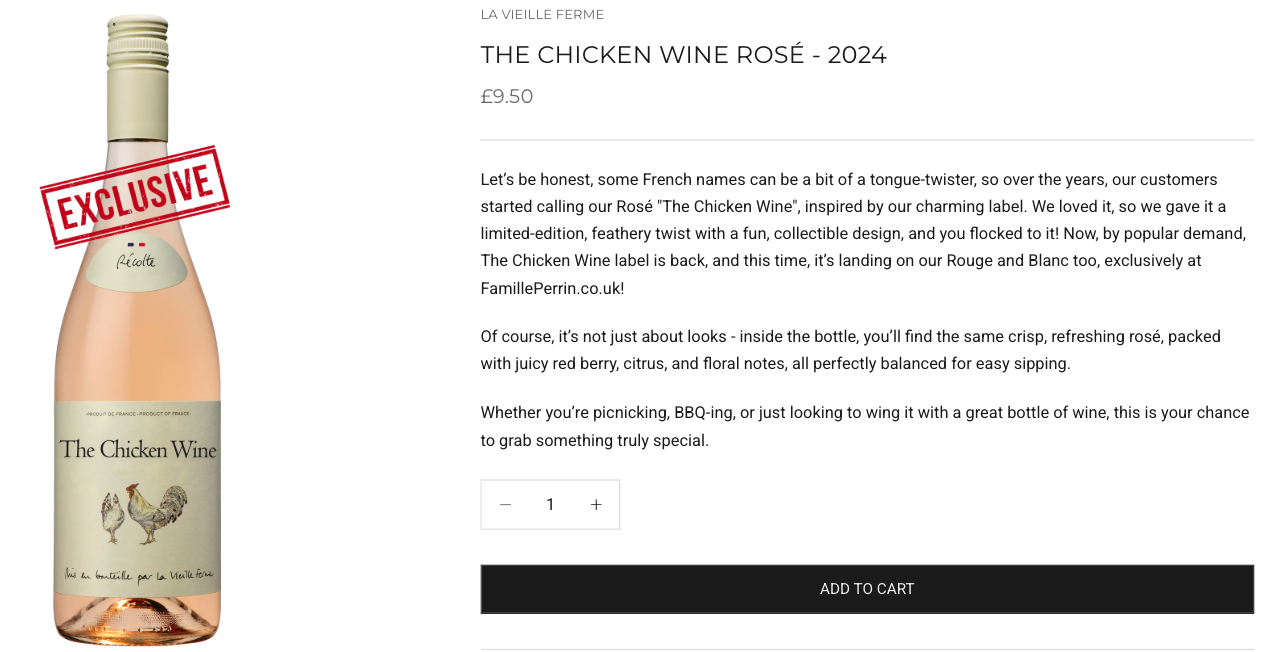
La Vieille Ferme temporarily changed the label and called it a collectible. The move was easy to execute, attention-grabbing, and short-term. |
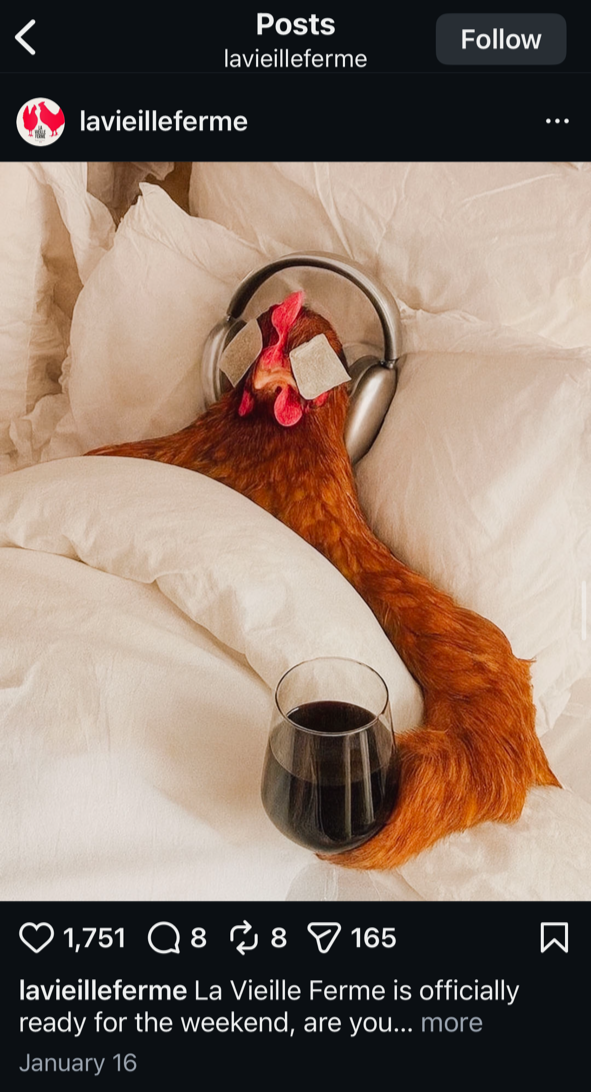
“Chicken Wine” was woven into all Marketing and the brand injected a poultry-positive sense of humor into social posts. |
But IMO, the biggest coup (coop?) was on the Product side.
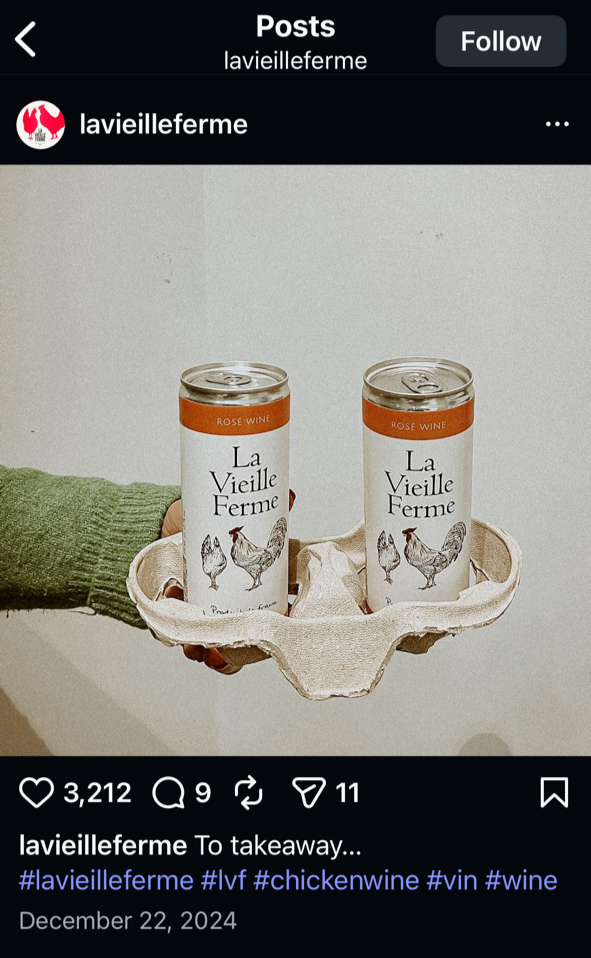
LVF’s post-viral halo was the perfect time to test new formats, like cans and boxed wine - formats that appeal to younger, cost-conscious consumers.
|
The goal: To make it easier for new customers to become repeat buyers. |
Josh & La Vielle Ferme (had to check that spelling again) show us that
there’s more than 1 meme-to-demand playbook.
Meme marketing can be an acquisition channel, but it’s easier to make it sustainable when the product has 3 things working already: 🚚: Distribution 🍷: A repeatable product experience 🔃: Low friction to buy again
Instead of reinventing the funnel, Josh reinvested in social to keep the brand culturally alive.
|
Meanwhile, La Vieille Ferme switched up its label, embraced the Chicken Wine nickname, and introduced new wine formats. Neither brand was starting from scratch, even if they were figuring out how to reintroduce themselves to a very new audience. They could make the most of their meme status, because they had the fundamentals figured out.
Here’s what the headlines and piles of reposts won’t tell you… You can’t guarantee virality, but you CAN guarantee that your brand will be ready to seize the opportunity if it comes.
This makes the “boring” Marketing Ops fundamentals (and the teams behind them) the real influencers.
I think we can drink to that. 🥂
|
|
|
MARKETING CHEAT SHEET (WHAT TO LEARN FROM THIS STORY): |
1️⃣. The key to viral success isn’t being fun, it’s having the fundamentals locked & loaded. Memes amplify what’s already frictionless, so virality converts best when a product’s already easy to buy.
Availability, distribution, and discoverability are important marketing levers to hone and prepare. Because you’ve gotta be ready to be lucky. 2️⃣. Memes are an opportunity to refresh.
Going viral brings renewed cultural relevance and gets brands in front of new customers. The best responses are operational, not trying too hard to be funny. Josh reinvested in social. La Vieille Ferme embraced “the Chicken Wine” across its Marketing and rolled out canned and boxed wine to keep new customers coming back.
3️⃣. Treat meme spikes like earned media. Attribution gets messy fast, but smart brands make a capture plan and do the virality math. Bank the awareness. Then measure success with 2nd-order signals, like search lift, store locator traffic, retailer reorders, and repeat purchase proxies. |
|
|
Ahh, the bell has rung. Please be sure to do the reading (follow The Marketing Millennials on LinkedIn and me, Professor Millennial, on X). Off you go, passing period is only 11 minutes and there’s already a line at the vending machine that sells Babybel cheese (pairs perfectly with my meme wines).
Until next time,
Professor Millennial |
|
|
{if !profile.vars.marketingland_user_fitness && profile.vars.marketingland_user_fitness != false}Join 7,390 other marketing leaders in Marketingland |
|
|
{/if}{if profile.vars.marketingland_user_fitness == true}{/if}Get your brand in front of 124,400+ marketing leaders. |
Workweek Media Inc.
1023 Springdale Road, STE 9E
Austin, TX 78721
Want to ruin my day? Unsubscribe. |
|
|
|