{if hosp_dorm_120 == true}
Quick favor: Our records indicate that you aren’t opening this email. But records can be wrong. Please click here if you’d like to remain subscribed to Hospitalogy. |
| |
{/if}Happy Thursday Hospitalogists!
After a bitterly cold start to the week and navigating some black ice on the roads (it hit record lows of ~10 in Dallas), I am now in sunny Santa Monica for Nabla’s AI Executive Summit and learning incredible things from the likes of Yann LeCun on why everything you thought about AI is wrong and how world models are the future and are inevitably coming for us all.
Kidding…sort of.
Today is an executive summary of my conversation with Pete McCanna. Thanks so much to everyone for the kind words on the podcast launch. I genuinely appreciate you guys reaching out and listening. Any and all feedback is welcome as I figure out this whole podcasting experiment. It’s a ton of fun.
Rik Renard and I also have some AI thoughts for you guys to munch on over the weekend, and plenty more is coming next week for Hospitalogists including HCA and UnitedHealth Group earnings breakdowns, the MA advance rate (woof), and takeaways from the Nabla event.
Enough chatting. Let’s get after it. |
Was this email forwarded to you? |
|
|
NOTE: This is not an offer to sell, or a solicitation of an offer to purchase, any security. Example companies are provided for illustrative purposes only are not necessarily indicative of any AV fund or investor, and are not available to future syndicate members, except potentially in the case of follow-on investments. Venture capital investing involves substantial risk, including risk of loss of all capital invested.
|
|
|
Breaking Down the New Age of Health System Consumerism with Pete McCanna, CEO of Baylor Scott & White |
Listen to the podcast on Apple here and Spotify here. |
Key Takeaways: -
Breaking down the castle walls for vibrant cities. Legacy health systems are "walled castles" built over 60 years of regulation and coverage decisions - defensive structures designed to keep things out. But the old health system playbook, things like acquiring physician practices for market share, creates zero value for customers. It only accretes value to the enterprise, and that isn’t customer-centric. Pete’s vision of a "vibrant city" model means breaking down walls, bringing in innovators as key partners, and offering services even if they aren’t the maximized financial result in your given economic model - because it builds customer loyalty and ecosystem experience.
- Customer-centricity is the next phase of health system transformation. Health systems’ shift from supply-driven (fill your beds) to demand-driven (respond to what customers actually need) is playing out in Baylor's numbers, and the KPIs they track: significant customer growth, higher loyalty, and better capacity utilization.
-
Own the customer relationship or become a commodity. Baylor has invested tens of millions into a proprietary digital platform that goes beyond the EHR. If every system innovates on commoditized tech, there's zero differentiation. Don’t let any entity get in between you and your customers.
|
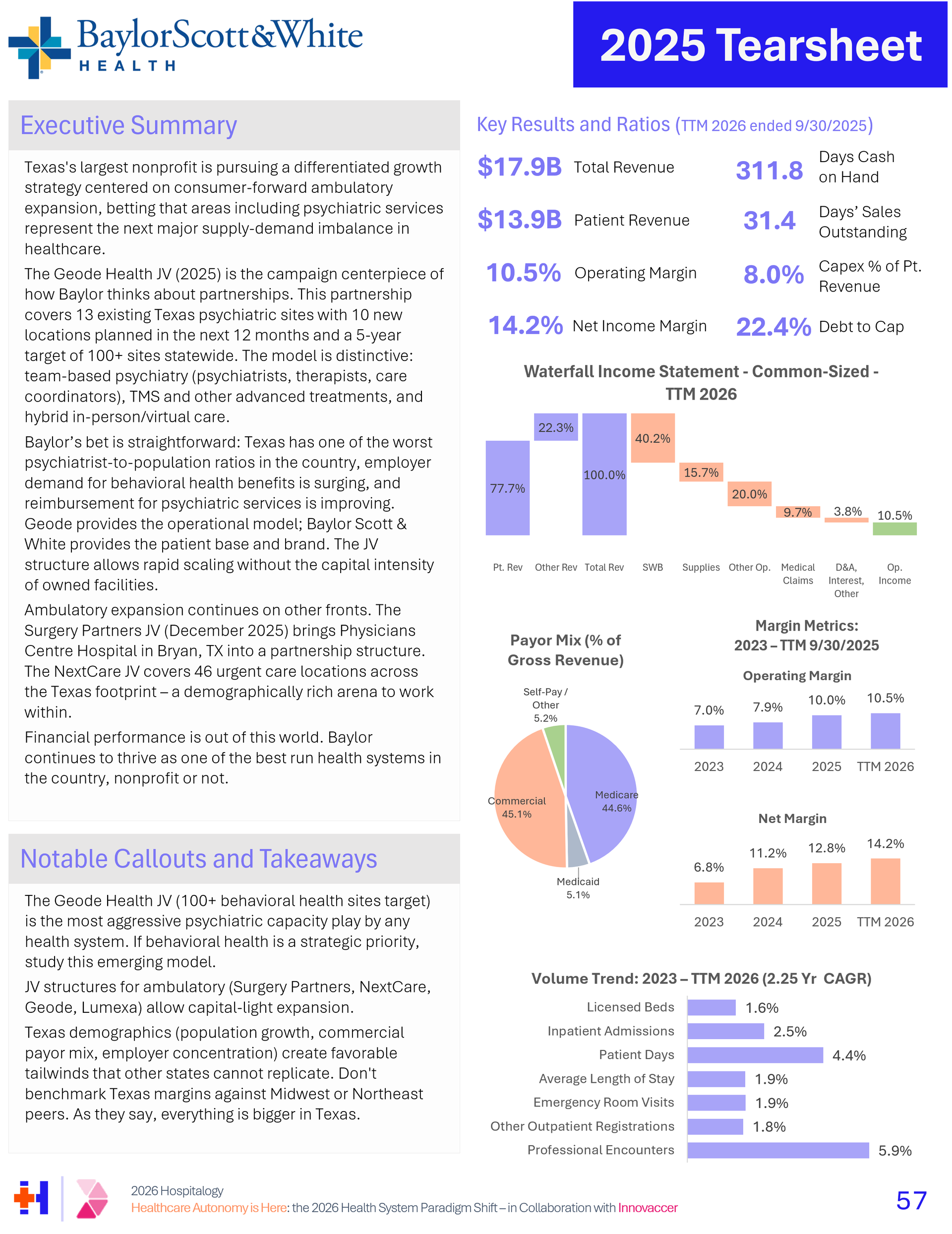
Note: this tear sheet is from my 2026 State of Hospitals and Health Systems report. Download it here. |
My breakdown:
I loved Pete's framing of the legacy health system as a "walled castle" built over decades of regulation and insurance coverage decisions. Castles are defensive structures designed to keep things out. And that's the problem when everything is getting between you and your patients, creating a fragmented, cold experience for the patient (the customer).
And on that note, what struck me most was Pete's insistence on the word "customer" over "patient." The patient framing bounds the relationship to episodes inside the four walls of the hospital. The customer framing forces you to think 24/7: - what do they need before the hospitalization,
- after discharge,
- while managing their chronic condition at home?
This new customer centric framework is an orientation shift aimed at breaking down the Old Guard, the castle walls of health system incumbents.
One example we talked about (and that I’ve written about before when announced) is Baylor’s JV with Geode Health and how it illustrates Baylor’s partnership model in real time: -
Post launch, Geode clinics received 10,000 referrals from primary care to specialized mental health within months of launch.
-
That's 10,000 slots freed up in primary care and 10,000 patients getting more appropriate care, which is a massive supply-demand rebalancing through partnership rather than trying to build everything internally - and meeting customers where they are in a comprehensive hybrid approach for low acuity mental health.
Of course, we chatted about AI as well which I talked about on Tuesday. Pete offered this clarifying AI framework for Baylor: customer solutions first, workflow efficiency second, individual assistant tools third. Most systems are starting with efficiency. Baylor is prioritizing how AI becomes "rocket fuel" for new service offerings.
I loved how Pete discussed the need to have a sort of child-like, naive optimism in healthcare. We need more of that. We need to ask “why” and say “I don’t know” more often. True transformation requires both intellectual buy-in (the business case is strong) and heart transformation (people reconnecting with why they got into healthcare). Baylor is on the journey to prove you can do right by the customer and do well as an organization, and be unapologetic about the resulting performance.
One Big Question
Do you have both the head and the heart to actually make the shift to a customer-centric platform? If not, what parts do you think you’re missing? |
|
|
This piece was co-written with Rik Renard, who shares weekly insights on healthcare AI and strategy on LinkedIn. One fascinating thing we read this week was a story about the GitLab founder who went "founder mode" on his cancer. Now it's no longer detectable.
After standard treatment failed, Sid Sijbrandij built a 1,000-page health handbook, ran every diagnostic available, and assembled a SWAT team to design personalized treatments in parallel instead of waiting for each one to fail sequentially.
Elliot Hershberg - a fantastic fellow creator - wrote a great piece on this.
What stands out isn't just what happened, but what's technically possible right now. Sid is a billionaire with a full-time team, so this isn't replicable for 99.9% of patients today. But it's a glimpse of where we could be heading.
The diagnostics exist. The personalized therapies exist. The bottleneck isn't the science, it's the system and the cost. Sid had to hire people just to get access to his own tissue samples. He had to file special applications to access experimental drugs that exist but aren't available through normal channels.
Which brings up something bigger: physicians need a mindset shift too. Treatment pathways can't be hard-coded in PDFs and updated every 18 months anymore. With new therapies emerging constantly*, oncology needs to move toward continuous iteration. AI-enabled tools like OpenEvidence, UpToDate, and others are enabling this iterative future. Kinda scary but also very promising. The question: will AI make this type of personalized approach feasible without requiring billions? Or will the gap between what's possible and what's accessible keep growing? Worth thinking about as we build the future of healthcare.
PS: Sid also started 8 companies in the oncology space to help other patients. So maybe it's closer than we think!
Note: Obviously patients aren't guinea pigs, new therapies need proper evidence and validation. But the pace of iteration can and should be faster than it is today. |
|
|
- Lightspeed Ventures raised $9B in 2025 and wrote an update on their healthcare investment thesis.
-
Will Johnson & co just used some of that $9B to raise $60M to fix the broken brokerage experience in healthcare. Meet Gyde!
-
A flatlined Medicare Advance Notice shocked the investment and managed care world expecting some reprieve, with a proposed 0.09% rate increase for 2027. Yikes.
|
|
|
For those of you who have been and/or live near Santa Monica, give me your best rec! See you guys Tuesday. Love you all. Healthcare is lit. |
|
|
Thanks for the read! Let me know what you thought by replying back to this email.
— Blake |
|
|
{if profile.vars.board_room_user_fitness == true}The conversation doesn't have to stop here
Keep learning and connecting in the Hospitalogy Network
EVENTS | FEED | LIBRARY | DIRECTORY
|
|
|
{/if}{if !profile.vars.board_room_user_fitness && profile.vars.board_room_user_fitness != false}I'm building a community of leaders in strategy, finance, and ops
at hospitals and health systems to help us connect, learn, and grow together. |
|
|
{/if}
Get your brand in front of 52,000+ executives and healthcare decision-makers. |
Workweek Media Inc.
1023 Springdale Road, STE 9E
Austin, TX 78721
Want to ruin my day? Unsubscribe. |
|
|
|