How Tech Metrics Change Your Values and Behaviour |
Insights from philosopher C. Thi Nguyen's book "The Score". |
|
|
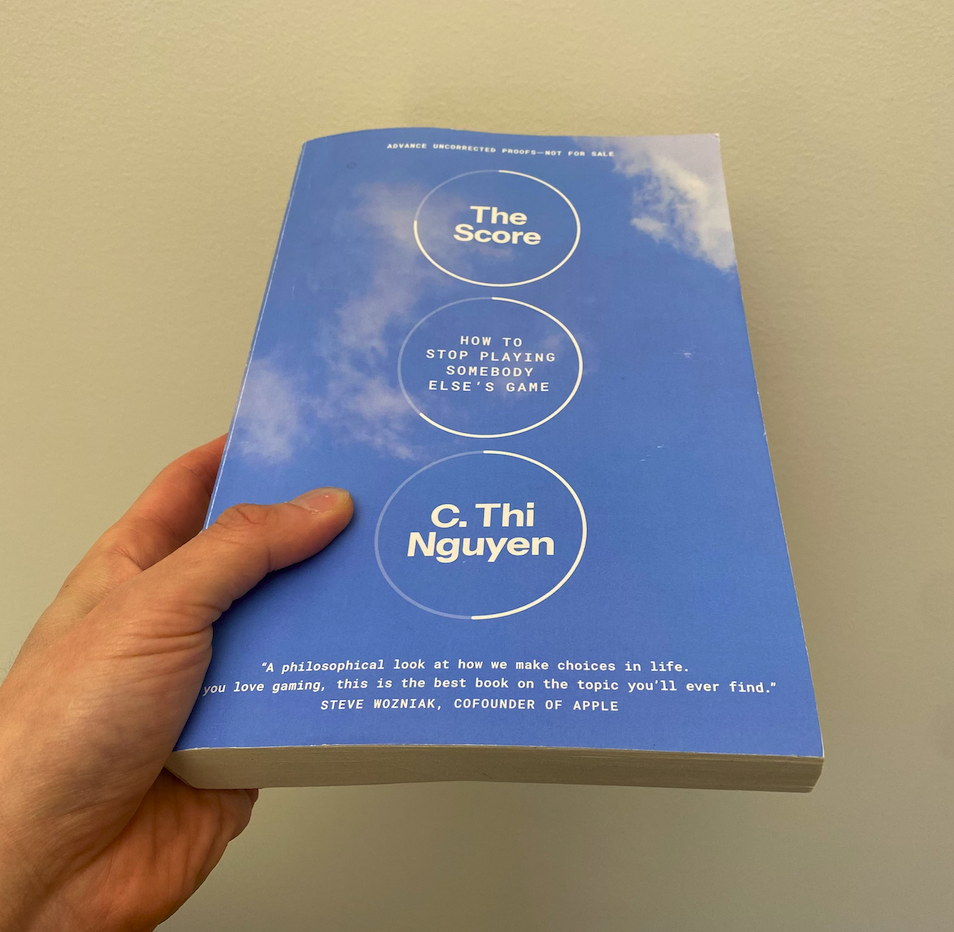
Thanks for subscribing to SatPost. Today, we are talking about philosopher C. Thi Nguyen’s new book “The Score” and how tech apps metrics are able to influence your values and behaviour. Also this week: |
You just woke up.
Oura Ring says your sleep score is 55 (“I guess I feel a bit groggy”). Apple Watch says you need 13,579 steps to hit your weekly goal (“Will feel way better after hitting that number”). Stock portfolio is down 3% (“Ugh, I’m an idiot. Need to stop buying quantum stocks based on random comments 84 replies down in a Reddit thread”).
X shows you gained 478 followers overnight and your last post had 10,901 likes (“People love my takes”). Kalshi just paid out $17 for you correctly predicting it would snow more than 2 inches in Boston (“Man, I’m smart”). Your NBA fantasy team just took the #1 spot in the league after Jokic dropped a 56-18-17 triple double (“MAN, I AM VERY SMART!").
Duolingo’s notification says you are on a 78-day streak of Spanish lessons…keep going (“HOMBRE, SOY MUY INTELIGENTE!”).
It’s only been 4 minutes and your central nervous system has been put through an emotional roller coaster, all triggered by a number (metric, ranking) from an external source (in this case, tech apps).
You’ll spend the rest of your day thinking about and making decisions based on these and other external metrics (sales quotas, word counts, tickets closed, billable hours, 5km run time, calorie targets, pull requests, amount of deep work, pages read, savings rate etc.).
Why do these metrics exist? Why do we design our lives around them? Of course, they set goals and are easily trackable, thus helping us accomplish tasks deemed important in our lives. But that is really just the tip of the iceberg.
In a new book titled “The Score: How to Stop Playing Somebody Else’s Game”, C. Thi Nguyen — a professor at the University of Utah who studies the philosophy of games — helps to answer these questions at a much deeper level. One of his key insights is a concept called “value capture,” which explains how the process of creating metrics (simplified, standardized, and quantified targets) often influences our behaviour in ways we do not actually want:
Value capture occurs when you get your values from some external source and let them rule you without adapting them. Value capture happens when a restaurant stops caring about making good food and starts caring about maximizing its Yelp rating. It happens when students stop caring about education and start caring about their GPA. It happens when scientists stop caring about finding truth and start caring about getting the biggest grants. […]
In value capture, you’re outsourcing your values to an institution. Instead of setting your values in the light of your own particular experiences, instead of adjusting them to your particular personality, you’re letting distant bureaucratic forces set them for you.
Maybe this wouldn’t matter if the institutional metrics got it exactly right—if they truly captured what is valuable in the world. But that almost never happens. Metrics are shaped by institutional forces. They are subject to demands for fast, efficient data collection at scale, to demands of fitting into spreadsheets and action reports. Institutional metrics are part of a system that abstracts away from personal differences and local detail and identifies some thin, measurable detail. And what’s easily measurable is rarely the same as what’s really valuable.
I pulled other great nuggets from "The Score" and combined them with previous work that Nguyen has done on how metrics influence various tech platforms. Check out the deep dive here including: - Value Capture In Law Schools, Wine Scoring and Fitness Trackers
-
Why Do We Create Metrics (And Why They Are Not Value Neutral)
- The Power and Appeal of Gamification (Metrics, Rankings)
- My Experience With X/Twitter Value Capture
- How To Deal With Value Capture
|
This issue of SatPost is brought to you by Bearly AI
Are you looking for a no-logging, encrypted and anonymized AI chat tool? Then try the Bearly AI research app, which provides an easy-to-use UX for the newest models from OpenAI, Anthropic, xAI, DeepSeek, Gemini and more.
While some AI providers keep chat logs indefinitely even after a user deletes them...Bearly AI has a default no-logging policy and user chats are encrypted while requests to LLM providers are completely anonymized. Try one month FREE of the Pro Plan using the code BEARLY1. |
Apple Finance Forays
Back in 2019, Goldman Sachs partnered with Apple to launch a credit card.
It was massive news in the finance world. Goldman sticking their bloodsucking vampire squid tentacles into the consumer game, specifically by tapping the iPhone (aka 1B+ installed devices for the most valuable smartphone users in the world).
Fast forward to 2025: Goldman Sachs is transferring the credit card program, including a $20B+ portfolio of accounts to JPMorgan. It’s doing so at a discount and will take a $1B loss.
WTF happened? Well, the prize of iPhone payments is so big that finance firms bend businesses around it…and Apple absolutely bent Goldman over in the initial negotiations, per WSJ: Apple, used to high consumer-appreciation marks, wanted Goldman to approve nearly all applicants. The result was a program with higher-than-normal exposure to subprime borrowers, which required Goldman to sock away more revenue for potential future defaults. The tech giant didn’t want late fees, removing a key credit-card issuer revenue generator. And Apple insisted all cardholders get their bills at the beginning of the month, in what would become a customer-service nightmare.
Goldman approving “nearly all applicants” is how 1/3rd of the Apple Credit Card balance are “subprime”. The program is apparently profitable now, which is why it took a few years for JPM and Goldman to agree on terms.
While we’re on the topic of the financial prize of iPhone, the Department of Justice (DoJ) had an antitrust case against Visa two years ago.
The case was about Visa’s insane debit card business, which is much larger than its credit card business: 60% of US debit transactions, $7B in fees
and an insane 82% operating margin (the only thing better are those gas stations that sell single bananas for $0.99).
Hilariously, the iPhone is so dominant that Apple caught a stray. Visa said Apple Pay was an “existential threat” and the credit card firm has been paying Apple “hundreds of millions of dollars” a year so the iPhone maker doesn’t deploy a competing functionality.
Apple also caught a stray in the government’s antitrust case against Google when it was officially revealed that Google is paid Apple $20B+ a year to be the default search engine for the Safari browser. ***
On a very related note: Apple is finally fixing Siri by turning it into an AI chatbot (eg. ChatGPT). It has agreed to pay Google $1B a year — which it can nicely offset against the 20 billy it gets on the search deal — to build a custom Gemini model to power Siri.
Unlike other AI chatbots, though, Apple will let Siri search through device (iPhone, iPad, Mac) apps and integrate a user’s context. The initial Apple Intelligence roll-out was so bad that Apple had to pull its ad campaign because it was shilling vapourware…but apparently the new Siri means the features from the ad may work.
|
Alcohol Makers Are In Trouble I’m not going to lie. During COVID, I got bored between doomscrolling all morning and then taking my kid to the same playground every afternoon for 300x straight days. To pass the evening time, I started getting back into casual happy hour drinks (after going dry for a few years). I suspect many of you readers were popping a few bottles for no reason whatsoever during that period.
Anyways, alcohol-producing firms definitely saw the trend…but then over-extrapolated forecasts and are now sitting on record-levels of inventory.
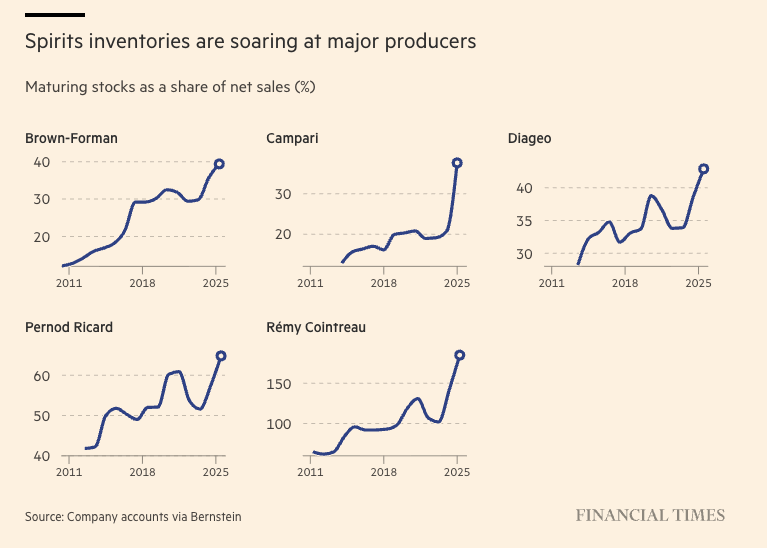
The Financial Times has some brutal stats: -
Five largest producers (Diageo, Pernod Ricard, Campari, Brown Forman and Rémy Cointreau) “sitting on $22bn worth of ageing spirits, the highest level of inventory in more than a decade”.
- Rémy (French cognac maker) has €1.8bn of maturing inventory (2x annual revenue and almost same as market cap)…bro, what?
-
A️cross these 5 firms, the relevant metric (maturing inventory stock as % of net sales) is up at least 50% since 2011.
Basically, from the start of COVID to now, these firms got absolutely clapped on the supply and demand sides. |
On the supply side, they extrapolated unsustainable COVID numbers as we discussed. Then, they got hammered by falling demand: - less consumer discretionary spend due to inflation
- broader health trend of less alcohol
- people taking Ozempic / Wegovy and having way less desire to drink
“Manufacturers have halted production while they try to sell off existing vintages,” explains FT. “Japanese drinks group Suntory has closed its main distillery for Jim Beam bourbon, based in Kentucky, for at least a year. Diageo, meanwhile, has halted whiskey production at its Texas and Tennessee facilities until the summer.” There haven’t been heavy discounts on these “spirit lakes” (unsold inventory) yet because a number of producers took on debt to expand production…and they need that sweet cash flow to pay it off. It takes 5-10 years to rebuild stock. So, if demand ever comes back to previous levels (I’m in the camp that it probably won’t), these companies could face an inventory shortfall issue in the early 2030s.
They def in a pickle. |
Links and Memes Some other content for your weekend consumption:
OpenAI CFO shared new financials for the startup and revenue is almost directly correlated to compute. Revenue for 2025 hit $20B+, a 3x increase from 2024 ($6B) and 10x since 2023 ($2B). Compute at end 2025 was 1.9GW, a 3x increase from 2024 (0.6GW) and 9.5x since 2023 (0.2GW). Probably not a coincidence OpenAI shared these details right before Sam Altman went to the Middle East to raise $50B at a valuation of $800B to $1T. Get the hype machine going.
Demis and Dario at Davos: The heads of Google DeepMind and Anthropic, respectively, had a solid chat together at Davos. Demis said we’ll need World Models and physical-world understanding to get to AGI. Dario said he expects Claude Code to do a software engineer’s job from “end-to-end” within 6-12 months. If that sounds hyperbolic, it’s worth flagging that Dario predicted last March that AI would produce all code within 12 months. 9 months later, Anthropic released Claude Cowork, with Claude Code writing the entire codebase (humans still planned and designed project, though…take that AI).
Oh, Dario and Demis also both said one of their favourite films was Contact (1997)…Dario called out this specific scene when Dr. Elie (Jodie Foster) tells an international panel the question she’d ask if she met the advanced alien civilization: “How did you do it? How did you evolve, how did you survive this technological adolescence without destroying yourself?”
Why America needs fewer bus stops: The Works In Progress newsletter makes the case that too many bus stops hurts public transport. More stops = slower travel = less reliable schedules = less ridership. European cities have greater length between stops (1,000 - 1,400ft) than American cities (<800ft) and have better public transport stats.
State of YouTube 2026: YouTube’s Neal Mohan penned a blog post with some interesting nuggets. The platform contributes $55B to GDP and employs 490k jobs across creators and their teams. Meanwhile, Mohan says a focus for 2026 is building scalable systems to deal with “AI slop”. I don’t know how that will work but after getting flagged 100x for uploading copyright song material, I suspect Google may have a technological solution…they need to auto-delete every single AI-generated short video that involves a baby.
Apple Developing AirTag-Sized AI Pin With Dual Cameras…according to some juicy rumors. AI wearables have been a complete dud so far. But Sir Jony Ive and OpenAI are making one, and it looks like Apple doesn’t want to give up that ground. And yes, if its real, I’ll probably buy one and lose it within 6 weeks (similar to every pair of AirPods I’ve ever owned).
Sinners pulled in a record 16 Academy Award nominations: My wild guess is it will win a bunch (Best Original Screenplay, Costume, Set Design, VFX). But Paul Thomas Anderson will get his first Oscars for One Battle After Another (Best Director, Adapted Screenplay and Picture). And Timothy Chalamet edges out Leo and Michael B for Best Actor. Either way, Ryan Coogler wins in life for getting the rights back on Sinners in 25 years and doing that unreal 10-minute explainer he did on film formats as a Sinners promo.
|
…and here them wild posts: |
Finally, this post kicked off a pretty trend on X: Prompt ChatGPT with, “Create an image of how I treat you.” Zvi Mowshowitz had a round-up of the results…and some were mildly concerning. |
|
|
Written by me, Trung Phan.
Workweek Media Inc.
1023 Springdale Road, STE 9E
Austin, TX 78721
Want to ruin my day? Unsubscribe. |
|
|
|